


Saudi-French Joint Ministerial Committee on AlUla Underlines Commitment to Deepen Partnership

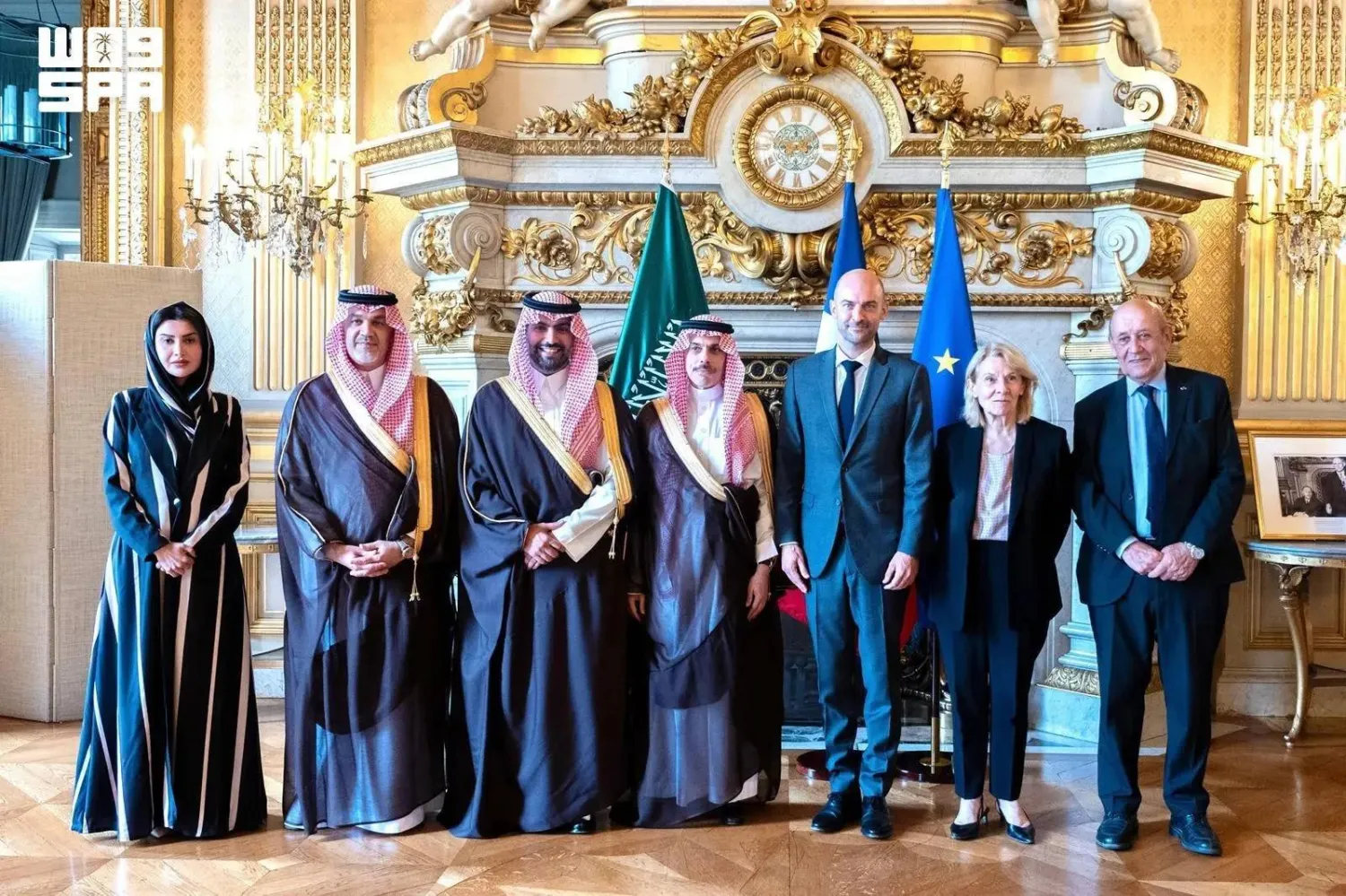
Saudi Minister of Culture and Governor of the Royal Commission for AlUla Prince Badr bin Abdullah bin Farhan (third from left) and French Minister for Europe and Foreign Affairs Jean-Noel Barrot (third from right) during the meeting of the joint Saudi-French Ministerial Committee on AlUla on Monday. (SPA)
TT

Saudi-French Joint Ministerial Committee on AlUla Underlines Commitment to Deepen Partnership

Saudi Minister of Culture and Governor of the Royal Commission for AlUla Prince Badr bin Abdullah bin Farhan (third from left) and French Minister for Europe and Foreign Affairs Jean-Noel Barrot (third from right) during the meeting of the joint Saudi-French Ministerial Committee on AlUla on Monday. (SPA)

The joint Saudi-French Ministerial Committee on AlUla held a meeting in Paris on Monday, chaired by Saudi Minister of Culture and Governor of the Royal Commission for AlUla Prince Badr bin Abdullah bin Farhan and French Minister for Europe and Foreign Affairs Jean-Noel Barrot.

The meeting was attended by Saudi Minister of Foreign Affairs Prince Faisal bin Farhan bin Abdullah, Minister of Investment Fahad Al-Saif, and Chief Executive Officer of the Royal Commission for AlUla Abeer Al-Akel. Also present were French Minister of Culture Catherine Pegard, Minister of Economy, Finance and Industry Roland Lescure, and Chairman of the French Agency for AlUla Development (AFALULA) Jean-Yves Le Drian.

The officials welcomed the signing of an agreement to extend and amend the agreement concluded between the Saudi and French governments on the cultural, environmental, tourism, human, economic, and heritage development of AlUla Governorate.

They reviewed the partnership's achievements and discussed avenues for future cooperation, reflecting the strength of relations between the two countries and affirming AlUla's position as a meeting point of civilizations and a global destination for culture, creativity, and sustainable development.

They underlined their commitment to further deepening the partnership, which has become a global model for international cooperation based on the exchange of mutual benefits and knowledge, contributing to the achievement of comprehensive and sustainable development goals.

The meeting reviewed the scale of joint investments and areas of ongoing cooperation in the sectors of archaeology, arts, culture, sports, hospitality, and human-capital development.

The partnership reflects a shared commitment to sustainable development through strategic projects, such as the AlUla Tram and the Sharaan Resort, designed by Jean Nouvel, as well as investments in renewable energy, water, and mobility, supporting the objectives of Saudi Vision 2030 to attract one million visitors and global investments while preserving AlUla's cultural and natural heritage.



Saudi Arabia Establishes Cultural Center in Paris

Saudi Arabia Establishes Cultural Center in Paris
TT

Saudi Arabia Establishes Cultural Center in Paris

Saudi Arabia Establishes Cultural Center in Paris

The Saudi Ministry of Culture announced on Monday the establishment of a Saudi cultural center in Paris on the sidelines of the visit of Prince Mohammed bin Salman bin Abdulaziz Al Saud, Crown Prince and Prime Minister, to France.

The center will serve as a platform for promoting Saudi culture and highlighting its historical depth and creative diversity through high-quality cultural programs and initiatives involving French practitioners, institutions and the public.

It will support the international presence of Saudi cultural practitioners, strengthen communication between intellectuals and creative professionals in the two countries, and build strategic partnerships between Saudi and French cultural institutions, facilitating the exchange of expertise and implementation of joint cultural initiatives.

The establishment of the center reflects the continued development of Saudi-French relations and underscores the Kingdom's commitment to strengthening its international cultural presence and presenting an authentic cultural image that introduces the world to its rich heritage and contemporary creative output.


Les Invalides in Paris: Icon of the French Military and Napoleon’s Final Resting Place

A view of the Les Invalides complex during the opening of the Olympic Games in Paris in 2024. (Reuters)
TT

Les Invalides in Paris: Icon of the French Military and Napoleon’s Final Resting Place

A view of the Les Invalides complex during the opening of the Olympic Games in Paris in 2024. (Reuters)

French Prime Minister Sébastien Lecornu will receive on Monday Prince Minister Mohammed bin Salman, Saudi Crown Prince and Prime Minister, in the Cour d’Honneur, or Court of Honor, at the historic Les Invalides complex in Paris, according to a statement from the French PM’s office.

The complex houses the Army Museum and Napoleon Bonaparte’s tomb and is crowned by its famous gilded dome.

Three-and-a-half centuries of history

Les Invalides, officially known as the Hôtel National des Invalides, dates back more than three-and-a-half centuries, to 1670, when King Louis XIV ordered and financed its construction to house sick, wounded and elderly soldiers.

A site was chosen on the Grenelle plain near Paris, on the banks of the Seine. Architect Libéral Bruant carried out the project between 1671 and 1675, designing a quadrangular complex whose buildings stand behind a monumental facade leading to a central courtyard.

The complex welcomed its first residents in 1674, before construction was completed, and later housed more than 4,000 veterans. It included a hospital, care home, barracks, monastery and manufacturing workshops. Some residents made shoes, textiles, clothing and illuminated books under a system combining military discipline with religious life.

In the spring of 1676, architect Jules Hardouin-Mansart replaced Bruant and took charge of building the churches. The soldiers’ church was completed in 1679, while Louis XIV inaugurated the domed royal church in 1706.

According to official French sources, the original plans envisaged a church with a double altar, but the site today comprises two separate buildings: the Saint-Louis Cathedral and Dôme Church.

The dome rises 107 meters and remained the tallest structure in Paris until the Eiffel Tower was built. According to information from the Army Museum, it is covered with around 550,000 sheets of gold leaf weighing a total of 12.6 kilograms.

Cour d’Honneur

Located in Paris’ 7th arrondissement, the complex has a northern facade about 195 meters long, with its buildings arranged around 19 interior courtyards.

The Cour d’Honneur is the largest. It measures 102 meters by 64 meters and is surrounded by four buildings with two levels of arcaded galleries.

Used for military and national ceremonies and events, the courtyard displays a collection of 60 bronze cannons documenting 200 years of French field artillery history.

At the center of the southern gallery stands a statue of Napoleon dressed as a colonel of the Chasseurs à Cheval of the Imperial Guard. It was moved to Les Invalides in 1911 after previously standing atop the Vendôme Column.

The complex also played a role in the French Revolution. In July 1789, revolutionaries seized rifles and cannons from Les Invalides and immediately used them in the storming of the Bastille.

The institution came close to being abolished. Saint-Louis Church was closed to worship and used to display flags seized from France’s enemies, while the Dôme Church was transformed into the Temple of Mars.

In 1800, Napoleon ordered the remains of military commander Turenne transferred there, giving the building a new role as a burial place honoring France’s military figures.

Napoleon’s final resting place

After Napoleon died on the island of Saint Helena in 1821, King Louis-Philippe decided in 1840 to return his remains to Paris.

Architect Louis Visconti carried out extensive excavation work to create a tomb beneath the dome, where the emperor’s remains were placed in April 1861.

At its center stands a red quartzite sarcophagus on a green granite base. The site also contains the tomb of military engineer and commander Sébastien Vauban, as well as the graves of Napoleon II, Joseph and Jérôme Bonaparte, generals Bertrand and Duroc, and marshals Ferdinand Foch and Hubert Lyautey.

The Army Museum was established in 1905 through the merger of the Artillery Museum, which had been housed at the complex since 1871, and the Historical Museum of the Army, founded in 1896.

The museum holds around 500,000 objects, including weapons, armor, uniforms, paintings and documents, covering military history from prehistoric times to the 11th century.

Les Invalides also houses the Museum of Relief Maps and Museum of the Order of Liberation, as well as facilities belonging to the National Institution of Invalides, which continues the complex’s original mission of caring for wounded and disabled military personnel and veterans.


Riyadh to Host Security and History Dialogue Conference in September

File photo of the Saudi flag/AAWSAT
TT

Riyadh to Host Security and History Dialogue Conference in September

File photo of the Saudi flag/AAWSAT

Under the patronage of Minister of Interior Prince Abdulaziz bin Saud bin Naif bin Abdulaziz, the Ministry of Interior will organize the Security and History Dialogue Conference in Riyadh from September 6 to 8, 2026, with the participation of experts, researchers, and academics from Saudi Arabia and abroad.

The conference organizing committee said the event serves as a national platform for exploring the Kingdom’s history through the lens of security and development, aiming to deepen awareness of the Kingdom’s journey, strengthen national identity, and produce documented knowledge for researchers and future generations, SPA reported.

The conference will feature more than 50 dialogue and interactive sessions, with over 160 experts and specialists and more than 30 partner organizations.

Discussions will cover the Saudi state’s history and its security, developmental, economic, social, and cultural dimensions, as well as national identity, international relations, the development of security institutions, and the role of security in supporting investment and quality of life.