

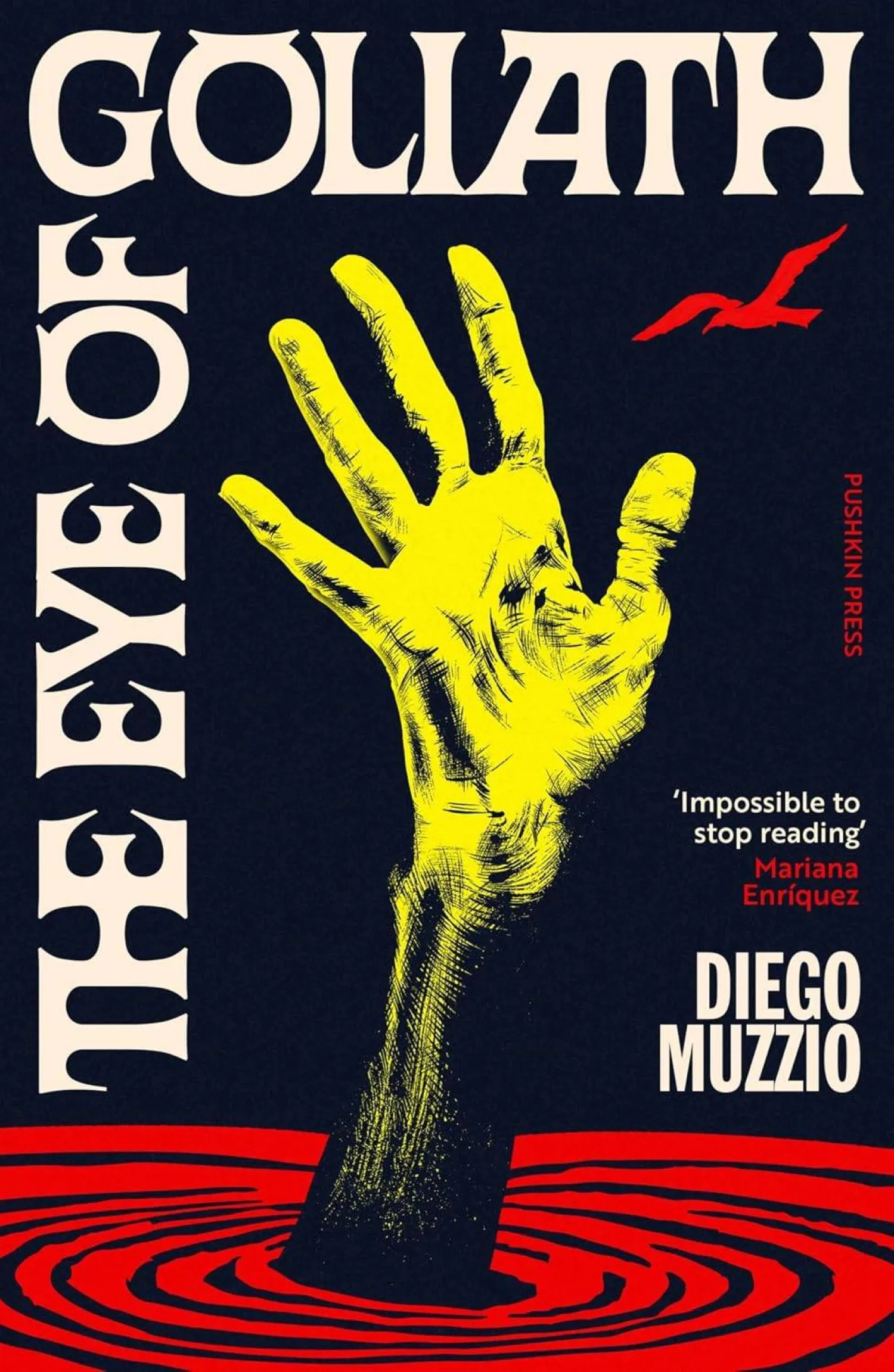

‘The Eye of Goliath’, A Novel That Recalls Jekyll and Hyde

Cover of “The Eye of Goliath” book
TT

‘The Eye of Goliath’, A Novel That Recalls Jekyll and Hyde

Cover of “The Eye of Goliath” book

By Dexter Palmer* 

“The Eye of Goliath”, the Argentine writer Diego Muzzio’s dark-humored, macabre puzzle box of a novel, is set just after World War I, in an Edinburgh sanitarium that “harbored a select group of the many mentally ill people who had come back from the war.”

The institution’s psychiatrist, Edward Pierce, conducts controversial research into hypnosis as a means of treating mental illness. His peers think his experiments are “destined to fail before too long,” while Pierce finds their “methods, based on pharmacology and electricity, to be ineffective and obsolete.”

A new patient, an engineer named David Bradley, arrives at the sanitarium after being stranded on an island with an abandoned lighthouse, which he was sent to assess by his employers.

Pierce sees a chance to prove the viability of his innovative psychiatric procedures.

Traumatized and unable to speak, Bradley is possessed by a need to swim at all times. He has documented his time on the island in a diary, which makes up the second part of the book and details his descent into madness and persistent terror. Muzzio then returns to Pierce and the treatment of his perplexing patient.

This complexly plotted novel is deeply intertextual, and Muzzio uses other writers’ themes as a hip-hop producer might use samples, crafting new tunes by borrowing fragments of familiar melodies and arranging them in new ways.

Allusions abound to Lewis Carroll’s “Alice’s Adventures in Wonderland,” Dante’s “Inferno,” the first Book of Samuel, the work of the writer and naturalist William Henry Hudson and Coleridge’s “The Rime of the Ancient Mariner.”

The most significant influence, however, is Robert Louis Stevenson’s Gothic novella “Strange Case of Dr Jekyll and Mr Hyde.”

A few mentions function as blinking neon signposts (Pierce has a copy of the book in his bedroom; the lighthouse engineer David Alan Stevenson, Robert’s real-life cousin, makes an appearance), but subtler engagements with the novella also come into view.

Pierce’s neuralgia, a condition of crippling headaches caused by shrapnel lodged in his head, is kept in check by increasingly frequent doses of morphine.

His habit echoes Dr Jekyll’s dependence on his secret elixir, which he first imbibes to deliver his evil alter ego, Hyde, to the world (and then takes to restrain Hyde from appearing on his own).

An act carried out on a pair of corpses is viewed from two perspectives, one that regards it as a desecration and the other as a performance of remorse; where one person might see a Hyde, another might see a Jekyll. Twins and duplicates appear throughout, including one clever moment when the book itself becomes doubled. In its elegant, sometimes playfully quaint prose (ably translated from the Spanish by Rahul Bery) and in its structure, particularly the documents that make up Bradley’s section, the novel gestures toward the Gothic without wholly turning into pastiche.

Behind Pierce’s and Bradley’s plotlines are memories of the recently ended war, which both men would prefer to forget.

Flashbacks to the phantasmagoria of trench warfare, a “fabulous catalyst for insanity,” are the novel’s most unsettling passages.

Pierce views the personification of war as a grotesque distortion of Carroll’s Alice, a girl with “glimmering eyes who went about with a jingling bunch of keys, opening all the chambers of the mind where legions of babbling demons had been shut away.”

The trenches are where every man is forced by circumstance to bring forth a Hyde, not for the pleasure that Stevenson’s Hyde takes in violence, but for mere survival. In this compelling novel, the fates of both Pierce and Bradley suggest that no matter how justified one may be for letting Hyde run riot the first time, it is extremely difficult to contain him again.


*The New York Times


Mercury Contamination Found at More Ancient Maya Sites

Tourists climb the Maya pyramid of Nohoch Mul at the archaeological site of Coba December 15, 2012. (Reuters)
TT

Mercury Contamination Found at More Ancient Maya Sites

Tourists climb the Maya pyramid of Nohoch Mul at the archaeological site of Coba December 15, 2012. (Reuters)

For the ancient Maya, the vibrant red mineral cinnabar held deep sacred meaning, representing blood, life and the soul. They used it widely as pigment in murals and temples while also employing it in ceremonies and funerary rites. What they did not know is that cinnabar is mostly mercury, which can be highly toxic.

Previous research showed how mercury from cinnabar left enduring contamination at the sites of certain ancient Maya cities such as Tikal in Guatemala. A new study reveals that this contamination was more widespread than previously known and documents how mercury, after leaching into the surrounding soil and bodies of water, proved deadly for many aquatic organisms.

Researchers obtained core samples from beneath lakes at two ancient Maya cities on Mexico's Yucatan peninsula — the well-studied site of Coba and the little-known site of Xcach.

The samples showed a mercury spike at Coba beginning around 250 AD ‌and lasting about ‌150 years around the outset of the golden age of Maya civilization, called the ‌Classic ⁠Period. At Xcach, there ⁠was a spike from around 125 AD to 200 AD, shortly before the Classic Period, then a second spike at about the same time as the one at Coba, and a third spike from about 535 AD to 820 AD, running to around the end of the Classic Period.

The study documents mercury contamination in the Maya northern lowlands, a region with previously sparse mercury records, and reveals some of the highest recorded Maya-era mercury concentrations.

Many of the great Maya cities collapsed and were abandoned at the end of the Classic Period. Varying hypotheses have been presented to explain this calamity, including climate change and warfare. The ⁠new research suggests mercury poisoning as one additional factor.

"Our study shows that modern toxicology ‌and pollution regulations were far exceeded at the most toxic levels for centuries ‌around Coba and Xcach," said paleolimnologist Matt Waters, a professor of environmental science at Auburn University in Alabama and lead author of ‌the study published in the journal Science Advances.

"Furthermore, we measured multiple biological markers in the sediments for bacteria, algae, cyanobacteria, ‌shelled organisms and insect midges, which all decreased or vanished in the lakes, meaning the mercury had made its way into multiple levels of the food chain," Waters said.

MERCURY POISONING

Mercury in people can harm the central nervous system, brain, kidneys, lungs and heart.

"While we do not show this in our sediment records, this trophic movement implies that the Maya people might have been exposed to mercury via ‌consumption of water or fish," said study co-author Savanna Wooten, a postdoctoral researcher at the Jones Center at Ichauway research facility in Georgia.

"This research does little to link ⁠mercury directly to the demise of ⁠Classic-era Maya cities. But it does add one more stressor to the growing list of environmental and climatic pressures documented to have co-occurred with the Classic Period Maya," Wooten said.

Coba (pronounced "koh-BAH") is estimated to have had a population of 60,000 to 90,000 people during the Classic Period. It is a well-known jungle archeological site visited by many tourists that features one of the tallest ancient pyramids in the Yucatan.

Less is known about Xcach (pronounced "SCOTCH"), a site on private land featuring multiple pyramids and structures where very little archeological work has been done.

Cinnabar is a naturally occurring mercury sulfide mineral and may have been a major trade commodity in places like Coba and Xcach where it is not found in natural abundance, the researchers said.

The Maya fashioned one of the great civilizations in the pre-Columbian New World, prospering in a broad area of Mexico as well as Guatemala, Belize, Honduras and El Salvador. Among other achievements, they built monumental structures, crafted great works of art, gained a sophisticated understanding of astronomy and mathematics, produced an advanced calendar and developed an intricate writing system.

"Their longevity as a culture and development in science, construction and art is both extensive and elegant. Cinnabar would have been a pigment that added beauty and culture to these people," Waters said.


Theater and Performing Arts Commission to Present a Variety of Performances across Six Saudi Cities

Theater and Performing Arts Commission to Present a Variety of Performances across Six Saudi Cities
TT

Theater and Performing Arts Commission to Present a Variety of Performances across Six Saudi Cities

Theater and Performing Arts Commission to Present a Variety of Performances across Six Saudi Cities

The Theater and Performing Arts Commission (TPAC) will present a variety of performances from November 11 to December 19, 2026, across six cities in the Kingdom. The program will kick off in the capital, Riyadh, with performances taking place in public spaces, offering visitors an immersive experience and a closer look at TPAC’s activities.

The program features theatrical shows, roving traditional performing arts, puppet shows, a traveling circus, and interactive experiences.
It includes 10 daily segments showcasing a variety of traditional performing arts rooted in each city's cultural heritage, SPA reported.

The performances will kick off at the U Walk complex in Riyadh from November 11 to 14; the House of Culture in Dammam from November 18 to 21; Al-Noor Park in Buraidah, in Qassim Region, from November 25 to 28; the House of Culture in Hail from December 2 to 5; and Arruddaf Park in Taif from December 9 to 12.

The program will conclude at Jeddah Promenade from December 16 to 19.
The venues will welcome visitors daily from 5:30 p.m. to 11:00 p.m.

The performances are part of TPAC’s efforts to develop the sector, empower creative talent, enhance their skills, and expand the presence of theater and performing arts in society.

The program also offers the public an opportunity to learn about TPAC’s initiatives and engage with its experiences and performances.


AlUla's Madrasat Addeera Opens Applications for Design and Handicrafts Program for Women

The program aims to develop young women’s skills and equip them to produce craft products inspired by AlUla's natural environment and cultural identity - SPA
TT

AlUla's Madrasat Addeera Opens Applications for Design and Handicrafts Program for Women

The program aims to develop young women’s skills and equip them to produce craft products inspired by AlUla's natural environment and cultural identity - SPA

Madrasat Addeera in AlUla Governorate has opened applications for its 2026–2027 vocational training program, targeting young women interested in design and handicrafts.

The program aims to develop young women’s skills and equip them to produce craft products inspired by AlUla's natural environment and cultural identity. Applications will remain open until November 12, SPA reported.

The seven-month program combines design principles with practical training in traditional crafts, using local materials and patterns inspired by nature. It prepares trainees to move on to design and production studios, develop made-to-order handicraft products, and create customized corporate gifts.

Established as the first girls' school in AlUla, Madrasat Addeera has been transformed since 2019 into a creative center and an educational and cultural hub for the governorate's residents.

It seeks to revive traditional crafts and historical arts and attract international expertise as the region's first arts and design center.
