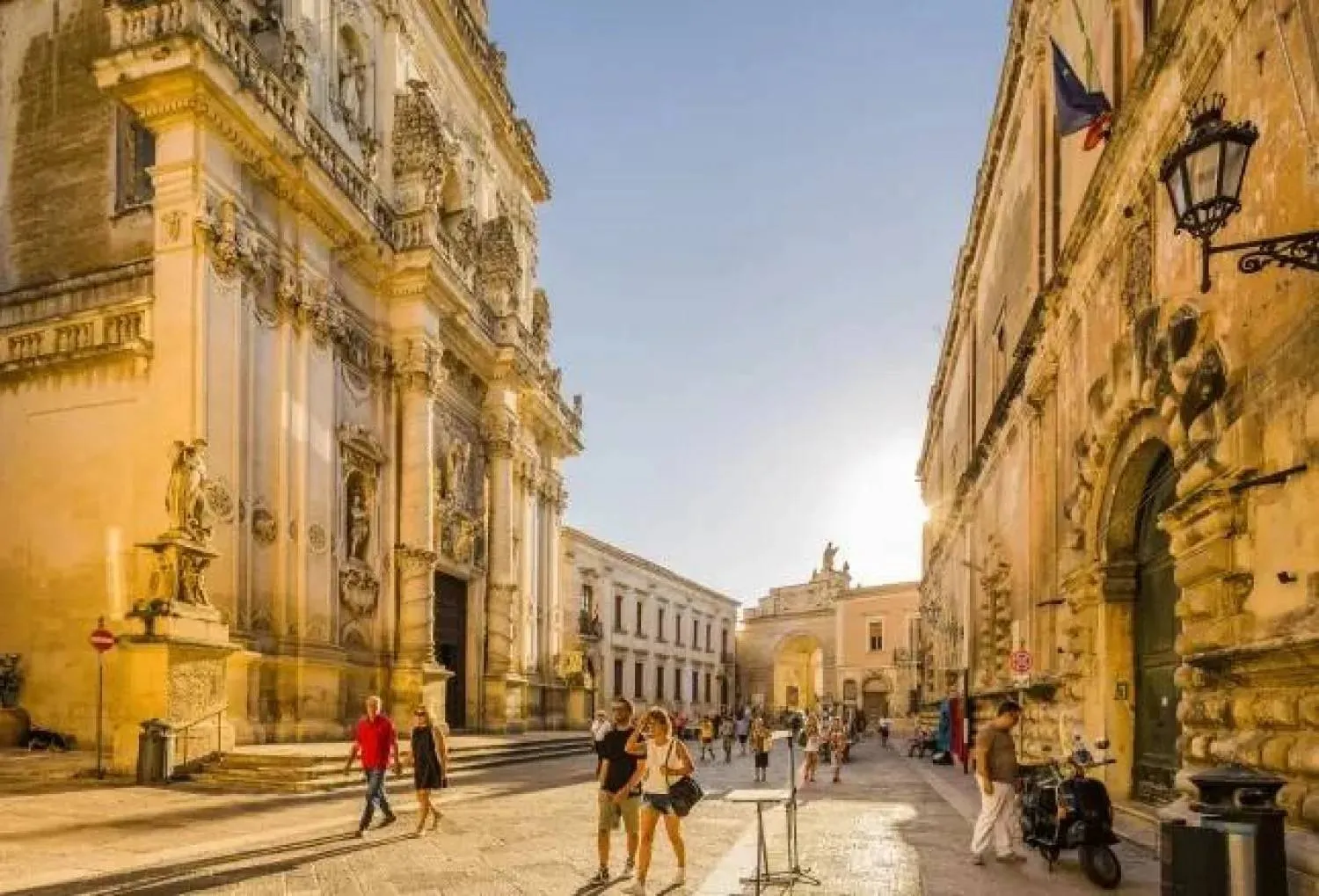
Italy’s Lecce… Florence of the South

The city has an ancient history that stretches back more than 2,000 years (Getty Images) 
TT

Italy’s Lecce… Florence of the South

The city has an ancient history that stretches back more than 2,000 years (Getty Images) 

‘The best way to experience Lecce is to walk around looking up.’

That is what a tourist is told shortly after arriving in the second-largest city in Italy’s Puglia region, often described as the “Florence of the South.”

And not because it is a place filled with skyscrapers like New York. Rather, because so much of its beauty is built into its exquisite architecture, according to London’s Metro newspaper.

The cobbled streets are steeped in history, and every Baroque-era building tells a story, much like its northern sister.

Florence attracts millions of tourists each year, many of them drawn by world-famous masterpieces.

There are frescoes by Giotto, canvases by Botticelli, and sculptures by Michelangelo — it is the cradle of the Renaissance, after all.

As for Lecce, the city sits in the Salento peninsula of Puglia, and its honey-drenched limestone is its dominant feature.

Much like Florence, you are never far from a church. Again and again, you see an unassuming facade and find an incredible duomo inside.

Nothing compares to Lecce Cathedral, built in the 12th century in the heart of the historic center, the Piazza del Duomo.

You could spend hours taking in the intricacies of the artwork: pillars romanticized with tiny cherubs, altars carved in gold and huge stone fonts.

Remembering the advice, tourists should look up at the ceiling and find a version of The Last Supper, painted by Giuseppe da Brindisi.

By night, the streets of Lecce are a gorgeous setting for walking off hearty meals, shopping and finding hidden gems like secret gardens in courtyards.

Lecce is smaller than Florence and less crowded, but is just as impressive. This city might be big on siestas, but it’s certainly not one to be slept on.


RCU Launches ‘An Ongoing Story’ Exhibition

The displayed items include stone tools, inscriptions, coins, pottery, jewellery, books, and historical photographs - SPA
TT

RCU Launches ‘An Ongoing Story’ Exhibition

The displayed items include stone tools, inscriptions, coins, pottery, jewellery, books, and historical photographs - SPA

The Royal Commission for AlUla (RCU) has launched the “An Ongoing Story” exhibition in the AlJadidah Arts District, featuring a collection curated by 16 trainees as part of a training program in museum studies and exhibition curation.

The program was conducted in collaboration with SOAS University of London and supported by the British Council through the AlUla Grants Program, SPA reported.

The exhibition features 25 archaeological and heritage artifacts from the RCU’s collections, highlighting AlUla’s history and cultural heritage across four sections: “Pre-Writing,” “Enduring Words,” “Trade Routes,” and “Documentation and Memory.”

The displayed items include stone tools, inscriptions, coins, pottery, jewellery, books, and historical photographs.

The exhibition marks the practical outcome of the training program and contributes to developing local talent in the museum sector.

It also promotes community engagement in heritage preservation and public presentation, paving the way for the future opening of several museums in AlUla, in line with Saudi Vision 2030.

The exhibition is open to the public free of charge at The Workshop in the AlJadidah Arts District until December 5, 2026. Visiting hours are Wednesday to Sunday, from 3:30 p.m. to 11:00 p.m.


Saudi Pavilion Highlights Ancient Arabian Civilizations and Traditional Woodcraft at Algiers Book Fair

The pavilion also highlighted traditional Saudi woodcraft, featuring live demonstrations by Saudi artisans who introduced visitors to heritage woodworking techniques and historical carving tools - SPA
TT

Saudi Pavilion Highlights Ancient Arabian Civilizations and Traditional Woodcraft at Algiers Book Fair

The pavilion also highlighted traditional Saudi woodcraft, featuring live demonstrations by Saudi artisans who introduced visitors to heritage woodworking techniques and historical carving tools - SPA

The Heritage Commission showcased a curated collection of rare archaeological replicas within the Kingdom of Saudi Arabia's pavilion at the 2026 Algiers International Book Fair, highlighting the depth of the Arabian Peninsula's history and its civilizational diversity spanning millennia.

The exhibits featured replicas of artifacts discovered across various regions of the Kingdom, including BCE inscriptions, petroglyphs, and sculptures that illustrate the ancient commercial and cultural prominence of the Arabian Peninsula.

The collection encompassed historical milestones through rock carvings and inscriptions from Madinah, Tabuk, and Northern Borders, alongside ornamental stonework displaying early Arabian scripts and artistic traditions, underscoring the Kingdom's historic role as a crossroads of civilizations and trade routes, SPA reported.

The pavilion also highlighted traditional Saudi woodcraft, featuring live demonstrations by Saudi artisans who introduced visitors to heritage woodworking techniques and historical carving tools.

The exhibition drew substantial interest from history and heritage enthusiasts as part of the Kingdom's active participation led by the Literature, Publishing, and Translation Commission throughout the fair, which concluded its activities on November 7.


Mercury Contamination Found at More Ancient Maya Sites

Tourists climb the Maya pyramid of Nohoch Mul at the archaeological site of Coba December 15, 2012. (Reuters)
TT

Mercury Contamination Found at More Ancient Maya Sites

Tourists climb the Maya pyramid of Nohoch Mul at the archaeological site of Coba December 15, 2012. (Reuters)

For the ancient Maya, the vibrant red mineral cinnabar held deep sacred meaning, representing blood, life and the soul. They used it widely as pigment in murals and temples while also employing it in ceremonies and funerary rites. What they did not know is that cinnabar is mostly mercury, which can be highly toxic.

Previous research showed how mercury from cinnabar left enduring contamination at the sites of certain ancient Maya cities such as Tikal in Guatemala. A new study reveals that this contamination was more widespread than previously known and documents how mercury, after leaching into the surrounding soil and bodies of water, proved deadly for many aquatic organisms.

Researchers obtained core samples from beneath lakes at two ancient Maya cities on Mexico's Yucatan peninsula — the well-studied site of Coba and the little-known site of Xcach.

The samples showed a mercury spike at Coba beginning around 250 AD ‌and lasting about ‌150 years around the outset of the golden age of Maya civilization, called the ‌Classic ⁠Period. At Xcach, there ⁠was a spike from around 125 AD to 200 AD, shortly before the Classic Period, then a second spike at about the same time as the one at Coba, and a third spike from about 535 AD to 820 AD, running to around the end of the Classic Period.

The study documents mercury contamination in the Maya northern lowlands, a region with previously sparse mercury records, and reveals some of the highest recorded Maya-era mercury concentrations.

Many of the great Maya cities collapsed and were abandoned at the end of the Classic Period. Varying hypotheses have been presented to explain this calamity, including climate change and warfare. The ⁠new research suggests mercury poisoning as one additional factor.

"Our study shows that modern toxicology ‌and pollution regulations were far exceeded at the most toxic levels for centuries ‌around Coba and Xcach," said paleolimnologist Matt Waters, a professor of environmental science at Auburn University in Alabama and lead author of ‌the study published in the journal Science Advances.

"Furthermore, we measured multiple biological markers in the sediments for bacteria, algae, cyanobacteria, ‌shelled organisms and insect midges, which all decreased or vanished in the lakes, meaning the mercury had made its way into multiple levels of the food chain," Waters said.

MERCURY POISONING

Mercury in people can harm the central nervous system, brain, kidneys, lungs and heart.

"While we do not show this in our sediment records, this trophic movement implies that the Maya people might have been exposed to mercury via ‌consumption of water or fish," said study co-author Savanna Wooten, a postdoctoral researcher at the Jones Center at Ichauway research facility in Georgia.

"This research does little to link ⁠mercury directly to the demise of ⁠Classic-era Maya cities. But it does add one more stressor to the growing list of environmental and climatic pressures documented to have co-occurred with the Classic Period Maya," Wooten said.

Coba (pronounced "koh-BAH") is estimated to have had a population of 60,000 to 90,000 people during the Classic Period. It is a well-known jungle archeological site visited by many tourists that features one of the tallest ancient pyramids in the Yucatan.

Less is known about Xcach (pronounced "SCOTCH"), a site on private land featuring multiple pyramids and structures where very little archeological work has been done.

Cinnabar is a naturally occurring mercury sulfide mineral and may have been a major trade commodity in places like Coba and Xcach where it is not found in natural abundance, the researchers said.

The Maya fashioned one of the great civilizations in the pre-Columbian New World, prospering in a broad area of Mexico as well as Guatemala, Belize, Honduras and El Salvador. Among other achievements, they built monumental structures, crafted great works of art, gained a sophisticated understanding of astronomy and mathematics, produced an advanced calendar and developed an intricate writing system.

"Their longevity as a culture and development in science, construction and art is both extensive and elegant. Cinnabar would have been a pigment that added beauty and culture to these people," Waters said.