


After a Year in Turmoil, the Louvre Faces Uncertain Future

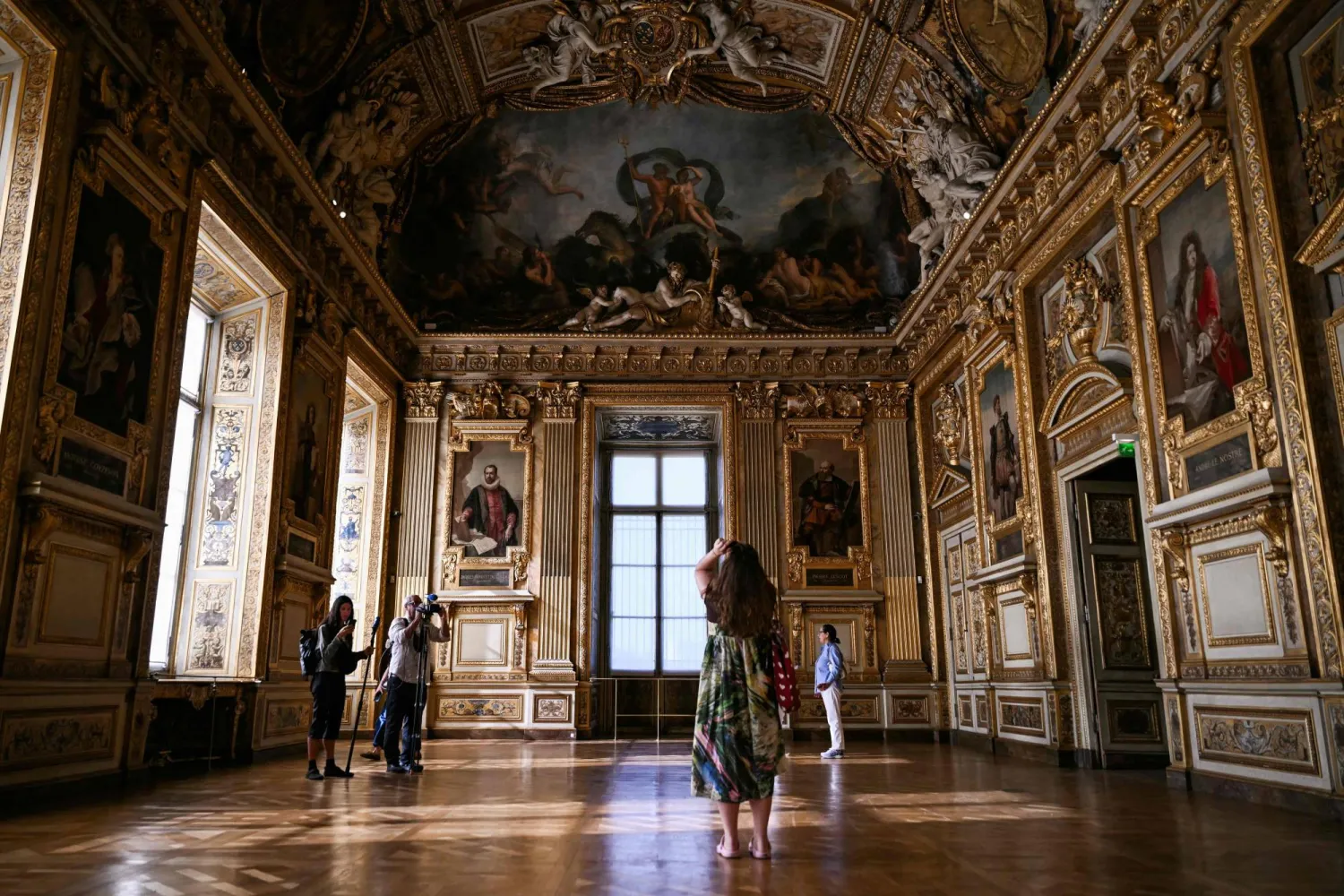
(FILES) Visitors take a picture of the window which was broken during the reopening to the public of the Apollo Gallery, where French crown jewels worth 88 million euros were stolen in 2025 in a brazen heist, at the Musée du Louvre in Paris on July 22, 2026. (Photo by LOU BENOIST / POOL / AFP)
TT

After a Year in Turmoil, the Louvre Faces Uncertain Future

(FILES) Visitors take a picture of the window which was broken during the reopening to the public of the Apollo Gallery, where French crown jewels worth 88 million euros were stolen in 2025 in a brazen heist, at the Musée du Louvre in Paris on July 22, 2026. (Photo by LOU BENOIST / POOL / AFP)

The Louvre is gradually plugging the security gaps exposed by the spectacular burglary of October 19 last year, but its reputation has taken a battering and its creaking infrastructure is a growing source of concern.

The beloved Parisian museum, the most visited in the world, has spent a year as the subject of police investigations, government reports and parliamentary inquiries following the theft of eight crown jewels in broad daylight a year ago.

The heist exposed a string of failures, from old or non-existent CCTV cameras and a chronic shortage of equipment to the lack of a modern security control room and a security director.
"We still feel the trauma of the burglary," Valerie Baud, a workers' representative from the CFDT trade union, told AFP.

Parliament has heard how, in the run-up to the burglary, the institution had spent just three million euros ($3.4 million) out of 83 million euros earmarked for a security masterplan because of administrative delays, management decisions and red tape.

The museum had "prioritized projects that were visible and attractive", the French Court of Auditors found in one of many damning judgements.

That report and others, compounded by a staff strike and a spate of other incidents -- including a water leak and a major ticket-fraud scandal -- hastened the downfall of Louvre president Laurence des Cars, who resigned in February.

"The Louvre needs a change in security culture, which has yet to happen and will take several years," said Laurent Lafon, who is monitoring the museum as chairman of the Senate's culture committee.

"The Louvre's leaders must embrace the idea that security is a priority, which wasn't the case," he told AFP.
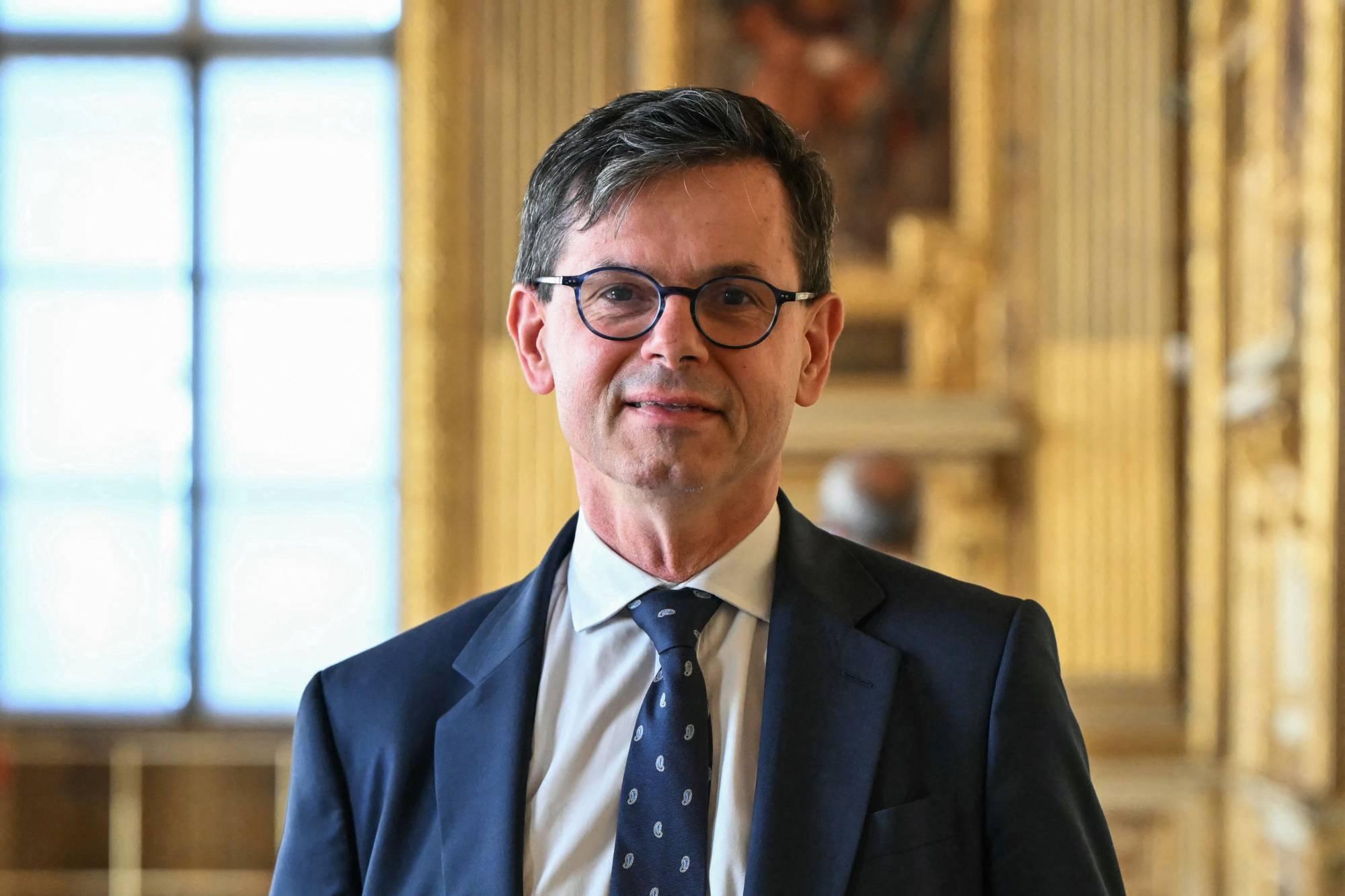
(FILES) Louvre's President Christophe Leribault poses during the reopening to the public of the Apollo Gallery, at the Musee du Louvre in Paris on July 22, 2026. (Photo by LOU BENOIST / POOL / AFP)

New museum chief Christophe Leribault, who replaced des Cars in February, argues that change is taking place.

"The security masterplan is making rapid progress," he told AFP in a written statement, while stressing the "complexity" of carrying out the work while keeping the museum open to the public.

The museum has pledged to invest around 20 million euros a year until 2032 and, since July, has a new dedicated security director.

Short-term worries about security are also giving way to longer-term questions about how to finance a palace-wide modernization program.

Every year, nearly nine million visitors walk the Louvre's galleries, many unaware of the decrepit state of some of the rooms, the ageing plumbing and wiring, as well as poor ventilation in summer and non-existent heating in winter.

Leribault issued his most alarming warning yet earlier this week, telling Le Figaro newspaper "that if the Louvre is not repaired, updated, and transformed, it will very quickly fall behind and will eventually have to close its doors to the public."

French President Emmanuel Macron unveiled his vision -- called "Louvre - Nouvelle Renaissance" -- in January 2025 which included a new entrance and gallery for the Mona Lisa among other changes.

It came with an eye-watering proposed price tag of a billion euros -- which now looks unrealistic for a country facing a severe budget crunch.

Unions accused him and Louvre management of prioritizing grandiose plans for an architectural overhaul instead of more modest changes that would improve the visitor experience.

"We can step up security without going through with this project, which does not address the priorities and states as its goal an unsustainable increase in visitor numbers," said Christian Galani, a representative of the hard-left CGT union.

Leribault remains committed to it, however.

Part of his task as Louvre head is finding new private sources of income from donors who will be invited to sponsor work -- and earn public recognition and perhaps naming rights in return.
Other sources of income could come from further ticket price hikes.

The target is 360 million euros.

"It's a huge challenge, and I don't know whether I'll succeed," he said in June.


King Salman Global Academy for Arabic Language, ALECSO Launch Unified Arabic Terminology Dictionary Platform

The dictionary platform aims to address the fragmentation of terminology dictionaries across multiple publications and different structures - SPA
TT

King Salman Global Academy for Arabic Language, ALECSO Launch Unified Arabic Terminology Dictionary Platform

The dictionary platform aims to address the fragmentation of terminology dictionaries across multiple publications and different structures - SPA

The King Salman Global Academy for Arabic Language (KSGAAL), in partnership with the Arab League Educational, Cultural and Scientific Organization (ALECSO), launched the Unified Arabic Terminology Dictionary platform during the 28th regular session of the ALECSO General Conference, held in Muscat, Oman.

The session saw the adoption of resolutions concerning two projects submitted by Saudi Arabia and implemented by the academy in cooperation with ALECSO and in coordination with the Saudi National Commission for Education, Culture and Science.

The launch coincides with Saudi Arabia’s presidency of the ALECSO Executive Council and comes within the framework of a memorandum of understanding (MoU) signed to strengthen joint Arab action and develop linguistic, knowledge-based, and digital resources, according to SPA.

The dictionary platform aims to address the fragmentation of terminology dictionaries across multiple publications and different structures, which has made it difficult to search their contents collectively or link them to digital applications. To address this, data from these dictionaries has been restructured in accordance with international standards, enabling instant searches across all their contents through a single interface. Application programming interfaces (APIs) have also been developed to connect the unified dictionary with external systems.

The conference also adopted the “Language Policy System in Arab Countries” project, which is intended to serve as an Arab reference supporting research, planning, and linguistic policymaking. The project includes data, studies, and reports documenting the state of linguistic policies in Arab countries and analyzing their impact.

The ALECSO General Conference commended Saudi Arabia’s efforts to serve the Arabic language and strengthen its regional and international presence. It also praised KSGAAL’s contributions to developing linguistic policies, indicators, and standards; building databases, corpora, dictionaries, and Arabic language processing tools; and harnessing scientific and technological capabilities to support joint projects.

The conference also commended Saudi Arabia, represented by KSGAAL, for implementing the two projects and supporting joint Arab efforts in the field of Arabic language. It called on linguistic, scientific, and academic institutions in Arab countries to benefit from the projects’ outcomes, contribute to enriching their content, update their data, and strengthen cooperation with the academy in related fields.

The launch of the platform and the adoption of the two project decisions mark a continuation of KSGAAL’s efforts to build strategic partnerships, develop digital language solutions, and strengthen integration among institutions concerned with the Arabic language. These efforts reinforce Saudi Arabia’s contribution to supporting joint Arab initiatives and providing scientific and knowledge-based references that serve the Arabic language and keep pace with its development.


India to Build Mega-Museum with World’s ‘Largest Display Area’

 Pedestrians walk amid smog at the Kartavya Path near India gate in New Delhi on November 3, 2026. (AFP)
Pedestrians walk amid smog at the Kartavya Path near India gate in New Delhi on November 3, 2026. (AFP)
TT

India to Build Mega-Museum with World’s ‘Largest Display Area’

 Pedestrians walk amid smog at the Kartavya Path near India gate in New Delhi on November 3, 2026. (AFP)
Pedestrians walk amid smog at the Kartavya Path near India gate in New Delhi on November 3, 2026. (AFP)

India's cabinet approved on Wednesday a mega-museum showcasing the country's history and civilization, which the government said will cost around $340 million and have the largest display area in the world.

First announced in 2023, the project received approval as Prime Minister Narendra Modi's Hindu nationalist government renewed its emphasis on the country's pre-colonial cultural identity.

The museum's name, Yuge Yugeen Bharat, translates roughly as "India through the ages" and invokes the country's ancient Sanskrit name, Bharat.

It will occupy former civil service offices in New Delhi, known as North and South Blocks, which were designed by British architects Edwin Lutyens and Herbert Baker in the 1920s.

In a statement, the cabinet said the museum will be "spread over a proposed built-up area of approximately 178,509 square meters".

"Benchmarked against major international museums, Yuge Yugeen Bharat Museum is going to be the museum (with) the largest display area in the world," it added.

India's cabinet said the Yuge Yugeen Bharat is "envisaged as a landmark civilizational museum showcasing the continuity, diversity and richness of Bharat's (India's) civilizational heritage".

The first gallery is expected to open to the public by the end of 2027, with project completion scheduled for financial year 2030-31.

Modi came to national power in May 2014, and has since taken multiple steps to glorify the country's heritage and culture.

His government built the world's tallest statue, a 182-meter (597-foot) monument to Vallabhbhai Patel, for his role in bringing princely states into India.

Modi also backed the revamp of New Delhi's historic administrative district in his second term and moved lawmakers to a new parliament building in 2023.

"The Museum is envisaged as a national public cultural institution... it will provide opportunities for learning, research, cultural engagement and appreciation of India's civilizational heritage," the government statement said on Wednesday.

Around 1.8 million objects have been identified from national and state museums, archaeological collections and private holdings for potential display.

The museum is designed to accommodate up to 10 million visitors a year.


The Hidden, Teeming World of Rembrandt’s Night Watch

 Rembrandt's "The Night Watch" hangs in Amsterdam's Rijksmuseum. (AFP)
Rembrandt's "The Night Watch" hangs in Amsterdam's Rijksmuseum. (AFP)
TT

The Hidden, Teeming World of Rembrandt’s Night Watch

 Rembrandt's "The Night Watch" hangs in Amsterdam's Rijksmuseum. (AFP)
Rembrandt's "The Night Watch" hangs in Amsterdam's Rijksmuseum. (AFP)

For years, millions of people have marveled at Rembrandt's use of light and shadows to depict the militia in his masterpiece, the "Night Watch".

Little did they know they were also looking at a hidden world of characters, some of them from as far away as Japan.

A new exhibition, "The Night Watch Lives," lifts the veil on this clandestine universe: the microbes covering one of the most famous works of the Dutch Golden Age paintings.

A joint effort by Rijksmuseum, where "The Night Watch" hangs and Amsterdam's Artis-Micropia Museum (more commonly known as the city's "microbe zoo") reveals the microscopic world covering the iconic painting.

The bacteria, isolated from samples taken over six months at around sixty different spots on the painting and subsequently cultivated into colonies, are displayed in Petri dishes alongside a life-size reproduction of the painting at the Artis-Micropia museum.

"We found a lot of microbes that are very commonly found, for instance, on human skin, or in the soil," Eline van Bloois, a microbiologist at the museum, told AFP.

The microbes are not harmful to the painting itself, van Bloois said, and it was impossible to determine if some of them could be a remnant from the great master himself.

"It would be really cool, right? If they could be linked to Rembrandt. But unfortunately, from one microbe, you cannot say whether it's been on there for 400 years or for a day," she said.

- 'Beauty of science' -

One of the most surprising findings was Microbacterium saccharophilum, a bacteria commonly found at a Japanese sugar refinery. It was found in an area where the varnish had been removed.

"That's something that will keep me up for years," van Bloois said.

"That's the beauty of science, because you ask one question, and you get 100 questions in return."

"As a microbiologist, I never imagined I would have the chance to get so close to this masterpiece," she said.

"Art and science are often seen as being at opposite ends of the spectrum, but this installation shows how closely these worlds are connected."

"And surely these Petri dishes full of microbes are little works of art in their own right?"

The idea behind the exhibit was to spark people's curiosity about microbes, the life teeming all around humans.

It's part of "Operation Night Watch," a large-scale research and restoration project on the painting, which has been ongoing since 2019, in a specially designed glass chamber at the Rijksmuseum.

The exhibition will be open to the public from November 11.
