Saudi Arabia, Algeria Stress Importance of Cultural Cooperation

Algerian President Abdelmadjid Tebboune receives Saudi Minister of Culture Prince Bader bin Abdullah bin Farhan at the presidential palace on Tuesday. (SPA)
TT

Saudi Arabia, Algeria Stress Importance of Cultural Cooperation

Algerian President Abdelmadjid Tebboune receives Saudi Minister of Culture Prince Bader bin Abdullah bin Farhan at the presidential palace on Tuesday. (SPA)

Saudi Arabia and Algeria underlined the depth of their bilateral relations, stressing the importance of joint cultural cooperation and joint positions to serve mutual interests within regional and international organizations.

Algerian President Abdelmadjid Tebboune received Saudi Minister of Culture Prince Bader bin Abdullah bin Farhan at the presidential palace on Tuesday. The meeting took place on the sidelines of the minister's visit to the Algiers International Book Fair 2026, where the Kingdom is participating as the guest of honor.

The selection of the Kingdom as the exhibition's guest of honor, which runs until Saturday, reflects the strong fraternal ties between the two countries. It further highlights the rapid momentum within the Saudi cultural sector, which continues to boost the global presence of Saudi culture and showcase its civilization's heritage.

President of the Algerian Council of the Nation Azzouz Nasri and President of the National People's Assembly Khalida Boufdech inaugurated the Saudi pavilion last week.
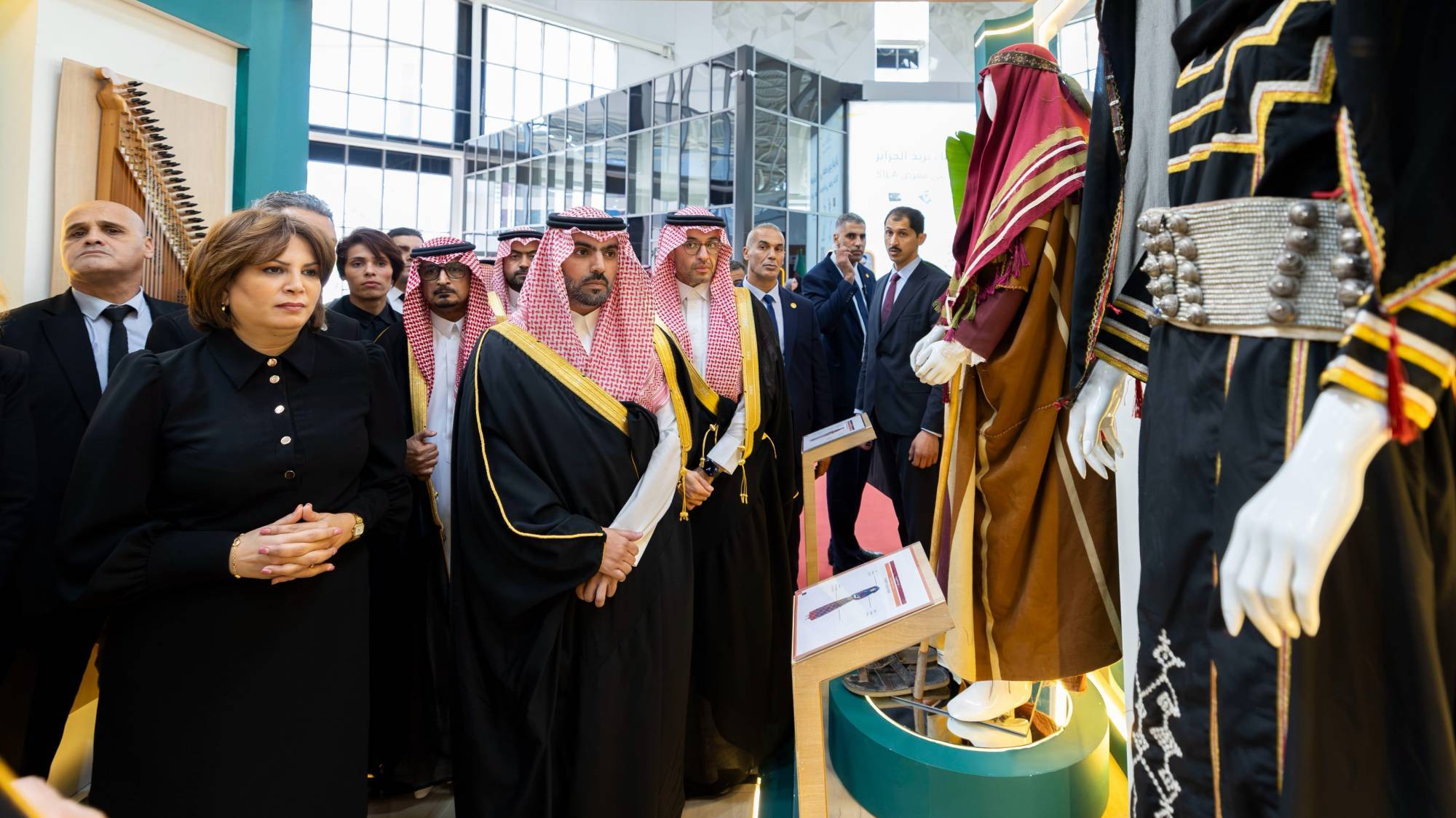
Minister of Culture Prince Bader bin Abdullah bin Farhan visits the Saudi pavilion on Tuesday. (SPA)

An extensive Saudi cultural and literary delegation, encompassing several national authorities and prominent cultural entities, is participating in the exhibition. The pavilion showcases Saudi Arabia's creative diversity and cultural identity through an integrated cultural program, featuring seminars and poetry evenings with a select group of Saudi writers.

Prince Bader visited the pavilion with his Algerian counterpart Malika Bendouda on Tuesday.

They had held a meeting in Algiers that highlighted the strong cultural ties between their countries and the importance of expanding cooperation across various cultural fields.

The meeting was attended by Assistant Minister of Culture Rakan Altouq, Saudi Ambassador to Algeria Abdullah Al-Busairi, and Assistant Deputy Minister for International Cultural Relations Fahd Al-Humaidani.


Saudi Arabia, Algeria Stress Importance of Cultural Cooperation

Algerian President Abdelmadjid Tebboune receives Saudi Minister of Culture Prince Bader bin Abdullah bin Farhan at the presidential palace on Tuesday. (SPA)
TT

Saudi Arabia, Algeria Stress Importance of Cultural Cooperation

Algerian President Abdelmadjid Tebboune receives Saudi Minister of Culture Prince Bader bin Abdullah bin Farhan at the presidential palace on Tuesday. (SPA)

Saudi Arabia and Algeria underlined the depth of their bilateral relations, stressing the importance of joint cultural cooperation and joint positions to serve mutual interests within regional and international organizations.

Algerian President Abdelmadjid Tebboune received Saudi Minister of Culture Prince Bader bin Abdullah bin Farhan at the presidential palace on Tuesday. The meeting took place on the sidelines of the minister's visit to the Algiers International Book Fair 2026, where the Kingdom is participating as the guest of honor.

The selection of the Kingdom as the exhibition's guest of honor, which runs until Saturday, reflects the strong fraternal ties between the two countries. It further highlights the rapid momentum within the Saudi cultural sector, which continues to boost the global presence of Saudi culture and showcase its civilization's heritage.

President of the Algerian Council of the Nation Azzouz Nasri and President of the National People's Assembly Khalida Boufdech inaugurated the Saudi pavilion last week.

Minister of Culture Prince Bader bin Abdullah bin Farhan visits the Saudi pavilion on Tuesday. (SPA)

An extensive Saudi cultural and literary delegation, encompassing several national authorities and prominent cultural entities, is participating in the exhibition. The pavilion showcases Saudi Arabia's creative diversity and cultural identity through an integrated cultural program, featuring seminars and poetry evenings with a select group of Saudi writers.

Prince Bader visited the pavilion with his Algerian counterpart Malika Bendouda on Tuesday.

They had held a meeting in Algiers that highlighted the strong cultural ties between their countries and the importance of expanding cooperation across various cultural fields.

The meeting was attended by Assistant Minister of Culture Rakan Altouq, Saudi Ambassador to Algeria Abdullah Al-Busairi, and Assistant Deputy Minister for International Cultural Relations Fahd Al-Humaidani.


Ithra Announces Launch of Ithra Winter 2026 Program

Ithra said the program's events will feature visual storytelling, lighting effects and live performances. (SPA)
TT

Ithra Announces Launch of Ithra Winter 2026 Program

Ithra said the program's events will feature visual storytelling, lighting effects and live performances. (SPA)

Saudi Arabia’s King Abdulaziz Center for World Culture (Ithra) announced on Tuesday the launch of the Ithra Winter 2026 program, in cooperation with the Sharqia Development Authority and the Saudi Tourism Authority (STA).

The program will coincide with the opening of Khobar Season on November 13 at the Khobar Sea Front.

Ithra said the partnership reflects the integration of efforts among various entities to strengthen cultural and tourism activities in Eastern Region by highlighting tourist destinations and attracting visitors through a range of programs, events and initiatives.

These efforts aim to enhance the region's standing as a destination offering a blend of cultural, recreational and creative experiences, it added.

Moreover, Ithra said the program's events will feature visual storytelling, lighting effects and live performances, including maritime boat shows and fishermen's performances, as well as poetry recitals, an artistic performance and the Saudi Ardah.

A cultural program will also be held at Dhahran International Exhibitions Company "Dhahran Expo" in Al-Khobar.


Egyptian Mummy Portraits Show Antiquity's Piercing Gaze in New Rome Show

Some of the masterpieces in the Rome exhibition were allowed to leave Egypt for the first time.  Andreas SOLARO / AFP
Some of the masterpieces in the Rome exhibition were allowed to leave Egypt for the first time. Andreas SOLARO / AFP
TT

Egyptian Mummy Portraits Show Antiquity's Piercing Gaze in New Rome Show

Some of the masterpieces in the Rome exhibition were allowed to leave Egypt for the first time.  Andreas SOLARO / AFP
Some of the masterpieces in the Rome exhibition were allowed to leave Egypt for the first time. Andreas SOLARO / AFP

An elegant woman gazes out from her portrait with expressive eyes, a gilded wreath worn in her hair and a gentle, questioning look on her face.

She is one of the 2,000-year-old "Faces of Fayum", startlingly realistic funerary -- or mummy -- portraits painted after Egypt became part of the Roman empire.

The fragile portraits dating from the first to third centuries AD -- painted on thin wooden panels and designed to be placed over the face of mummies -- will go on display in Rome in what organizers hail as a "milestone" collaboration between Italy and Egypt, AFP reported.

"Egypt and Rome, the Faces of Fayum", opening Wednesday at Rome's Ara Pacis museum, also includes mummies, masks, shrouds, jewelry, marble busts and statuary.

The majority of the artefacts come from Egypt, with some allowed to leave the country for the first time.

Such is the case of the "Tondo of the Two Brothers" from Cairo's Egyptian Museum, a freshly restored double portrait from the time of Emperor Hadrian that depicts two curly-haired young men, possibly brothers, with soulful eyes.

Rome's top official for cultural heritage, Claudio Parisi Presicce, called the work an "absolute masterpiece, perhaps the most important pictorial work to have survived from antiquity".

"These are simple wooden panels, often just a few millimeters thick, made of wood... and they were used to depict, through extremely naturalistic painting, the faces of the individuals who were being buried," Parisi Presicce told a press conference Monday.

Rooted in the tradition of Hellenistic painting, the portraits placed over the head of the mummy and secured into its wrappings come from a relatively brief period between the first and third centuries AD, after Egypt became a province of Rome.

In a fusion of two great civilizations -- Egyptian and Roman -- the men, women and children portrayed often bear Egyptian features, but wear Roman dress.

Their faces are vivid, and haunting, whether bearing signs of greying hair and wrinkles, or the long eyelashes and chubby cheeks of a child.

"These people are not dead," Italian figurative painter Amedeo Modigliani once said of the Fayum portraits.

"They are more alive than those who gaze upon them."

- Ushering the dead -

Works from the Louvre, the Metropolitan Museum of Art, the J. Paul Getty Museum, the Landesmuseum Württemberg and other international museums round out the exhibit.

A fertile area of Egypt on the edge of the desert, Fayum's arid climate helped preserve the delicate painted wood, textiles and papyrus on display in the exhibition.

One work, on loan from the Louvre, is a spectacular, near-pristine linen shroud depicting a man standing between the mummy he will become and Anubis, who helped usher the dead into the Afterlife.

Some of the female portraits are adorned in sumptuous jewelry, such as that of the woman "Isidora" from the first century AD, whose three-tiered gold necklace adorned with precious stones, pearl earrings and elaborately curled hairdo project her status.

Parisi Presicce said that "countless questions" remain about the compelling portraits.

"Were they made earlier and kept until the moment of death? Were they painted at the time the deceased was buried? Were they panels that were hung in homes, in residences?" he asked.

A nail found at the top of one of the portraits makes this theory plausible, he said.

Hisham El-Leithy, secretary-general of Egypt's Supreme Council of Antiquities, said the images from so long ago have an uncanny power to move us.

"They are people like us, we look at them, they look back at you across 2,000 years," he said.

"That is the power of the portrait."

The exhibition runs until May 2.