


Legal Battles Loom as First Mickey Mouse Copyright Ends 

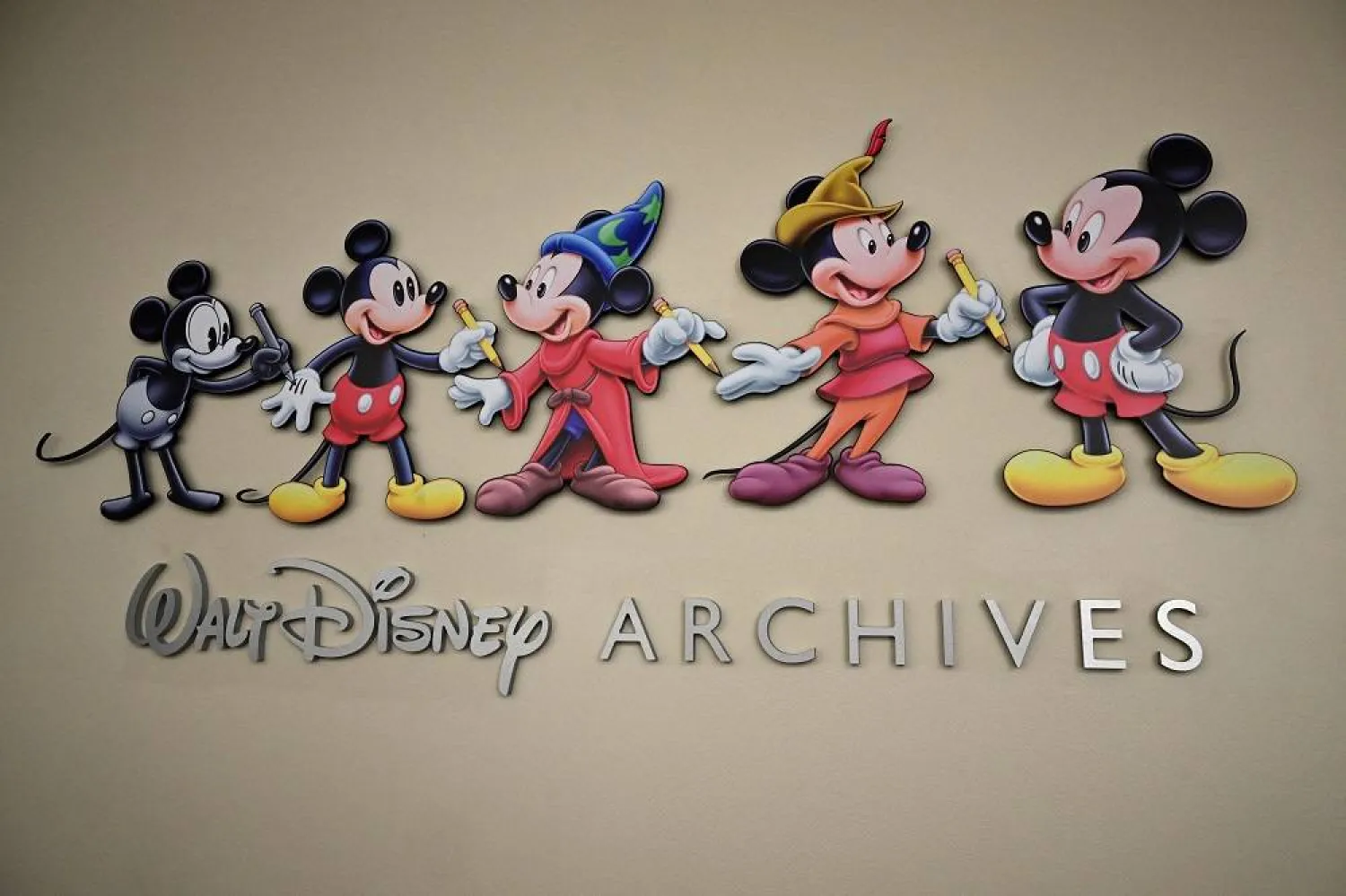
Mickey Mouse animations annouce the entrance to the Walt Disney Archives during a media tour of the Disney Studio and Walt Disney Archives,on June 20, 2023 at the Disney Studio lot, in Burbank, California. (AFP)
TT

Legal Battles Loom as First Mickey Mouse Copyright Ends 

Mickey Mouse animations annouce the entrance to the Walt Disney Archives during a media tour of the Disney Studio and Walt Disney Archives,on June 20, 2023 at the Disney Studio lot, in Burbank, California. (AFP)

Almost a century after his big-screen debut, Mickey Mouse enters the public domain Monday, opening the floodgates to potential remakes, spin-offs, adaptations... and legal battles with Disney.

The copyright on "Steamboat Willie" -- a short, black-and-white 1928 animation that first introduced audiences to the mischievous rodent who would become emblematic of American pop culture -- expires after 95 years, on January 1, under US law.

The date has loomed large on the calendars of everyone from filmmakers, fans and intellectual property lawyers to Disney executives, who in the past helped lobby to change law to prolong US copyright terms.

"This is a deeply symbolic, highly anticipated moment," said Jennifer Jenkins, director of the Duke Center for the Study of the Public Domain.

Anyone is now free to copy, share, reuse and adapt "Steamboat Willie" and "Plane Crazy" -- another 1928 Disney animation -- and the early versions of the characters that appear within them, including Mickey and Minnie.

A vital caveat is that later versions of the characters, like those in 1940 film "Fantasia," are not in the public domain, and cannot be copied without a visit from Disney's lawyers.

But artists would be free, for instance, to create a "climate change awareness version" of "Steamboat Willie" in which Mickey's ship runs aground on a dry riverbed, or a feminist retelling where Minnie takes the wheel, said Jenkins.

That would echo imaginative re-uses of other characters whose copyrights recently expired such as Sherlock Holmes and Winnie-the-Pooh.

'Legal skirmishes'

But it will not be plain sailing.

In a statement to AFP, Disney said it would "continue to protect our rights in the more modern versions of Mickey Mouse and other works that remain subject to copyright."

Indeed, the version of Mickey in "Steamboat Willie" is a spindly, roguish creature who would not be recognizable to many younger viewers.

"What's in the public domain is kind of a frightful little black-and-white animal," said Justin Hughes, a professor at Loyola Law School.

He added: "The Mickey Mouse that is most familiar to current generations of Americans will remain under copyright protection.

"I wouldn't be surprised if we see some legal skirmishes, and I wouldn't be surprised if we see Disney out there educating people on that point."

Cease-and-desist letters could be sent to artists producing "high-budget fan art" if they use elements from later Mickey cartoons, such as red shorts and white gloves, he predicted.

Additionally, while the copyright has expired, the trademark has not.

Copyrights prevent the unlicensed copying of the creative work itself, for example books, films and characters. They expire after a set time.

Trademarks guard the source of a work, preventing anyone else from making a product that could mislead consumers into thinking it came from the original author. They can be renewed indefinitely.

Disney said it will "work to safeguard against consumer confusion caused by unauthorized uses of Mickey and our other iconic characters."

The company has even added a clip from "Steamboat Willie" to the opening sequence of every Walt Disney Animation Studios film.

"They were very smart folks at Disney -- they realized that the best thing to do was to establish that iconic sequence of Steamboat Willie as a trademark," said Hughes.

Anybody using the classic image of Mickey at the helm of the boat on shirts, caps or mugs could be open to legal action, he said.

'Circumvent'

Other experts such as Jenkins remain more bullish about public domain freedoms.

"Our Supreme Court has made clear that you can't use trademark rights to circumvent what copyright expiration allows," she said.

Both sides agree that the law is likely to be tested in court soon.

Anyone hoping to cash in on Disney's beloved mascot "should move cautiously and with counsel," added Hughes.

In the short term, novelty and shocking adaptations, similar to recent high-profile slasher film "Winnie-the-Pooh: Blood and Honey," are likely to grab the headlines.

But copyright law should ensure artists can use characters like Mickey to create enduring works, just as Shakespeare has been adapted to make modern classics from "West Side Story" (a retelling of "Romeo and Juliet") to "Rosencrantz and Guildenstern Are Dead," (Tom Stoppard's exploration of the fates of two minor characters from "Hamlet"), said Jenkins.

"I'm interested to see what happens in 2024," she said.

"But I'm even more interested to see what we're still talking about and thinking about and teaching and writing about and sharing with our children in 2054."



First Bond Game in a Decade Hit by Two-month Delay

'007 First Light' depicts a younger Bond earning his license to kill. Ina FASSBENDER / AFP
TT

First Bond Game in a Decade Hit by Two-month Delay

'007 First Light' depicts a younger Bond earning his license to kill. Ina FASSBENDER / AFP

A Danish video game studio said it was delaying the release of the first James Bond video game in over a decade by two months to "refine the experience".

Fans will now have to wait until May 27 to play "007 First Light" featuring Ian Fleming's world-famous spy, after IO Interactive said on Tuesday it was postponing the launch to add some final touches.

"007 First Light is our most ambitious project to date, and the team has been fully focused on delivering an unforgettable James Bond experience," the Danish studio wrote on X.

Describing the game as "fully playable", IO Interactive said the two additional months would allow their team "to further polish and refine the experience", giving players "the strongest possible version at launch".

The game, which depicts a younger Bond earning his license to kill, is set to feature "globe-trotting, spycraft, gadgets, car chases, and more", IO Interactive added.

It has been more than a decade since a video game inspired by Bond was released. The initial release date was scheduled for March 27.


Movie Review: An Electric Timothee Chalamet Is the Consummate Striver in Propulsive ‘Marty Supreme’

 Timothee Chalamet attends the premiere of "Marty Supreme" at Regal Times Square on Tuesday, Dec. 16, 2025, in New York. (AP)
Timothee Chalamet attends the premiere of "Marty Supreme" at Regal Times Square on Tuesday, Dec. 16, 2025, in New York. (AP)
TT

Movie Review: An Electric Timothee Chalamet Is the Consummate Striver in Propulsive ‘Marty Supreme’

 Timothee Chalamet attends the premiere of "Marty Supreme" at Regal Times Square on Tuesday, Dec. 16, 2025, in New York. (AP)
Timothee Chalamet attends the premiere of "Marty Supreme" at Regal Times Square on Tuesday, Dec. 16, 2025, in New York. (AP)

“Everybody wants to rule the world,” goes the Tears for Fears song we hear at a key point in “Marty Supreme,” Josh Safdie’s nerve-busting adrenaline jolt of a movie starring a never-better Timothee Chalamet.

But here’s the thing: everybody may want to rule the world, but not everybody truly believes they CAN. This, one could argue, is what separates the true strivers from the rest of us.

And Marty — played by Chalamet in a delicious synergy of actor, role and whatever fairy dust makes a performance feel both preordained and magically fresh — is a striver. With every fiber of his restless, wiry body. They should add him to the dictionary definition.

Needless to say, Marty is a New Yorker.

Also needless to say, Chalamet is a New Yorker.

And so is Safdie, a writer-director Chalamet has called “the street poet of New York.” So, where else could this story be set?

It’s 1952, on Manhattan’s Lower East Side. Marty Mauser is a salesman in his uncle’s shoe store, escaping to the storeroom for a hot tryst with his (married) girlfriend. This witty opening sequence won’t be the only thing recalling “Uncut Gems,” co-directed by Safdie with his brother Benny before the two split for solo projects. That film, which feels much like the precursor to “Marty Supreme,” began as a trip through the shiny innards of a rare opal, only to wind up inside Adam Sandler’s colon, mid-colonoscopy.

Sandler’s Howard Ratner was a New York striver, too, but sadder, and more troubled. Marty is young, determined, brash — with an eye always to the future. He’s a great salesman: “I could sell shoes to an amputee,” he boasts, crassly. But what he’s plotting to unveil to the world has nothing to do with shoes. It’s about table tennis.

How likely is it that this Jewish kid from the Lower East Side can become the very face of a sport in America, soon to be “staring at you from the cover of a Wheaties box?”

To Marty, perfectly likely. Still, he knows nobody in the US cares about table tennis. He’s so determined to prove everyone wrong, starting at the British Open in London, that when there’s a snag obtaining cash for his trip, he brandishes a gun at a colleague to get it.

Shaking off that sorta-armed robbery thing, Marty arrives in London, where he fast-talks his way into a suite at the Ritz. Here, he spies fellow guest Kay Stone (Gwyneth Paltrow, in a wise, stylish return to the screen), a former movie star married to an insufferable tycoon (“Shark Tank” personality Kevin O’Leary, one of many nonactors here.)

Kay’s skeptical, but Marty finds a way to woo her. Really, all he has to say is: “Come watch me.” Once she sees him play, she’s sneaking into his room in a lace corselet.

This would be a good time to stop and consider Chalamet’s subtly transformed appearance. He is stick-thin — duh, he never stops moving. His mustache is skimpy. His skin is acne-scarred — just enough to erase any movie-star sheen. Most strikingly, his eyes, behind the round spectacles, are beady — and smaller. Definitely not those movie-star eyes.

But then, nearly all the faces in “Marty Supreme” are extraordinary. In a movie with more than 100 characters, we have known actors (Fran Drescher, Abel Ferrara); nonacting personalities (O’Leary, and an excellent Tyler Okonma (Tyler, The Creator) as Marty’s friend Wally); and exciting newcomers like Odessa A’Zion as Marty’s feisty girlfriend Rachel.

There are also a slew of nonactors in small parts, plus cameos from the likes of David Mamet and even high wire artist Philippe Petit. The dizzying array makes one curious how it all came together — is casting director Jennifer Venditti taking interns? Production notes tell us that for one hustling scene at a bowling alley, young men were recruited from a sports trading-card convention.

Elsewhere on the creative team, composer Daniel Lopatin succeeds in channeling both Marty’s beating heart and the ricochet of pingpong balls in his propulsive score. The script by Safdie and cowriter Ronald Bronstein, loosely based on real-life table tennis hustler Marty Reisman, beats with its own, never-stopping pulse. The same breakneck aesthetic applies to camera work by Darius Khondji.

Back now to London, where Marty makes the finals against Japanese player Koto Endo (Koto Kawaguchi, like his character a deaf table tennis champion). “I’ll be dropping a third atom bomb on them,” he brags — not his only questionable World War II quip. But Endo, with his unorthodox paddle and grip, prevails.

After a stint as a side act with the Harlem Globetrotters, including pingpong games with a seal — you’ll have to take our word for this, folks, we’re running low on space — Marty returns home, determined to make the imminent world championships in Tokyo.

But he's in trouble — remember he took cash at gunpoint? Worse, he has no money.

So Marty’s on the run. And he’ll do anything, however messy or dangerous, to get to Japan. Even if he has to totally debase himself (mark our words), or endanger friends — or abandon loyal and brave Rachel.

Is there something else for Marty, besides his obsessive goal? If so, he doesn’t know it yet. But the lyrics of another song used in the film are instructive here: “Everybody’s got to learn sometime.”

So can a single-minded striver ultimately learn something new about his own life?

We'll have to see. As Marty might say: “Come watch me.”


Nicki Minaj Surprises Conservatives with Praise for Trump, Vance at Arizona Event

CEO and Chair of the Board of Turning Point USA Erika Kirk (L) listens to US rapper Nicki Minaj speak during Turning Point's annual AmericaFest conference in Phoenix, Arizona on December 21, 2025. (Photo by Olivier Touron / AFP)
TT

Nicki Minaj Surprises Conservatives with Praise for Trump, Vance at Arizona Event

CEO and Chair of the Board of Turning Point USA Erika Kirk (L) listens to US rapper Nicki Minaj speak during Turning Point's annual AmericaFest conference in Phoenix, Arizona on December 21, 2025. (Photo by Olivier Touron / AFP)

Rapper Nicki Minaj on Sunday made a surprise appearance at a gathering of conservatives in Arizona that was memorializing late activist Charlie Kirk, and used her time on stage to praise President Donald Trump and Vice President JD Vance, calling them “role models” for young men.

The rap star was interviewed at Turning Point USA’s AmericaFest convention by Erika Kirk, the widow of Charlie Kirk, about her newly found support for Trump — someone she had condemned in the past — and about her actions denouncing violence against Christians in Nigeria.

The Grammy-nominated rapper's recent alignment with the Make America Great Again movement has caught some interest because of her past criticism of Trump even when the artist's own political ideology had been difficult to pin down. But her appearance Sunday at the flagship event for the powerful conservative youth organization may shore up her status as a MAGA acolyte.

Minaj mocked California Gov. Gavin Newsom, referring to him as New-scum, a nickname Trump gave him. Newsom, a Democrat, has 2028 prospects. Minaj expressed admiration for the Republican president and Vance, who received an endorsement from Erika Kirk despite the fact he has not said whether he will run for president. Kirk took over as leader of Turning Point.

“This administration is full of people with heart and soul, and they make me proud of them. Our vice president, he makes me ... well, I love both of them,” The Associated Press quoted Minaj as saying. “Both of them have a very uncanny ability to be someone that you relate to.”

Minaj’s appearance included an awkward moment when, in an attempt to praise Vance’s political skills, she described him as an “assassin.”

She paused, seemingly regretting her word choice, and after Kirk appeared to wipe a tear from one of her eyes, the artist put her hand over her mouth while the crowd murmured.

“If the internet wants to clip it, who cares? I love this woman,” said Erika Kirk, who became a widow when Charlie Kirk was assassinated in September.

Last month, the rapper shared a message posted by Trump on his Truth Social network about potential actions to sanction Nigeria saying the government is failing to rein in the persecution of Christians in the West African country. Experts and residents say the violence that has long plagued Nigeria isn’t so simply explained.

“Reading this made me feel a deep sense of gratitude. We live in a country where we can freely worship God,” Minaj shared on X. She was then invited to speak at a panel at the US mission to the United Nations along with US Ambassador Mike Waltz and faith leaders.

Minaj said she was tired of being “pushed around,” and she said that speaking your mind with different ideas is controversial because “people are no longer using their minds.” Kirk thanked Minaj for being “courageous,” despite the backlash she is receiving from the entertainment industry for expressing support for Trump.

“I didn’t notice,” Minaj said. “We don’t even think about them.” Kirk then said “we don’t have time to. We’re too busy building, right?”

“We’re the cool kids,” Minaj said.

The Trinidadian-born rapper is best known for her hits “Super Freaky Girl,” “Anaconda” and “Starships.” She has been nominated for 12 Grammy Awards over the course of her career.

In 2018, Minaj was one of several celebrities condemning Trump’s zero-tolerance immigration policy that split more than 5,000 children from their families at the Mexico border. Back then, she shared her own story of arriving to the country at 5 years old, describing herself as an “illegal immigrant.”

“This is so scary to me. Please stop this. Can you try to imagine the terror & panic these kids feel right now?” she posted then on Instagram.

On Sunday on stage with Erika Kirk, Minaj said, “it’s OK to change your mind.”