


Gillian Anderson and Rufus Sewell Recreate a Royal Media Disaster in Prince Andrew Drama ‘Scoop’

 US actor Gillian Anderson poses on the red carpet upon arrival to attend the World Premiere of the film "Scoop" in central London on March 27, 2024. (AFP)
US actor Gillian Anderson poses on the red carpet upon arrival to attend the World Premiere of the film "Scoop" in central London on March 27, 2024. (AFP)
TT

Gillian Anderson and Rufus Sewell Recreate a Royal Media Disaster in Prince Andrew Drama ‘Scoop’

 US actor Gillian Anderson poses on the red carpet upon arrival to attend the World Premiere of the film "Scoop" in central London on March 27, 2024. (AFP)
US actor Gillian Anderson poses on the red carpet upon arrival to attend the World Premiere of the film "Scoop" in central London on March 27, 2024. (AFP)

As the past few weeks have shown, British royalty and the media can be an explosive mix.

The absence of the Princess of Wales after abdominal surgery in January sparked uncontrolled online speculation that was first heightened by the release of a manipulated photo, then eased by a video statement from Kate disclosing that she is being treated for cancer.

It’s a reminder that when palace privacy meets public curiosity and the public interest, things can get messy.

For more evidence, watch “Scoop,” a behind-the-scenes Netflix drama about a disastrous interview Prince Andrew gave in 2019 in response to allegations of sexual misconduct. Released on Friday (April 5), it stars Rufus Sewell as Andrew and Gillian Anderson as journalist Emily Maitlis, who grilled the prince for the BBC’s “Newsnight” program.

The feature-length drama is a return to royal themes for “The X-Files” star Anderson, who played a leading role in series four of “The Crown,” albeit as Prime Minister Margaret Thatcher, not as a member of the House of Windsor. Anderson says the “complex” relationship between royalty and media needs reassessment.

“Whether that’s (Prince) Harry and his cases against the tabloids and all of the truths around that that have come to the fore, or other aspects that are becoming more public knowledge, it probably needs a proper rethink,” Anderson told The Associated Press.

Prince Andrew agreed to be interviewed to address reports about his friendship with financier Jeffrey Epstein – found dead in a New York prison in August 2019 while awaiting trial on sex trafficking charges — and allegations by a woman that she’d had sex with Andrew when she was 17 and being trafficked by Epstein.

“Scoop” is based on a book by Sam McAlister, the tenacious producer who secured the interview. As played by Billie Piper, she promises the palace: “An hour of television can change everything.”

That proved grimly true for Andrew.

Under Maitlis’ gentle but determined probing, the prince denied all allegations, failed to show empathy for the exploited young women and said Epstein had “conducted himself in a manner unbecoming,” which struck many viewers as an understatement.

He claimed he couldn’t have been at a nightclub with his accuser on an alleged date because he was at a suburban Pizza Express restaurant with his daughter Princess Beatrice. He couldn’t have been sweating on the dancefloor because an “overdose of adrenaline” during his time as a helicopter pilot in the 1982 Falklands War had left him unable to perspire.

McAlister recalled the “extraordinary” experience of being in the room as the interview was recorded inside Buckingham Palace.

“As a journalist, and an ex-lawyer, I knew profoundly that he was doing something that would change the course of his life and the course of life of everyone in the royal family,” she said at the show's London premiere.

Andrew initially thought the interview had been a great success, even giving Maitlis a tour of Buckingham Palace after it was recorded.

But he “stepped back” from public duties days after it was broadcast, and has not returned. In 2022 he reached an out-of-court settlement with his accuser, Virginia Giuffre, paying her an unspecified sum without admitting guilt.

Sewell, who spent up to four hours a day being transformed into the prince with makeup and prosthetics, said he tried to find “all of the contradictions” in Andrew. He saw a man whose self-image was forged through a lifetime of deference from those around him, and who played up to his tabloid image as a “naughty scamp” – “Randy Andy” in his bachelor youth, “Air Miles Andy” in his role as a British trade emissary.

Sewell said he felt Andrew’s self-image was “dependent on the other party acquiescing to the idea that he is the prince.”

“In order to maintain the idea of himself, he needs someone to play along,” said the British actor, recently seen as a mischief-making ambassadorial spouse in “The Diplomat” on Netflix.

“And the interview is the process by which this fish finds himself out of his bowl, gulping for air — because Emily Maitlis does not even need to be rude or aggressive, she just needs to not agree to her side of that contract. And suddenly he is a creature that cannot get the oxygen.”

The show's recreation of the infamous interview is remarkably tense, even for viewers who have seen the real thing.

“We prepared completely separately and, and there was no rehearsal,” Anderson said. “So when we came together to shoot the interview, it was on our first day of work together and we started the day sitting across from each other in those chairs and the cameras rolled. And so there was tension in and of itself.”

“Scoop” is the first of two TV dramas based on the interview. Amazon’s rival miniseries “A Very Royal Scandal” is due later this year, with Michael Sheen as Andrew and Ruth Wilson as Maitlis.

Anderson is proud that “Scoop” is a story with “four strong female leads in the ensemble.” The cast also includes Keeley Hawes as Andrew’s private secretary Amanda Thirsk and Romola Garai as “Newsnight” boss Esme Wren.

As for what the palace can learn from it, she said: “If this tells us anything, it would be that the royal family should never do an interview at all.”

“But actually,” she added, “I think what is amazing and what stands out is the importance of independent journalism, to hold authority to account and to at least attempt to get some semblance of the truth.”



Bad Bunny Positioned to Consolidate His Popularity in Brazil with First-Ever Performances

 Puerto Rican singer Bad Bunny performs during his "Debí Tirar Más Fotos" world tour at the Allianz Parque stadium in Sao Paulo, Brazil, on February 20, 2026. (AFP)
Puerto Rican singer Bad Bunny performs during his "Debí Tirar Más Fotos" world tour at the Allianz Parque stadium in Sao Paulo, Brazil, on February 20, 2026. (AFP)
TT

Bad Bunny Positioned to Consolidate His Popularity in Brazil with First-Ever Performances

 Puerto Rican singer Bad Bunny performs during his "Debí Tirar Más Fotos" world tour at the Allianz Parque stadium in Sao Paulo, Brazil, on February 20, 2026. (AFP)
Puerto Rican singer Bad Bunny performs during his "Debí Tirar Más Fotos" world tour at the Allianz Parque stadium in Sao Paulo, Brazil, on February 20, 2026. (AFP)

While Bad Bunny has dominated global charts, the superstar has not had quite the same success in Brazil, a country notoriously hard for foreign stars to win over due to a devotion to national artists.

But a shift that began with his Grammy-winning album "Debí Tirar Más Fotos" may accelerate further after his first-ever gigs in Brazil on Friday and Saturday in Sao Paulo.

Bad Bunny has come to Brazil at the peak of his career so far, following the phenomenal hype around his performance at the Super Bowl halftime show.

"It’s the best time to try and unlock a country like Brazil, at a time when he’s managed to dominate practically the entire world," said Felipe Maia, an ethnomusicologist who is pursuing a doctoral degree on popular music and digital technologies at Paris Nanterre University.

For years, the Puerto Rican artist born Benito Antonio Martínez Ocasio has been one of the most-streamed artists on the planet.

But neither the singer, nor his album, nor his songs were among the most played last year in Brazil, according to Spotify. The most streamed artists in the country on the platform in 2025 were all Brazilian.

In the land of samba, funk, bossa nova, choro, sertanejo, forro and pagode, among other Brazilian music genres, 75% of streaming consumption in Brazil focuses on national artists, according to the 2025 midyear music report of Luminate, a company specializing in entertainment industry data. Brazil is the country that most listens to its own music, it said.

Still, particularly since "Debí Tirar Más Fotos," the fever around Bad Bunny has made headway in Brazil. Only one performance was initially scheduled at the Allianz Parque arena, but it sold out so quickly the artist added an extra date, which also sold out.

By mid-afternoon on Friday, long queues had formed. Brazilian fans mixed with people from El Salvador, Colombia and Venezuela. Many came wearing straw hats — used by Bad Bunny and traditionally worn by jíbaros, rural Puerto Rican farmers.

Tickets on Ticketmaster, the official vendor, ranged from $50 to $210, but resellers on Friday were selling tickets for that same night for more than $830 — more than 2.5 times the minimum monthly wage in Brazil.

Flávia Durante, a Sao Paulo -based DJ who specializes in Latin American music, said that some Brazilians have a tendency to see Spanish-language music as corny due to the association with Mexican telenovelas, but that Bad Bunny pierced a bubble with his latest album.

"Nowadays everyone knows all the songs, they sing along and really get into it. I normally play him at the peak of the night. People request him, even at rock or 80s pop themed parties," Durante said.

Since the half-time Super Bowl show, that popularity has grown. Bad Bunny’s average streams grew by 426% on Spotify in Brazil in the following week compared with the previous one. Many songs experienced massive streaming surges, with "Yo Perreo Sola" leading the growth with a 2,536% increase.

‘Latino resistance’

During Brazil’s Carnival celebrations, Bad Bunny themed costumes were a fixture in Rio’s raucous, dazzling street parties.

Nicole Froio, a Colombian Brazilian writer specializing in Latin American cultural issues, went kitted out in a straw hat and plastic, tropical plants that echo the background of his latest album. It was the third Carnival in which Froio — who has two Bad Bunny tattoos and a third one planned — wore attire that evoked the Puerto Rican artist.

For a long time, Froio was the sole person among her Brazilian friendship group who liked Bad Bunny. She believes that Brazilians in general have trouble identifying themselves as Latino.

"There’s a lot of prejudice around Hispanic music and there were preconceptions against him because of his Puerto Rican accent, because people don’t understand him," she said.

Brazil’s Latino identity exists but it is diffuse and difficult to seize due to the variety within the continent-sized country, said Maia. But Bad Bunny succeeds in giving it emphasis, particularly in cosmopolitan cities such as Sao Paulo and Rio de Janeiro, he said.

Brazil, like other countries in the Americas, was listed by Bad Bunny in the Super Bowl halftime show, when he reminded the world that while "America" is used as a synonym for the US in the US, it is the name used across two continents.

Bad Bunny’s global success, including in Brazil, "reinforces that we’re part of this — that we belong," said 22-year-old Diogo da Luz, a longtime fan of the Puerto Rican ahead of Friday's concert. "He reinforces that we are one people and that we’re very united."

For Froio, who has been waiting to see him live for six years and will see him on Saturday, Bad Bunny "represents a Latino resistance."

She pointed to the fact that other Latin American superstars, including Anitta, Shakira, and Ricky Martin, have recorded full songs in other languages, while Bad Bunny has kept his music almost entirely in Spanish.

"For me, there’s a great authenticity in his sound that inspires me to be who I am and let everyone else deal with it," Froio said.


Political Drama Overshadows Berlin Film Festival Finale

Jury president Wim Wenders at the opening of the Berlin Film Festival which has been rocked by political controversy. Ronny HARTMANN / AFP
TT

Political Drama Overshadows Berlin Film Festival Finale

Jury president Wim Wenders at the opening of the Berlin Film Festival which has been rocked by political controversy. Ronny HARTMANN / AFP

The 76th Berlin Film Festival draws to a close on Saturday after 10 days in which the 22 films in competition were often overshadowed by a row over the role politics should play in filmmaking.

The controversy erupted at the beginning of the festival when jury president Wim Wenders answered a question about the German government's support for Israel by saying: "We cannot really enter the field of politics."

At the same press conference, he had earlier said that films had the power to "change the world" but in a different way from party politics.

"No movie has ever changed the ideas of a politician, but we can change the idea that people have of how they should live," Wenders, 80, said.

But his comments in response to the question on Israel prompted a storm of outrage.

Award-winning Indian novelist Arundhati Roy, who had been due to present a restored version of a 1989 film she wrote, pulled out of the event, branding Wender's words "unconscionable" and "jaw-dropping".

On Tuesday, a letter signed by dozens of film industry figures, including Javier Bardem, Tilda Swinton and Adam McKay, condemned the Berlin festival's "silence on the genocide of Palestinians".

- Films overshadowed -

The letter, drafted by the Film Workers for Palestine collective, accused the Berlinale of being involved in "censoring artists who oppose Israel's ongoing genocide against Palestinians in Gaza and the German state's key role in enabling it".

Director Tricia Tuttle, in her second year at the helm of the Berlinale, has firmly rejected the accusations, describing some of the claims in the letter as "misinformation" and "inaccurate".

She called for "cool heads in hot times" and expressed fears that the controversy was crowding out conversation about the films.

Among the standout entries in the official competition was "We Are All Strangers" by Anthony Chen.

Set in Chen's native Singapore, the film is a moving family drama which playfully satirizes the yawning social disparities to be found in the city-state's glittering skyscrapers.

German actress Sandra Hueller, who gained international acclaim for her roles in "The Zone of Interest" and "Anatomy of a Fall", received audience plaudits for her turn as the title character in "Rose" by Austrian director Markus Schleinzer.

The black-and-white drama tells the story of a woman passing herself off as a man in rural 17th-century Germany to escape the constraints of patriarchy.

- Repression in Iran -

Juliette Binoche, playing a woman caring for her mother with dementia, also moved cinemagoers in "Queen at Sea" by American director Lance Hammer, who had not made a feature film since 2008.

Sensitively, the film portrays the devastation Alzheimer's disease inflicts on a patient's loved ones.

"My husband's got dementia, so I have had a lot of background," a visibly moved actress Anna Calder-Marshall, who plays the ailing mother in the film, told a press conference.

The first major event of the film calendar also provided a platform for Iranian filmmakers to address the deadly crackdown on anti-government protests in their home country.

Director Mahnaz Mohammadi, who has spent time in Tehran's notorious Evin prison, presented "Roya", a searing portrayal of conditions in the jail and the traces they leave on prisoners' psyches.

Dissident director Jafar Panahi, who won the Cannes Palme d'Or for "It Was Just An Accident", also spoke from the Berlinale to denounce the Iranian government's repression of protestors, which international organizations say has left thousands dead.

"An unbelievable crime has happened. Mass murder has happened. People are not even allowed to mourn their loved ones," Panahi told a talk organized as part of the festival.

"People do not want violence. They avoid violence. It is the regime that forces violence upon them," Panahi said.

In December he was sentenced to one year in prison and a travel ban in Iran but has expressed his intention to return nevertheless.


Eric Dane, who Played 'McSteamy' on 'Grey's Anatomy', Dies at 53

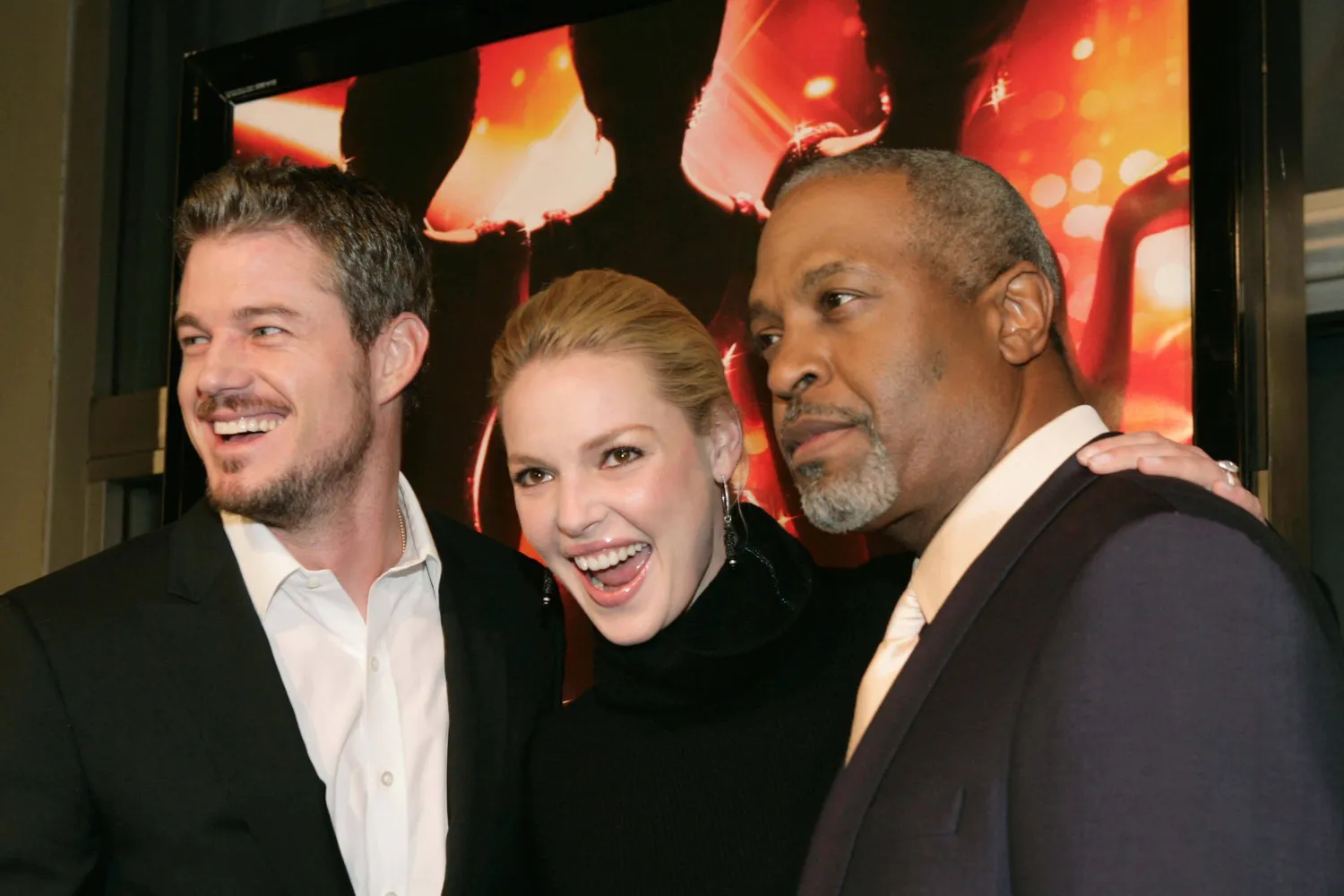
FILE - Actor Eric Dane, left, Katherine Heigl, center, and James Pickens Jr. from the show "Grey's Anatomy" arrive at the premiere of "Dreamgirls," in Beverly Hills, Calif., Dec. 11, 2006. (AP Photo/Matt Sayles, File)
TT

Eric Dane, who Played 'McSteamy' on 'Grey's Anatomy', Dies at 53

FILE - Actor Eric Dane, left, Katherine Heigl, center, and James Pickens Jr. from the show "Grey's Anatomy" arrive at the premiere of "Dreamgirls," in Beverly Hills, Calif., Dec. 11, 2006. (AP Photo/Matt Sayles, File)

Actor Eric ‌Dane, who played the handsome Dr. Mark Sloan on the hit television series "Grey's Anatomy," died on Thursday aged 53, his family said, less than a year after revealing that he suffered from amyotrophic lateral sclerosis, or ALS.

For 15 years, Dane played a plastic surgeon nicknamed "McSteamy" by female characters in the show. He also starred in the series "Euphoria," and said after the diagnosis he would still return to the set for ‌its third ‌season.

"Eric Dane passed on Thursday afternoon ‌following ⁠a courageous battle with ⁠ALS," his family said in a statement, according to People magazine and other media.

"He spent his final days surrounded by dear friends, his devoted wife, and his two beautiful daughters, Billie and Georgia, who were the center of his world."

ALS is a progressive ⁠disease in which a person’s brain ‌loses connection with the muscles. ‌It is also known as Lou Gehrig's disease after the ‌Hall of Fame baseball player who died from ‌it in 1941 at age 37.

"Throughout his journey with ALS, Eric became a passionate advocate for awareness and research, determined to make a difference for others facing the same ‌fight," Dane's family added, according to Reuters.

Dane and his wife, actor Rebecca Gayheart, the mother of their two ⁠children, ⁠separated in 2018 after 14 years of marriage.

But last March, just before Dane announced his diagnosis, Gayheart sought to dismiss her petition for divorce, People said, citing court documents.

Eric William Dane, the older of two brothers, was born on November 9, 1972, in San Francisco, to an architect father and homemaker mother, his biography on IMDB.com shows.

His first television role was in "The Wonder Years" in 1993, while 2005 brought his big break with "Grey's Anatomy." His big screen credits include "Marley & Me" and "X-Men: The Last Stand."