New York City's Freewheeling Era of Outdoor Dining Has Come to End

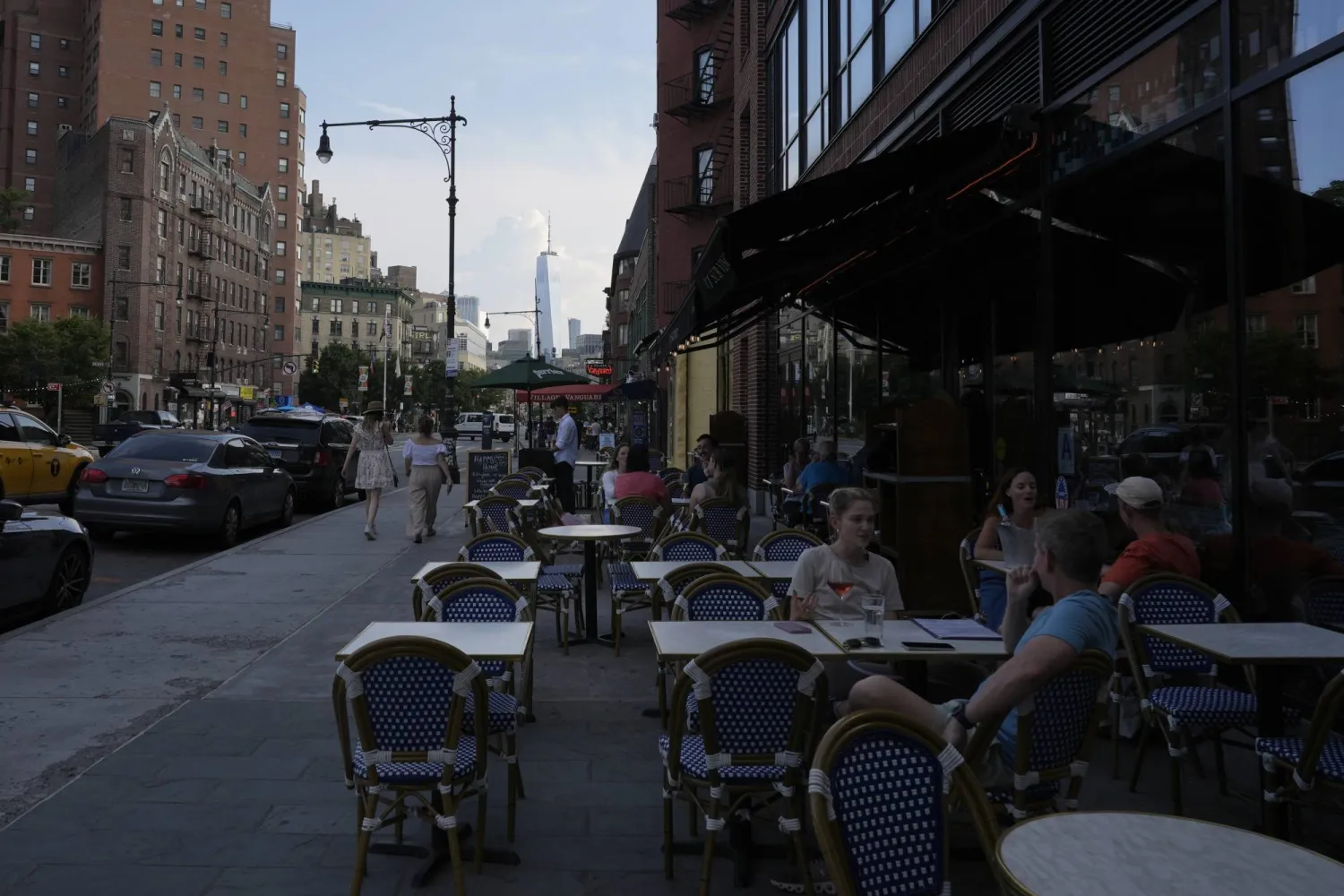
People eat outside a restaurant in New York, Wednesday, July 31, 2024. (AP Photo/Pamela Smith)
TT

New York City's Freewheeling Era of Outdoor Dining Has Come to End

People eat outside a restaurant in New York, Wednesday, July 31, 2024. (AP Photo/Pamela Smith)

Outdoor tables saved thousands of New York City restaurants from ruin when they were forced to close their dining rooms during the COVID-19 pandemic.
But four years into an experiment that transformed New York’s streetscape — briefly giving it a sidewalk cafe scene as vibrant as Paris or Buenos Aires — the freewheeling era of outdoor dining has come to an end.
Over the weekend, restaurants hit a deadline to choose between abiding by a strict set of regulations for their alfresco setups or dismantling them entirely — and thousands chose to tear down the plywood dining structures that sprouted on roadways in the pandemic's early days.
Fewer than 3,000 restaurants have applied for roadway or sidewalk seats under the new system, a fraction of the 13,000 establishments that participated in the temporary Open Restaurants program since 2020, according to city data.
Mayor Eric Adams said the new guidelines address complaints that the sheds had become magnets for rats and disorder, while creating a straightforward application process that will expand access to permanent outdoor dining.
But many restaurant owners say the rules will have the opposite effect, dooming a vestige of the pandemic that gave them unusual freedom to turn parking spaces into rent-free extensions of their dining rooms with minimal red-tape.
“They’ve found a middle ground to do one thing while saying another thing,” said Patrick Cournot, the co-founder of Ruffian, a Manhattan wine bar. “They’ve managed us out, essentially.”
Ramshackle plywood dining structures seemed to sprout from New York City’s streets almost overnight in the early days of the COVID pandemic.
With its crowded sidewalks and traffic-choked streets, the city had never really been known previously for an outdoor dining scene. But with customers banned from congregating indoors for months, the city gave restaurants a green light to expand dining areas onto public sidewalks and roadways.
Simple sheds for outdoor seating were soon replaced or expanded into more elaborate constructions, which have remained standing long after the days of social distancing and disinfected groceries. Restaurants added planters, twinkling lights, flowers and heating lamps so people could dine outdoors well into the cold weather. Other outside dining spaces appeared inside heated igloos, or with open fire places and under tiered rooftops.
Now, these structures must conform to uniform design standards, with licensing and square footage fees that could total thousands of dollars a year, depending on size and location.
But the most significant change, according to many restaurants, is a requirement that the roadside sheds be taken down between December and April each year.
That's a deal-breaker for Blend, a Latin Fusion restaurant in Queens that once won an Alfresco Award for its “exemplary” outdoor set-up.
“I understand they want to keep it consistent and whatever else, but it’s just too much work to have to take it down every winter,” said manager Nicholas Hyde. “We’re not architects. We’re restaurant managers.”
Blend's 60 outdoor seats “kept us alive” during the pandemic and remained well-used with diners who “since COVID just want to be able to enjoy themselves outside,” Hyde said. But after looking over the application, they decided to remove the curbside structure, opting instead to apply for sidewalk seating that can remain year-round.
Of the 2,592 restaurants that have applied for the new program, roughly half will forgo roadway set-ups in favor of sidewalk-only seating, according to the city.
Karen Jackson, a teacher, was going to lunch indoors Tuesday at Gee Whiz diner in Tribeca, one of the restaurants that took its outdoor shed down ahead of the deadline.
Jackson said she has mixed feelings, recalling how having coffee outside in a shed was one of the few entertainment options available early in the pandemic, The Associated Press reported.
“Some of them were really cute,” but others were unattractive and rat-infested, Jackson said.
“Unfortunately I think the places with more money were able to build the cute sheds and the places that were struggling couldn’t,” she said.
Andrew Riggie, the executive director of the NYC Hospitality Alliance, said the city should examine why so few eligible restaurants have applied, and consider how costly it will be to take down, store and rebuild the structures each year.
Applications for roadway dining structures must also undergo a review from local community boards, where some of the fiercest debates over outdoor dining have played out. Opponents have complained that the sheds eliminate parking, contribute to excessive noise and attract vermin.
On the Lower East Side, a row of sheds owned by a sushi counter, a coffee shop, a Mexican eatery and a Filipino restaurant stand side-by-side.
Paola Martinez, a manager at Barrio Chino, the Mexican restaurant, acknowledged the trash headaches and neighborhood conflict — on one particularly busy night, an angry neighbor hurled glass at the structure from an upstairs window, she said. But her restaurant has applied to stay in the roadway.
“It attracts a lot more people to the area,” she said. “It’s been great for business.”
City officials say restaurants who missed the deadline are welcome to apply in the future, while those that haven't will soon be fined $1,000 each day their set-ups remain.
Watching contractors take a crowbar to his once-vibrant dining shed, Cournot described a sense of relief. He said the sheds had come to symbolize an incredibly challenging period when a coworker died from the virus and a drop in sales nearly ended his East Village wine bar.
“When people say it’s the end of an era, I think it’s the end of a uniquely awful era for restaurants in New York,” Cournet said. “Like going through any kind of extended group trauma, the positives that we feel collectively are a little bit of a mirage.”



Taylor Swift Bags Best-selling Artist of 2025 Award

FILE PHOTO: Taylor Swift poses at the red carpet during the 67th Annual Grammy Awards in Los Angeles, California, US, February 2, 2025. REUTERS/Daniel Cole/File Photo
TT

Taylor Swift Bags Best-selling Artist of 2025 Award

FILE PHOTO: Taylor Swift poses at the red carpet during the 67th Annual Grammy Awards in Los Angeles, California, US, February 2, 2025. REUTERS/Daniel Cole/File Photo

US pop star Taylor Swift was crowned the biggest-selling global artist of 2025, industry body IFPI announced Wednesday, the fourth consecutive year and sixth time she has claimed its annual prize.

The 36-year-old's success was turbo-charged by the October release of her latest album, "The Life of a Showgirl", which set several streaming records, as well as the release of a docuseries about her record-breaking The Eras tour.

"2025 was another landmark year (for Swift), driven by exceptional worldwide engagement across streaming, physical and digital formats with the release of her 12th album ... and the documentary of her tour," IFPI said.

The body, which represents the recorded music industry worldwide, noted Swift had now won its top annual artist prize as many times as all other artists combined over the past 10 years, AFP.

IFPI hands out the Global Artist of the Year Award after calculating an artist's or group's worldwide sales across streaming, downloads and physical music formats during the calendar year and covers their entire body of work.

Swift beat out Korean group Stray Kids, which came in second -- its highest-ever ranking and the third consecutive year in the global top five.

Fresh from his Super Bowl halftime show, Puerto Rican artist Bad Bunny placed fifth in the rankings, his sixth consecutive year in the chart.

American rapper Tyler, The Creator marked his first appearance on the chart, in 12th place, with IFPI noting he had "continued to generate strong vinyl sales across his catalogue".

Meanwhile Japanese rock band Mrs. Green Apple entered the rankings for the first time one place below him, following what IFPI called "the success of their anniversary album '10'".


Berlin Film Festival Rejects Accusation of Censorship on Gaza

Berlinale Festival Director Tricia Tuttle speaks during the Berlinale Camera award ceremony honoring British composer Max Richter during the 76th Berlin International Film Festival, in Berlin, Germany, 18 February 2026. (EPA)
TT

Berlin Film Festival Rejects Accusation of Censorship on Gaza

Berlinale Festival Director Tricia Tuttle speaks during the Berlinale Camera award ceremony honoring British composer Max Richter during the 76th Berlin International Film Festival, in Berlin, Germany, 18 February 2026. (EPA)

The director of the Berlin Film Festival on Wednesday rejected accusations from more than 80 film industry figures that the festival had helped censor artists who oppose Israel's actions in Gaza.

In an open letter published on Tuesday, Oscar-winning actors Javier Bardem and Tilda Swinton were among dozens who criticized the Berlinale's "silence" on the issue and said they were "dismayed" at its "involvement in censoring artists who oppose Israel's ongoing genocide against Palestinians in Gaza".

In an interview with Screen Daily, the Berlinale's director, Tricia Tuttle, said the festival backs "free speech within the bounds of German law".

She said she recognized that the letter came from "the depth of anger and frustration about the suffering of people in Gaza".

However, she rejected accusations of censorship, saying that the letter contained "misinformation" and "inaccurate claims about the Berlinale" made without evidence or anonymously.

The row over Gaza has dogged this year's edition of the festival since jury president Wim Wenders answered a question on the conflict by saying: "We cannot really enter the field of politics."

The comments prompted award-winning novelist Arundhati Roy, who had been due to present a restored version of a film she wrote, to withdraw from the festival.

Tuttle said the festival represents "lots of people who have different views, including lots of people who live in Germany who want a more complex understanding of Israel's positionality than maybe the rest of the world has right now".

German politicians have been largely supportive of Israel as Germany seeks to atone for the legacy of the Holocaust.

However, German public opinion has been more critical of Israeli actions in Gaza.

Commenting on the row to the Welt TV channel, German Culture Minister Wolfram Weimer defended Wenders and Tuttle from criticism, saying they were running the festival "in a very balanced way, very sensitively".

"Artists should not be told what to do when it comes to politics. The Berlinale is not an NGO with a camera and directors," Weimer said.

Gaza has frequently been a topic of controversy at the Berlinale in recent years.

In 2024, the festival's documentary award went to "No Other Land", which follows the dispossession of Palestinian communities in the Israeli-occupied West Bank.

German government officials criticized "one-sided" remarks about Gaza by the directors of that film and others at that year's awards ceremony.


Over 80 Berlin Film Festival Alumni Sign Open Letter Urging Organizers to Take Stance on Gaza 

12 February 2026, Berlin: President of the Berlinale jury Wim Wenders waves to the audience on the opening night of the 76th Berlin International Film Festival, before the premiere of the opening film "No Good Men" at the Berlinale Palast. (dpa)
TT

Over 80 Berlin Film Festival Alumni Sign Open Letter Urging Organizers to Take Stance on Gaza 

12 February 2026, Berlin: President of the Berlinale jury Wim Wenders waves to the audience on the opening night of the 76th Berlin International Film Festival, before the premiere of the opening film "No Good Men" at the Berlinale Palast. (dpa)

More than 80 actors, directors and other ‌artists who have taken part in the Berlin Film Festival, including Tilda Swinton and Javier Bardem, signed an open letter to the organizers published on Tuesday calling for them to take a clear stance on Israel's war in Gaza.

"We call on the Berlinale to fulfil its moral duty and clearly state its opposition to Israel's genocide, crimes against humanity and war crimes against Palestinians," said the open letter, which was published in full in entertainment industry magazine Variety.

Multiple human rights experts, scholars and a UN inquiry say Israel's assault on Gaza amounts to genocide. Israel calls its actions self-defense after Hamas' October 2023 attack on Israel.

"We are appalled by Berlinale's institutional silence," ‌said the letter, which ‌was also signed by actors Adam McKay, Alia Shawkat and ‌Brian ⁠Cox, and director ⁠Mike Leigh.

It said organizers had not met demands to issue a statement affirming Palestinians' right to life and committing to uphold artists' right to speak out on the issue.

"This is the least it can - and should - do," the letter said.

The festival did not immediately respond to an emailed request for comment.

THE MOST POLITICAL FESTIVAL

The Berlin Film Festival is considered the most political of its peers, Venice and Cannes, and ⁠prides itself on showing cinema from under-represented communities and young ‌talent. However, it has been repeatedly criticized by pro-Palestinian activists ‌for not taking a stand on Gaza, in contrast to the war in Ukraine ‌and the situation in Iran.

Calls have also previously been made for the ‌entertainment industry to take a stance on Gaza.

Last year, over 5,000 actors, entertainers, and producers, including some Hollywood stars, signed a pledge to not work with Israeli film institutions that they saw as being complicit in the abuse of Palestinians by Israel.

Paramount studio later condemned that ‌pledge and said it did not agree with such efforts.

ROY PULLS OUT

Tuesday's letter also condemned statements by this year's ⁠jury president, German director ⁠Wim Wenders, that filmmakers should stay out of politics, writing: "You cannot separate one from the other."

Wenders' comments prompted Indian novelist Arundhati Roy, winner of the Booker Prize in 1997 for her novel "The God of Small Things", to pull out of the festival earlier this week.

Roy, who had been due to present "In Which Annie Gives It Those Ones", a 1989 film which she wrote, in the Berlinale's Classics section, characterized Wenders' comments as "unconscionable."

In response, festival director Tricia Tuttle issued a note on Saturday defending artists' decision not to comment on political issues.

"People have called for free speech at the Berlinale. Free speech is happening at the Berlinale," she said.

"But increasingly, filmmakers are expected to answer any question put to them," she wrote, and are criticized if they do not answer, or answer "and we do not like what they say."