


Voice Actors Push Back as AI Threatens Dubbing Industry 

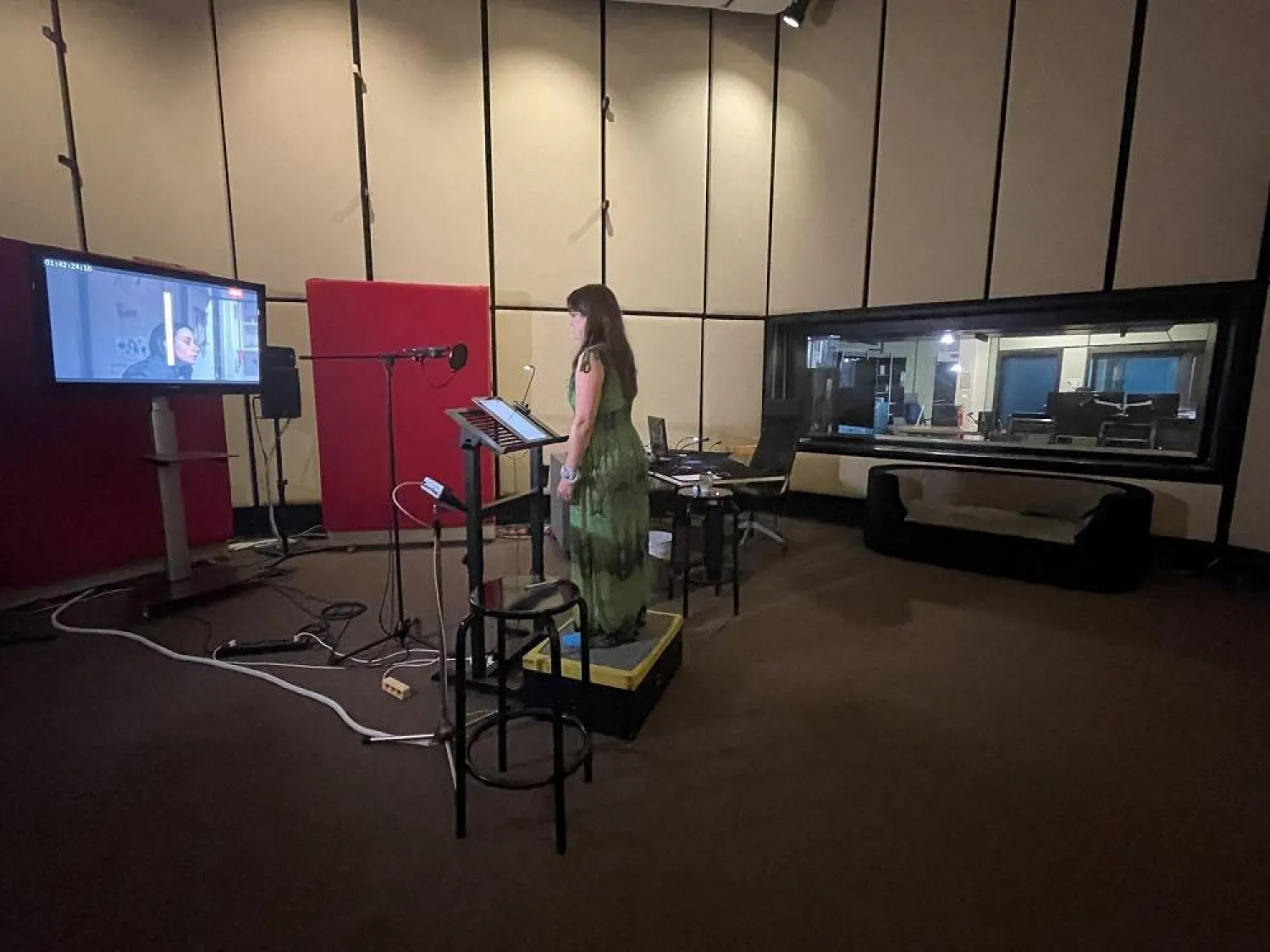
Synchronous speaker Bettina Zech stands in a dubbing studio in Munich, July 2, 2025. (Reuters) 
TT

Voice Actors Push Back as AI Threatens Dubbing Industry 

Synchronous speaker Bettina Zech stands in a dubbing studio in Munich, July 2, 2025. (Reuters) 

Boris Rehlinger may not turn heads on the streets of Paris, but his voice is instantly recognizable to millions of French filmgoers.

As the French voice of Ben Affleck, Joaquin Phoenix, and even Puss in Boots, Rehlinger is a star behind the scenes — and now he is fighting to keep his craft alive in the age of AI.

"I feel threatened even though my voice hasn't been replaced by AI yet," the actor, who is part of a French initiative, TouchePasMaVF, to protect human-created dubbing from artificial intelligence, told Reuters.

He said there was a team of professionals, including actors, translators, production directors, dialogue adapters and sound engineers, to ensure audiences barely notice that the actor on screen is speaking a different language than they hear.

The rise of global streaming platforms such as Netflix, which relies heavily on dubbing to make global hits such as "Squid Game" and "Lupin", has amplified demand.

Consumer research firm GWI says 43% of viewers in Germany, France, Italy and Britain prefer dubbed content over subtitles.

The market is expected to grow to $4.3 billion in 2025, reaching $7.6 billion by 2033, according to Business Research Insights.

That growth could also amplify demand for the so-far nascent technology-based solutions, with platforms competing for subscribers and revenue, and seeking to win over advertisers from their rivals by emphasizing their increasing reach.

But as AI-generated voices become more sophisticated and cost-effective, voice actor industry associations across Europe are calling on the EU to tighten regulations to protect quality, jobs and artists' back catalogues from being used to create future dubbed work.

"We need legislation: Just as after the car, which replaced the horse-drawn carriage, we need a highway code," Rehlinger said.

Worries over technology in the movie industry and whether it will replace the work of humans are not new. AI has been a flashpoint in Hollywood since the labor unrest of 2023, which resulted in new guidelines for the use of the technology.

Netflix co-CEO Ted Sarandos said this month that the company used generative AI to produce visual effects for the first time on screen in the original series "El Eternauta (The Eternaut)".

It has also tested GenAI to synchronize actors' lip movements with dubbed dialogue to improve the viewing experience, according to three sources familiar with the work.

These experiments rely on local voice actors to deliver the lines, rather than use AI to synthetically translate the on-screen performer's voice into another language.

Such a use of AI for dubbing is permitted under the new SAG-AFTRA actors' union contract, which covers voice-over dubbing from foreign languages into English. It also requires that the actor rendering the dubbing service be paid.

Netflix declined to comment on its use of AI in dubbing when asked by Reuters.

INTELLECTUAL PROPERTY

Such test-runs by an industry giant will do little to allay the fears of dubbing actors.

In Germany, 12 well-known dubbing actors went viral on TikTok in March, garnering 8.7 million views, for their campaign saying: "Let's protect artistic, not artificial, intelligence".

A petition from the VDS voice actors' association calling on German and EU lawmakers to push AI companies to obtain explicit consent when training the technology on artists' voices and fairly compensate them, as well as transparently label AI-generated content, gained more than 75,500 signatures.

When intellectual property is no longer protected, no one will produce anything anymore "because they think 'tomorrow it will be stolen from me anyway'," said Cedric Cavatore, a VDS member who has dubbed films and video games including the PlayStation game "Final Fantasy VII Remake".

VDS collaborates with United Voice Artists, a global network of over 20,000 voice actors advocating for ethical AI use and fair contracts.

In the United States, Hollywood video game voice and motion capture actors this month signed a new contract with video game studios focused on AI that SAG-AFTRA said represented important progress on protections against the tech.

STUDIOS EXPERIMENT

Some studios are already cautiously exploring AI.

Eberhard Weckerle, managing director of the Neue Tonfilm Muenchen studio, hopes AI and human dubbing can one day coexist.

"The fear is that AI will be used to make something as cheap as possible and then people will say, 'Okay, I'll accept that I'll have poorer quality'. And that would actually be the worst thing that could happen to us," said the sound engineer whose studio worked on the German version of "Conclave" and is currently dubbing Guy Ritchie's new film.

Earlier this year, the German-dubbed version of streaming service Viaplay's Polish crime series "Murderesses" was removed after criticism from viewers about the monotony of its AI-generated dialogue.

The streamer had decided to look into alternative dubbing options due to how prohibitively expensive going through the traditional channels can be in Germany.

The hybrid dubbing, created with Israeli startup DeepDub, used a mix of human and AI voices. DeepDub did not respond to an emailed request for comment.

"We'll continue offering subtitles and reserve dubbing for select content," said Vanda Rapti, the executive vice president of ViaPlay Group, ViaPlay Select & Content distribution.

Despite the disquiet over that series, other potential viewers seem more sanguine. According to GWI, nearly half of viewers said their opinion would not change if they learned that the content they liked was generated by AI.

Some 25% said they would like it slightly less, and only 3% said they would like it much more.

'INTEREST IS HUGE'

Stefan Sporn, CEO of Audio Innovation Lab, which used AI to dub the Cannes Film Festival entry "Black Dog" from Chinese to German, believes AI will reshape, but not replace, voice work.

Humans will always be needed for emotion, scripting, and language nuance, he said, "just not to the same extent".

Audio Innovation Lab's technology alters the original actor's voice to match the target language, aiming for authenticity and efficiency.

"Interest is huge," said Sporn, adding that producers, studios and advertisers all want to know how well it works.

Another startup, Flawless AI, bills itself as an ethical AI company that works with local voice actors and uses its technology to match the on-screen actor's lip movements to the different languages.

"When AI technologies are used in the right way, they are a silver bullet to change how we can film-make in a new way," co-CEO Scott Mann said.



Labubu Creators Hope for Monster Film Hit in Sony Co-production

FILE PHOTO: Toys are displayed at at Pop Mart's Skullpanda pop-up shop in Manhattan, in New York City, US, December 12, 2025. REUTERS/Mike Segar/File Photo
TT

Labubu Creators Hope for Monster Film Hit in Sony Co-production

FILE PHOTO: Toys are displayed at at Pop Mart's Skullpanda pop-up shop in Manhattan, in New York City, US, December 12, 2025. REUTERS/Mike Segar/File Photo

China's snaggle-toothed Labubu dolls will soon come alive on the big screen after flying off the toy shelves, with maker Pop Mart announcing a collaboration with Sony Pictures.

The movie, which is still in early development, will feature the fanged plushie monsters in a "live-action and CGI hybrid", Beijing-based Pop Mart said on Thursday.

Created in 2015 by Hong Kong artist Kasing Lung, Labubus sparked a craze nine years later, with the "ugly-cute" charms adorning the handbags of celebrities such as Rihanna and Dua Lipa and sparking massive queues at Pop Mart stores around the world.

Vivian Jia, a Canadian tourist visiting Pop Mart's flagship Shanghai flagship store, said she was looking forward to watching the Labubu movie with her children.

"I think they're so cute, especially the ones with the eyes that move... my friends' kids all like (Labubus) too," she told AFP.

Jia said she spent more than 400 yuan ($58) on a Labubu figure, which she said she planned to display in her living room in Vancouver.

The new film project, unveiled by Lung and director Paul King ("Wonka" and "Paddington") in Paris on Thursday, will seek to capitalize on the dolls' viral fame by bringing "Labubu's whimsical world to the big screen", Pop Mart said.

The collectable dolls, which typically sell for around $40, are released in limited quantities and sold in "blind boxes", meaning buyers do not know the exact model they will receive.

Some of the less common Labubu figures can fetch thousands of dollars.

Pop Mart sold more than 100 million Labubu dolls worldwide last year, with Chinese officials hailing the toothy characters' popularity as evidence of China's growing cultural and soft power.

They have become furry ambassadors for a "cool" China, even in places such as Europe and North America, where public opinion towards Beijing has not always been positive.

Camilla Pinheiro, a Brazilian Pop Mart fan who bought several dolls at the Shanghai store, said she would prefer a movie franchise about some of Pop Mart's less well-known toy lines, such as the punk-inspired Peach Riot figures.

"The whole (Labubu) fever, it was kind of intense... by the time they finish the movie, it will be so saturated," Pinheiro said.

King will share scriptwriting duties with Tony Award-winner Steven Levenson.

"The collaboration between Pop Mart and Sony Pictures marks a significant milestone," Pop Mart said, which promises "a unique cinematic experience with creative storytelling, artistic vision and enduring global appeal".

The company now has more than 600 stores in over 30 countries and regions.

A release date for the film has not yet been announced.


Tina Turner’s Name, Image, Likeness and Most Music Catalog Rights Acquired by Pophouse

Tina Turner is shown during an interview in New York on Sept. 14, 1984. (AP)
TT

Tina Turner’s Name, Image, Likeness and Most Music Catalog Rights Acquired by Pophouse

Tina Turner is shown during an interview in New York on Sept. 14, 1984. (AP)

Pophouse Entertainment has acquired Tina Turner’s name, image and likeness rights as well as the majority share of her music catalog rights from music company BMG, it announced Thursday.

The Swedish company, co-founded by ABBA’s Björn Ulvaeus, is known for their digital avatars and immersive experiences.

Pophouse CEO Jessica Koravos would not disclose the deal's financial details or describe the company's plans for the Turner acquisition but told The Associated Press “that one of the reasons that we were so interested in Tina is because she has such an incredible visual presence and such an incredible stage energy. And so, we’re very much looking at projects that can portray that and try to recreate that to some degree.”

“What we want to do is really help to consolidate her legacy,” she added. “I think that Tina Turner is up there, or is going to be up there, with the Elvises and the Marilyn Monroes of the world.”

Koravos would not confirm if a digital avatar is on the way. She did say Pophouse will announce plans in the next six months.

Turner, known as the “Queen of Rock ’n’ Roll” for her chart-topping hits such as “What’s Love Got to Do With It,” “The Best” and “Proud Mary,” died in 2023 at 83. Across her multidecade career, Turner won 12 Grammy Awards — including a Lifetime Achievement Award — was inducted into the Rock & Roll Hall of Fame in 1991 and 2021, was honored at the Kennedy Center in 2005 and sold over 150 million records worldwide.

Conversations for the Pophouse deal began after her death. Koravos told the AP that BMG still holds a percentage of her catalog. She said Turner's estate was not involved “as a counterparty but certainly involved and in the sense of informed and participating in the conversations.”

“Tina Turner’s voice and spirit shaped modern music and popular culture,” Alistair Norbury, president of BMG UK, Continental Europe and APAC, wrote in a statement. “Our responsibility, alongside Pophouse and the Estate, is to ensure her work continues to resonate with audiences around the world, while remaining true to the strength, independence and originality that defined her career.”

One of many musical investments Pophouse has been making investments outside of Sweden as of late. In 2024, hard rock quartet Kiss sold their catalog, brand name and intellectual property to Pophouse in a deal estimated to be over $300 million. Previously, the band partnered with Pophouse to develop digitized avatars of themselves, which they revealed onstage at the final night of their 2023 farewell tour.

The cutting-edge technology was created by George Lucas’ special-effects company, Industrial Light & Magic, in partnership with Pophouse. The same companies teamed up for the “ABBA Voyage” show in London, where fans could attend a full concert by the Swedish band in their heyday, as performed by their own digital avatars.

Also in 2024, Cyndi Lauper entered a partnership with Pophouse, which included the sale of the majority share of her music.

“Most suits, when you tell them an idea, their eyes glaze over, they just want your greatest hits,” Lauper told the AP at Pophouse's Stockholm headquarters at the time. “But these guys are a multimedia company, they’re not looking to just buy my catalog, they want to make something new.”

“I think what interests artists, and the estates of artists in some cases, is that there aren’t very many people who are talking to them about what they want to achieve, creatively, around their body of work,” Koravos says. “So I think that is interesting to people, it's interesting to artists, who have got creative projects in their heads that they would like some support realizing. And those are the people we’re interested in talking to.”

“We’re not trying to be a major (label),” she adds. “It’s not a volume game for us. We want to acquire 10 or 12 really unique properties that have even more unique projects attached to them.”


Director Plans to Put Val Kilmer Back on Screen Thanks to AI

A director says Val Kilmer authorized using AI to have him 'act' in a movie after his death. JIM WATSON / AFP
TT

Director Plans to Put Val Kilmer Back on Screen Thanks to AI

A director says Val Kilmer authorized using AI to have him 'act' in a movie after his death. JIM WATSON / AFP

The late American film star Val Kilmer could soon be "acting" on the big screen again after allowing a director to use AI tools to produce his likeness for an upcoming film, media reports said Wednesday.

Coerte Voorhees had tapped Kilmer, who died of pneumonia last year after years of battling throat cancer, for "As Deep as the Grave," about the pioneering archaeologist Ann Morris, a co-discoverer of the Anasazi civilization.

Kilmer was to play a Catholic priest named Fintan, said AFP.

"He was the actor I wanted to play this role," Voorhees told industry magazine Variety. "It drew on his Native American heritage and his ties to and love of the Southwest."

He said Kilmer signed on to the project but later became too ill to begin filming.

"I was looking at a call sheet the other day, and we had him ready to shoot," Voorhees said. "He was just going through a really, really tough time medically, and he couldn't do it."

He said Kilmer's family had provided video images of Kilmer, who was known for keeping a vast archive of footage from various moments of his life, that would be used to build the AI actor.

The project will likely get a wary welcome from many in Hollywood, where actors, writers and others are worried that AI could replace an array of jobs.

AI was already used with Kilmer so he could again play one of his most iconic roles, the cocky pilot Iceman, in the 2022 sequel to the era-defining 1980s hit "Top Gun."

Kilmer, who played in big-budget successes and indie films throughout his career, was one of the late actors praised during the In Memoriam segment of the Oscars ceremony on Sunday.