


Yemen Introduced the World to Coffee. Now, Its Coffeehouse Culture Is Booming in the US

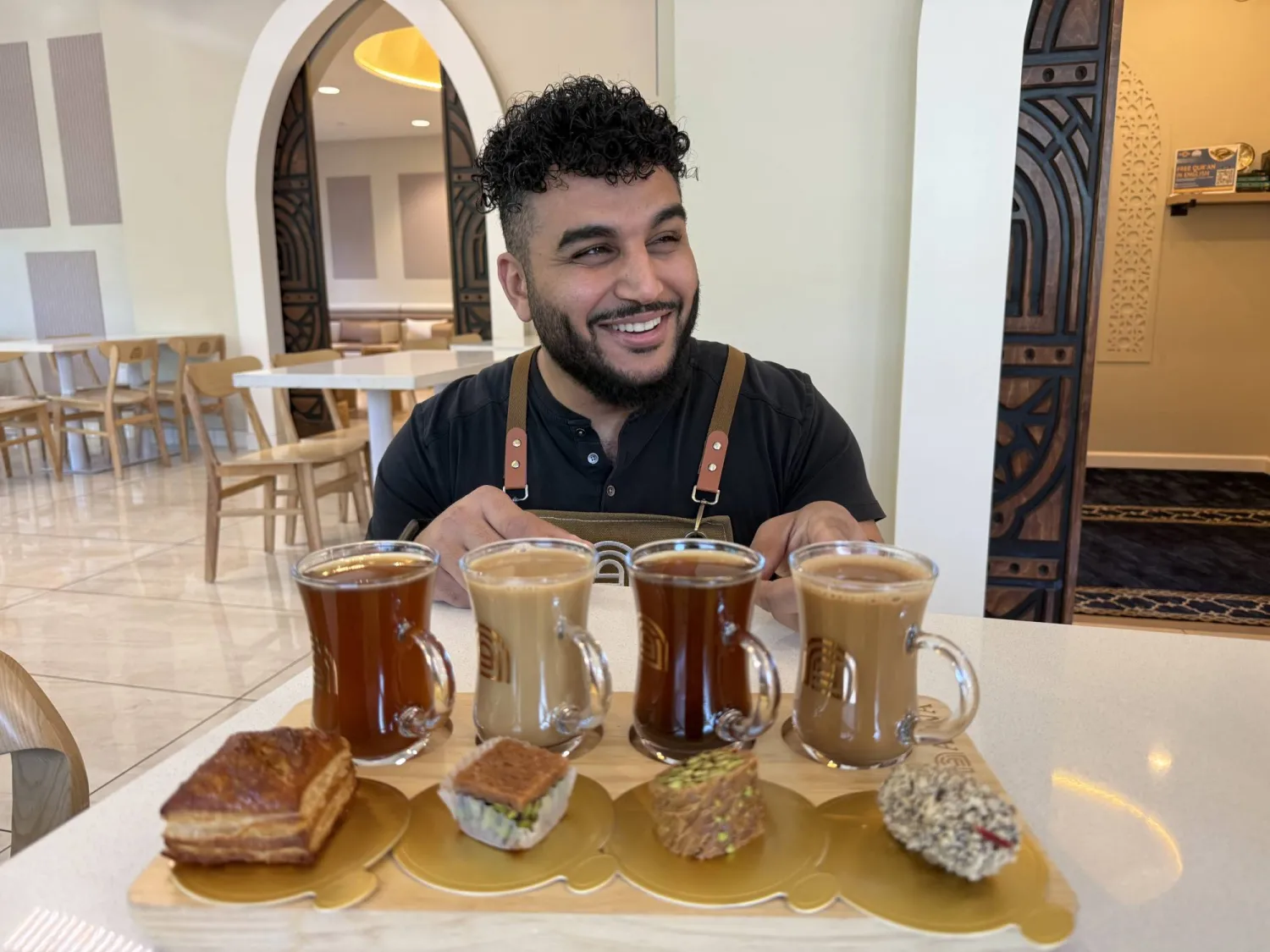
Franchisee Ahmad Badr serves a drink and treat sampler at Arwa Yemeni Coffee on April 6, 2026, in Sunnyvale, Calif. (AP)
TT

Yemen Introduced the World to Coffee. Now, Its Coffeehouse Culture Is Booming in the US

Franchisee Ahmad Badr serves a drink and treat sampler at Arwa Yemeni Coffee on April 6, 2026, in Sunnyvale, Calif. (AP)

Hundreds of years ago, Yemen helped introduce the world to coffee. Lately, the mountainous, war-ravaged country that borders Saudi Arabia and Oman is exporting something else: its coffee culture.

Yemeni coffeehouses are opening at a rapid pace across the US. The number of cafes run by six major chains that serve Yemeni-style drinks grew 50% last year to 136, according to Technomic, a restaurant industry consulting company. The count doesn’t include the many smaller chains and independent cafes serving coffees and teas imported from Yemen.

Yemeni coffeehouses are meeting the moment for several reasons. They stay open late — sometimes past 3 a.m., especially during Ramadan — and provide a place to socialize for the growing number of Americans who don’t drink alcohol. Last year, a Gallup poll found that just 54% US adults reported drinking alcohol, the lowest percentage in 90 years.

“Generally in the Middle East, our nightlife is coffee, right? People hang out at coffee shops, they play cards, they talk. We wanted to bring that here,” said Ahmad Badr, who owns an Arwa Yemeni Coffee franchise in Sunnyvale, California.

Another reason for the cafes’ popularity is the growing number of Americans of Arab descent. Between 2010 and 2024, the Arab American population in the US rose by 43%, compared to around 10% growth for the US population as a whole, according to the Arab American Institute.

While most Yemeni coffee shops are in places with high concentrations of Arab Americans, including Michigan, California and Texas, they’re also opening in locations as diverse as Alpharetta, Georgia; Overland Park, Kansas; and Portland, Maine.
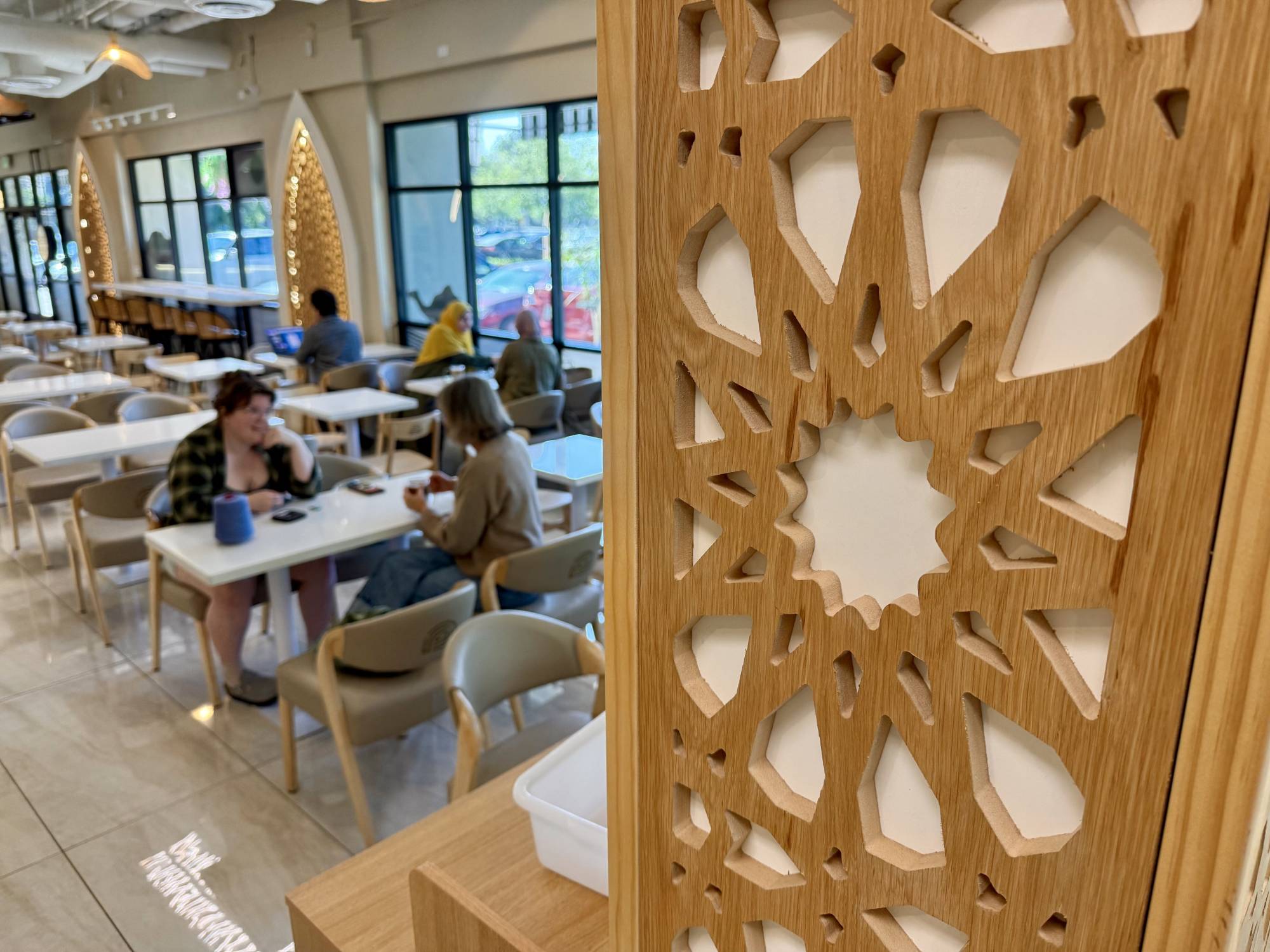
Customers are seen inside Arwa Yemeni Coffee on April 6, 2026, in Sunnyvale, Calif. (AP)

A taste of home

Faris Almatrahi is the co-founder and owner of Texas-based Arwa Yemeni Coffee, a chain with 11 cafes across the US and 30 more in development. He said an ongoing civil war in Yemen that began in 2014 has prevented Yemeni Americans like himself from visiting their homeland, so he has tried to evoke Yemen in his cafes.

Arwa locations are painted in natural desert tones, with archways that mimic mosques and lampshades shaped like the hats worn by Yemen’s coffee farmers.

“One of the ways to actually visit without traveling there was to bring that experience to the US, and that was a huge passion for us when we opened our first location,” Almatrahi said. “It was extremely emotional for all of us due to the fact that it really transported us to Yemen."

But Almatrahi noted that most of his customers aren’t of Arab descent. In fact, Americans of all backgrounds are seeking out new global flavors and authentic experiences, according to market research company Datassential. Food trends are also spreading quickly through social media.

Menus vary, but Yemeni cafes generally serve specialties like Adeni tea, a spiced tea similar to chai, and qishr, a traditional drink made from the dried husks of coffee cherries. Familiar drinks like lattes might contain special spices or honey; at Arwa, lattes features the outline of a camel stenciled in spices.

Bakery cases might contain khaliat nahal, or Yemeni honeycomb bread, a cheese-filled pastry drizzled with honey, or basboosa, a cake soaked in sugar syrup and often flavored with lemon or rose water. Many Yemeni menus also mix in more typical US coffeeshop fare, like matcha lattes or berry refreshers.
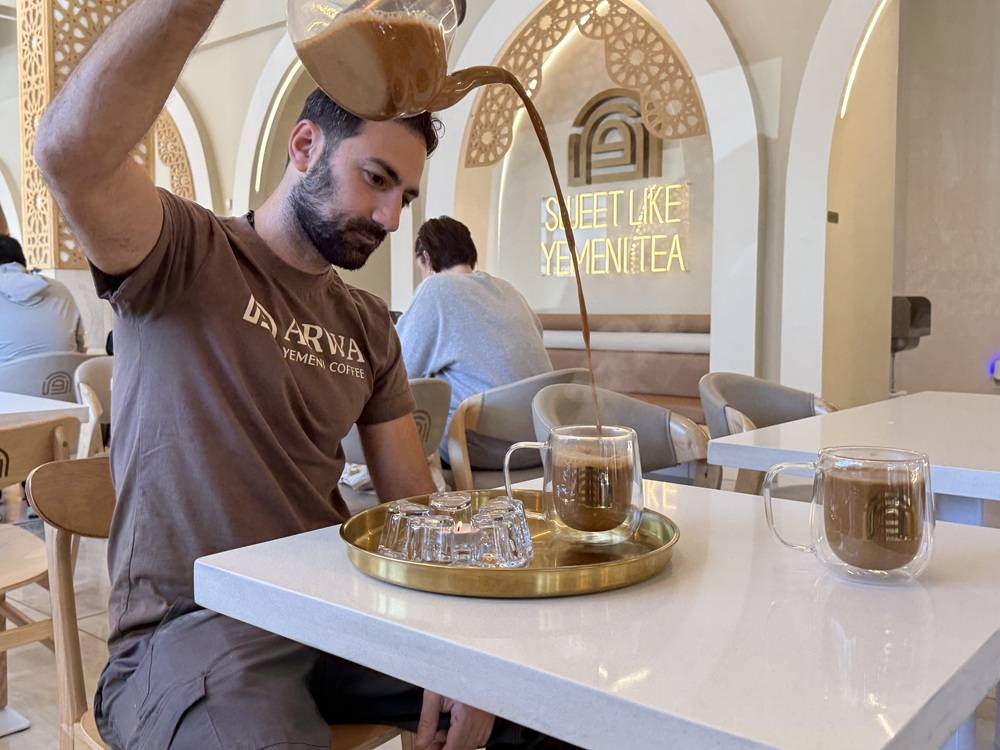
Franchisee Samir Irani pours Adeni tea inside Arwa Yemeni Coffee on April 6, 2026, in Sunnyvale, Calif. (AP)

Choices for coffee lovers

Peter Giuliano, a researcher with the Specialty Coffee Association, a California-based nonprofit, said culturally specific cafes have been a key growth driver in the US coffee industry for the last few years. In addition to Yemeni cafes, he cited the Latin-style chain Tierra Mia in California and Nguyen Coffee Supply, a New York-based company that roasts Vietnamese beans.

A customer who visited Badr's shop in Sunnyvale for the first time said an internet search brought her there on a recent weekday. Cindy Donovan said she’s always on the hunt for good coffee and was excited by Yemeni coffees she tried.

“I think they're much more refined and mellow, and much more full of flavor than a regular cup of dark roast, for instance,” Donovan said. “The cardamom in the drinks is fantastic. Very, very flavorful, rich but not heavy.”

Most Yemeni coffee is sun-dried, which enhances its flavor and brings out undertones of chocolate and fruit, Almatrahi said. Yemeni cafes often mix coffee with special spice mixes – or hawaij – that may contain cardamon, ginger, cinnamon, cloves, coriander or nutmeg.

“Our coffee and teas are not just made through a fully automatic machine,” said Mohamed Nasser, the director of operations for Haraz Coffee House, a Dearborn, Michigan-based chain with 50 US outlets and another 50 in development. “We have to manually blend and mix our coffee and tea, boil it with water and evaporated milk, make sure that it comes out (with the) perfect taste, perfect color.”

Yemen's flavorful history

Coffee has a long history in Yemen. While the plant was likely discovered in Ethiopia, by the 1400s it was being cultivated in Yemen, where monks brewed it to stay awake during prayers, according to the National Coffee Association, a US trade group.

Yemen monopolized the coffee trade for around 200 years until Dutch merchants smuggled coffee seeds to Indonesia and began growing plants there.

Almatrahi said a revitalization of the Yemeni coffee industry over the last two decades, led by coffee companies, foundations and young entrepreneurs, helped make the current US boom possible.

Coffee is one of the most promising sectors for economic development in Yemen, where more than 80% of the population lives in poverty, according to the Food and Agriculture Organization of the United Nations.

“We are ambassadors for our culture and our people. So when we open these shops, we want to perform the outreach, to show the hospitality, to show what we have to offer,” Almatrahi said.




Private Museums Bolster Cultural Tourism in Qassim Region

A prominent example is the private museum of Abdullah Al-Suhaibani, an expert with over 40 years of experience in gemstones and minerals - SPA
TT

Private Museums Bolster Cultural Tourism in Qassim Region

A prominent example is the private museum of Abdullah Al-Suhaibani, an expert with over 40 years of experience in gemstones and minerals - SPA

Qassim Region is witnessing a significant rise in private museums, as individual collectors transform personal passions into vital cultural projects. These museums serve as a living memory for the community, preserving rare artifacts, historical documents, antique weapons, and vintage collections that document critical stages of the region's history. By connecting the present with its roots, these sites strengthen national identity and provide essential research resources for scholars and tourists alike, SPA reported.

A prominent example is the private museum of Abdullah Al-Suhaibani, an expert with over 40 years of experience in gemstones and minerals.

His collection features rare agates, fossils from ancient geological eras, and unique rock formations discovered throughout the Kingdom.

The museum acts as a scientific platform, promoting geology and field research while educating the community on the Kingdom’s diverse natural resources and mineral wealth.

Located near Al-Khabra Historical Village, these private initiatives have become key cultural landmarks in Riyadh Al-Khabra Governorate. Their growth aligns with Saudi Vision 2030 goals to develop cultural and scientific tourism, support local content, and position the Kingdom’s heritage and natural sites as premier global destinations.


Saudi Arabia Showcases Literary Diversity at 2026 Rabat International Book Fair

‏The Saudi pavilion brings together a range of government entities and cultural institutions - SPA
TT

Saudi Arabia Showcases Literary Diversity at 2026 Rabat International Book Fair

‏The Saudi pavilion brings together a range of government entities and cultural institutions - SPA

The Literature, Publishing and Translation Commission launched the Saudi pavilion at the 2026 International Publishing and Book Fair in Rabat, which continues through May 10.

‏Commission CEO Dr. Abdullatif Alwasel affirmed that the Kingdom’s participation in the event embodies the deep historical ties between Saudi Arabia and Morocco while showcasing a diverse, contemporary cultural movement driven by Saudi Vision 2030.

“Saudi Arabia’s participation at the 2026 International Publishing and Book Fair emphasizes the Kingdom’s commitment to spotlighting publishers and the creative literary sector, which continues to go from strength to strength,” Alwasel said, SPA reported.

‏He added: “The Saudi pavilion is an opportunity to invite people from every corner of the world to experience Saudi culture and diverse literary works, showcase unique Saudi talent and creative thinking, while facilitating cultural exchange and engaging discussions.”

‏The Saudi pavilion brings together a range of government entities and cultural institutions, led by the Literature, Publishing and Translation Commission, highlighting the integrated approach of the Kingdom’s cultural environment.

‏As part of the pavilion, the commission has organized a series of topical panel discussions, poetry evenings, and workshops featuring Saudi writers and creative thinkers, encouraging discussions on key issues relating to the literature, publishing and translation sector and its impact on Arab and global conversations.

‏The participation at the 31st International Publishing and Book Fair event reaffirms the Kingdom’s efforts towards platforming local talent and enhancing collaboration and cultural exchange.


Georg Baselitz, the German Painter Who Turned Postwar Art Upside Down, Dies at 88

German artist Georg Baselitz attends the opening of his exhibition "The Heroes" (Die Helden) at the Staedel museum in Frankfurt, Germany June 29, 2016. (Reuters)
TT

Georg Baselitz, the German Painter Who Turned Postwar Art Upside Down, Dies at 88

German artist Georg Baselitz attends the opening of his exhibition "The Heroes" (Die Helden) at the Staedel museum in Frankfurt, Germany June 29, 2016. (Reuters)

Georg Baselitz liked to insist — sometimes as a taunt, ‌sometimes as a shield — that he did not know how to paint. That he had "no talent".

Rejected at 17 by the Dresden Academy of Fine Arts, he talked his way into an academy in East Berlin only to be expelled two semesters later for "sociopolitical immaturity".

"I was stupid," he recalled. "I was uneducated, but I was a rebel."

From that rebellion, Baselitz forged a career that made the child of Nazi Germany, schooled under Soviet communism, into one of the defining artists of postwar Germany.

The painter and sculptor, known for his depictions of raw bodies and inverted landscapes, has died at the age of 88, Germany's Die Welt newspaper reported on Thursday. No cause of death was given.

A REBEL SHAPED BY TWO DICTATORSHIPS

Georg Baselitz was born Hans-Georg Bruno Kern on January 23, 1938, in the Saxon village of Deutschbaselitz, a name he later adopted.

His father, a village schoolteacher and Nazi Party member, recorded Hans-Georg's birth in his diary. Inexplicably, he recorded the birth of none of his other four children, the Sächsische Zeitung daily reported in 2018.

After the war, ‌his father was ‌barred from teaching. Baselitz's mother took over his duties at the school.

Baselitz spent his childhood ‌amid ⁠the unforgiving discipline of ⁠Nazi Germany, and his adolescence amid the rubble and ideological re-education of the country's Soviet occupation zone.

"I was born into a destroyed order, a destroyed landscape, a destroyed people, a destroyed society," he later recalled. "And I didn't want to reestablish an order: I had seen enough of so-called order. I was forced to question everything, to be 'naive', to start again."

After he was expelled from the East Berlin academy, he moved to West Berlin, where he finished his studies and absorbed modernism in a way that felt, he said, like a sudden intake of oxygen.

He recalled the shock of first seeing works by Jackson Pollock and other abstract expressionists — evidence, in his telling, that ⁠the United States had a serious culture despite what he had been taught.

But rather than ‌imitate an American style, Baselitz turned back to German sources, drawing on expressionism, ‌folk traditions and imagery often dismissed by critics as ugly or even "degenerate".

SCANDAL AS A CALLING CARD

At a 1963 solo show in Berlin, authorities ‌seized two of his paintings on obscenity grounds. The episode made Baselitz famous.

The early pictures, marked by raw bodies, stunted masculinity and abrasive humor, were widely seen as provocation.

Supporters and museum curators have also framed them as a blunt report on postwar German life: damaged, compromised and struggling to find a new footing.

That sensibility carried into his mid-1960s "Heroes" paintings, which presented hulking, battered figures that looked less like victors than survivors ‌stumbling out of a defeated national myth.

But Baselitz's most recognizable works came in 1969, when he began painting motifs upside down.

After earlier experiments that fractured or partially inverted figures, he ⁠produced fully inverted works including "The ⁠Wood on Its Head" and "The Man by the Tree".

He did not simply flip finished images, he composed and painted them inverted from the start.

That approach altered how viewers read his works. By disrupting recognition, it forced attention onto the mechanics of painting — its color, balance and composition.

"An object painted upside down is suitable for painting because it is unsuitable as an object," Baselitz said.

The inversions made Baselitz an international figure in the 1970s and 1980s, as the market and institutions that once treated him as scandalous increasingly positioned him as a pillar of European postwar art.

His public reputation, however, did not settle into quiet respectability.

He repeatedly sparked backlash with remarks about female painters, including a widely reported claim that women "don't paint very well".

He also confronted the limits Germany's history places on gesture and imagery: a wooden sculpture shown at the 1980 Venice Biennale was widely read as evoking a Nazi salute, a reading he denied.

He was married to Johanna Elke Kretzschmar, known as Elke, with whom he had two sons.

In later life, Baselitz painted huge canvases from his wheelchair and moved his brushes and paints in a rolling cart.

"The sensible thing, in my situation, would naturally be to say: 'I stick to small formats'," he told Spanish newspaper El Pais at age 87. "But of course I don't do what's sensible. What's right for me is the nonsensical."