



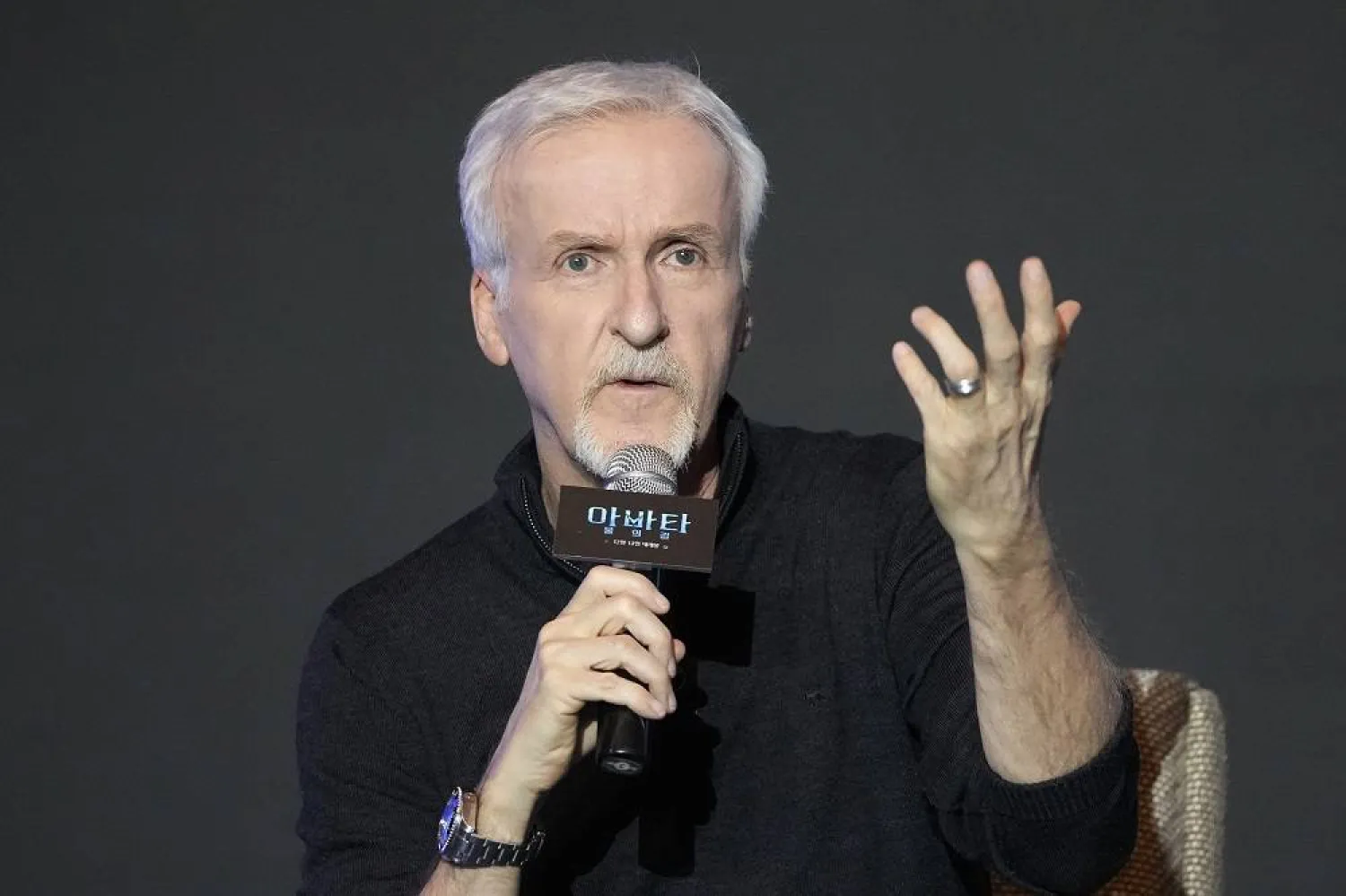

James Cameron recently turned 71 as he brought his third "Avatar" film, "Fire and Ash," to the finish line.
Cameron first began developing "Avatar" more than 30 years ago. He started working on the first film in earnest 20 years ago. Production on "Fire and Ash," which ran concurrently with 2022's "The Way of Water," got underway eight years ago.
By any measure, "Avatar" is one of the largest undertakings ever by a filmmaker. It's maybe the only project that could make "Titanic" look like a modest one-off. Cameron has dedicated a huge chunk of his life to it. Now, as he prepares to unveil the latest chapter of his Na'vi opus on Dec. 19, Cameron is approaching what he calls a crossroads.
"As you get older you start to think of time in a slightly different way," Cameron says from his 5,000-acre organic farm in New Zealand. "It’s not an infinite resource."
Two more "Avatar" films are already written and have release dates, in 2029 and 2031. Right now, though, Cameron is focused on completing "Fire and Ash," which is almost guaranteed to be the biggest movie of the fall. To get "Avatar" — a franchise already worth $5.2 billion in worldwide tickets sales — back in the minds of moviegoers, "The Way of Water" will also be rereleased Oct. 3.
"As I told the brass at Disney, we’re right at the glide slope to land right on time for delivery," Cameron says. "The first film was a nightmare. Movie two was hectic. But here, I keep having to pinch myself because it’s all going well. The film is strong."
There may be no filmmaker more at the nexus of past and future blockbuster making than Cameron. "Avatar: Fire and Ash" will arrive as Hollywood is reconciling itself to a new theatrical normal. In a movie industry of shrinking ambition, "Avatar," an original spectacle that once was the wave of the future, is already beginning to look like an endangered species.
In a recent interview, Cameron reflected on his history with "Avatar" and what's next for him, including a planned adaptation of Charles Pellegrino's "Ghosts of Hiroshima." For Cameron, most of his work is likely to touch on one of what he calls "the big three": Nuclear weapons, machine super intelligence and climate change.
"Avatar," a family saga that grows more complicated and darker in "Fire and Ash," relates to the latter. The films are environmental parables, set in a verdant faraway world. Sustainability, community, connection to nature — these are some of the pillars of Cameron's life right now, in the movies and outside them.
"I’m just a humble movie farmer," he says, smiling, "who’s also a farmer farmer."
AP: When you decided to embark on "Avatar," was it more likely that if you didn't, you'd spend your time mostly away from movies, doing deep sea exploration and other things?
CAMERON: It was sort of: Do the "Avatar" saga or follow my interests more. I knew that "Avatar" would be all-consuming, and it has been. When I set down that path, a reasonable projection was eight to 10 years to get it all written and do movie two and movie three together and get them out. But it’s actually turned out to be more than that. It was a major commitment and decision to make for me as a life choice.
But the "Avatar" movies reach people and they reach people with positive messaging. Not just positive about the environment but positive from the standpoint of humanity, empathy, spirituality, our connection to each other. And they’re beautiful. There’s a kind of magnetic draw into the film. It almost feels like it’s being pulled out of the audience’s dreams and subconscious state.
AP: "Avatar" began as a dream, didn't it?
CAMERON: I was 19. I was in college and I had a very vivid dream of a bioluminescent forest with glowing moss that reacted to your feet and these little spinning lizards that floated around. It’s all in the movie, by the way. The reason it’s in the movie is because I got up and painted it. That later became the inspiration, just a few years later, for a science-fiction script. I said, "Hey I got this idea for a planet where everything glows at night." We wrote that in and it never went away.
Years after that, when I was the CEO of Digital Domain, I wanted to push Digital Domain to be able to create CG worlds, CG humanoid creatures using performance capture. I just threw the kitchen sink into the treatment called "Avatar." So it came from almost a Machiavellian reason. I was trying to drive a business model for the development of CG. Of course, the answer I got from my technical team was: "We are not ready to make this film. We may not be ready for years." But it still served that inspirational purpose, which was: Well, how do we get ready?
AP: "Ghosts of Hiroshima" would be your first non-"Avatar" feature as director since "Titanic" in 1997. What do you think when you hear that?
CAMERON: It’s interesting. As I said earlier, "Avatar" has been all-consuming. In the process, we’ve developed many new technologies. I enjoy the day-to-day process with a team. I’ve surrounded myself with really intelligent, really creative people who enjoy the process of the world building. We enjoy leveling up in our working process. It’s a long, steady state thing where I’m not having to create a new startup, build a team and then disband that team — the way the movies cycled for me back in the ’80s and ’90s. Now, I’m at a kind of a crossroads where I have to decide if I want to keep doing this.
Four and five are written. If we’re as successful as we might potentially be, I’m sure the films will continue. The question for me will be: Do I direct them both? Do I direct one of them? At what point do I pass the baton? How pervasive do I want it to be in my life?
AP: When do you think you’ll decide?
CAMERON: I’m not going to make any decisions about that until probably Q2 of next year, when the dust has settled. And there are also new technologies to consider. Generative AI is upon us. It’s going to transform the film business. Does that make our work flow easier? Can I make "Avatar" movies more quickly? That would be a big factor for me.
AP: You’ve said the movie industry needs to use technological advances to bring down budgets. Is that the way forward?
CAMERON: The theatrical business is dwindling. Hopefully it doesn’t continue to dwindle. Right now, it’s plateaued at about 30% down from 2019 levels. Let’s hope it doesn’t get cannibalized more. In fact, let’s hope we can bring some of that magic back. But the only way to keep that magic alive and strengthen it is to make the kinds of movies people feel they need to see in a movie theater. Unfortunately, those movies are not getting greenlit as much as they used to be because studios can’t afford them. Or they can only afford to take the risk on certain blue chip stocks, so it doesn’t allow new IP to get launched. It doesn’t allow new filmmakers to come into those genres.
I’d like to see the cost of VFX artists come down. VFX artists get scared and say, "Oh, I’m going to be out of a job." I’m like, "No, the way you’re going to be out of a job is if trends continue and we just don’t make these kinds of movies anymore." If you develop these tools or learn these tools, then your throughpoint will be quicker and that will bring the cost of productions down, and studios will be encouraged to make more and more of these types of films. To me, that’s a virtuous cycle that we need to manifest. We need to make that happen or I think theatrical might never return.
AP: I do sometimes feel watching movies like "Lawrence of Arabia" or "Titanic" that these are monuments of a bygone era.
CAMERON: I would love to think that we’ve been building a new monument for the last three or four years. And I think there will always be a market for the new monument builds. The streamers kind of cannibalized the theatrical market with the promise of a lot of money to attract top filmmakers and top casts, and then that money has all retrenched back. The budgets aren’t there. Everything is starting to look like it’s driving toward mediocrity. Everything starts to look to me like a typical network procedural, or at least that could be an end point within just a couple years.
Unfortunately, the economics of streaming expanded rapidly and then contracted rapidly. Now, we’re betwixt and between models. It’s cannibalized theatrical and, at the same time, it’s not delivering the budgets to do the kind of imaginative, phantasmagorical filmmaking.
AP: "Avatar" has basically unfolded as a family saga. It seems like in these films, what you're most interested is spirituality and human connection.
CAMERON: The "Avatar" films, and certainly the new one "Fire and Ash," do exactly the same thing. In a way, they cast us in a good light. The humans in the story are the bad guys. But really what it’s saying is that the attributes we value — our interpersonal and intercommunity connections, our spirituality, our empathy — in the movies they reside in the Na’vi. But of course, we as the audience take the Na’vi’s side. So they seem a kind of aspirational, better version of us. In a sense, it’s still empowering and reinforcing certain values and ethics and morals.
Now, it’s a little more challenging in movie three because we show Na’vi who have kind of fallen from grace and are adversarial with other Na’vi. I think one of the reasons "Avatar" has been successful in all markets around the world is because everybody is in a family or wishes they were in a family. They have their ties. They have their tribes. They have their connections. And that’s what these films are about. What would you risk everything for?
AP: Does that apply to "Ghosts of Hiroshima" as well? You've spoken about it like a tragedy of disconnection.
CAMERON: "Ghosts of Hiroshima" is about testing our empathy boundaries. Somebody needed to be empathetic to the fact that a nuclear weapon was going to be used against human beings. And I don’t want to go down the rabbit hole of should the bombs have been dropped, who was right, who was wrong. But I do want to remind people of what these weapons are capable of doing against targets. It’s unfathomable.
There were three bombs in 1945. One was used as a test and two against people. There are now 12,000 and they range in power from 100 to over 200 times the energy that was generated at either one of those two bombings. We’re in a very precarious world right now. And because of all the geopolitical challenges internationally — more nuclear powers, more saber rattling, unaccountable leadership in Russia and America right now — I think we’re in as precarious a situation as we were in the Cuban missile crisis era.
