

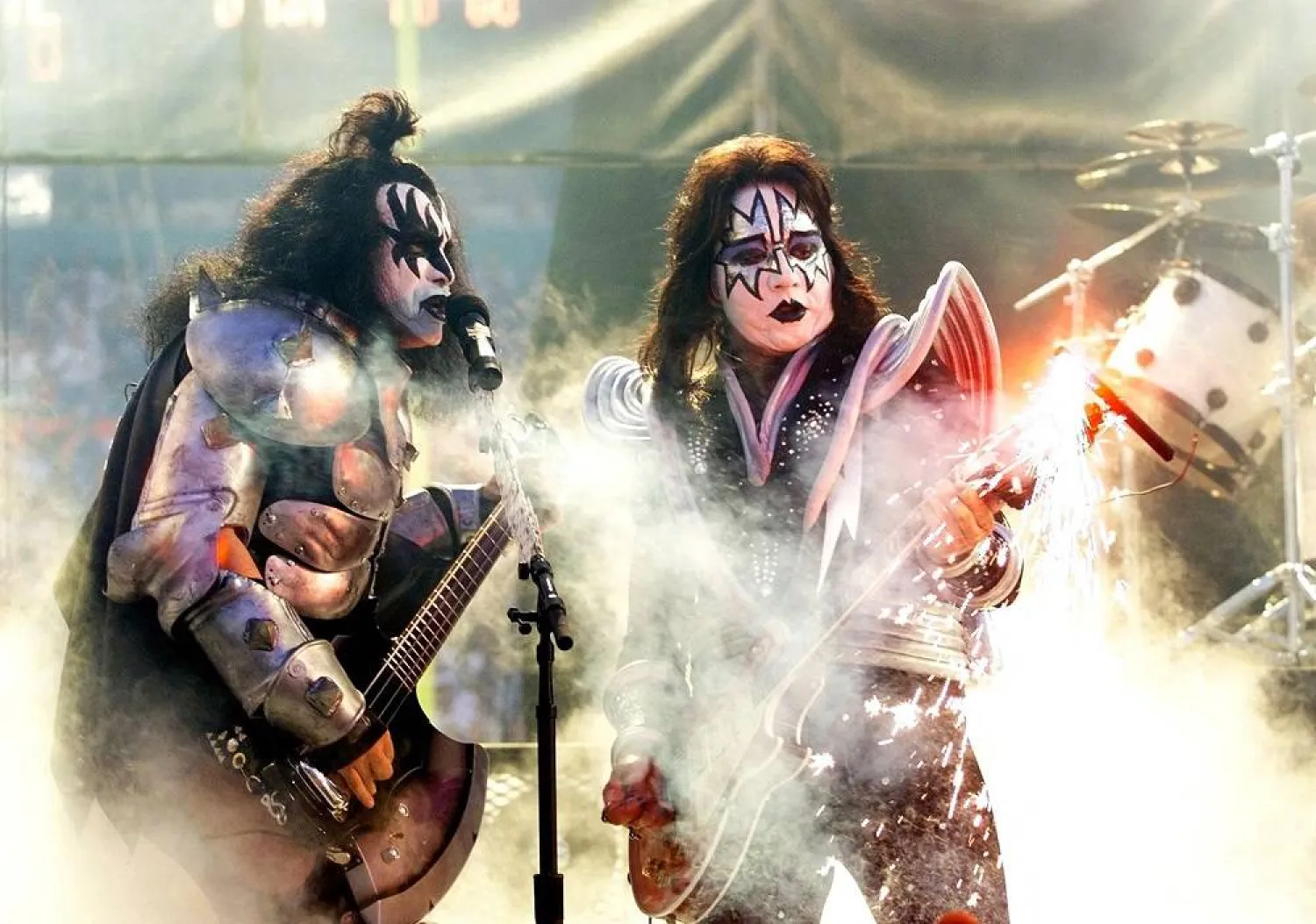

Ace Frehley, Kiss’ Original Lead Guitarist and Founding Member, Dies at 74 

Gene Simmons (L) and Ace Frehley (R) of the rock group Kiss perform before the start of Super Bowl XXXIII January 31, 1999 at Pro Player Stadium in Miami, Florida. (AFP) 
TT

Ace Frehley, Kiss’ Original Lead Guitarist and Founding Member, Dies at 74 

Gene Simmons (L) and Ace Frehley (R) of the rock group Kiss perform before the start of Super Bowl XXXIII January 31, 1999 at Pro Player Stadium in Miami, Florida. (AFP) 

Ace Frehley, the original lead guitarist and founding member of the glam rock band Kiss, who captivated audiences with his elaborate galactic makeup and smoking guitar, died Thursday. He was 74.

Frehley died peacefully surrounded by family in Morristown, New Jersey, following a recent fall, according to his agent.

Family members said in a statement that they are "completely devastated and heartbroken" but will cherish his laughter and celebrate the kindness he bestowed upon others.

Kiss, whose hits included "Rock and Roll All Nite" and "I Was Made for Lovin’ You," was known for its theatrical stage shows, with fire and fake blood spewing from the mouths of band members dressed in body armor, platform boots, wigs and signature black-and-white face paint.

Kiss' original lineup included Frehley, singer-guitarist Paul Stanley, tongue-wagging bassist Gene Simmons and drummer Peter Criss. Frehley’s is the first death among the four founding members.

Band members took on the personas of comic book-style characters — Frehley was known as "Space Ace" and "The Spaceman." The New York-born entertainer and Rock & Roll Hall of Famer often experimented with pyrotechnics, making his guitars glow, emit smoke and shoot rockets from the headstock.

"We are devastated by the passing of Ace Frehley," Simmons and Stanley said in a joint statement. "He was an essential and irreplaceable rock soldier during some of the most formative foundational chapters of the band and its history. He is and will always be a part of KISS’s legacy."

Born Paul Daniel Frehley, he grew up in a musical family and began playing guitar at age 13. Before joining Kiss, he played in local bands around New York City and was a roadie for Jimi Hendrix at age 18.

Kiss was especially popular in the mid-1970s, selling tens of millions of albums and licensing its iconic look to become a marketing marvel. "Beth" was its biggest commercial hit in the US, peaking at No. 7 on the Billboard Top 100 in 1976.

As the Kennedy Center’s new chairman, President Donald Trump named Kiss as one of this year’s honorees.

In 2024, the band sold their catalog, brand name and intellectual property to Swedish company Pophouse Entertainment Group in a deal estimated to be over $300 million.

Frehley frequently feuded with Stanley and Simmons through the years. He left the band in 1982, missing the years when they took off the makeup and had mixed success. Stanley later said they nearly replaced Frehley with Eddie Van Halen, but Vinnie Vincent assumed the lead guitar role.

Frehley performed both as a solo artist and with his band, Frehley’s Comet.

But he rejoined Kiss in the mid-1990s for a triumphant reunion and restoration of their original style that came after bands including Nirvana, Weezer and the Melvins had expressed affection for the band and paid them musical tributes.

He would leave again in 2002. When the original four entered the Rock & Roll Hall of Fame in 2014, a dispute scrapped plans for them to perform. Simmons and Stanley objected to Criss and Frehley being inducted instead of then-guitarist Tommy Thayer and then-drummer Eric Singer.

Simmons told Rolling Stone magazine that year that Frehley and Criss "no longer deserve to wear the paint.The makeup is earned," he added. "Just being there at the beginning is not enough."

Frehley and Kiss also had a huge influence on the glammy style of 1980s so-called hair metal bands including Mötley Crüe and Poison.

"Ace, my brother, I surely cannot thank you enough for the years of great music, the many festivals we’ve done together and your lead guitar on Nothing But A Good Time," Poison front man Bret Michaels said on Instagram.

Harder-edged bands like Metallica and Pantera were also fans, and even country superstar Garth Brooks joined the band members for a recording of their "Hard Luck Woman" on a 1994 compilation.

Frehley would appear occasionally with Kiss for shows in later years. A 2023 concert at Madison Square Garden was billed as the band’s last. While Stanley and Simmons said they would not tour again, they’ve been open to the possibility of more concerts, and they’ve stayed active promoting the group’s music and memorabilia.

Australia’s Music Industry Bans AI-Generated Tracks from Official Charts

Madonna poses before the Saint Laurent Spring/Summer 2026 collection presented in Paris, on Sept. 29, 2025. (AP)
TT

Australia’s Music Industry Bans AI-Generated Tracks from Official Charts

Madonna poses before the Saint Laurent Spring/Summer 2026 collection presented in Paris, on Sept. 29, 2025. (AP)

Australia’s recorded music industry will bar tracks wholly generated by artificial intelligence from official charts as burgeoning generative technologies threaten artists’ livelihoods, a representative said on Tuesday.

The crackdown comes as a variation of Madonna’s pop hit “Like a Prayer” created by an Australian producer using AI-generated vocals and drums has spent 16 weeks in the Australian top 20, stoking debate about generative AI’s place in music. It peaked at number two on the Australian Record Industry Association’s top 20 Australian singles chart in May and remained in fourth place on Tuesday.

Wholly AI-generated tracks will be banned from the ARIA charts from Monday next week, but some AI-assisted music will remain eligible, an ARIA statement said.

Tracks can be eligible only if “humans wrote the song and performed the lead vocal and the primary instruments,” among other requirements, the statement said.

AI-generated music would also be ineligible for the Australian industry’s prestigious ARIA awards.

ARIA chief executive Annabelle Herd said: “These changes reflect our intent to remain dynamic and promote the human nature of artistry in what is — to say the least — a rapidly developing space.”

“The ARIA Charts will always remain a transparent measurement of the music Australia consumes, but a chart that rewards unlicensed AI output would undercut the very basis of the recorded music we exist to represent,” Herd added.

Eligible music must also be produced using legal AI services. Music was appearing on streaming services that had apparently been developed with AI tools trained on artists’ music without authorization.

The Australian rules are in step with new principles released in July by the London-based International Federation of the Phonographic Industry. The federation represents the recording industry worldwide.

The international guidelines state that to qualify for official music charts, a track must be “substantially human made.”

Sydney Conservatorium of Music composer and lecturer Alexis Weaver told Australian Broadcasting Corp. the debate around AI in music was “exceptionally fraught and very emotional for a lot of musicians and so everyone will have a different opinion.”

Weaver applauded ARIA’s move as a “wonderful step forward” that sent a message ARIA wanted to “prioritize and value human creativity.”

“It can be quite hard to avoid AI tools in the current landscape,” Weaver said. “There is a way to use it while you’re still steering the ship and making the main creative choices.”


Qiddiya Investment Company, Paris Sign MoU to Explore Development of Entertainment Destination in France

Qiddiya Investment Company, Paris Sign MoU to Explore Development of Entertainment Destination in France
TT

Qiddiya Investment Company, Paris Sign MoU to Explore Development of Entertainment Destination in France

Qiddiya Investment Company, Paris Sign MoU to Explore Development of Entertainment Destination in France

Qiddiya Investment Company signed on Monday a Memorandum of Understanding with the French government to explore the development of a new entertainment-led, mixed-use destination in France.

The MoU was among several agreements and memoranda signed on the sidelines of the official visit of Prince Mohammed bin Salman bin Abdulaziz Al Saud, Crown Prince and Prime Minister, to France.

The MoU marks the beginning of a phase of joint work to define the project’s scope, development model and contractual framework, in accordance with the applicable procedures and approvals in France.

The project will build on the capabilities, experience and partnerships that Qiddiya Investment Company is developing from Saudi Arabia. It reflects the Company’s evolution as a Saudi national brand contributing to the creation and development of entertainment experiences while expanding its global presence.

Qiddiya City remains the Company’s flagship project and the principal reference point for its model. The international project will provide a platform to introduce Qiddiya’s Power of Play philosophy, broaden the Company’s experience and partnerships, and strengthen the presence of the Saudi model in global markets.


Dutch Say Won’t Participate in ‘No Longer’ Neutral Eurovision

A logo of the Eurovision Song Contest is seen in front of the St. Jakobshalle in Basel, Switzerland, May 1, 2025. (Reuters)
TT

Dutch Say Won’t Participate in ‘No Longer’ Neutral Eurovision

A logo of the Eurovision Song Contest is seen in front of the St. Jakobshalle in Basel, Switzerland, May 1, 2025. (Reuters)

The Netherlands will not participate in next year's Eurovision Song Contest, its broadcaster said Monday, saying the event can "no longer be considered neutral" given divisions over the Gaza war. 

"It is undeniable that international conflicts are increasingly affecting the Contest, undermining its neutral character. The Eurovision Song Contest has therefore become a platform for division," said Taco Zimmerman, Director-General of AVROTROS in a statement from the broadcaster. 

The contest has recently been hit by a wave of boycotts over Israel's participation. 

Earlier this month, organizers announced they were excluding any country involved in an armed conflict from hosting the competition. 

"However, the recently announced changes... do not provide sufficient confidence that the independent and neutral character of the Eurovision Song Contest has been restored," said the AVROTROS statement. 

Israel came close to winning the competition in both 2025 and 2026, ultimately finishing second on each occasion. 

Next year's event, the world's biggest live televised music event, will take place on May 15 in Bulgaria's Black Sea city of Burgas. 

It will be the first time that the Balkan nation hosts the contest, coming after Bulgarian singer Darina Yotova, known as Dara, won this year's contest in the Austrian capital Vienna with the catchy floor-filler "Bangaranga". 

Since its launch in 1955, Eurovision has become the ultimate pop platform, catapulting Swedish icons ABBA to worldwide fame, as well as boosting the likes of Celine Dion, Cliff Richard and Olivia Newton-John. 

The 2026 competition was watched by 131 million viewers, down 35 million on the year before after five countries boycotted it over Israel's participation. 

The Netherlands, Iceland, Spain, Ireland and Slovenia all pulled out of the contest -- with the latter three refusing to broadcast the show at all. 

The Dutch took part in the very first Eurovision Song Contest back in 1956 and have won on five occasions. 

The most recent winner was Duncan Laurence whose song Arcade won the contest in 2019, going on to top charts globally. 

It became the first Eurovision entry to reach one billion streams on Spotify, according to the Eurovision website. 

The withdrawal is "painful as we would have very much liked to be part of the Contest again next year," said Zimmerman. 

"As a public broadcaster, we remain committed to our values. They guide us in everything we do, even when that means stepping away from an event that is very close to our hearts," he added.