

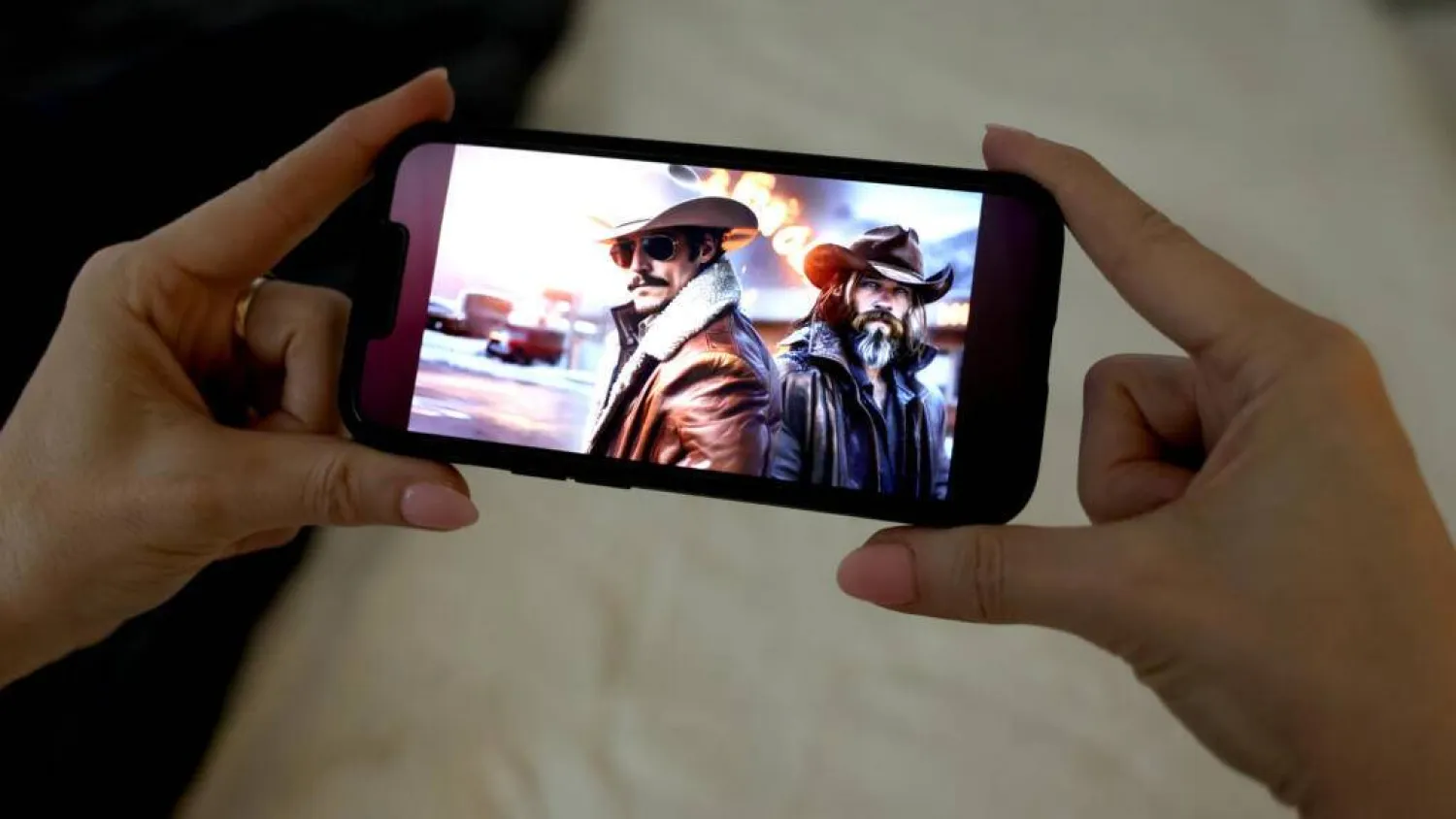

AI-generated Artists Break Through in Country Music

"Whiskey & Water," a song by Cain Walker featuring Cade Winslow, is one of many AI-generated country music tunes. TIMOTHY A. CLARY / AFP
TT

AI-generated Artists Break Through in Country Music

"Whiskey & Water," a song by Cain Walker featuring Cade Winslow, is one of many AI-generated country music tunes. TIMOTHY A. CLARY / AFP

AI-generated singers routinely rank among the top-streamed country music artists in the United States -- a trend that for now is limited to a genre that industry observers fear is becoming too formulaic.

Breaking Rust, Cain Walker, Aventhis, and Outlaw Gospel have more in common that cowboy hats, denim and leather. They are all completely computer-generated, from their faces to their melodies, said AFP.

And they are all hitmakers.

"That's a phenomenon I didn't see coming," said Jennie Hayes Kurtz of the country music band Brother and The Hayes.

"I thought AI was going to be curing cancer or something."

Many of the AI country tunes tap into the genre's archetype of the lone cowboy: a rugged, taciturn, plain-spoken man who, above all, refuses to apologize for simply existing.

Lyrics are delivered in raspy, gravelly voices that sound as authentic as the real thing.

"It's scary as songwriters," said Kassie Jordan, who forms the singing duo Blue Honey with her husband Troy Brooks.

"We are starting to see a lot of people just putting words into these chatbots and it is writing songs for them," she said. "As a songwriter, it's kind of like, is anyone going to even think I really wrote this?"

Berklee College of Music professor Joe Bennett noted that a sampling of AI singers suggests that the words used to "prompt" AI songs were "not particularly detailed."

None of the producers behind AI-generated music projects responded to AFP's requests for comment.

So how did AI find a place in a genre that is fundamentally rooted in the human experience and storytelling, blending folk, blues, and even gospel influences?

For Bennett, the emergence of modern country music in the early 2000s -- with a highly polished, more pop sound and repeated "melodic shapes" -- is key.

AI models could become adept at replicating such a sound, when fueled with those elements, he explained.

- 'Superficial' -

Once overshadowed by rap and Latin music, and hindered by the industry's shift to digital music formats, country music has nevertheless staged a comeback thanks to a generation of artists with stronger pop, not folk, sensibilities.

Following in the footsteps of country-turned-pop megastar Taylor Swift, today's headliners are more likely to sport baseball caps than wide Stetsons.

Their music breaks genre boundaries, while artists such as Beyonce and Post Malone win fans and sell albums with their crossover efforts.

Last year, country stars Morgan Wallen and Zach Bryan were both in the top 10 most streamed artists on Spotify.

Some in the industry believe country's rebirth signifies a dulled-down formula designed to appeal to the widest possible audience.

"The lyrics aren't as deep as they used to be," Jordan said.

"A big portion of popular country music has become kind of shallow, so that is pretty easy to duplicate."

Bennett says the industry must do a better job of identifying AI-generated music, noting that Deezer is the only major streaming platform to clearly label such material.

"We need AI detection," Bennett maintained.

"It will happen, and there is a consumer demand for it."

Hayes Kurtz said there is a large audience of "passive" listeners who don't care whether music is made by AI, but there are also "active listeners" who attend concerts, buy band merchandise, and deeply respect the integrity of the artists.

"That audience seems to really care it the music is made by the actual humans they are going to see," Hayes Kurtz said.

Jordan says she remains optimistic about the future.

"There's another wave of country artists that are coming that is really into doing it the old school way and showing emotion," she said.

"That will be harder for AI to duplicate. That might save the genre."


Tom Cruise Touts ‘Wild’ Dark Comedy ‘Digger’ to Theater Owners

 Cast member Tom Cruise and director Alejandro Gonzalez Inarritu of the upcoming film "Digger" react during the Warner Bros. Pictures presentation at CinemaCon, the official convention of Cinema United, in Las Vegas, Nevada, US, April 14, 2026. (Reuters)
Cast member Tom Cruise and director Alejandro Gonzalez Inarritu of the upcoming film "Digger" react during the Warner Bros. Pictures presentation at CinemaCon, the official convention of Cinema United, in Las Vegas, Nevada, US, April 14, 2026. (Reuters)
TT

Tom Cruise Touts ‘Wild’ Dark Comedy ‘Digger’ to Theater Owners

 Cast member Tom Cruise and director Alejandro Gonzalez Inarritu of the upcoming film "Digger" react during the Warner Bros. Pictures presentation at CinemaCon, the official convention of Cinema United, in Las Vegas, Nevada, US, April 14, 2026. (Reuters)
Cast member Tom Cruise and director Alejandro Gonzalez Inarritu of the upcoming film "Digger" react during the Warner Bros. Pictures presentation at CinemaCon, the official convention of Cinema United, in Las Vegas, Nevada, US, April 14, 2026. (Reuters)

Tom Cruise said he took four decades of acting to get to a place where he could play the eccentric oil tycoon at the center of an upcoming dark comedy, "Digger."

Cruise introduced the first images from the movie on Tuesday at the CinemaCon convention of theater owners in Las Vegas.

They showed the 63-year-old transformed into the character Digger Rockwell, an older man with thinning gray hair, a beer belly, a Southern accent and a fondness ‌for cats.

In ‌the movie, Rockwell inadvertently unleashes an ecological disaster that ‌carries ⁠the world to ⁠the brink of nuclear war, before scrambling to try and save the planet.

"It took 40 years to be able to put on the boots of Digger Rockwell and play the many, many layers of this character," Cruise said. "The movie is wild, it's funny, and I can't wait for you all to see it."

The Warner Bros movie is set ⁠to debut in theaters in October.

Cruise was joined on ‌stage by the film's director, four-time Oscar ‌winner Alejandro Inarritu.

The maker of "Birdman" and "The Revenant" said he and Cruise first discussed ‌the film seven years ago.

Cruise, who was filming "Top Gun: Maverick" ‌at the time, said he had been an admirer of Inarritu's films and rushed over to the director's house on his motorcycle when he asked to meet.

"We know that he is fearless: the stunts, the planes, the jumps," Inarritu ‌said of Cruise. "But I have to say, I think this is another kind of fearless. This ⁠role possibly could ⁠be (his) most challenging," adding, "It was a high-wire act."

Cruise kicked off a celebrity-studded presentation of upcoming films from Warner Bros, the studio coming off a year of commercial success and 11 Oscars. It is in the process of being sold to Paramount Skydance in $110-billion deal.

Zendaya, Timothee Chalamet and Jason Momoa touted "Dune: Part Three," the conclusion to the sci-fi series due for release in December. The film is set 17 years after the events of the second "Dune" movie.

"The years don't seem to have been kind to anyone on Dune," Zendaya said, explaining where the series picks up. "It's been a really difficult, challenging, ungentle and unkind few years, and I think there's so much left still to fight for."


Billy Crystal Will Return to Broadway in One-Man Show About the House He Lost to LA Wildfires

Billy Crystal arrives at the Vanity Fair Oscar Party on March 2, 2025, at the Wallis Annenberg Center for the Performing Arts in Beverly Hills, Calif. (AP)
TT

Billy Crystal Will Return to Broadway in One-Man Show About the House He Lost to LA Wildfires

Billy Crystal arrives at the Vanity Fair Oscar Party on March 2, 2025, at the Wallis Annenberg Center for the Performing Arts in Beverly Hills, Calif. (AP)

Billy Crystal will return to Broadway this fall in a very intimate one-man show that will take the audience into his family's longtime Los Angeles home that was leveled in wildfires.

“860,” written and performed by the Tony- and Emmy-winner, will begin previews this October at a theater to be revealed later. The title comes from the street address for the home Crystal and his family lived in for 46 years, a house lost in last year's devastating Palisades fires.

“I invite you to come inside 860 and I’ll tell you all the funny and touching things that happened there, not only in my career but to our family,” Crystal said in a statement. “It’s a joyous and heartfelt visit, about how with the love of family and friends and your inner strength, you can get through tough times.”

This is Crystal’s first return to Broadway following his “Mr. Saturday Night,” which he premiered in 2022 and earned Tony nominations for best book and lead actor in a musical. Scott Ellis will direct his new work.

Crystal has had success with one-man shows before. He turned his memoir “700 Sundays” into a stage show — in 2004 and revived in 2013 — that won him a Drama Desk Award in 2005.

The Palisades and Eaton fires erupted in Jan. 7, 2025, killing 31 people and destroying about 13,000 homes and other residential properties. The fires burned for more than three weeks and clean-up efforts took about seven months.

At the televised fundraising concert FireAid, held at the end of January 2025, Crystal appeared as the first host in the same clothes he was wearing when he fled his family home.

Crystal said he returned to the wreckage of his home and began to wail: “I had not cried like that since I was 15 and I was told that my father had just died.” His daughters soon found a rock in the wreckage with the word “Laughter” engraved in it.

Crystal made a name for himself first in comedy, from stand-up to TV’s “Soap” to the films “When Harry Met Sally” and “City Slickers.” Then in 1992, he got serious with the movie “Mr. Saturday Night,” which he directed, co-wrote and starred in.


Inside the Fireproof Vault Housing US Movie History

Nitrate Film vault Leader George Willeman explains how the different functions of the vault work at the Packard Campus of the Library of Congress' National Audio-Visual Conservation Center in Culpeper, Virginia, on April 2, 2026. (AFP)
TT

Inside the Fireproof Vault Housing US Movie History

Nitrate Film vault Leader George Willeman explains how the different functions of the vault work at the Packard Campus of the Library of Congress' National Audio-Visual Conservation Center in Culpeper, Virginia, on April 2, 2026. (AFP)

Once upon a time in the golden days of Hollywood, the movies were bigger, the stars brighter and the celluloid they were filmed on was, well, explosive.

Which is why the US Library of Congress maintains a special, fireproof vault in Virginia, near Washington, DC.

There, the highly combustible nitrate film used from the dawn of cinema in the 1890s until the early 1950s has a permanent home, rarely accessed by the public but toured by AFP.

Lost movies on the volatile but durable medium are still being discovered and preserved in the facility. And thanks to digitization, the lost treasures can also be safely viewed for the first time in decades.

Some 145,000 film reels are stored in strictly fireproof conditions in a vast, chilly vault at the library's National Audio-Visual Conservation Center in Culpeper, Virginia.

It is crammed with cinematic treasures that rekindle warm memories of an era when movies ruled.

The vault's leader, George Willeman, reeled off the names of classics with negatives there: "Casablanca," Frank Capra-directed films like "Mr. Smith Goes to Washington," and the grand-daddy of all action movies, "The Great Train Robbery" from 1903.

Down a spartan corridor so long it seemed to recede into the distance, he unlocked a series of cell-like steel doors.

Inside each of the 124 cells -- there's one dedicated just to the Disney archive -- were floor-to-ceiling cubby holes.

Each one held film canisters containing negatives and prints, all arranged meticulously: packed tight to prevent canisters from opening, but far enough apart to prevent any fire from spreading.

Since being set up in 2007 in a former US Federal Reserve building in the foothills of the Blue Ridge Mountains, the vault has maintained a perfect no-fire record.

- Film nerds' delight -

Nitrate film is just part of the center's collection of more than six million items of moving images and recorded sound. They also have supporting scripts, posters and photos.

Willeman, who sports a button badge with the invocation to "Experience Nitrate," said the Library of Congress began preserving the medium when in the 1960s, "it was discovered that so much film was being lost" due to fires and defunct companies throwing negatives away.

With the American Film Institute, the library began collecting and copying nitrate film, including the holdings of big Hollywood studios - RKO, Warner Brothers, Universal, Columbia and Walt Disney.

They also tapped the personal collections of film icons like movie impresario and silent era star Mary Pickford and motion pictures inventor Thomas Edison, whose early studio produced hundreds of films.

"We're 50 some years in, and it (the collection) just keeps growing," Willeman said.

With the arrival of digital media, the mission has expanded beyond preservation for purists and cinema historians -- who say movies just look better on nitrate footage -- to putting old films online.

"Now we can make them available for everybody, which to me, being the film nerd I've been since, like, third grade, is just amazing."

Nitrate film made by early artisans often preserves better than the later safety film, said Courtney Holschuh, nitrate archive technician.

At a workstation with no light bulbs or exposed batteries -- either of which could ignite dust or gas from vintage film -- Holschuh recounted how last September she carefully peeled apart a cache of 10 vintage reels donated by a retired schoolteacher.

There were 42 different titles on the reels -- only 26 of which have been identified. They included a lost film, "Gugusse and the Automaton," by French cinema pioneer Georges Melies.

"So much of our early film history is still out there for us to see and to experience," Willeman said.
