


Movie Review: In Christopher Nolan’s ‘The Odyssey,’ an Ancient Epic Is Reborn

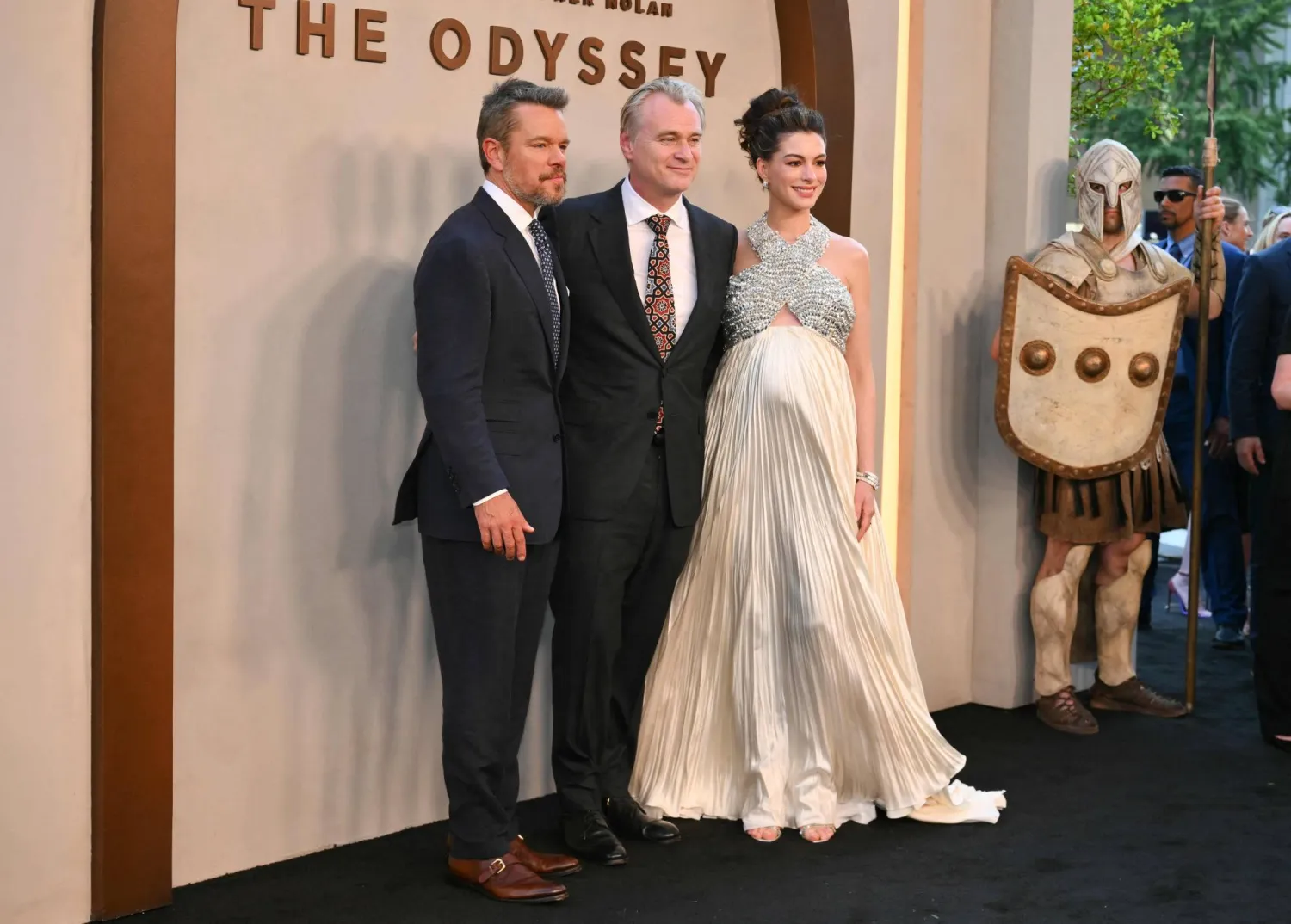
 US actor Matt Damon (L), British-US director Christopher Nolan (C) and US actress Anne Hathaway (R) attend "The Odyssey" premiere at the AMC Lincoln Square in New York on July 14, 2026. (AFP)
US actor Matt Damon (L), British-US director Christopher Nolan (C) and US actress Anne Hathaway (R) attend "The Odyssey" premiere at the AMC Lincoln Square in New York on July 14, 2026. (AFP)
TT

Movie Review: In Christopher Nolan’s ‘The Odyssey,’ an Ancient Epic Is Reborn

 US actor Matt Damon (L), British-US director Christopher Nolan (C) and US actress Anne Hathaway (R) attend "The Odyssey" premiere at the AMC Lincoln Square in New York on July 14, 2026. (AFP)
US actor Matt Damon (L), British-US director Christopher Nolan (C) and US actress Anne Hathaway (R) attend "The Odyssey" premiere at the AMC Lincoln Square in New York on July 14, 2026. (AFP)

Getting home, and turning back the clock, has long been at the root of Christopher Nolan’s films. The astronauts of “Interstellar” painstakingly lose 23 years in space travel, almost the same length of time Odysseus is away from home in “The Odyssey”: a decade fighting the Trojan War, a decade trying to return to Ithaca.

So, to a remarkable degree, Nolan’s “The Odyssey” — faithful as it is to Homer’s epic poem — feels, down to its nonlinear DNA, like a Nolan movie. The authorship of the epic poem, dated to the 7th or 8th century BC, is complex. But no one could question the maker of this “Odyssey,” an earthy, existential epic that ravishingly melds the storytelling of antiquity with contemporary IMAX-sized bravado.

As a story about a man whose cunning offends the gods, “The Odyssey” feels very much like a companion piece, if not a downright sequel, to “Oppenheimer.” Odysseus (Matt Damon, in the role of his life) is increasingly racked with guilt for the violence and death he’s wrought after his ingenuity led to the sacking of Troy.

The arrival of any new Nolan spectacle inevitably leads to its own kind of assault, and avalanches of “masterpiece” proclamations. (I’m not innocent.) But while “The Odyssey,” Nolan’s first film shot entirely with IMAX cameras, doesn’t skimp on grandiosity, it works surprisingly well as a simpler, human-sized tale.

The journey — you may have heard, it’s about the journey — is sometimes a little clunky, and the sheer Nolan-ness of the production, not to mention the historic nature of the tale, inevitably saps it of some freshness. You could make a credible case that Nolan has already made a movie about a guy trying to reach his family through strata of mind-warping illusion, and it’s called “Inception.” Such is the trouble with urtexts.

But “The Odyssey” is rarely not transfixing, and it’s a ripping adventure story, besides. At the least, it’s the definitive big-screen adaptation of one of literature's oldest tales — a not-too-shabby accomplishment for a filmmaker of restless ambition.

It’s not until Book 5 that Odysseus enters Homer’s poem, and Nolan, who also wrote the screenplay, likewise begins in Ithaca. There, Odysseus’ home is overrun by feasting suitors in pursuit of his wife, Penelope (Anne Hathaway). Foremost among them is Antinous, who’s played with sleazy perfection by Robert Pattinson. For an actor often (pleasingly) at odds with the movies around him, Pattinson has never slid more seamlessly into a part.

Telemachus (Tom Holland, also well-cast), the youthful son of Penelope and Odysseus, resolves to go in search of his father. Meanwhile, we catch up with Odysseus, weathered and white-bearded, following the fall of Troy. His forced conscription, by Agamemnon, is shown in flashbacks. Agamemnon is depicted with an imposing Darth Vader-like presence and played by Benny Safdie, but the real star is his hulking, mohawked helmet.

Such vivid details abound in Nolan’s richly textured film. The simple rocking of Odysseus’ longship, off the Mediterranean coast, is glorious. Some of Nolan’s and cinematographer Hoyte van Hoytema’s most impressive work has come when they’re faced with the elements (as in “Dunkirk”). And “The Odyssey” is flooded with stormy seas and enchanted isles. If anything, the movie could have gone further; I was promised rosy-fingered dawns.

The first line of Homer’s poem, as translated by Emily Wilson (the version Nolan leaned on), refers to Odysseus as “a complicated man.” James Joyce, whose “Ulysses” was based on “The Odyssey,” once noted that while Hamlet is merely a son, Ulysses, or Odysseus, is a father, a husband, a lover and a warrior. In short, he’s an Everyman, albeit an especially smart one. And Damon, the most amiable of Everymen, proves especially attuned to the multifaceted nature of the archetypal hero.

We meet him first as a soldier, leading a small group of ships away from Agamemnon’s fleet, setting a southerly course with his second-in-command Eurylochus (an excellent Himesh Patel). Their route takes them on a series of episodic quests: a cave encounter with Polyphemus, the Cyclops; a pine forest attack by the man-eating giants, the Laestrygonians; a meal with the witch Circe (Samantha Morton); and Odysseus’ seven-year interlude with the sea nymph Calypso (a beguilingly sincere Charlize Theron).

You could argue that the movie can feel like a series of sketched-together set pieces, but what set pieces! That includes the tale of the Trojan horse, a fleeting mention in the poem but here a centerpiece. You can tell that Nolan, who nearly made “Troy” more than two decades ago, has had the sequence — beginning with the Trojan horse sunk in the sand and leading to the burning of Troy — on his mind for years.

Each stop on Odysseus' journey gives Nolan a mythic playground to explore imagery that verges on the stuff of horror. I was most intoxicated by “The Odyssey” in its most surreal moments: the sight of a giant hand emerging out of the shadows, the meeting with the “shades” of Odysseus’ dead army, risen from the black soil of Hades.

“A time of apparent magic” is how the movie is introduced. Nolan has wisely opted to keep the gods sidelined. Their powers are real, but with the exception of Zendaya’s Athena, who appears like a confidant to Odysseus, the gods, themselves, remain off-screen.

That choice draws Nolan’s “Odyssey,” and its themes of sacrifice, fidelity and honor, closer to reality. And it makes Nolan’s decision to cast his film widely all the more essential. This is a story, passed down for centuries by singers and storytellers, that belongs to all of humankind.

Casting the movie with a wide spectrum of actors, including Lupita Nyong’o as Helen of Troy, is not only fair game for a purely mythic tale, but it gives the movie a present-day vitality. Seeing actors like Elliot Page (indelible as a fallen soldier), John Leguizamo (as the loyal servant Eumaeus) and Damon in this ancient context is a very big reason to see “The Odyssey,” and why Homer’s told and retold tale is worth revisiting, at all. If today has no role, what's the point? They didn't have cameras in 700 B.C., either.

Nolan’s “Odyssey” is nearly three hours long but never slow going. And it's the friction between past and present that propels the movie as much as Odysseus' wayward path. The ending of the poem, a tricky thing since it features mass murder, is given a more palatable action-movie melee. But the essence of “The Odyssey” is here, and Odysseus' quest to live down his mistakes and uphold his convictions feels vibrant again. Nolan, you might say, is at home.



A Viking Longship in ‘The Odyssey’? It’s a Case of History Meets Hollywood

The Draken Harald Harfagre, the ship used in the movie "The Odyssey", is docked outside Oslo Opera in the Norwegian capital on August 14, 2026. (AFP)
TT

A Viking Longship in ‘The Odyssey’? It’s a Case of History Meets Hollywood

The Draken Harald Harfagre, the ship used in the movie "The Odyssey", is docked outside Oslo Opera in the Norwegian capital on August 14, 2026. (AFP)

The eras of "The Odyssey" and the Vikings happened about 2,000 years apart -- so how did a Viking longship end up with a starring role in this year's blockbuster movie?

Look to director Christopher Nolan, and his obsession with bringing spectacle to life with real props, real scenes.

But also credit a team of Norwegian shipwrights and sailors who built a vessel that speaks to both history and Hollywood.

With its tar-soaked rigging, creaking oak deck and 50 spruce oars, Draken Harald Harfagre is the largest modern replica of a Viking ship.

It mattered little that it had to drop its Scandinavian roots for Greek mythology -- the anachronism blended into the service of Nolan's brand of realism.

For the film, though, Draken had to be stripped of the dragon figurehead at its bow -- typical of the Viking era, from the 8th to 11th centuries -- as it sailed for the cameras in Greek, Italian and Scottish waters.

"We found a Viking ship that had been built exactly according to those ancient specifications. And it was very much the whole shape and the rig that we needed to do a Bronze Age ship," Nolan told US television last month.

"We took the crew, and we put their crew all in our costumes. They became part of the movie crew, as it were. And Odysseus' guys, the actors, joined in with them, and they figured out how to raise the sail, how to rig it, how to row, all of this stuff."

For months, the longship's crew of seasoned sailors rubbed shoulders with Hollywood star Matt Damon, who plays Odysseus on-screen, and a host of professional actors.

- 'Doing the real thing' -

"There was one day where one of the actors who was sitting in front of me got seasick and threw up over the rail. It blew back on me," recalled sailor Trammell Hudson.

"I thought that would be my big scene, because the IMAX camera was very focused on him and me in the background dodging the debris. But I didn't see that particular scene in the film," he told AFP when the Draken and its crew made a recent visit to Oslo.

Based on Homer's epic, Nolan's film retraces the hero Odysseus in a perilous journey to his home on the island of Ithaca after the Trojan War in the 12th century BCE.

Rather than recreating a ship with computer-generated images, Nolan wanted a real one, capable of sailing on the open sea with flesh-and-blood men aboard.

"Most of the scenes would be completely different if it wasn't for us being there, doing the real thing with the real ship and the real crew in the real ocean and real weather," said Emanuel Persson, expedition director for Draken.

"I think the viewers can actually feel the genuine materials. I don't know if you can really smell the tar, but you can tell it's really genuine handicraft instead of being a digital creation," he said.

- All hands on deck -

On board, everyone played their part.

"Matt Damon was very nice and very good. Never complained. Every one of the actors was out for a long time and it was very cold and sometimes rough," recalled the longship captain, Bjorn Ahlander.

"No complaints, nothing, never. So that was fantastic to see."

With such a mixed crew on board, it wasn't always easy to row in perfect sync.

"It's very important that the hundred rowers coordinate because the oars are quite long and they will tangle with each other," Trammell Hudson stressed.

He recalled being thrown "a meter-and-a-half into the air", along with his rowing partner, when the blade of their oar hit a wave head-on.

The sweet memories from the shoot are in sharp contrast to those from neighboring Sweden.

Like Penelope waiting for Odysseus, the owners of another Viking ship used in the film had their patience tested: after the ship incurred damage during a shoot, they had to wait a year for compensation.


ByteDance Signs AI Copyright Pact with Hollywood Trade Group

The ByteDance logo is seen in this illustration taken February 8, 2025. (Reuters)
TT

ByteDance Signs AI Copyright Pact with Hollywood Trade Group

The ByteDance logo is seen in this illustration taken February 8, 2025. (Reuters)

ByteDance ‌and the Motion Picture Association on Monday signed an agreement to strengthen copyright safeguards on the Chinese company's AI video and image-generation models, months after the Hollywood trade group challenged its handling of ‌intellectual property.

The ‌deal, which covers ‌ByteDance's ⁠Seedance video and Seedream ⁠image-generation models, follows a cease-and-desist letter the MPA sent in February over these tools.

Disney and other studios in ⁠February raised concerns the ‌AI ‌tools could generate content featuring copyrighted ‌characters and celebrity likenesses ‌without authorization.

ByteDance said newer versions of the models include stronger intellectual-property protections.

Models ‌are offered through services including TikTok, CapCut and Dreamina.

The ⁠MPA's challenge came amid concerns that Seedance could generate content featuring copyrighted film and television characters without permission.

Both sides said they will continue collaborating on safeguards for copyrighted content as AI technology evolves.


Andrew Garfield Finds Wonder in Everyday Life in ‘The Magic Faraway Tree’

Andrew Garfield at a special screening of "The Magic Faraway Tree" in New York City on July 29. (Getty Images)
TT

Andrew Garfield Finds Wonder in Everyday Life in ‘The Magic Faraway Tree’

Andrew Garfield at a special screening of "The Magic Faraway Tree" in New York City on July 29. (Getty Images)

Andrew Garfield wants audiences to look up from their phones and remember that there is still plenty of magic in the world around them.

That idea drew the two-time Oscar nominee to “The Magic Faraway Tree,” a family adventure about Tim, a stay-at-home father whose family is forced to reconsider life after his wife, Polly, quits her job. They move to the countryside, where their children discover the magical Faraway Tree and its ever-changing worlds, sending the family into a series of fantastical adventures. The film, based on Enid Blyton’s children’s books, arrives in US theaters on Friday.

For Garfield, the story’s themes of nature, imagination and community feel especially timely as technology increasingly shapes everyday life. “I think people are craving connection and community and a kind of reconnection to the earth and to each other,” he said.

Garfield said he became passionate about the project after reading Simon Farnaby’s screenplay. “I really just adore his sense of whimsy and heartfeltness and magic and joy,” he said. “I felt very, very passionate about it.”

Tim’s journey reflects the film’s larger ideas about finding wonder outside the routine and distractions of modern life. For Garfield, that sense of wonder extends beyond fantasy. “I think it’s all around us,” he said. “There are so many things to be in awe of on this planet.”

The film, he said, is ultimately about recognizing that “there’s magic in the ordinary” as well as in the extraordinary.

Garfield, whose credits include playing Spider-Man, says he is drawn to roles with an element of play, community and the natural world. He focuses on “anything that keeps me awake to the remembering of the connection that we have to each other, the connection we have to nature, how we are all interconnected,” he said.

Garfield grew up reading Enid Blyton’s “The Famous Five” with his brother but did not read “The Faraway Tree” series as a child. His mother introduced him to another beloved literary adventurer: Bilbo Baggins, the hero of J.R.R. Tolkien’s “The Hobbit.”

“Any underdog story, really, those are the ones that get me,” Garfield said.

Another childhood escape was the video store. Garfield remembers being fascinated by the rows of VHS tapes and the possibilities behind their covers. The habit has survived in a new form in adulthood: spending an evening browsing streaming services without picking anything, enjoying the feeling of looking “into the windows of all these imaginary worlds.”

That may help explain why Garfield welcomes the resurgence of VHS and other analog technology among younger audiences.

“I dig that,” he said. “The regression to analog is looking good to me.”