Italy's Luxury Groups Set Aside Rivalries to Keep it Local

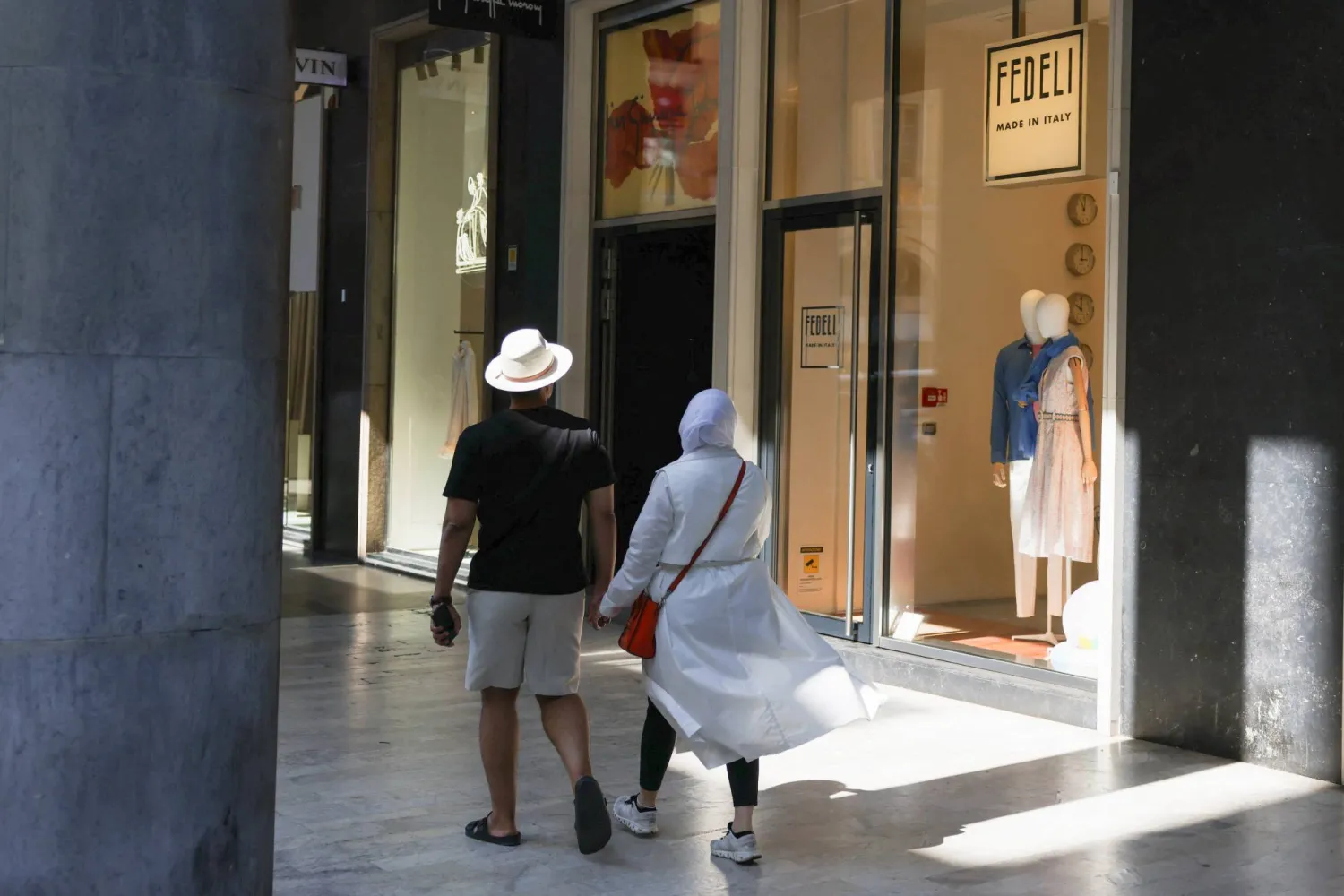
A couple walks by an Italian knitwear brand Fedeli shop in Milan, Italy, June 23, 2023. REUTERS/Claudia Greco
TT

Italy's Luxury Groups Set Aside Rivalries to Keep it Local

A couple walks by an Italian knitwear brand Fedeli shop in Milan, Italy, June 23, 2023. REUTERS/Claudia Greco

Italy's luxury fashion groups, which for decades jealously guarded their independence, have started teaming up to protect their supply chains and the Italian roots of smaller companies, showing a new spirit of collaboration.
Control of the supply chain has become increasingly important for luxury brands, ensuring products get to shops on time and avoiding reputational risks linked to sourcing of raw materials or labor conditions.
Italy's patchwork of specialist artisan workshops and family-owned labels offer particularly rich pickings for larger companies with the cash to cement relationships through investment.
In this spirit, Prada and fellow Italian fashion brand Ermenegildo Zegna in June acquired a minority stake in knitwear company Luigi Fedeli e Figlio, based in Monza, just north of Milan.
The family-owned company, which has a focus on cashmere and jumpers, was founded in 1934 and is distributed in 13 own-brand boutiques and around 400 multi-brand stores worldwide.
Prada and Zegna had previously invested jointly in Filati Biagioli Modesto S.p.A. in 2021, acquiring a majority stake in one of their suppliers, specialized in the production of cashmere and other luxury yarns.
"We invested in Biagioli to relaunch a company that was in crisis, while for Fedeli it's a case of helping the company to grow," Patrizio Bertelli, leading shareholder and chairman of Prada Group, told Reuters.
Bertelli, 77, added that smaller Italian companies have in the last two decades had to juggle the handover from one generation of the family to the next with more complex issues such as expanding in new markets.
"Italian brands have wanted to go it alone for too long, and then suddenly they realize you can't always go it alone and you start to look around," he added.
SMALL MANUFACTURERS APLENTY
Italy is home to thousands of small manufacturers that cover 50-55% of the global production of luxury clothing and leather goods, consultancy Bain calculates.
"Biagioli and Fedeli are two different examples of caring about 'made in Italy' and helping to strengthen the Italian supply chain either directly or indirectly," said Gildo Zegna, 67, chairman and CEO of Ermenegildo Zegna.
"Bertelli and I want to preserve the 'made in Italy' jewels and keep the know-how in the country," Zegna added.
The Italian groups are facing competition from French luxury giants such as LVMH or Gucci-owner Kering, which have also bought suppliers in Italy over the years, especially in the leather industry.
LVMH announced in May it had taken a majority stake in Nuti Ivo Group, an Italian company that has specialized in making leather products since 1955.
Private equity firms have also sensed an investment opportunity and started combining suppliers into larger entities.
Kering managing director Jean-Francois Palus said the luxury group is increasingly looking to bring production in house.
It's an issue of traceability but also of quality, sourcing of materials, shorter lead times to produce goods and get them to the market and competition for specialist artisans among brands, he said.
FORGING CLOSER RELATIONS
There have also been other examples of Franco-Italian cooperation such as a deal whereby Chanel bought a stake in cashmere yarn company Cariaggi Lanificio in partnership with Brunello Cucinelli.
"Italy has not created a (major) luxury hub, but we have entrepreneurs who have the ability to activate the right relationships at the right time," said Stefania Lazzaroni, general manager at Italian luxury industry association Altagamma.
"The approach has changed, (it is) much more collaborative - to face more complex challenges," she said.
Indeed, Prada and Zegna's decision to invest together was born out of a friendship strengthened by recent hard times.
"We got to know each other better during the COVID pandemic, in a difficult moment for the industry, when we needed to support each other," Zegna said, adding that a fundamental role was played by the meetings held at industry body Camera Nazionale della Moda.
Roberto Costa, head of Global Luxury Investment Banking for Citigroup, said closer working ties reflected a more confident and outward approach from Italian brands.
"Italian groups are now more managerialized, more organized and also stronger, which makes them more open to thinking together," he said. But he did not necessarily see big deals in the offing.
"There is a greater ability to talk to each other, but this does not mean that there will necessarily be mergers," he added.
Zegna and Bertelli now sit together on the board of Fedeli and Biagioli, leaving scope for more investments lower down the supply chain.
"If new opportunities arise we will grab them. Whether we do it together or not remains to be seen," Zegna said.



Nike Shares Rise as Apple’s Cook Doubles His Bet on CEO Hill’s Overhaul Effort

A jogger wearing Nike shoes runs along the Charles River in Cambridge, Massachusetts, US, March 18, 2019. (Reuters)
TT

Nike Shares Rise as Apple’s Cook Doubles His Bet on CEO Hill’s Overhaul Effort

A jogger wearing Nike shoes runs along the Charles River in Cambridge, Massachusetts, US, March 18, 2019. (Reuters)

Nike shares rose 5% in early trading on Wednesday after Apple CEO Tim Cook doubled his personal stake in the sportswear maker, raising his bets on the margin-pinching turnaround efforts led by CEO Elliott Hill.

Cook, who has been on Nike's board since 2005, bought 50,000 shares at $58.97 ‌each, according to ‌a regulatory filing. As of December ‌22, ⁠he holds about ‌105,000 shares, which is now worth nearly $6 million.

It was the largest open market stock purchase for a Nike director or executive and possibly the largest in more than a decade, said Jonathan Komp, analyst at Baird Equity Research.

"(We see) Cook's move as a positive signal for the progress under CEO Elliott Hill and Nike's 'Win ⁠Now' actions," Komp said.

The purchase comes days after Nike reported weaker quarterly margins and weak ‌sales in China even as CEO ‍Hill tries to revive demand ‍through fresh marketing plans and innovation focused on running and sports, ‍while phasing out lagging lifestyle brands.

He has also attempted to mend Nike's ties with wholesalers such as Dicks Sporting Goods to increase visibility among shoppers amid stiff competition from newer brands.

However, the strategy has strained Nike's margins, which have been declining for over a year, while its efforts to win back its ⁠premier position in discount-friendly China appears to be faltering.

Nike's shares have slumped nearly 13% since it reported results on December 18 and are on track for the fourth straight year of declines. They were trading at $60.19 on Wednesday.

Cook has been a lead independent director of Nike since 2016 when co-founder Phil Knight stepped down as its chairman.

The Apple CEO "remains extremely close" with Knight, Komp said, adding that he has advised Nike through key strategic decisions including Hill's appointment last year.

Board director and former Intel CEO ‌Robert Swan also bought about 8,700 shares for about $500,000 this week.


Etro Founding Family Exits Group as New Investors Including Türkiye's RAMS Global Join

L Catterton, a private equity firm backed by French luxury giant LVMH, will remain Etro's majority owner. Reuters
TT

Etro Founding Family Exits Group as New Investors Including Türkiye's RAMS Global Join

L Catterton, a private equity firm backed by French luxury giant LVMH, will remain Etro's majority owner. Reuters

The founding family of Italian fashion house Etro has sold the minority stake it still owned in the brand to a group of investors including Turkish group RAMS Global, the company said on Friday.

L Catterton, a private equity firm backed by French luxury giant LVMH, will remain Etro's majority owner and "will continue to actively support the brand's long-term growth strategy," Etro added, according to Reuters.

The new investors comprise also Italian fashion group Swinger International and small private equity firm ⁠RSI.

In addition to buying the stake, they all subscribed to a capital increase that will lower L Catterton's holding in Etro to between 51% and 55% from around 65%.

When including both the acquisition and the capital increase, the deal is worth around 70 ⁠million euros ($82 million), two sources close to the matter said. Etro did not disclose financial details.

Chief Executive Fabrizio Cardinali will remain at the helm, while Faruk Bülbül, representing RAMS Global, will become chairman of the board.

L Catterton bought a 60% stake in the brand known for its paisley motif four years ago, and it slightly increased the holding over the years.

The company, founded by Gimmo Etro in 1968, has ⁠been struggling with its turnaround. Last year it posted a net loss of 23 million euros with net revenues declining to 245 million euros from 261 million euros, according to filings with the local chambers of commerce reviewed by Reuters.

Rothschild advised L Catterton and the Etro family on the deal.

Rothschild had been hired in 2024 to look for a new investor who could buy all or part of the Etro fashion group, sources had previously told Reuters.


Paris Court Rejects Bid to Suspend Shein Platform in France

A customer holds shopping bags with a Shein logo in the first physical space of Chinese online fast-fashion retailer Shein on the day of its opening inside the Le BHV Marais department store, the Bazar de l'Hotel de Ville, in Paris, France, November 5, 2025. REUTERS/Sarah Meyssonnier/File Photo
TT

Paris Court Rejects Bid to Suspend Shein Platform in France

A customer holds shopping bags with a Shein logo in the first physical space of Chinese online fast-fashion retailer Shein on the day of its opening inside the Le BHV Marais department store, the Bazar de l'Hotel de Ville, in Paris, France, November 5, 2025. REUTERS/Sarah Meyssonnier/File Photo

A Paris court on Friday rejected a government request to suspend Chinese fast-fashion platform Shein in France after authorities found illegal weapons and child-like sex dolls for sale on the fast-fashion giant’s website.

Shein welcomed the decision, saying it remains committed to strengthening its control processes in cooperation with French authorities.

“Our priority remains protecting French consumers and ensuring compliance with local laws and regulations," the company said in an emailed statement to The Associated Press.

The controversy dates to early November, when France’s consumer watchdog and Finance Ministry moved toward suspending Shein’s online marketplace after authorities said they had found childlike sex dolls and prohibited “Class A” weapons listed for sale, even as the company opened its first permanent store in Paris.

French authorities gave Shein hours to remove the items. The company responded by banning the products and largely shutting down third-party marketplace listings in France.

French officials have also asked the European Commission to examine how illegal products were able to appear on the platform under EU rules governing large online intermediaries.