


AI-Generated Fashion Models Could Bring More Diversity to the Industry - Or Leave It with Less

A model presents a creation by Gefferson Vila Nova during the Sao Paulo Fashion Week 2024 (SPFW) at the Iguatemi shopping mall in Sao Paulo, Brazil, 13 April 2024. SPFW continues through 14 April with a total of 27 shows. (EPA)
TT

AI-Generated Fashion Models Could Bring More Diversity to the Industry - Or Leave It with Less

A model presents a creation by Gefferson Vila Nova during the Sao Paulo Fashion Week 2024 (SPFW) at the Iguatemi shopping mall in Sao Paulo, Brazil, 13 April 2024. SPFW continues through 14 April with a total of 27 shows. (EPA)

London-based model Alexsandrah has a twin, but not in the way you’d expect: Her counterpart is made of pixels instead of flesh and blood.

The virtual twin was generated by artificial intelligence and has already appeared as a stand-in for the real-life Alexsandrah in a photo shoot. Alexsandrah, who goes by her first name professionally, in turn receives credit and compensation whenever the AI version of herself gets used — just like a human model.

Alexsandrah says she and her alter-ego mirror each other “even down to the baby hairs.” And it is yet another example of how AI is transforming creative industries — and the way humans may or may not be compensated.

Proponents say the growing use of AI in fashion modeling showcases diversity in all shapes and sizes, allowing consumers to make more tailored purchase decisions that in turn reduces fashion waste from product returns. And digital modeling saves money for companies and creates opportunities for people who want to work with the technology.

But critics raise concerns that digital models may push human models — and other professionals like makeup artists and photographers — out of a job. Unsuspecting consumers could also be fooled into thinking AI models are real, and companies could claim credit for fulfilling diversity commitments without employing actual humans.

“Fashion is exclusive, with limited opportunities for people of color to break in,” said Sara Ziff, a former fashion model and founder of the Model Alliance, a nonprofit aiming to advance workers’ rights in the fashion industry. “I think the use of AI to distort racial representation and marginalize actual models of color reveals this troubling gap between the industry’s declared intentions and their real actions.”

Women of color in particular have long faced higher barriers to entry in modeling and AI could upend some of the gains they've made. Data suggests that women are more likely to work in occupations in which the technology could be applied, and are more at risk of displacement than men.

In March 2023, iconic denim brand Levi Strauss & Co. announced that it would be testing AI-generated models produced by Amsterdam-based company Lalaland.ai to add a wider range of body types and underrepresented demographics on its website. But after receiving widespread backlash, Levi clarified that it was not pulling back on its plans for live photo shoots, the use of live models or its commitment to working with diverse models.

“We do not see this (AI) pilot as a means to advance diversity or as a substitute for the real action that must be taken to deliver on our diversity, equity and inclusion goals and it should not have been portrayed as such,” Levi said in its statement at the time.

The company last month said that it has no plans to scale the AI program.

The Associated Press reached out to several other retailers to ask whether they use AI fashion models. Target, Kohl’s and fast-fashion giant Shein declined to comment; Temu did not respond to a request for comment.

Meanwhile, spokespeople for Nieman Marcus, H&M, Walmart and Macy's said their respective companies do not use AI models, although Walmart clarified that “suppliers may have a different approach to photography they provide for their products but we don’t have that information.”

Nonetheless, companies that generate AI models are finding a demand for the technology, including Lalaland.ai, which was co-founded by Michael Musandu after he was feeling frustrated by the absence of clothing models who looked like him.

“One model does not represent everyone that’s actually shopping and buying a product,” he said. “As a person of color, I felt this painfully myself.”

Musandu says his product is meant to supplement traditional photo shoots, not replace them. Instead of seeing one model, shoppers could see nine to 12 models using different size filters, which would enrich their shopping experience and help reduce product returns and fashion waste.

The technology is actually creating new jobs, since Lalaland.ai pays humans to train its algorithms, Musandu said.

And if brands “are serious about inclusion efforts, they will continue to hire these models of color,” he added.

London-based model Alexsandrah, who is Black, says her digital counterpart has helped her distinguish herself in the fashion industry. In fact, the real-life Alexsandrah has even stood in for a Black computer-generated model named Shudu, created by Cameron Wilson, a former fashion photographer turned CEO of The Diigitals, a UK-based digital modeling agency.

Wilson, who is white, designed Shudu in 2017, described on Instagram as the “The World’s First Digital Supermodel.” But critics at the time accused Wilson of cultural appropriation and digital Blackface.

Wilson took the experience as a lesson and transformed The Diigitals to make sure Shudu — who has been booked by Louis Vuitton and BMW — didn’t take away opportunities but instead opened possibilities for women of color. Alexsandrah, for instance, has modeled in-person as Shudu for Vogue Australia, and writer Ama Badu came up with Shudu’s backstory and portrays her voice for interviews.

Alexsandrah said she is “extremely proud” of her work with The Diigitals, which created her own AI twin: “It’s something that even when we are no longer here, the future generations can look back at and be like, ‘These are the pioneers.’”

But for Yve Edmond, a New York City area-based model who works with major retailers to check the fit of clothing before it's sold to consumers, the rise of AI in fashion modeling feels more insidious.

Edmond worries modeling agencies and companies are taking advantage of models, who are generally independent contractors afforded few labor protections in the US, by using their photos to train AI systems without their consent or compensation.

She described one incident in which a client asked to photograph Edmond moving her arms, squatting and walking for “research" purposes. Edmond refused and later felt swindled — her modeling agency had told her she was being booked for a fitting, not to build an avatar.

“This is a complete violation,” she said. “It was really disappointing for me.”

But absent AI regulations, it’s up to companies to be transparent and ethical about deploying AI technology. And Ziff, the founder of the Model Alliance, likens the current lack of legal protections for fashion workers to “the Wild West.”

That's why the Model Alliance is pushing for legislation like the one being considered in New York state, in which a provision of the Fashion Workers Act would require management companies and brands to obtain models’ clear written consent to create or use a model’s digital replica; specify the amount and duration of compensation, and prohibit altering or manipulating models’ digital replica without consent.

Alexsandrah says that with ethical use and the right legal regulations, AI might open up doors for more models of color like herself. She has let her clients know that she has an AI replica, and she funnels any inquires for its use through Wilson, who she describes as "somebody that I know, love, trust and is my friend.” Wilson says they make sure any compensation for Alexsandrah's AI is comparable to what she would make in-person.

Edmond, however, is more of a purist: “We have this amazing Earth that we’re living on. And you have a person of every shade, every height, every size. Why not find that person and compensate that person?”



French Designer Threads a Path in London Fashion Week

This photo taken on February 6, 2026 shows French fashion designer Pauline Dujancourt posing for a photograph in her studio in south London. (Photo by Ben STANSALL / AFP)
TT

French Designer Threads a Path in London Fashion Week

This photo taken on February 6, 2026 shows French fashion designer Pauline Dujancourt posing for a photograph in her studio in south London. (Photo by Ben STANSALL / AFP)

Just days before her third runway show, French designer Pauline Dujancourt was riding a wave of excitement and nerves.

The 31-year-old admitted she had begun having strange, nightmarish dreams ahead of her big moment at London Fashion Week on Sunday.

The British capital will once again host its Autumn/Winter fashion week from Thursday to Monday, after New York's bonanza and before the catwalk carousel moves to Milan and Paris.

London, known for its raw creative energy and rising talents, is where Dujancourt launched her label in April 2022 after training at the renowned arts and design school Ecole Duperre in Paris, and fashion hub Central Saint Martins in London.

She and her team began work in November on her autumn-winter 2026/27 collection to be unveiled before some 450 guests -- journalists, buyers and VIP clients.

For designers, everything comes down to those few precious minutes on the catwalk. It's no wonder nervousness mixes with the creative buzz.

"I go through every emotion," Dujancourt told AFP with a smile. "Some days I'm super excited, full of ideas, and others I'm like: why did I pick this color, this fabric?"

The questions and worries snowball: "Will everyone be on time? Will there be last-minute hitches on the day?"

In recent weeks, she has been running her daily schedule with military precision.
Dujancourt works year-round with four assistant designers, but the team swells to around 50 people ahead of the show.

And she works with a community of knitters in Lima, Peru, with handknitting -- "something that my grandmother taught me as a child" -- being a hallmark of her garments.

"She was so skillful and so humble about it. And no one really realized how much work it takes and how much technique it takes," she said.

Known for her sensual, airy knitwear, Dujancourt was a finalist for the LVMH Prize, won Elle UK's young talent award, and is supported by the British Fashion Council.

Her clients span the globe from Japan to the United States, France and the UK, with regular requests for wedding dresses.

Her new collection pays tribute to women persecuted during historical witch hunts.

"I really want to celebrate the fact that there are so many women around the world who are working so humbly on domestic skills ... like sewing, hand knitting," she said.

Two weeks before the show, young seamstresses were crocheting floral motifs in mohair and Japanese metallic thread at a south London studio overlooking the Thames river and Big Ben.

Workers were hunched over their desks pouring over designs, with the looks still "in pieces".

Then comes the moment when everything is assembled. "It's the magical stage, when the clothes start to come alive," she said, her blue eyes lighting up her face framed by long dark hair.

Less than a week before the show, fittings begin with an in-house model, followed by the castings to find the right models.

On the eve of the show come final fittings, hair and make-up tests. And finally, on Sunday morning, the full rehearsal.

Show day always brings surprises. At Dujancourt's last catwalk in September, several models arrived extremely late, held up by another show.

"They turned up still wearing the other show's make-up. We had to dress them and redo everything ... I nearly died," she recalled.

What is her worst nightmare? A model tripping or garments ripping in front of the cameras.

"I once dreamt I'd forgotten to get dressed before coming out to greet the audience -- that would be a bit embarrassing," she joked.

Around 25 outfits will strut the catwalk on Sunday, a moment that "goes by in a flash".
Afterwards comes the crash.

"We barely see it happening ... because we are backstage in the madness and the chaos of it," she said.

But then it's finished "and there's a bit of baby blues afterwards," as she comes down off the adrenaline rush.

Dujancourt heads to Paris after London Fashion Week to meet buyers, before work begins again for her next show, in September.


Fashion Commission, Saudi Retail Academy to Develop National Talent 

Fashion Commission, Saudi Retail Academy to Develop National Talent 
TT

Fashion Commission, Saudi Retail Academy to Develop National Talent 

Fashion Commission, Saudi Retail Academy to Develop National Talent 

The Saudi Fashion Commission signed a memorandum of understanding (MoU) with the Saudi Retail Academy to develop national capabilities and boosting specialized skills in the fashion and retail sectors, reported the Saudi Press Agency on Monday.

The MoU aims to support local talent and the creation of sustainable employment opportunities in this vital industry. It stems from the two sides’ keenness to cooperate in the fields of training and professional development.

The agreement was signed on the sidelines of the graduation ceremony of the academy’s first cohort.

The Fashion Commission focuses on developing local talent, transferring global expertise, and advancing the fashion sector in the Kingdom, while the Saudi Retail Academy is a non-profit institute and a specialized entity in training and development in the retail field and in building professional competencies and skills related to retail and sales.

The MoU aims to establish a framework for cooperation to design and implement specialized training programs that boost the readiness of national cadres and qualify them according to the highest professional standards, with a focus on developing skills in sales, customer experience, and store management to meet labor market requirement and the needs of the growing fashion sector.

Fashion Commission chief executive Burak Cakmak said that developing human capital is a fundamental pillar for the long-term growth of the Kingdom’s fashion sector.

The partnership reflects the commitment to strengthening the capabilities that form the foundation of a competitive and sustainable industry through investment in specialized skills within retail and customer experience, enabling brands to grow and supporting the sector’s confident evolution, he added.

Saudi Retail Academy chief executive Hend Al-Dhaban stressed that the partnership embodies a shared vision to empower national talent and elevate professionalism in the retail sector.

The agreement will help channel training expertise to meet the specialized needs of the fashion sector and equip young men and women with the practical skills required to succeed in the labor market, thereby boosting service quality and supporting localization targets and economic growth, she explained.

This cooperation is part of the Fashion Commission’s ongoing efforts to develop the fashion value chain through building strategic partnerships with specialized training and education entities, expanding professional opportunities for national talent, and linking education and training outputs with labor-market needs.

Through their partnership, the commission and the academy will help in building an integrated ecosystem that connects education, vocational qualification, and employment, bolstering the competitiveness of the fashion and retail sectors and supporting the objectives of Saudi Vision 2030 in empowering national cadres, localizing jobs, and improving quality of life.


Saudi 100 Brands Debuts Landmark Fashion Presentation at Saudi Cup 2026

The experience introduced global audiences to Saudi Arabia’s dynamic and growing fashion ecosystem - SPA
TT

Saudi 100 Brands Debuts Landmark Fashion Presentation at Saudi Cup 2026

The experience introduced global audiences to Saudi Arabia’s dynamic and growing fashion ecosystem - SPA

The Fashion Commission launched its Saudi 100 Brands showcase at the Saudi Cup 2026, marking a historic milestone for the world-renowned equestrian event at King Abdulaziz Racecourse in Riyadh.
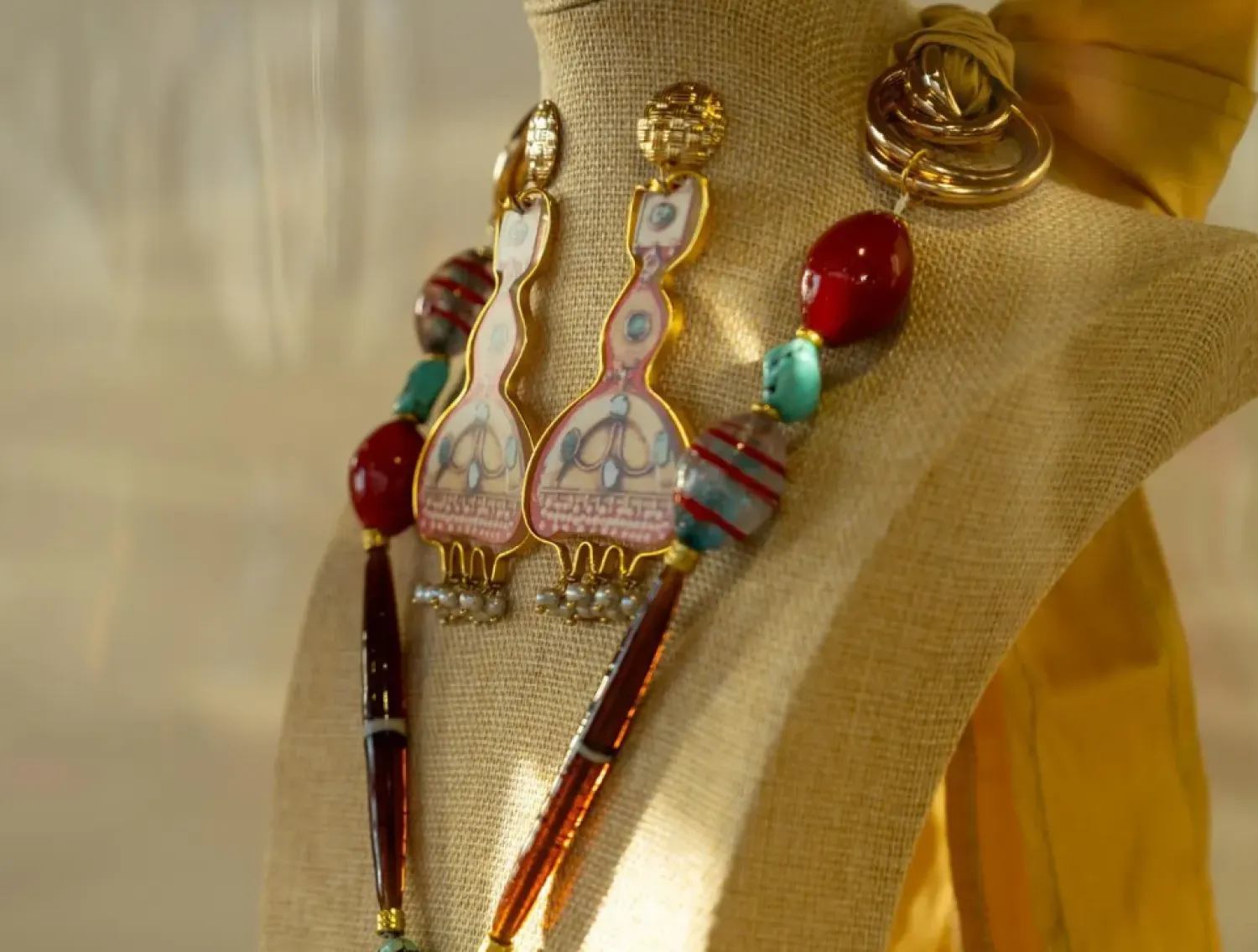
The collections celebrate Saudi heritage by blending traditional and contemporary design. Jewelry and accessory brands also exhibited throughout, providing Saudi designers with a platform to reach a broader global audience. These showcases emphasize the fusion of heritage and modern design, offering a new perspective on the Kingdom's creative identity.
The Saudi 100 Brands program, a flagship initiative of the Fashion Commission, supports emerging designers by providing tools, expertise, and platforms to grow their global presence. This collaboration with the Saudi Cup underscores the importance of celebrating cultural heritage while advancing design innovation.

Each piece in the exhibition incorporates heritage motifs, textiles, and storytelling, reimagined through innovative design to appeal to modern and international audiences.

The exhibition aims to celebrate national identity, highlight local creative talent, and present the evolving direction of Saudi fashion, SPA reported.

Visitors explored the intersection of craftsmanship and cultural expression, discovering how designers honor tradition while advancing fashion design.

The experience also introduced global audiences to Saudi Arabia’s dynamic and growing fashion ecosystem.

This participation reflects the Fashion Commission’s vision to develop a thriving fashion sector rooted in cultural heritage and global ambition. By combining cultural narratives with innovative design, the commission enables Saudi fashion to contribute to global creative industries, nurture talent, and position Saudi brands for sustained success.