

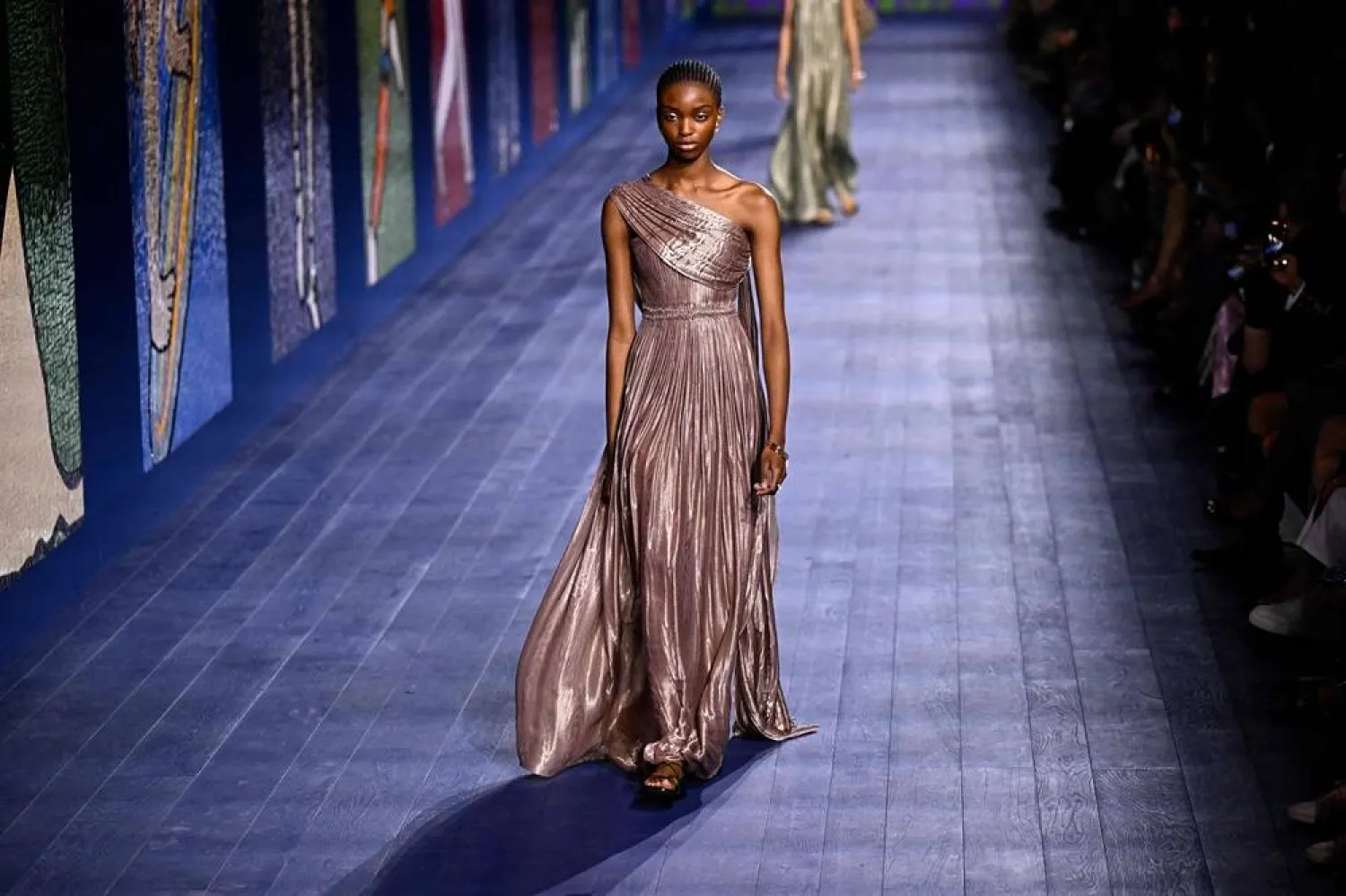

Dior’s Mount Olympus: A Sporty Couture Homage to the Paris Games

Models present creations by Christian Dior during the Haute-Couture Fall/Winter 2024 show as part of the Paris Fashion Week in Paris, on June 24, 2024. (AFP)
TT

Dior’s Mount Olympus: A Sporty Couture Homage to the Paris Games

Models present creations by Christian Dior during the Haute-Couture Fall/Winter 2024 show as part of the Paris Fashion Week in Paris, on June 24, 2024. (AFP)

Dior staged an homage to sport on the eve of the Paris Olympics on the grounds of the Musée Rodin on the first day of Paris Couture Week on Monday.

The show let the sumptuous, lightweight silks — georgette, taffeta, tulle, and sporty jersey — speak for themselves, draped elegantly over the body.

Here are some highlights of the fall-winter 2024 collections:

Athletes old and new

The walls were lined with dazzling artworks of athletes by Faith Ringgold, a feminist artist who died in April. Designer Maria Grazia Chiuri used fall’s couture as a stage “to pay a fitting tribute to all athletes ... from antiquity to the present day.”

On the runway, Grecian-style draping evoked the original Olympics. The nod to antiquity echoed the Italian designer’s penchant for historical influences.

Jersey fabric, an unconventional couture material, was handled poetically. It cascaded down the model’s body in loose, fluttery segments, with a twin leather belt to define the waist.

Mosaic embroidery on skin-tight tank tops added a contemporary twist, seeming to sculpt the bust. Sandals adorned with pearls sported crisscross straps up the leg.

The nicest looks were the simplest. An ecru lightweight wool gown seemed like a single whoosh of fabric, hanging whimsically and loosely from the shoulders. It had an unexpected cowl back. This simplicity with an element of surprise is quintessential Chiuri, who has said she often finds elegance in restraint.

Serena Williams marveled and applauded from the front row.

Van Herpen breaks the mold

Iris van Herpen presented her couture as sculptures in what the house called a “profound shift” in the Dutch designer’s trajectory.

“For a long time I’ve been working on expanding people’s perception of how fashion and art can be symbiotic,” van Herpen said. She compared her techniques in couture, such as draping directly on the mannequin, to sculpting.

“Even though we call one practice ‘haute couture’ and the other ‘art,’ to me, it’s one universe,” she said.

Van Herpen unveiled her collection amid her new large-scale, monumental pieces at a “hybrid" show. They were crafted with innovative techniques on tulle surfaces and suspended via steel tubes.

While preparing her retrospective in Paris' Musée des Arts Décoratifs that recently closed, van Herpen realized a longstanding ambition to delve into sculpture and painting. Her new works, developed over a year, reconnect with nature and the freedom of slowing down. Her move to a tranquil residence outside Amsterdam fostered this idea.

“The little transformations that happen every day fiercely inspire me,” she said.

The fall couture dovetailed with similar themes. Gravity-defying, slowed-down silhouettes and ethereal draping embraced the couturier’s signature three-dimensional printing and silk folding. The Umwelt and Aeromorphosis gowns featured a gradient of pearls mimicking cyclonic sculptures, while the transparent Ataraxy dress, sculpted with a heat gun, captured the sense of floating away. They held a Renaissance-like feel.

Honoring Japanese craftsmanship, the Sensorium dress was crafted from obi fabric, which evoked a sense of spirituality and peace.




Demna in the Spotlight at Milan Fashion Week as Industry Seeks Creative Reset

The logo of fashion house Gucci is seen outside a store in Cannes, France, May 16, 2024. (Reuters)
TT

Demna in the Spotlight at Milan Fashion Week as Industry Seeks Creative Reset

The logo of fashion house Gucci is seen outside a store in Cannes, France, May 16, 2024. (Reuters)

Milan ‌Fashion Week opens on Tuesday, setting the stage for a slate of creative director debuts from Demna's first runway show for Gucci to Maria Grazia Chiuri's initial collection at Fendi.

The Milan womenswear collections, which follow fashion weeks in New York and London, and ahead of Paris, come as the sector is showing some timid signs of recovery.

While practical wool coats and cashmere sweater dresses featured in New York, industry watchers expect some bold creations in the Milan autumn/winter collections as new designers seek to stamp their mark.

One of the most closely watched will be Georgian designer Demna, hired in July to reinvigorate Gucci after sales at the Italian fashion house fell 22% last ‌year.

Demna, who spent ‌a decade at Balenciaga, sketched out a collection for Kering-owned ‌Gucci, ⁠called "La Famiglia", in a ⁠lookbook on Instagram last September. He stages his first full-scale runway show for the brand on Friday.

Designers across luxury fashion face mounting pressure to deliver fresh visions while keeping a tight focus on sales as the industry is still trying to pull out of a prolonged downturn.

"This season we are expecting bold creative resets. The anticipation around new creative directions makes this edition particularly charged, with houses redefining their codes under intense ⁠global scrutiny," said Tiffany Hsu, chief buying and group fashion ‌venture officer at luxury e-commerce platform Mytheresa.

"We are ‌looking for collections that feel culturally sharp, emotionally resonant, and commercially intelligent in equal measure", she ‌added.

BALANCING HERITAGE AND CREATIVITY

Chiuri's first collection for LVMH’s Fendi on Wednesday, following her ‌departure from Dior last year, is expected to draw close scrutiny.

On Thursday, Belgian designer Meryll Rogge will present her first show for Marni, owned by Italian fashion group OTB.

A sharp increase in prices of luxury goods post-pandemic, which was not matched by an equal effort ‌in creativity, has alienated some customers, whom brands are now struggling to win back.

"All of them (brands) are thinking more commercially - they're ⁠all trying to ⁠get revenue to grow. But ultimately what is defining for all of these businesses is the brand and the heritage, which has to be supported by creativity in the product. So it needs to be a careful balance between the two," said Emily Cooledge, head of luxury research at Rothschild & Co Redburn in London.

Francesco Fiorese, partner at consultancy firm Simon Kucher, said consumers want more understated quality.

"Consumers' fatigue with omnipresent logos and purely aesthetic 'status symbols' (sold at very high prices) is leading to a search for authenticity and craftsmanship," he said.

Milan Fashion Week will also feature shows by Dolce & Gabbana, Giorgio Armani, Ferragamo and Tod's.

It follows the Milan Cortina Winter Games, which have put Italy’s fashion capital in the global spotlight and offered brands a chance to appeal to affluent visitors arriving for the competitions.


Japan's Traditional Kimonos Are Being Repurposed in Creative Ways

Designer Tomoko Ohkata, left, and her assistant Koki Unami hold Ohkata's designs made from old kimono, in Tokyo, on Jan. 15, 2026. (AP Photo/Yuri Kageyama)
TT

Japan's Traditional Kimonos Are Being Repurposed in Creative Ways

Designer Tomoko Ohkata, left, and her assistant Koki Unami hold Ohkata's designs made from old kimono, in Tokyo, on Jan. 15, 2026. (AP Photo/Yuri Kageyama)

The kimono, that elaborate, delicate wrap-around garment worn by geisha and samurai from centuries back, is getting a vibrant remake, appreciated these days for a virtue that’s more relevant than ever: sustainability.

A genuine silk kimono, which literally means “worn thing,” lasts a hundred years or more. In a Japanese family, it’s handed down over generations like heirloom jewelry, artworks and military medals.

It never goes out of style.

The design of the kimono and accompanying “obi” sash has remained basically the same since the 17th century Edo period depicted in Akira Kurosawa samurai movies.

But today, some people are taking a different creative approach, refashioning the traditional kimono, and also taking apart and resewing them as jackets, dresses and pants.

“I noticed that a lot of beautiful kimono is just sleeping in people’s closets. That’s such a waste,” said Mari Kubo, who heads a kimono-remake business called K’Forward, pronounced “K dash forward.”

Hers is among a recent surge in such services, which also turn old kimono into tote bags and dolls.

The most popular among Kubo’s products are “tomesode,” a type of formal kimono that is black with colorful, embroidered flowers, birds or foliage at the bottom, The Associated Press reported.

She also creates matching sets, or what she calls “set-ups.” A tomesode is turned into a jacket with its long, flowing sleeves intact, and its intricate patterns placed at the center in the back. She then takes a kimono with a matching pattern to create a skirt or pants to go with the top. Sometimes, an obi is used at the collar to add a pop of color.

Kubo said many of her customers are young people who want to enjoy a kimono without the fuss.

A remade kimono at K’Forward can cost as much as 160,000 yen ($1,000) for a “furisode,” a colorful kimono with long sleeves meant for young unmarried women, while a black tomesode goes for about 25,000 yen ($160).

What Tomoko Ohkata loves most about the products she designs using old kimonos is that she doesn’t have to live with a guilty conscience, and instead feels she is helping solve an ecological problem.

“I feel the answer was right there, being handed down from our ancestors,” she said.

Recycling venues in Japan get thousands of old kimonos a day as people find them stashed away in closets by parents and grandparents. These days, Japanese generally wear kimonos just for special occasions like weddings. Many women prefer to wear a Western-style white wedding dress rather than the kimono, or they wear both.

Many of Ohkata’s clientele are people who have found a kimono at home and want to give it new life. They care about the story behind the kimono, she added.

Her small store in downtown Tokyo displays various dolls, including a figure of an emperor paired with his wife, who are traditionally brought out for display in Japanese homes for the Girls’ Day festival every March 3. Her dolls, however, are exquisitely dressed in recycled kimonos, tailored in tiny sizes to fit the dolls. They sell for 245,000 yen ($1,600) a pair.

The original old-style kimono is also getting rediscovered.

“Unlike the dress, you can arrange it,” says Nao Shimizu, who heads a school in Japan’s ancient capital of Kyoto that teaches people how to wear a kimono and how to carry oneself while wearing it.

“In half a year, you can learn how to do it all by yourself,” she said, briskly demonstrating several ways to tie the obi to express different moods, from playful to understated.

Besides its durability, said Shimizu, that versatility also makes the kimono sustainable.

Younger Japanese are taking a more relaxed view, wearing a kimono with boots, for instance, she laughed. Traditionally, kimono is worn with sandals called “zori.”

Although it requires some skill to put on a kimono in the traditional way, one can take lessons from teachers like Shimizu, like learning a musical instrument. Professional help is also available at beauty parlors, hotels and some shops.

Most Japanese might wear a kimono just a few times in their lives. But wearing one is a memorable experience.

Sumie Kaneko, a singer who plays the traditional Japanese instruments koto and shamisen, often performs wearing flashy dresses made of recycled kimonos. The idea of sustainability is deeply rooted in Japanese culture, she says, noting that the ivory and animal hide used in her musical instruments are now hard to obtain.

She calls it “the recycling of life.”

“The performer breathes new life into them,” says the New York-based Kaneko.
“In the same way, a past moment — and those patterns and colors that were once loved — can come back to life.”


Scottish Fashion Seeks New Talent for Homespun Crafts 

Members of staff work at the Alex Begg mill in Ayr, southwest Scotland, on January 15, 2026. (AFP)
TT

Scottish Fashion Seeks New Talent for Homespun Crafts 

Members of staff work at the Alex Begg mill in Ayr, southwest Scotland, on January 15, 2026. (AFP)

Far from the glamor of fashion weeks in Paris, Milan and London, a nondescript cashmere mill on Scotland's western coast that supplies luxury labels hopes local training programs can attract new talent.

"It's a dying trade," 61-year-old Maria Wade said of her job as a "greasy mender" at Alex Begg, a semi-rural mill that has been based in Ayr in southwest Scotland for more than a century.

The weaving mill supplies cashmere to prestigious fashion brands, which cannot be named for confidentiality reasons, as well as its own luxury label, Begg x Co.

"You don't get many people mending raw cashmere," said Wade, whose role is to meticulously inspect and darn any defects in the fabric by hand, before it is washed, cut and shipped around the world.

Famed for its luxury tweeds, wools and cashmeres, Scotland's textile industry has seen a sharp decline in recent decades as high manufacturing costs struggle to compete with cheap production abroad, and an ageing workforce retires, taking traditional manufacturing skills with them.

When technical transformation director Lorna Dempsey joined Alex Begg more than 25 years ago, the average age was "quite old", she told AFP, "about 50-plus".

Since then, the company has made a "conscious effort to try and recruit younger people" and brought the average age down to around 40.

It's no easy task in the run-down former mining town, with those interested in fashion careers looking to places such as Glasgow, around an hour's drive away, or even further afield.

"We don't have a lot of skills within the Ayrshire area, so it's very difficult for us to try and find skilled staff," said Dempsey.

The rise of fast fashion has made it harder to find young people with manufacturing know-how.

"A lot of our operations are definitely a skill from the past," said Dempsey, adding that people don't learn how to "darn their socks anymore."

- 'On my doorstep' -

The mill's partnership with the King's Foundation -- a charity founded by King Charles III and headquartered in the nearby Dumfries House estate -- has helped turn things around.

The foundation runs programs aimed at addressing "a skills gap within the UK textile industry".

Trainees learn about production lines, supply chains, working with different materials and sustainable design -- skills that employers say are often not covered in fashion school.

They are then given work experience at Scottish mills such as Alex Begg, and some like Emma Hyslop manage to secure a job.

Sat behind a fringing machine at the mill, Hyslop, 28, deftly ran a dark cashmere fabric destined for a Spanish luxury brand through its frame, twisting the ends of the cloth into fringes.

After getting a fashion design diploma at a Glasgow college, Hyslop did a six-week course with the King's Foundation, through which she discovered the luxury mill in her backyard.

"I had no idea about the place beforehand, and it's on my doorstep," said Hyslop, from south Ayrshire.

"We're actually quite a hidden gem," said Dempsey.

"So it's our job, our legacy, to keep bringing people through our manufacturing businesses, and keep bringing the skills alive again."

- Heritage skills -

The mill currently has four apprentices and is hoping to add more this year.

Dempsey also gives talks to local primary school children with the King's Foundation.

It is an issue close to the king's heart, with the British monarch attending Thursday's opening of London Fashion Week and meeting apprentices "supporting heritage skills and sustainability" -- including students on King's Foundation programs.

Nicole Christie founded her own sustainable women's luxury brand, Ellipsis, after completing a textile program at Dumfries House in 2020.

Entering luxury fashion in Scotland is "difficult", said Christie, with other major brands usually based in London or other European cities.

"At one point, leaving university, I did think that I would have to move down south," said Christie, who instead decided to build her brand in Glasgow.

"I'm really proud that I'm doing it here, and I really hope one day that I'll actually be able to give other people opportunities."