


Japan's Traditional Kimonos Are Being Repurposed in Creative Ways

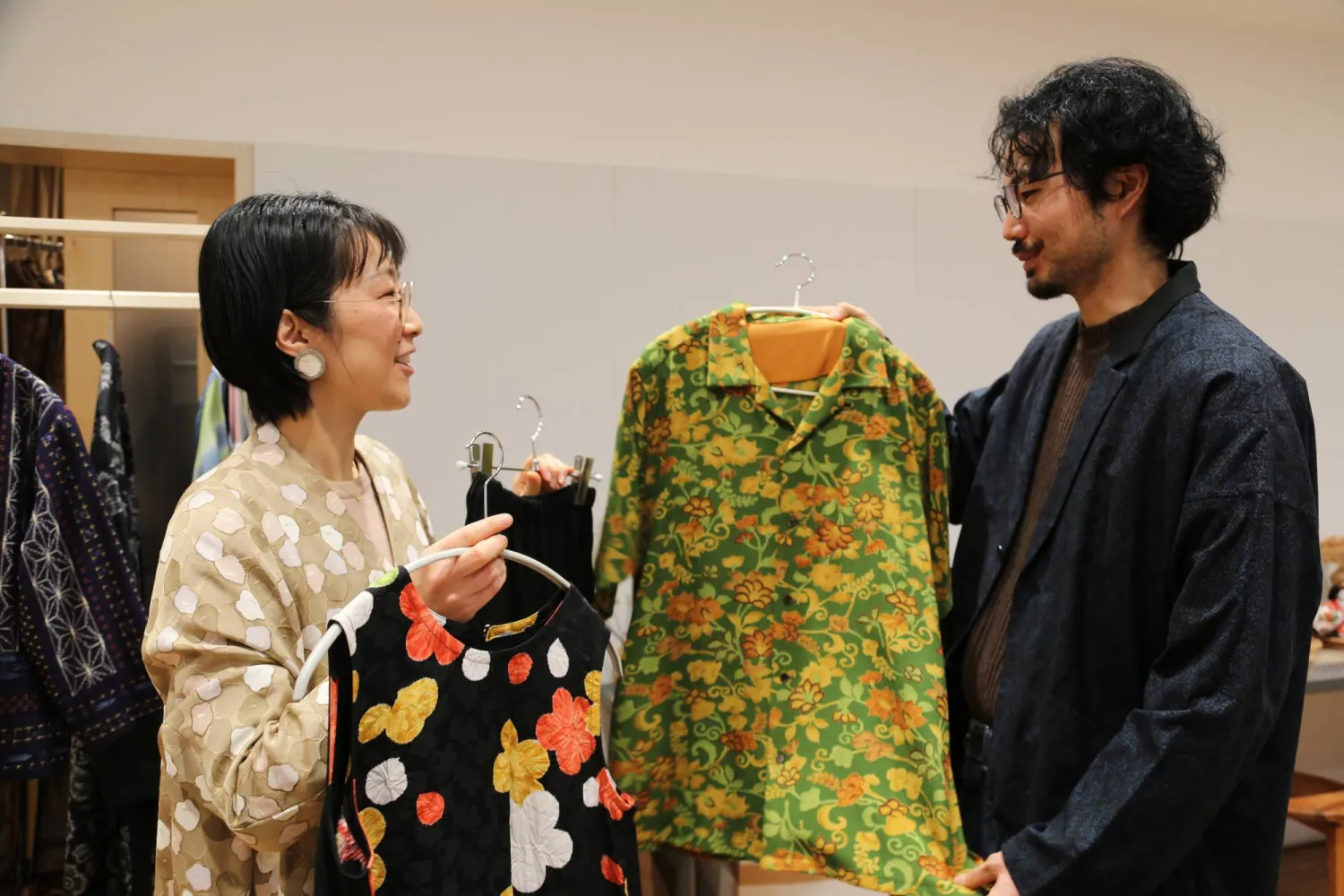
Designer Tomoko Ohkata, left, and her assistant Koki Unami hold Ohkata's designs made from old kimono, in Tokyo, on Jan. 15, 2026. (AP Photo/Yuri Kageyama)
TT

Japan's Traditional Kimonos Are Being Repurposed in Creative Ways

Designer Tomoko Ohkata, left, and her assistant Koki Unami hold Ohkata's designs made from old kimono, in Tokyo, on Jan. 15, 2026. (AP Photo/Yuri Kageyama)

The kimono, that elaborate, delicate wrap-around garment worn by geisha and samurai from centuries back, is getting a vibrant remake, appreciated these days for a virtue that’s more relevant than ever: sustainability.

A genuine silk kimono, which literally means “worn thing,” lasts a hundred years or more. In a Japanese family, it’s handed down over generations like heirloom jewelry, artworks and military medals.

It never goes out of style.

The design of the kimono and accompanying “obi” sash has remained basically the same since the 17th century Edo period depicted in Akira Kurosawa samurai movies.

But today, some people are taking a different creative approach, refashioning the traditional kimono, and also taking apart and resewing them as jackets, dresses and pants.

“I noticed that a lot of beautiful kimono is just sleeping in people’s closets. That’s such a waste,” said Mari Kubo, who heads a kimono-remake business called K’Forward, pronounced “K dash forward.”

Hers is among a recent surge in such services, which also turn old kimono into tote bags and dolls.

The most popular among Kubo’s products are “tomesode,” a type of formal kimono that is black with colorful, embroidered flowers, birds or foliage at the bottom, The Associated Press reported.

She also creates matching sets, or what she calls “set-ups.” A tomesode is turned into a jacket with its long, flowing sleeves intact, and its intricate patterns placed at the center in the back. She then takes a kimono with a matching pattern to create a skirt or pants to go with the top. Sometimes, an obi is used at the collar to add a pop of color.

Kubo said many of her customers are young people who want to enjoy a kimono without the fuss.

A remade kimono at K’Forward can cost as much as 160,000 yen ($1,000) for a “furisode,” a colorful kimono with long sleeves meant for young unmarried women, while a black tomesode goes for about 25,000 yen ($160).

What Tomoko Ohkata loves most about the products she designs using old kimonos is that she doesn’t have to live with a guilty conscience, and instead feels she is helping solve an ecological problem.

“I feel the answer was right there, being handed down from our ancestors,” she said.

Recycling venues in Japan get thousands of old kimonos a day as people find them stashed away in closets by parents and grandparents. These days, Japanese generally wear kimonos just for special occasions like weddings. Many women prefer to wear a Western-style white wedding dress rather than the kimono, or they wear both.

Many of Ohkata’s clientele are people who have found a kimono at home and want to give it new life. They care about the story behind the kimono, she added.

Her small store in downtown Tokyo displays various dolls, including a figure of an emperor paired with his wife, who are traditionally brought out for display in Japanese homes for the Girls’ Day festival every March 3. Her dolls, however, are exquisitely dressed in recycled kimonos, tailored in tiny sizes to fit the dolls. They sell for 245,000 yen ($1,600) a pair.

The original old-style kimono is also getting rediscovered.

“Unlike the dress, you can arrange it,” says Nao Shimizu, who heads a school in Japan’s ancient capital of Kyoto that teaches people how to wear a kimono and how to carry oneself while wearing it.

“In half a year, you can learn how to do it all by yourself,” she said, briskly demonstrating several ways to tie the obi to express different moods, from playful to understated.

Besides its durability, said Shimizu, that versatility also makes the kimono sustainable.

Younger Japanese are taking a more relaxed view, wearing a kimono with boots, for instance, she laughed. Traditionally, kimono is worn with sandals called “zori.”

Although it requires some skill to put on a kimono in the traditional way, one can take lessons from teachers like Shimizu, like learning a musical instrument. Professional help is also available at beauty parlors, hotels and some shops.

Most Japanese might wear a kimono just a few times in their lives. But wearing one is a memorable experience.

Sumie Kaneko, a singer who plays the traditional Japanese instruments koto and shamisen, often performs wearing flashy dresses made of recycled kimonos. The idea of sustainability is deeply rooted in Japanese culture, she says, noting that the ivory and animal hide used in her musical instruments are now hard to obtain.

She calls it “the recycling of life.”

“The performer breathes new life into them,” says the New York-based Kaneko.
“In the same way, a past moment — and those patterns and colors that were once loved — can come back to life.”


‘Something Borrowed’: Dutch Bride Opts for Recycled Wedding

Sustainable development communications specialist and bride-to-be Lara Beters and groom Mathijs Dordregter walk through a ticket gate in Utrecht train station for their wedding inside the station as part of an initiative to highlight sustainability issues, in Utrecht on April 2, 2026. (AFP)
TT

‘Something Borrowed’: Dutch Bride Opts for Recycled Wedding

Sustainable development communications specialist and bride-to-be Lara Beters and groom Mathijs Dordregter walk through a ticket gate in Utrecht train station for their wedding inside the station as part of an initiative to highlight sustainability issues, in Utrecht on April 2, 2026. (AFP)

"Within like 30 minutes I knew this was the one," Lara Peters said of the second-hand wedding dress she had just worn to her marriage -- in the Netherlands' busiest rail station.

Peters, 42, had found the dress two days earlier in a shop run by "Free Fashion", a Dutch foundation devoted to recycling clothing to combat waste -- a cause close to her heart.

That is why she and her 44-year-old husband Mathijs Dordregter chose sustainability as the theme of their wedding -- with the help of Free Fashion.

The organization says it is the kind of trend people everywhere will need to adopt if humankind wants to curb over-consumption and its destructive effect on the planet.

"The message that during your wedding you can also choose sustainable options is very important to me," the bride explained.

Peters works in communications in the sustainable development field, so the couple's choice to hold their wedding ceremony in the bustle of Utrecht rail station had a certain logic to it.

Nina Reimert of the Free Fashion foundation helped organize the event.

"We know that in terms of emissions... producing a wedding dress is similar to something like 250 kilometers (155 miles) by car," she told AFP.

"And they're made of all different materials so they are really hard to recycle and almost everything is polyester," she added.

With 17,000 weddings a year in the Netherlands, she explained, that adds up to a lot of emissions. "It's a nightmare."

It was to draw attention to the over-consumption inherent in many weddings that the Free Fashion foundation decided to make an online appeal to convince couples to approach the happy day from a different perspective.

For as the old saying for weddings goes: "Something old, something new; Something borrowed, something blue."

- Love me, love my planet -

For Free Fashion's co-founder Lot van Os, opting for a second-hand bridal dress -- something that is normally only worn once -- sends a strong message.

"When you celebrate love you should also celebrate love for the planet," he told AFP.

Free Fashion's team of 800 volunteers is much in demand by local councils who want to meet their targets for reducing waste and recycling.

The foundation also works with businesses, helping them organize exchanges of clothing between employees.

For van Os, this practice of exchanging rather than constantly buying new items is a habit people are going to have to acquire in the future.

This "circular transition", he says is something we are all going to have to go through. "It's not a matter of if but when we are going to change," he said.

To underline the wedding's sustainability theme, a pop-up store at the rail station offered dozens of wedding dresses, free to anyone willing to sign up to the concept.

"There are now already enough clothes in the world for the next six generations," said a sign printed outside the store.

Both the bride and the bridegroom wore second-hand outfits for the big day -- as did all their guests.

And the sustainability theme did not end there, said Peters.

Their wedding meal was vegetarian -- less harmful for the environment -- and they travelled to the venue on bikes or by public transport.

"Everything I bought for the wedding was already used at other weddings," added the bride.

As for her wedding dress, she promised: "It's not going to be hanging in my closet!"


Nike’s Turnaround Put to Test as Middle East Conflict Poses New Risks

A man walks past Nike booth with installation of shoes at the 8th China International Import Expo (CIIE) venue in Shanghai, China, November 5, 2025. (Reuters)
TT

Nike’s Turnaround Put to Test as Middle East Conflict Poses New Risks

A man walks past Nike booth with installation of shoes at the 8th China International Import Expo (CIIE) venue in Shanghai, China, November 5, 2025. (Reuters)

Nike's efforts to steady its business ‌face a fresh setback, with executives cautioning that unrest in the Middle East could further complicate the turnaround, while the sportswear giant still struggles to regain traction in China.

The company on Tuesday warned of a sharp drop in current-quarter sales and slower-than-expected progress on its turnaround, as higher trade-related costs squeeze its margins and cautious consumers rein in spending.

Shares of the company slumped 10% to $47.35 in premarket trading on Wednesday and were on track to open at their lowest in over a ‌decade.

On an earnings ‌call, Chief Financial Officer Matthew Friend said ‌the ⁠conflict in the ⁠Middle East had already disrupted shopping behavior in parts of Europe, the Middle East and Africa, contributing to softer store traffic and weaker sportswear sales.

"The Middle East conflict is compounding the pressure, with Nike flagging traffic disruption and elevated inventory across EMEA," said Josh Gilbert, market analyst at eToro.

Nike CEO Elliott Hill, ⁠who took the helm in 2024, has ‌been looking to steady the company ‌as it grapples with several challenges, including a sluggish digital business, ‌stubborn excess inventory and intensifying competition from Chinese sportswear brands.

To boost ‌margins and bolster investor confidence, Hill has moved to rein in promotions, sharpen product innovation and refocus the business on core franchises such as running.

The efforts showed some signs of improvement in the ‌reported quarter, with the running category growing over 20%, but analysts still see a long road ⁠ahead for ⁠Nike.

At least eight brokerages cut their price target on the stock.

"We are turning at least somewhat frustrated, with seemingly slower than planned pace of recovery," Oppenheimer analyst Brian Nagel said.

The company's forward price-to-earnings multiple, a common benchmark for valuing stocks, is 25.47, compared with 13.54 for Adidas and Under Armour's ratio of 25.72, according to LSEG data.

"These earnings show Nike is keeping pace at a steady jog, but it keeps tripping over hurdles along the way," eToro's Gilbert added.

"Patience is clearly the price of admission."


From Plastic Jars to Transport, Iran War Drives up Beauty Industry Costs

Visitors browse stalls at the beauty industry Cosmoprof trade show, in Bologna, Italy, March 26, 2026. Picture taken with a mobile phone. (Reuters)
TT

From Plastic Jars to Transport, Iran War Drives up Beauty Industry Costs

Visitors browse stalls at the beauty industry Cosmoprof trade show, in Bologna, Italy, March 26, 2026. Picture taken with a mobile phone. (Reuters)

The Iran war is seeping into the cosmetics supply chain, pushing up the cost of everything from plastic jars and lipstick tubes to transport, and reminding the beauty industry that even a tub of face cream depends on fragile global trade routes.

Cost pressures were a recurring theme last week at one of the sector's largest trade fairs in the northern Italian city of Bologna, as executives watched Iran's blockade of the vital Strait of Hormuz shipping route approach a fifth week.

The Cosmoprof fair drew 3,100 exhibitors from 68 countries and 255,000 visitors from 150 nations, ranging from companies seeking packaging solutions to retailers scouting new products.

Cosmetics companies are primarily worried about higher raw material and transport costs due to rising oil prices ‌and disrupted shipping, five ‌industry executives told Reuters.

"We are beginning to see cost increases driven ‌by ⁠energy price inflation, compounded ⁠by delivery delays," said Simone Dominici, CEO of Italian cosmetics group Kiko, who estimates additional logistics-related costs of about 1.5 million euros ($1.7 million) for the group over the year.

Kiko, which sells lipsticks starting at 5 euros and mascaras from 7.5 euros, operates more than 1,000 stores worldwide.

"With so many containers stuck in the Middle East, there is a tighter container availability ... and goods are not being moved efficiently," Dominici said, adding that higher prices for some chemical components and packaging - much of it sourced from the ⁠Far East - would add further pressure.

As the Iran crisis upends supply ‌chains, Yonwoo, a container maker for L'Oreal and K-beauty firms, ‌said it was scrambling to secure stocks of plastic resin to manufacture the pots used for skincare and cosmetics.

ALTERNATIVE ‌ROUTES

Beyond higher costs, the industry could also face softer demand from consumers whose purchasing power ‌is being eroded by inflation, Dominici said.

"It's the perfect storm," he warned.

Milan-listed Intercos and privately owned Ancorotti Group, among Italy's largest contract manufacturers in the sector, said they had not yet faced major supply shortages but cited higher logistics costs, longer delivery times and rising raw material prices as challenges.

"Lead times have lengthened as routes have ‌become longer and ports more congested. What once took eight weeks now can take 12 to 14 weeks," said Ancorotti Chief Executive Roberto ⁠Bottino.

Some clients have turned ⁠to rail transport to reach Asia, Bottino added.

Ancorotti Group makes around 220 million euros in revenues per year from selling products to beauty brands worldwide.

Bottino said it was difficult to imagine supply-chain cost increases not ultimately being passed downstream.

"Middle East customers value quality and are willing to pay a premium for added value, so being unable to access these markets can have a negative impact," said Fabio Franchina, chairman of haircare products maker Framesi.

Franchina said the company's distributor in the region was exploring alternative delivery routes.

"They are looking at ... (options such as) shipping to Jeddah and then moving goods by road instead of routing them through Gulf ports," he said.

Some goods are currently being shipped by air rather than by sea, he added, further lifting costs.

Italy produced 18 billion euros of cosmetics in 2025, including 8.4 billion euros in exports, according to industry body Cosmetica Italia, making the country the world's fifth-largest exporter of beauty products and one of the leading producers of hair dyes, eye make-up and fragrances.