


JD Sports' Quarterly Sales Fall on Weak UK but US Shows Improvement

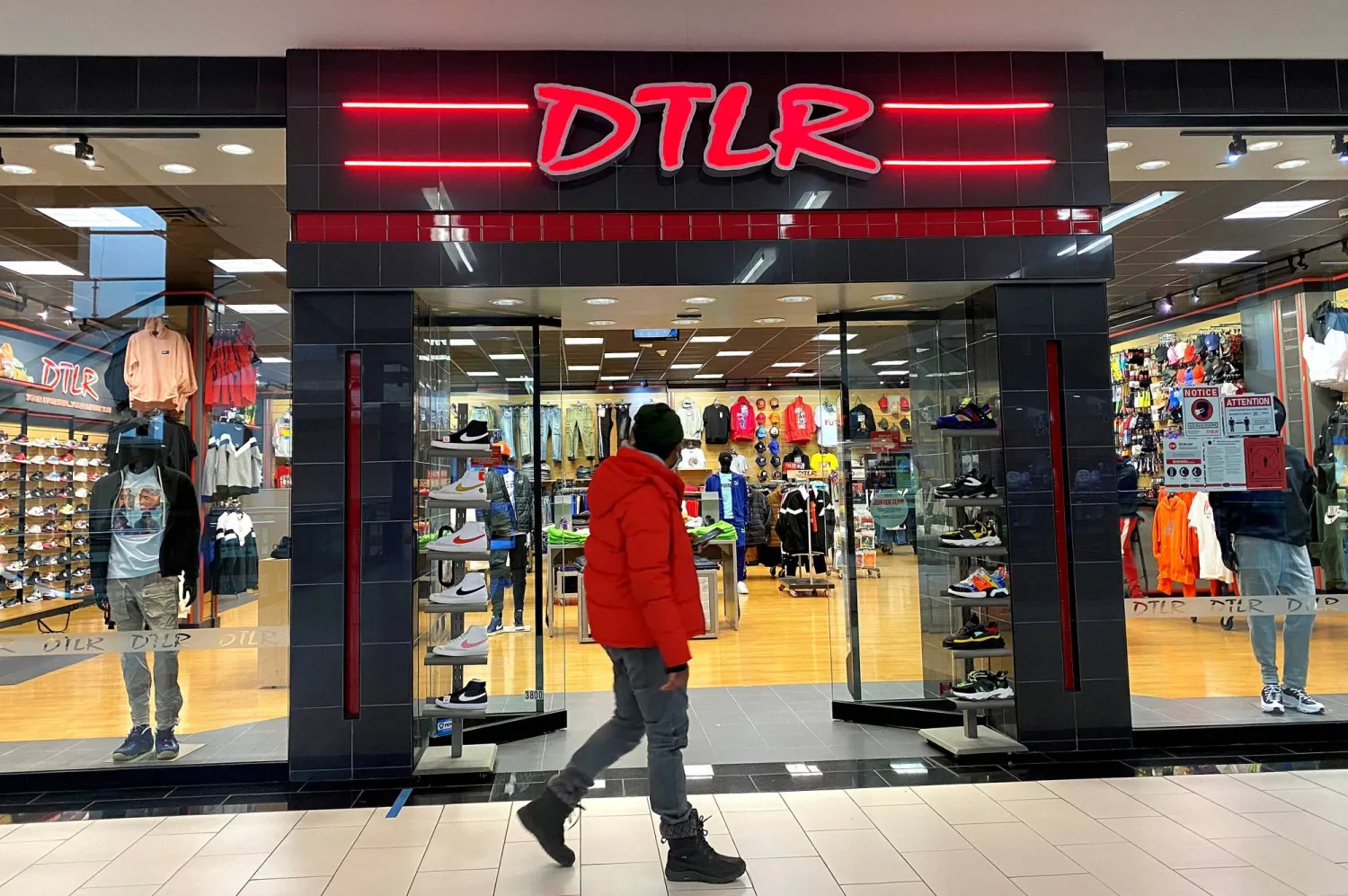
FILE PHOTO: A person walks past a DTLR sportswear store at Palisades Center Mall in West Nyack, New York, US, February 3, 2021. REUTERS/Mike Segar/File Photo
TT

JD Sports' Quarterly Sales Fall on Weak UK but US Shows Improvement

FILE PHOTO: A person walks past a DTLR sportswear store at Palisades Center Mall in West Nyack, New York, US, February 3, 2021. REUTERS/Mike Segar/File Photo

JD Sports Fashion reported a steeper decline in second quarter underlying sales, reflecting weakness in the UK, though there were signs of stabilization in its key US market after a sharp decline in the previous quarter.

The sportswear retailer, which makes nearly 40% of its revenue in the United States through its JD Sports, Hibbett, DTLR and Shoe Palace stores, said like-for-like sales for its second quarter to August 2 fell 3.0%, having been down 2.0% in the first quarter.

Shares in FTSE 100-listed JD have lost a third of their value over the last 12 months, reflecting a market driven by discounts, a drop-off in demand for Nike products, which account for about 45% of its sales, and uncertainty over the impact of US President Donald Trump's tariffs on costs and consumer demand.

The stock was up 4% in early trading Wednesday.

The group said a 6.1% fall in like-for-like sales in the UK reflected a tough prior year comparison when trade was boosted by the men's Euro 2024 soccer tournament.

But it saw an improving trend in North America where like-for-like sales fell 2.3%, having been down 5.5% in the previous quarter, reflecting the deferral of several product launches from the first quarter, as well as stronger sales trends in apparel and online.

"We believe this is a better outcome than the market expected and is further vindication of strategy," analysts at Peel Hunt said.

JD forecast full-year 2025/26 profit before tax and adjusting items in line with current market expectations of 852 million pounds to 915 million pounds ($1.15-$1.24 billion), down from the 923 million pounds made in 2024/25.

That forecast is, however, before any indirect impact of US tariffs which the group is continuing to work through.

"Across our regions and fascias, in general we see a resilient consumer, albeit very selective on their purchases. We therefore remain cautious on the trading environment going into H2," CEO Regis Schultz said.

JD also announced a new 100 million pound share buyback program, which it said reflected its confidence in medium-term industry growth and ongoing market share gains.



A Nonprofit in France Is Fighting Fast-Fashion Waste, One Sneaker at a Time

 Mohamed Boukhatem, co-founder and director of SneakCoeurZ, a nonprofit organization giving used footwear a second life, poses in Champs-sur-Marne, east of Paris, Wednesday, March 25, 2026. (AP)
Mohamed Boukhatem, co-founder and director of SneakCoeurZ, a nonprofit organization giving used footwear a second life, poses in Champs-sur-Marne, east of Paris, Wednesday, March 25, 2026. (AP)
TT

A Nonprofit in France Is Fighting Fast-Fashion Waste, One Sneaker at a Time

 Mohamed Boukhatem, co-founder and director of SneakCoeurZ, a nonprofit organization giving used footwear a second life, poses in Champs-sur-Marne, east of Paris, Wednesday, March 25, 2026. (AP)
Mohamed Boukhatem, co-founder and director of SneakCoeurZ, a nonprofit organization giving used footwear a second life, poses in Champs-sur-Marne, east of Paris, Wednesday, March 25, 2026. (AP)

Hundreds of used sneakers arrive each week at a workshop east of Paris, where workers inspect them and ask a simple question: Can a shoe be saved?

The nonprofit SneakCœurZ is in the business of sorting the shoes to check which ones can be resold or redistributed, and which have to be rejected. It says it collected 30,000 pairs of used sneakers last year and resold 2,000 pairs, and wants to scale up that process.

“Today, there is no project of this scale in the sneaker sector,” said Mohamed Boukhatem, the organization's director general and co-founder. “We are the only ones able to industrialize both the processes and the collection of sneakers for reuse.”

The group's work underscores a growing waste problem in France, where the capital Paris is long one of the world’s fashion and luxury hubs.

The stakes are huge: the textile industry is among the world’s most polluting, and the fashion and textiles sector accounts for up to 8% of global greenhouse gas emissions, according to the United Nations. The European Parliament has said textiles were the third-largest source of water degradation and land use in the European Union in 2020.

Refashion, the French government-approved eco-organization for clothing, household linen and footwear, says 259 million pairs of shoes were sold in France in 2024.

It says only about a third of used textiles and footwear are separately collected, with much of the rest left in cupboards or thrown away with household waste.

At its workshop in Champs-sur-Marne, workers for SneakCœurZ inspect the used shoes and check which can be salvaged.

“The structural elements of the shoe are what determine whether we can refurbish it or not,” workshop manager Paul Defawes Abadie said.

“A damaged Velcro strap isn’t a deal breaker. A lace isn’t a deal breaker. Dirt is never a deal breaker,” he said. “What really matters is the wear of the structural materials, especially the outsole.”

Pairs that make the cut are cleaned from the sole upward, disinfected inside and, in some cases, whitened under UV light before being put back into circulation.

The nonprofit says it redistributed more than 7,000 pairs to people in need and helped create 19 jobs.

“Over the next three years, the goal is to triple or even quadruple these volumes and move to an industrial scale,” Boukhatem said.

France has tried to respond to the issue of fast-fashion waste with law, as well as rhetoric.

Its 2020 anti-waste law requires unsold nonfood goods to be reused, donated or recycled instead of destroyed.

Authorities introduced a state-backed repair bonus for clothing and shoes in November 2023. Separately, lawmakers are still working on a bill aimed at reducing the textile industry’s environmental impact.

The bill passed the National Assembly in March 2024 and the Senate in June 2025, and the government said in February that it was still aiming for a joint parliamentary committee this spring.


H&M's Q1 Profit Grows More Than Expected, Sees March Sales Up 1%

FILE PHOTO: A Swedish flag hangs outside a business on a street of the old city of Stockholm, Sweden, February 24, 2024. REUTERS/Tom Little/File Photo
TT

H&M's Q1 Profit Grows More Than Expected, Sees March Sales Up 1%

FILE PHOTO: A Swedish flag hangs outside a business on a street of the old city of Stockholm, Sweden, February 24, 2024. REUTERS/Tom Little/File Photo

Swedish fashion retailer H&M reported on Thursday a slightly bigger rise than expected in December-February operating profit, and predicted March sales would be up 1% in local currencies.

"Towards the end of the quarter our well-received spring collections contributed to a positive sales trend, which also continued into March," CEO Daniel Erver said in a statement.

Operating profit in H&M's fiscal first quarter, ⁠which includes the key ⁠Christmas shopping period, rose for a third consecutive quarter to 1.51 billion crowns ($162 million) from a year-earlier 1.20 billion and a mean forecast in an LSEG poll of analysts of 1.39 billion, on an organic sales decrease of 1%.

The rival ⁠to Inditex in January flagged that local-currency sales in the first two months of the quarter were down 2%.

According to Reuters, H&M said it is closely monitoring developments in the Middle East and the implications for global trade.

"With good flexibility in the supply chain and a low proportion of air freight, there are opportunities to adapt the flow of goods to changed conditions," it said. "Middle Eastern markets account for a ⁠small portion ⁠of the company’s total sales and the markets are operated through franchise partners."

On February 28, the United States and Israel launched coordinated strikes against Iran. Iran has in response launched strikes against Israel, US bases and Gulf states.

It has attacked vessels and infrastructure throughout the Gulf region and effectively closed the Strait of Hormuz, hitting global supply chains and causing soaring energy costs, raising concern over war-driven inflation and potential impact on consumer demand.


Next Says UK Sales Have Held Up Since Iran War Started

Women tour a popular outdoor shopping mall in Beijing, China, Sunday, March 8, 2026. (AP Photo/Andy Wong)
TT

Next Says UK Sales Have Held Up Since Iran War Started

Women tour a popular outdoor shopping mall in Beijing, China, Sunday, March 8, 2026. (AP Photo/Andy Wong)

British clothing retailer Next has not seen a noticeable drop off in UK sales since the US-Israeli war on Iran started at the end of February, its boss said on Thursday.

"Eight weeks, ⁠including the war ⁠weeks, have been good in the UK," CEO Simon Wolfson told Reuters after Next published full-year ⁠results.

He said sales in the Middle East, which account for about 6% of the group's annual turnover, fell "dramatically" in the first few days of the war and demand remains "suppressed.”

Wolfson said if ⁠Next ⁠did have to raise prices around June or July to make up for higher costs caused by the war, the increases would only be 1% to 2%.