

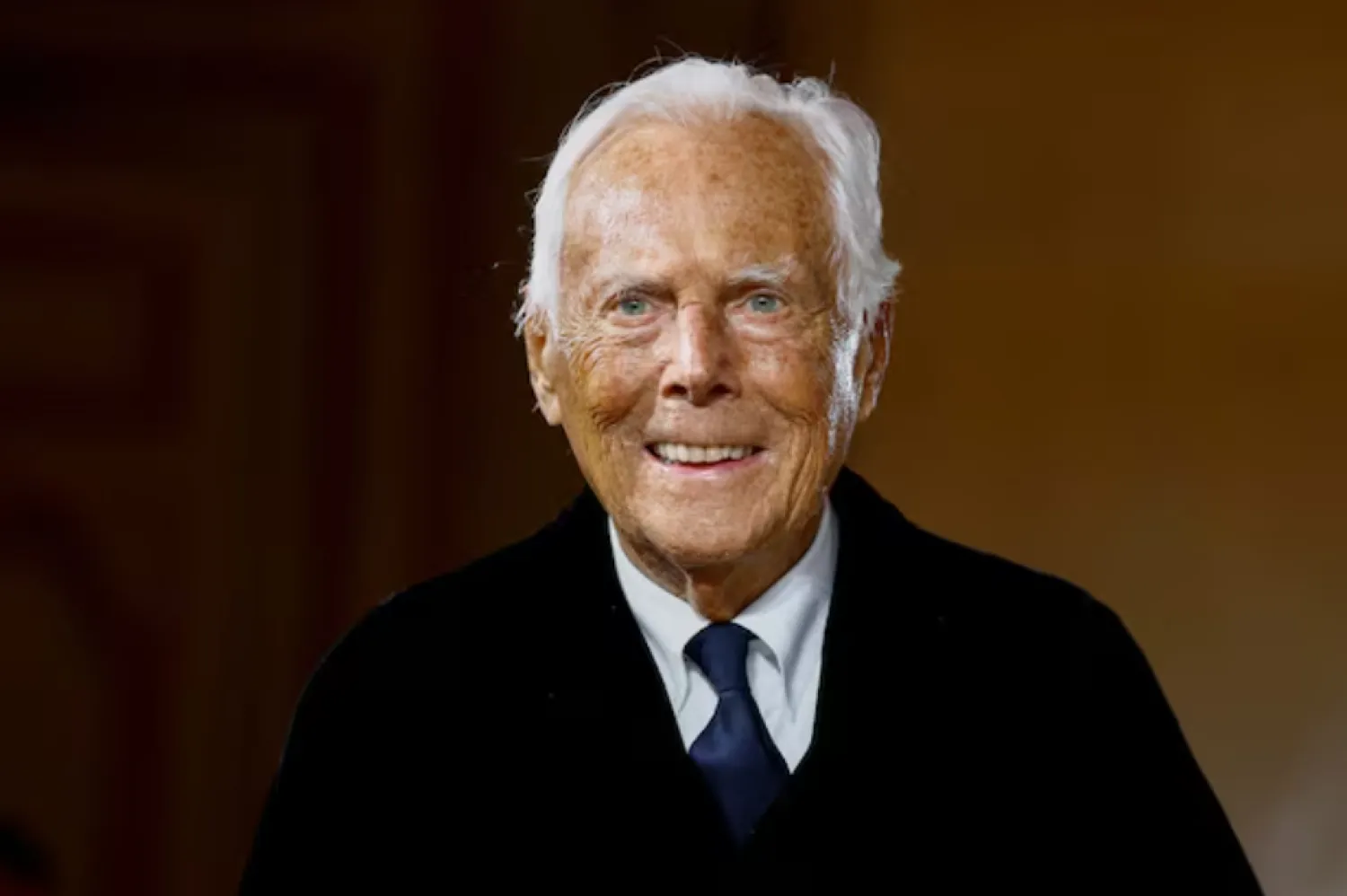

Fashion Designer Giorgio Armani Dead at 91

Designer Giorgio Armani appears at the end of his Haute Couture Spring/Summer 2025 collection show for Giorgio Armani Prive in Paris, France, January 28, 2025. REUTERS/Sarah Meyssonnier/File Photo
TT

Fashion Designer Giorgio Armani Dead at 91

Designer Giorgio Armani appears at the end of his Haute Couture Spring/Summer 2025 collection show for Giorgio Armani Prive in Paris, France, January 28, 2025. REUTERS/Sarah Meyssonnier/File Photo

Giorgio Armani, the Italian designer who turned the concept of understated elegance into a multibillion-dollar fashion empire, has died, his fashion house confirmed. He was 91.

Armani died at home, the fashion house said. Armani, one of the most recognizable names and faces in the global fashion industry, missed Milan Fashion Week in June 2025 for the first time during the previews of Spring-Summer 2026 menswear to recover from an undisclosed condition. He was planning a major event to celebrate 50 years of his signature Giorgio Armani fashion house during Milan Fashion Week this month.

Starting with an unlined jacket, a simple pair of pants and an urban palette, Armani put Italian ready-to-wear style on the international fashion map in the late 1970s, creating an instantly recognizable relaxed silhouette that has propelled the fashion house for half a century, The AP news reported.

From the executive office to the Hollywood screen, Armani dressed the rich and famous in classic tailored styles, fashioned in super-soft fabrics and muted tones. His handsome black tie outfits and glittering evening gowns often stole the show on award season red carpets.

At the time of his death, Armani had put together an empire worth over $10 billion, which along with clothing included accessories, home furnishings, perfumes, cosmetics, books, flowers and even chocolates, ranking him in the world’s top 200 billionaires, according to Forbes.

The designer also owned several bars, clubs, restaurants and his own basketball team EA7 Emporio Armani Milan, better known as Olympia Milano. Armani opened more than than 20 restaurants from Milan to Tokyo since 1998, and two hotels, one in Dubai in 2009 and another in Milan, in 2010.

Armani himself was the foundation of his style Armani style began with Giorgio Armani himself, from the penetrating blue eyes framed in a permanent tan and early-age shock of silver hair, to the trademark jeans and t-shirt work clothes and the minimalist decoration of his private homes.

Armani’s fashion vision was that of easygoing elegance where attention to detail made the difference.

“I design for real people. There is no virtue whatsoever in creating clothes and accessories that are not practical,” he liked to say when asked to identify his clientele.

In conversation, the designer’s disarming smile and exquisitely mild manners belied the tough businessman underneath, who was able to turn creative talent into a fashion empire worth over $10 billion. Never a merger nor a sale, Re Giorgio (King George) as the Italians call him, was always his own boss.

Born July 11, 1934, in Piacenza, a small town south of Milan, Armani dreamed of becoming a doctor before a part-time job as a window decorator in a Milan department store opened his eyes to the world of fashion.

In 1975, Armani and his partner Sergio Galeotti sold their Volkswagen for $10,000 to start up their own menswear ready-to-wear label. Womenswear followed a year later.

The symbol of his new style was the liningless sports jacket, which was launched in the late 1970s and became an instant success from Hollywood to Wall Street. The designer paired the jacket with a simple t-shirt, an item of clothing he termed “the alpha and omega of the fashion alphabet.”

The Armani suit soon became a must in the closet of the well-heeled man. And for women, the introduction of the pantsuit in the executive workroom was all but revolutionary. Dubbed the “power suit” with its shoulder-padded jacket and man-tailored trousers, it became the trademark of the rising class of businesswomen in the 1980s.

Over the years Armani would soften the look with delicate detailing, luxurious fabrics and brighter shades for his basic beige and gray palette. His insistence on pants and jackets led some critics to label his fashion “androgynous.”

Armani hits Hollywood The 1980 film classic “American Gigolo” launched both Armani and actor Richard Gere on their Hollywood careers. Dressed in Armani, Gere became America’s new favorite heart throb, and “Geeorgeeo” as they called him, the glam set’s most popular designer.

The Hollywood connection earned him wardrobe film credits in over 200 films, and in 2003 a place on Rodeo Drive’s “Walk of Fame.”

Oscar night always sparkled, with smart suiting for the men, and glittering gowns for the ladies. The 2009 best actor winner Sean Penn picked up his statue in a black-on-black Armani outfit, while best actress nominee Anne Hathaway walked the red carpet in a shimmering white strapless evening gown from Armani’s latest Prive couture collection.

Other longtime devotees included Jodie Foster, George Clooney, Sofia Loren and Brad Pitt. David and Victoria Beckham were the “face” of his 2009 underwear ad campaign.

So significant was the impact of Armani style, not only on how people dressed but how they approached fashion, that in 2000 New York’s Guggenheim museum presented a retrospective of Armani’s first 25 years in fashion.

“I love things that age well, things that don’t date and become living examples of the absolute best,” Armani said of his efforts.

Armani has gone well beyond fashion Today, the Armani empire has an army of more than 9,000 employees, with women comprising half of the executive suite, along with seven industrial hubs and over 600 stores worldwide, according to figures released in 2023. Along with clothes and accessories, the company produces perfumes, cosmetics and home furnishings, as well as selling its own candy, flowers and even books. The designer opened his fifth multi-brand store on New York’s fashionable Fifth Avenue in February 2009.

In the realm of fashion hobbies, Armani owned several bars, restaurants and clubs, as well as the basketball team. Recreation time was spent in getaways in Broni in the countryside near Milan, the isle of Pantelleria off Sicily and St. Tropez on the French Riviera. Each home bore the trademark of Armani design: bare walls, important pieces, few knickknacks.

Like many of his colleagues, Armani tried to give back some of the fame and fortune he amassed during the heyday of the “moda Milanese” which put Italian ready-to-wear at the center of the world’s fashion map at the turn of the millennium. Personally involved in several charity organizations devoted to children and a staunch supporter of the battle against AIDS, in 2002 Armani was named a U.N. goodwill ambassador for refugees.

Galeotti died in 1985. Armani had no children but was very close to his niece Roberta, daughter of his late brother Sergio. She abandoned a budding film career to become his director of public relations, and often represented her uncle, who wasn’t much of a party-goer, at social events. In later years she was a key go-between with the celebrity world.

In 2006, she orchestrated the top-billed wedding of actors Tom Cruise and Katie Holmes in a medieval castle outside Rome, while Uncle Giorgio designed the attire for both bride and groom.

Armani had indicated that as he considered succession he was looking toward his longtime head of menswear Leo Dell’Orco and his niece Silvana Armani, who fills the same role for womenswear.



Valentino, Fashion Designer to the Jet Set, Dies Aged 93 in Rome

Italian fashion designer Valentino Garavani celebrates 45 years in the fashion business as his latest haute couture line makes its debut at the "Complesso Monumentale di Borgo Santo Spirito in Sassia", in Rome, Italy, on 07 July 2007. (EPA)
TT

Valentino, Fashion Designer to the Jet Set, Dies Aged 93 in Rome

Italian fashion designer Valentino Garavani celebrates 45 years in the fashion business as his latest haute couture line makes its debut at the "Complesso Monumentale di Borgo Santo Spirito in Sassia", in Rome, Italy, on 07 July 2007. (EPA)

Valentino Garavani, the jet-set Italian designer whose high-glamour gowns — often in his trademark shade of “Valentino red” — were fashion show staples for nearly half a century, has died at home in Rome, his foundation announced Monday. He was 93.

“Valentino Garavani was not only a constant guide and inspiration for all of us, but a true source of light, creativity and vision,” the foundation said in a statement posted on social media.

His body will repose at the foundation’s headquarters in Rome on Wednesday and Thursday. The funeral will be held Friday at the Basilica Santa Maria degli Angeli e dei Martiri in Rome’s Piazza della Repubblica.

Universally known by his first name, Valentino was adored by generations of royals, first ladies and movie stars, from Jackie Kennedy Onassis to Julia Roberts and Queen Rania of Jordan, who swore the designer always made them look and feel their best.

“I know what women want,” he once remarked. “They want to be beautiful.”

Never one for edginess or statement dressing, Valentino made precious few fashion faux-pas throughout his nearly half-century-long career, which stretched from his early days in Rome in the 1960s through to his retirement in 2008.

His fail-safe designs made Valentino the king of the red carpet, the go-to man for A-listers’ awards ceremony needs. His sumptuous gowns have graced countless Academy Awards, notably in 2001, when Roberts wore a vintage black and white column to accept her best actress statue. Cate Blanchett also wore Valentino — a one-shouldered number in butter-yellow silk — when she won the Oscar for best supporting actress in 2004.


Milan Fashion Week: Five Trends and Buzzwords from Menswear Previews for Next Winter

Models wear creations as part of the Ermenegildo Zegna Fall/Winter 2026-2027 Men's collection presented in Milan, Italy, Friday, Jan. 16, 2026. (AP Photo/Antonio Calanni)
TT

Milan Fashion Week: Five Trends and Buzzwords from Menswear Previews for Next Winter

Models wear creations as part of the Ermenegildo Zegna Fall/Winter 2026-2027 Men's collection presented in Milan, Italy, Friday, Jan. 16, 2026. (AP Photo/Antonio Calanni)

The Olympic spirit permeated Milan Fashion Week, closing Monday, from Canadian designers Dsquared2 cheeky tribute to the Games, Emporio Armani’s in-store parade of Team Italia’s uniforms and Ralph Lauren’s celebrity-packed runway show, strong on ski resort wear as it prepares to outfit Team USA.

Fashion always reflects what is going on in the world at large, and the front-row chatter went beyond silhouettes, notably streamlined at Prada, and striking, inventive accessories, like Dsquared2’s hybrid winter footwear, to questions of diversity and sustainability.

Some highlights from four days of mostly menswear previews for Fall-Winter 2026-27:

Olympic Spirit The Italian fashion house Dsquared2, founded by Canadian twins Dean and Dan Caten, made a strong, if ironic, case for why they would have been a fun choice as Team Canada’s official Olympic outfitter for the Feb. 6-22 Games. Fellow Canadian Hudson Williams, the actor starring in the buzzy series “Heated Rivalry’’ about a gay hockey love story, opened the show, strutting down a fake-snow-covered staircase wearing a ripped double denim jacket and sparkly racing number.

Dsquared2 was a gold-medal contender for best footwear of the season. For women, the twins created a hybrid floating high heel that snaps into a sturdy ski boot at the ankle. The brand created a similar mashup for men. The designers played with Olympic imagery with their usual irreverence, including an intarsia Gold medal on a ski sweater, yet mindful of the International Olympic Committee’s strictly enforced copyrights.

Ralph Lauren presented a much more patrician approach to mountaineering in its stately Milan palazzo, with a mélange of colorful patterned knits and cozy fleece jackets layered with puffers and flannel that evoked the brand’s wholesome American heritage. Shown to an intimate celebrity crowd that included Nick Jonas, Tom Hiddleston and Noah Schnapp, the collection offered a cozy entrée to the Olympic season, even as news from home was anything but reassuring.

"As a designer you feel the vibrations in the world. Living in New York City and traveling around the world, you feel the vibrations, and if you are sensitive to that, you develop an ear or a feel for the clothes that you think you're going to do the next season,'' founder Ralph Lauren said in a social media campaign before the show.

Hats off at Prada Prada’s co-creative directors Miuccia Prada and Raf Simons explored the range of men’s headwear, from berets to fedoras, made foldable as if origami, that when flattened could be snapped onto the back of outerwear.

Runway highlights included a modular men’s cape that fit over coats and jackets, giving a layer of protection and utility. Men’s dress shirts had T-shirt necklines and buttoned down the back; exaggeratedly long and purposely worn cuffs protruded from jacket sleeves.

The ultra-slim silhouette of base layer car coats had fashionistas talking, but Miuccia Prada was unapologetic: “That’s fashion.’’

“Talking about intellectual honesty, we are working for a brand that sells expensive clothes to possibly rich people, and so you have to deal with beauty, elegance, to understand what is believable,’’ she said.

Legacy and Sustainability Zegna creative director Alessandro Sartori’s latest collection is about wardrobe building over seasons with pieces that can endure generations, like the fashion house itself that recently named co-CEOs from its fourth generation.

Sartori said he aims to produce more than fashion, but pieces that offer both quality and aesthetics. The jacket of the season was longer and more voluminous with square shoulders that can be worn single-breasted, double-breasted or more casually in a unique formation of three horizontal buttons. The styling versatility is achieved with a clever button-reversing mechanism.

“Our customers are collectors, and not just fashionistas,’’ he said. “I want people to collect pieces like watches.’’

Underlining that brand identity, Zegna displayed behind glass a nearly century-old jacket made with the company’s own fabrics. Today, the family-run business controls about 60% of its supply chain, which gives it a unique footprint as other Italian brands are enveloped in a supply chain scandal.

Simon Cracker, a 15-year-old brand featuring upcycled fashion, is among a small cadre of fashion houses on the Milan runway that can talk up sustainability with any credibility.

Jewelry for Men From the red carpet to the runway, jewelry is becoming a central consideration for men’s wardrobes. Dolce & Gabbana’s evening looks were strong on lapel jewels, from big floral pins to ornate gold brooches embedded with watches, some with long, elegant chains — true heirloom pieces. Giorgio Armani included a smattering of subtle lapel pins for men.

Prada fastened its exaggeratedly long sleeves with gemstone cufflinks, like lapis lazuli and tiger’s eye. Mismatched sculptural earrings finished the look.

Diversity and inclusion Ghanaian designer Victor Hart made his Milan runway debut supported by the decade-old Afrofashion Association, with a strong collection of statuesque denim looks that incorporated street touches like industrial belting.

Milan fashion experienced a mini-Renaissance of diversity and inclusion in the wake of the Black Lives Matters movement in 2020, after designers like Stella Jean and Edward Buchanan as well as the Afrofashion Association's Michelle Ngonmo, demanded action. But the spotlight has dimmed more recently.

Casting models from different races is the easiest, and some say most performative, way to achieve diversity. And still brands fall short. Dolce & Gabbana, which weathered a storm in 2018 over advertisements that were perceived as anti-Asian, was called out on social media for all-white runway casting for Saturday’s menswear show.

French fashion TikToker Elias Medini called it “fifty shades of white," while Hanan Besovic, the influencer behind @ideservecouture, said “having a cast of all white models in 2026 is diabolical.’’


Cartier Owner Richemont Beats Sales Forecasts as China Recovery Continues

The Swiss-based company said sales in its fourth quarter to end-March rose to 5.17 billion euros ($5.80 billion). (AFP)
TT

Cartier Owner Richemont Beats Sales Forecasts as China Recovery Continues

The Swiss-based company said sales in its fourth quarter to end-March rose to 5.17 billion euros ($5.80 billion). (AFP)

Cartier owner Richemont reported sales ahead of market expectations on Thursday, buoyed by strong global demand for jewelry and a continued recovery in greater China, its second-biggest market and a bellwether for the luxury sector.

The Swiss company's shares rose 3% on the reading with investors looking for signs the luxury goods industry can return to stable growth in a year already marked by geopolitical turmoil and the bankruptcy of one of the sector's largest retail groups, Saks Global.

The world's second-largest luxury company, which also owns Van Cleef & Arpels and Buccellati, said sales in its September-to-December third quarter rose to 6.4 billion euros ($7.45 billion), a 4% year-on-year increase in reported currencies.

That beats an analyst consensus of 6.28 billion euros cited by Visible Alpha and represents an ‌11% increase when ‌measured in constant currencies, Reuters said.

Richemont's trading update provides the first clues on demand for ‌luxury ⁠goods going into ‌2026. LVMH is due to report its annual results later this month, followed by Hermes and Gucci-owner Kering in February. Smaller Italian cashmere brand Brunello Cucinelli was the first luxury brand to report quarterly sales this week.

Shares of sector peers, including watch company Swatch and Birkin-bag maker Hermes, rose in early trade following Richemont's results announcement.

CHINESE MARKET CONTINUES GROWTH REBOUND

Richemont highlighted continued improvement in China, Hong Kong and Macau, where its sales rose by 2%. China accounts for just under 20% of the company's sales, according to a Bank Vontobel estimate, ranking second behind the United States.

The greater China performance "mostly led by ⁠solid activity in Hong Kong" was the second quarter in a row that Richemont has reported improved sales in the region, following a 7% rise ‌in the previous three months.

China has been luxury's main growth engine in ‍recent years, but has been struggling with a sticky ‍real estate crisis and a shift in consumer appetite that have weighed on demand for Western brands.

Richemont's reported ‍trends from China "may be regarded as a pivotal moment", RBC analyst Piral Dadhania said in a note, adding that its performance is a positive signal for the wider luxury sector.

Demand in China, where most European houses saw their sales decline heavily last year, is seen as a decisive factor for the luxury industry to return to sustained growth.

"The Chinese consumer holds the key to luxury and is thus the critical sector theme for 2026," Berenberg analyst Nick Anderson said in a recent note to clients.

JEWELLERY UP BUT GOLD PRICES, STRONG FRANC PRESSURE MARGINS

Following two ⁠years of stagnation, analysts are beginning to turn more optimistic on the $400 billion luxury industry, with jewelry seen as a critical growth driver since inflation-wary shoppers view it as an investment rather than a mere treat.

Richemont's jewelry sales were up 14% helped by the launch of novelty items such as bracelets and pendants, which tended to be slightly cheaper and were popular during the gifting season.

"Jewelry is in strong shape, and Richemont dominates it with its brands," Bernstein analysts said.

The company's watchmaking business, which includes the IWC and Jaeger-LeCoultre brands, lifted sales by 7%.

Pressures on Richemont's margins due to record-high gold prices and the strong Swiss franc, however, will likely persist and could impact the group's profit outlook for the next business year if not countered by more price increases, analysts from Deutsche Bank said.

A company spokesperson declined to comment on the bankruptcy of Saks Global, the owner of US department stores Saks Fifth Avenue, Bergdorf Goodman and Neiman Marcus.

Richemont ‌is among the retailer's top unsecured creditors. Saks owes about $3.4 billion to creditors, while claims by the top 30 unsecured creditors are worth a total of $712 million, bankruptcy filings show.