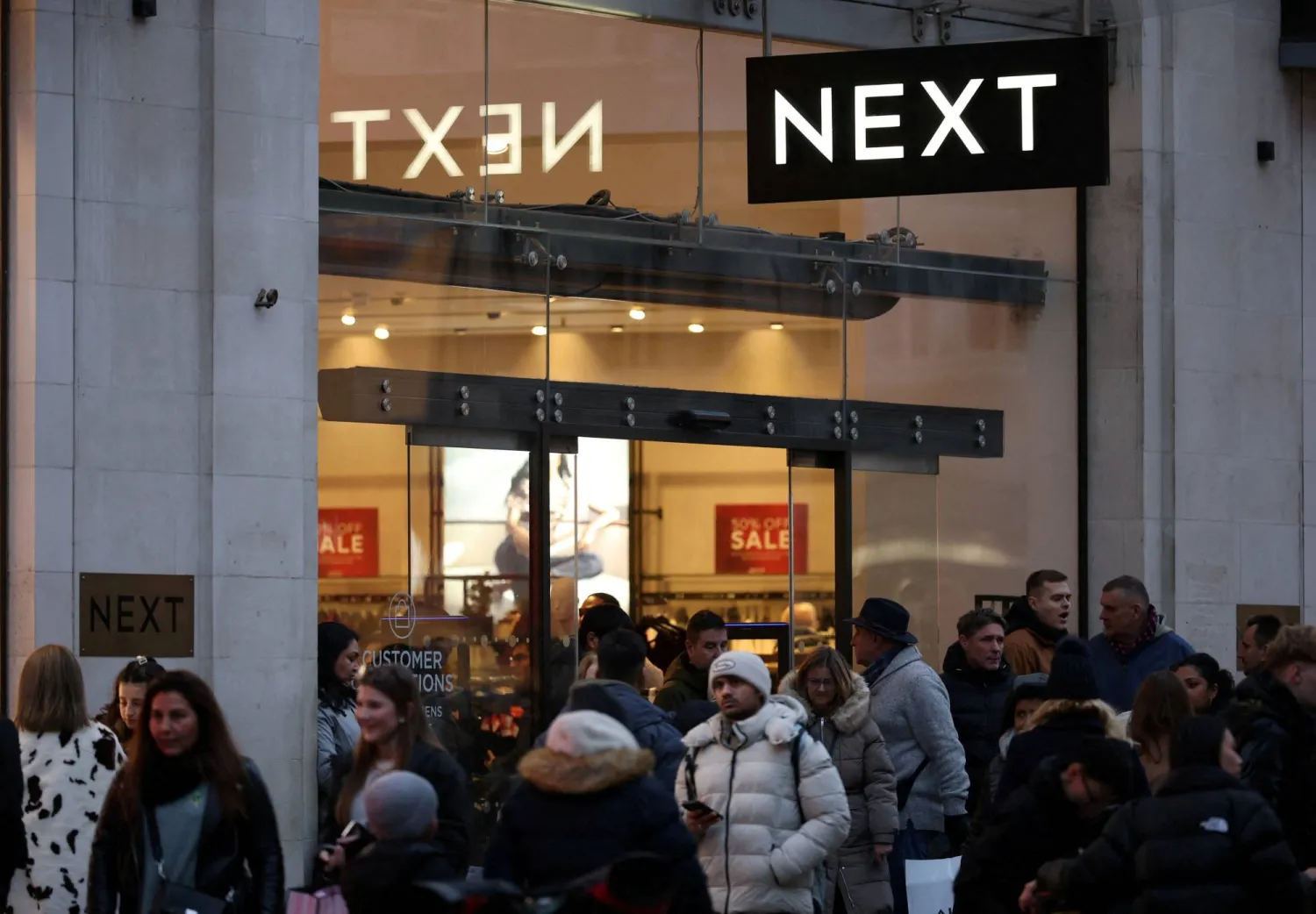
UK's Next Edges Up Profit Outlook after Christmas Sales Beat Expectations

FILE PHOTO: Shoppers walk past a NEXT retail store on Oxford Street in London, Britain, December 28, 2025. REUTERS/Isabel Infante/File Photo
TT

UK's Next Edges Up Profit Outlook after Christmas Sales Beat Expectations

FILE PHOTO: Shoppers walk past a NEXT retail store on Oxford Street in London, Britain, December 28, 2025. REUTERS/Isabel Infante/File Photo

British fashion retailer Next on Tuesday reported a better-than-expected 10.6% increase in full-price sales for the nine weeks to December 27 and edged up its annual profit guidance for the fifth time over the last year.

Subdued UK ⁠consumer confidence ahead of Christmas coupled with unseasonably mild weather had left analysts cautious about clothing retailers' festive trading prospects.

However, Next reported a 5.9% increase in UK ⁠sales year-on-year, with international sales up 38.3%.

According to Reuters, the group said it now expected to report a pretax profit of 1.15 billion pounds ($1.56 billion) for its year to January 2026, up from previous guidance of 1.135 billion pounds and the 1.011 billion pounds it made in ⁠2024/25 when it breached the 1 billion pounds mark for the first time.

Next forecast a further 4.5% increase in profit to 1.202 billion pounds for its 2026/27 year, on full-price sales up 4.5%.

Shares in Next have risen 43% over the last year.


Tailors and Dressmakers Retire their Pincushions as US Demand for Skilled Sewers Grows

A heart-shaped pincushion bristling with needles hangs on the wall inside Kil Bae's store on Friday, March 27, 2026, in New York. (AP Photo/Andres Kudacki)
TT

Tailors and Dressmakers Retire their Pincushions as US Demand for Skilled Sewers Grows

A heart-shaped pincushion bristling with needles hangs on the wall inside Kil Bae's store on Friday, March 27, 2026, in New York. (AP Photo/Andres Kudacki)

Hunched over a sewing machine, Kil Bae is hemming a dress inside his Manhattan tailor shop when a new customer stops by with a vintage Tommy Hilfiger jacket he wants taken in.

The modeling agent paid $20 at a thrift store for his reversible bomber style that's plaid on one side and red on the other. He's willing to spend $280 to have it slimmed down. Alteration requests with such a price disparity would have seemed odd a few years ago, the tailor says, but are helping to keep the bobbins bobbing at his one-man shop, 85 Custom Tailor.

Bae carefully examines the cotton jacket before moving in to pin it, circling the customer like a sculptor with a chisel. He started training as a tailor at age 17, in his native South Korea. Now 63, he's part of a shrinking breed in the US, where professional sewers, dressmakers and tailors are aging out of the workforce as their services find fresh demand.

Shoppers who grew up on disposable fast fashion are enlisting tailors and seamstresses to give off-the-rack purchases a custom fit or personal flair, to revive secondhand finds or to extend the lives of their wardrobes, according to fashion industry experts. Weight-loss drugs like Zepbound and Wegovy mean more Americans are seeking adjusted waistbands, tapered sleeves and other types of resizing, Bae said.

“I recommend this job to young people because this one cannot be AI’d,” Bae said, noting artificial intelligence is automating pattern making but so far can't replicate a tailor's handiwork. “Different bodies. Different shape. They cannot copy like this. If I close this door, I can go out and find another one.”

But like engraving, repairing musical instruments and many other skilled trades, creating and fitting garments to individual specifications hasn't attracted enough entry-level workers over the years to replace the professionals retiring their pincushions after decades of performing their craft.

The US Bureau of Labor Statistics estimated almost two years ago there were fewer than 17,000 tailors, custom sewers and dressmakers working in business establishments nationwide, a 30% decline from a decade earlier.

Including self-employed individuals and people working in private households, the median age for all sewers, dressmakers and tailors was 54 last year, 12 years older than the median for the entire employed population, according to the bureau.

The income that a proficiency with needle and thread commands relative to the skills needed and the physical toll of bending over detailed work for hours likely discourages teenagers and young adults from heeding Bae's advice, fashion industry experts said.

The mean annual wage tailors, dressmakers and custom sewers earned as of May 2024 was $44,050 a year, compared to $68,000 for all workers, according to BLS calculations.

“Most of fashion training is really aimed at mass production, not spending time in a shop handmaking a garment,” said Scott Carnz, the provost of LIM College, a for-profit college that offers degrees in disciplines from the business side of fashion. “The work is also tedious.”

Online job postings for tailors, dressmakers and sewers have remained fairly stable, according to Cory Stahle, an economist with the research arm of jobs site Indeed. Between February 2020 and the end of the same month this year, advertised openings decreased by roughly 2%, while postings for both marketing and software jobs declined by nearly 30%, he said.

“There is a kind of a craftsmanship ... that I think is an important piece that we can’t ignore,” Stahle, who focuses on the US labor market, said.

Immigrants with and without permanent legal status, refugees and naturalized citizens have powered America's garment industry for well over a century.

An analysis of recent census data by the Migration Policy Institute found about 40% of tailors, dressmakers and sewers were foreign-born, according to Julia Gelatt, associate director of the nonpartisan think tank's US Immigration Policy Program. The biggest shares came from Mexico, South Korea, Vietnam and China, she said.

To address a worsening labor shortage, the fashion industry is looking to create a new generation of master tailors.

Nordstrom, North America’s largest employer of tailors and alteration specialists, teamed up with New York's Fashion Institute of Technology to launch a nine-week program in advanced sewing and alteration techniques.

“Customarily, tailoring has never been part of the American skill set,” said FIT instructor and Broadway costume builder Michael Harrell, who teaches the course.

The fashion institute received 200 applications for the inaugural cohort of 15 students, who started in October and received certificates of completion in February, said Jacqueline Jenkins, the executive director of the school's Center for Continuing and Professional Studies.

The hands-on training was designed to prepare participants to work at Nordstrom. The luxury department store chain employs 1,500 people to provide tailoring and alternations, from hemming jeans and repairing rips to fitting suits and reworking evening gowns.

Ten members of the first class were hired or are in the process of being hired, Marco Esquivel, Nordstrom’s director of alterations, said.

“We owe it to the broader industry to ensure that this is an art form that exists for years and years to come and continues to serve customers both within our walls as well as outside,” Esquivel said.

Meanwhile, other retailers are expanding their tailoring services because of demand.

Brooks Brothers, a luxury brand that has made custom men’s clothes since the 1800s, tested a similar service for women at five stores last year. This year, it expanded bespoke women's tailoring to 40 more stores. Prices start at $165 for shirts and $1,398 for suits, the company said.

No one to take over Back at 85 Custom Tailor, Bae asked more than once if the customer with the Tommy Hilfiger jacket was certain he wanted to proceed with the alterations. Jonathan Reiss, 33, was sure. He said he planned to wear the jacket often.

“I think I fell victim to buying cheap stuff, and then you realize it just falls apart or shrinks or it just doesn’t last long,” The Associated Press quoted Reiss as saying.

Bae has a son who's a year older than Reiss. He tried to persuade him to go into tailoring. The son used to work with computers and then opened a bagel shop.

“Young people. They just want to find a job in computers,” Bae said. “I think that’s too boring. I think this is very interesting. Every time, I am drawing in my head. I am like an artist.”

Bae trained under his older sister and brother at their custom apparel shop about 93 miles (150 kilometers) from Seoul. After five years, he moved to South Korea's capital to work on custom orders and samples for various companies. He moved to the New York City area, where he worked as a pattern maker for Ralph Lauren, Donna Karan and other designer brands.

He opened his own shop in Connecticut in 2011, but the COVID-19 pandemic forced him to close after a decade. He reopened in his current location a year later.

He uses three different sewing machines: a basic one, another for for heavy materials like denim and leather, and an overlock machine, which cuts, trims, and finishes fabric edges simultaneously.

Bae said he intends to keep working as long as his hands stay steady enough.

“I'm always learning,” he said.


‘Something Borrowed’: Dutch Bride Opts for Recycled Wedding

Sustainable development communications specialist and bride-to-be Lara Beters and groom Mathijs Dordregter walk through a ticket gate in Utrecht train station for their wedding inside the station as part of an initiative to highlight sustainability issues, in Utrecht on April 2, 2026. (AFP)
TT

‘Something Borrowed’: Dutch Bride Opts for Recycled Wedding

Sustainable development communications specialist and bride-to-be Lara Beters and groom Mathijs Dordregter walk through a ticket gate in Utrecht train station for their wedding inside the station as part of an initiative to highlight sustainability issues, in Utrecht on April 2, 2026. (AFP)

"Within like 30 minutes I knew this was the one," Lara Peters said of the second-hand wedding dress she had just worn to her marriage -- in the Netherlands' busiest rail station.

Peters, 42, had found the dress two days earlier in a shop run by "Free Fashion", a Dutch foundation devoted to recycling clothing to combat waste -- a cause close to her heart.

That is why she and her 44-year-old husband Mathijs Dordregter chose sustainability as the theme of their wedding -- with the help of Free Fashion.

The organization says it is the kind of trend people everywhere will need to adopt if humankind wants to curb over-consumption and its destructive effect on the planet.

"The message that during your wedding you can also choose sustainable options is very important to me," the bride explained.

Peters works in communications in the sustainable development field, so the couple's choice to hold their wedding ceremony in the bustle of Utrecht rail station had a certain logic to it.

Nina Reimert of the Free Fashion foundation helped organize the event.

"We know that in terms of emissions... producing a wedding dress is similar to something like 250 kilometers (155 miles) by car," she told AFP.

"And they're made of all different materials so they are really hard to recycle and almost everything is polyester," she added.

With 17,000 weddings a year in the Netherlands, she explained, that adds up to a lot of emissions. "It's a nightmare."

It was to draw attention to the over-consumption inherent in many weddings that the Free Fashion foundation decided to make an online appeal to convince couples to approach the happy day from a different perspective.

For as the old saying for weddings goes: "Something old, something new; Something borrowed, something blue."

- Love me, love my planet -

For Free Fashion's co-founder Lot van Os, opting for a second-hand bridal dress -- something that is normally only worn once -- sends a strong message.

"When you celebrate love you should also celebrate love for the planet," he told AFP.

Free Fashion's team of 800 volunteers is much in demand by local councils who want to meet their targets for reducing waste and recycling.

The foundation also works with businesses, helping them organize exchanges of clothing between employees.

For van Os, this practice of exchanging rather than constantly buying new items is a habit people are going to have to acquire in the future.

This "circular transition", he says is something we are all going to have to go through. "It's not a matter of if but when we are going to change," he said.

To underline the wedding's sustainability theme, a pop-up store at the rail station offered dozens of wedding dresses, free to anyone willing to sign up to the concept.

"There are now already enough clothes in the world for the next six generations," said a sign printed outside the store.

Both the bride and the bridegroom wore second-hand outfits for the big day -- as did all their guests.

And the sustainability theme did not end there, said Peters.

Their wedding meal was vegetarian -- less harmful for the environment -- and they travelled to the venue on bikes or by public transport.

"Everything I bought for the wedding was already used at other weddings," added the bride.

As for her wedding dress, she promised: "It's not going to be hanging in my closet!"


Nike’s Turnaround Put to Test as Middle East Conflict Poses New Risks

A man walks past Nike booth with installation of shoes at the 8th China International Import Expo (CIIE) venue in Shanghai, China, November 5, 2025. (Reuters)
TT

Nike’s Turnaround Put to Test as Middle East Conflict Poses New Risks

A man walks past Nike booth with installation of shoes at the 8th China International Import Expo (CIIE) venue in Shanghai, China, November 5, 2025. (Reuters)

Nike's efforts to steady its business ‌face a fresh setback, with executives cautioning that unrest in the Middle East could further complicate the turnaround, while the sportswear giant still struggles to regain traction in China.

The company on Tuesday warned of a sharp drop in current-quarter sales and slower-than-expected progress on its turnaround, as higher trade-related costs squeeze its margins and cautious consumers rein in spending.

Shares of the company slumped 10% to $47.35 in premarket trading on Wednesday and were on track to open at their lowest in over a ‌decade.

On an earnings ‌call, Chief Financial Officer Matthew Friend said ‌the ⁠conflict in the ⁠Middle East had already disrupted shopping behavior in parts of Europe, the Middle East and Africa, contributing to softer store traffic and weaker sportswear sales.

"The Middle East conflict is compounding the pressure, with Nike flagging traffic disruption and elevated inventory across EMEA," said Josh Gilbert, market analyst at eToro.

Nike CEO Elliott Hill, ⁠who took the helm in 2024, has ‌been looking to steady the company ‌as it grapples with several challenges, including a sluggish digital business, ‌stubborn excess inventory and intensifying competition from Chinese sportswear brands.

To boost ‌margins and bolster investor confidence, Hill has moved to rein in promotions, sharpen product innovation and refocus the business on core franchises such as running.

The efforts showed some signs of improvement in the ‌reported quarter, with the running category growing over 20%, but analysts still see a long road ⁠ahead for ⁠Nike.

At least eight brokerages cut their price target on the stock.

"We are turning at least somewhat frustrated, with seemingly slower than planned pace of recovery," Oppenheimer analyst Brian Nagel said.

The company's forward price-to-earnings multiple, a common benchmark for valuing stocks, is 25.47, compared with 13.54 for Adidas and Under Armour's ratio of 25.72, according to LSEG data.

"These earnings show Nike is keeping pace at a steady jog, but it keeps tripping over hurdles along the way," eToro's Gilbert added.

"Patience is clearly the price of admission."