


The Trends at Paris Fashion Week Are Statement Coats, Even Bigger Shoulders and Sharp Tailoring

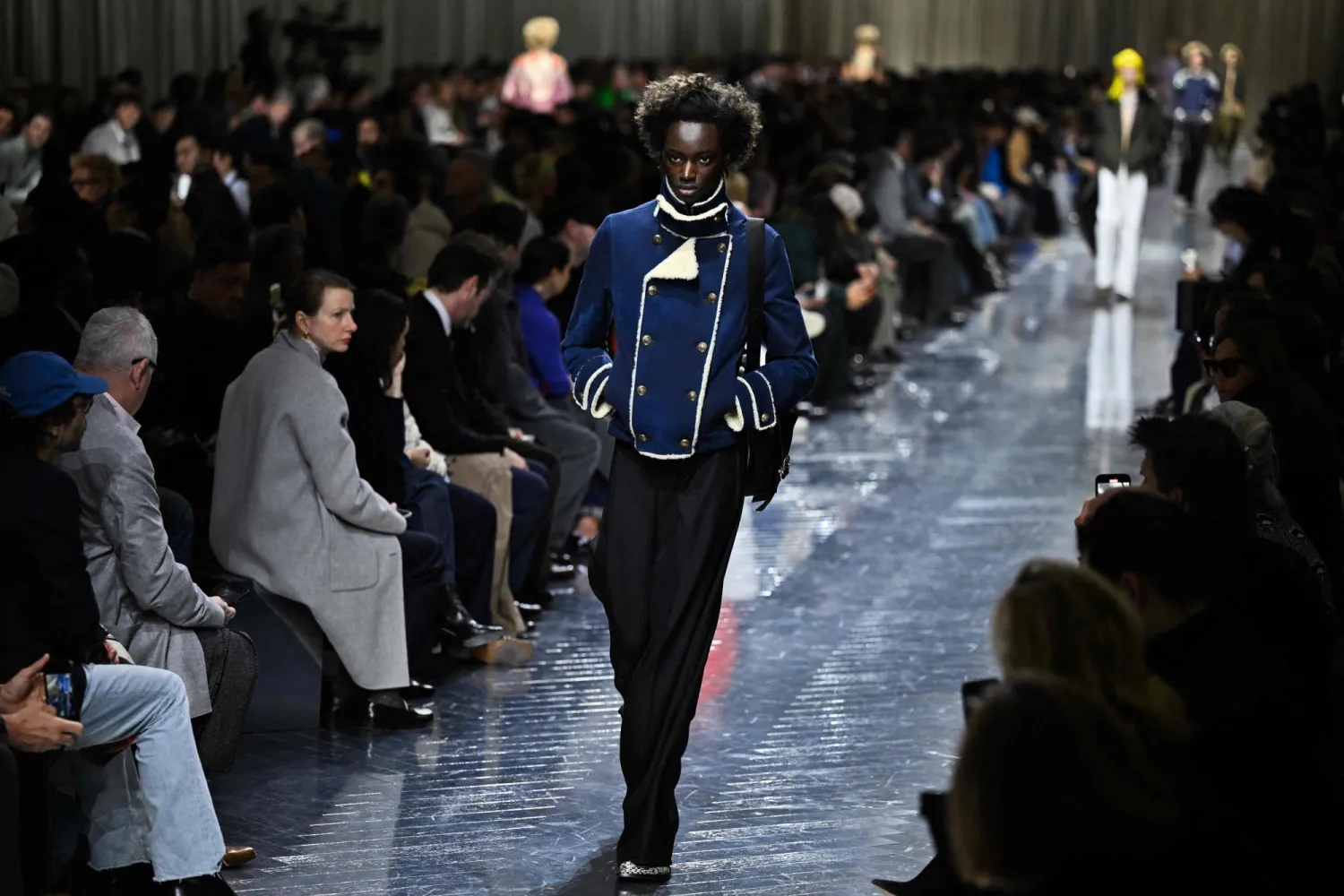
 A model presents a creation by Dior for the Menswear Ready-to-wear Fall-Winter 2026/2027 collection as part of the Men Paris Fashion Week in Paris on January 21, 2026. (AFP)
A model presents a creation by Dior for the Menswear Ready-to-wear Fall-Winter 2026/2027 collection as part of the Men Paris Fashion Week in Paris on January 21, 2026. (AFP)
TT

The Trends at Paris Fashion Week Are Statement Coats, Even Bigger Shoulders and Sharp Tailoring

 A model presents a creation by Dior for the Menswear Ready-to-wear Fall-Winter 2026/2027 collection as part of the Men Paris Fashion Week in Paris on January 21, 2026. (AFP)
A model presents a creation by Dior for the Menswear Ready-to-wear Fall-Winter 2026/2027 collection as part of the Men Paris Fashion Week in Paris on January 21, 2026. (AFP)

Paris men’s Fashion Week has been arguing for a new kind of authority this season — coat-first.

Across the runways, statement outerwear, bigger shoulders and sharp tailoring have been doing the work, turning familiar staples — trench coats, suits, denim and workwear — into clothes with a harder stance.

With the fashion week heading into its final stretch, the common thread is a push to make menswear more protective, performance-minded and built for real life, without losing the showmanship that defines Paris.

That argument landed most clearly at Dior Men, where Jonathan Anderson bent classic codes into new proportions, and Louis Vuitton, where Pharrell Williams framed luxury as practical convenience — heritage shapes upgraded with weatherproofing, reflectivity, reversibility and engineered comfort.

Other designers from Ami Paris to Rick Owens, Yohji Yamamoto and IM Men at Issey Miyake worked along the same lines: rebuild the shoulder, reshape the body, and lean into the idea of uniform, not as costume, but as modern equipment.

Celebrity presence raises the stakes

Paris menswear is also being driven by celebrity gravity, the kind that turns a runway into a global moment within minutes.

Dior’s room was packed with VIPs including Robert Pattinson, Lewis Hamilton and SZA.

Louis Vuitton delivered a front row mixing music, film and online fame — SZA, Usher, Future and Jackson Wang among them — plus a runway cameo from BamBam of GOT7.

The clothes are the product, but the frenzy is amplified by who is watching, who is posting, and who is seen.

A season built on ‘classic, but smarter’

Instead of chasing novelty for its own sake, many designers are taking familiar silhouettes and making them perform.

At Vuitton, Williams’ show was filled with recognizable pieces — double-breasted suits, blousons, polished outerwear; then the twist arrived in the materials and construction.

Tailoring carried reflective elements for night visibility.

Jackets turned into water-repellent hybrids.

Fabrics were lightened, waterproofed and sometimes embellished with crystal details that mimicked raindrops.

Accessories followed the same logic: caps designed to be crushed and returned to shape; shoes built to flex more like sneakers while still reading as traditional footwear.

The message was clear: luxury is not only a look. It is also capability.

The silhouette: shoulders, height, and controlled volume

Across brands, the silhouette focus moved upward. The shoulder became the season’s main design focus — where structure, protection and attitude all meet.

Anderson’s Dior treated tailoring history as a series of pivots.

Jackets nodded to the 1940s and early 1960s, then were cut abruptly short or shrunken to expose the hipbone.

Ordinary pieces were pushed into new scale, including a round-neck sweater extended to ankle length.

Throughout, he made the familiar feel new by changing proportion, fabric or what it was paired with.

IM Men also leaned into shoulder architecture, remixing outerwear by blending storm flaps into trench coats and amplifying volume.

Yohji Yamamoto used padding along arms and legs to give different bodies a similar shape, then controlled that bulk with buttons and adjustable details.

Even when designers disagreed on mood — sharp, romantic, severe, strange — they converged on shape: the body is being redesigned.

The mood: protection, uniform and modern armor

There has also been a clear emotional undercurrent: protection. Paris is dressing men for a world that feels harder, more uncertain, and more public.

Rick Owens described thinking about police uniforms and the impulse to mock a threat as a way of processing it.

His runway delivered skinny foundations, then added cropped jackets, tactical hybrids, leather and Kevlar-like materials, and ambiguous details that hinted at insignia without turning into costume.

His question — “sheriffs or outlaws?” — captured the season’s tension between authority and rebellion.

Yamamoto also drew from army and working clothes, but described a softer kind of protection: enveloping layers meant to endure long stretches outdoors.

IM Men’s draped, layered looks pushed a related idea, less militant than nomadic: clothing as shelter.

Paris wearability, sharpened

For all the experimentation, the week has not abandoned everyday dressing.

Ami Paris’ anniversary show was built on an idea of real Parisian style — camel coats, stripes, denim, clean tailoring — then refined through better proportion and styling.

The clothes were designed to mix easily, with small shifts that made them feel current: longer coats that sit better on the shoulder and cleaner lines.

The takeaway is that the daily wardrobe still matters, but it is being tightened and upgraded.

Dries Van Noten sharpened that idea with color and craft. Julian Klausner built the show around “coming of age" — men leaving home in hand-me-down coats, then made knitwear the engine, from structured-shoulder cardigans to patterned collar pieces on narrow coats and cloaks.

He also brought kilts and skirt-like belted layers back into the mix.

Saturated, pattern-heavy coats, including Polaroid florals and patchworked panels, showed how Paris can make a wardrobe feel new through layering, proportion and finish.

Styling as the signal

Many of the season’s strongest statements have come from styling as much as garments.

At Dior, Anderson’s “anti-normal” attitude appeared in wild wigs and ruff collars that turned what was formal and old into something sharp and slightly dangerous.

At Vuitton, the styling did the opposite — staying restrained — while letting materials and construction carry the message: classic shapes, but built for movement and weather.

While Dior and Vuitton set the tone, the rest of the schedule reinforced it in different registers — wearability with precision at Ami, confrontation and control at Owens, protection through layering at Yohji, and sculpted outerwear at IM Men.

With the week ending Sunday, the final shows will decide whether this season’s turn toward function and shape becomes a deeper shift or remains a Paris moment where luxury briefly proved it can be practical, too.

Kering’s Fourth-Quarter Sales Fall Less Than Expected as Gucci Slide Continues

The logo of French luxury group Kering is seen at Kering headquarters in Paris, France, February 13, 2023. (Reuters)
TT

Kering’s Fourth-Quarter Sales Fall Less Than Expected as Gucci Slide Continues

The logo of French luxury group Kering is seen at Kering headquarters in Paris, France, February 13, 2023. (Reuters)

Kering reported on Tuesday a slightly smaller-than-expected drop in fourth-quarter sales, as investors await details of CEO Luca de Meo's plans ​to revive the Gucci owner's flagging fortunes.

Sales reached 3.9 billion euros ($4.64 billion), down 3% from the previous year when adjusted for currency swings. That beat analysts' consensus forecast for a 5% drop, according to Visible Alpha.

The revenue drop was 10% at Italian flagship label Gucci, which accounts for most of Kering's profits, versus analyst expectations of a 12% decline.

It ‌was the brand's ‌10th straight quarter of revenue ‌decline.

Finance ⁠Chief ​Armelle ‌Poulou told journalists Gucci saw some improvement at the end of last year in "almost all regions", helped by newly introduced products and handbag sales.

Grappling with weak sales since the maximalist styles of Gucci's former star designer Alessandro Michele fell out of fashion in 2022, Kering has faced heightened investor scrutiny over its high ⁠debt and declining profitability.

Free cash from operations fell by 35% last year ‌when excluding one-off payments from real estate ‍sales, reaching 2.3 billion euros, Kering ‍said.

"For Kering, it's really about (restoring) the broad desirability globally," said ‍JPMorgan analyst Chiara Battistini.

Facing an uncertain business outlook, the group, which also owns Gucci Balenciaga, Bottega Veneta and Yves Saint Laurent, further reduced its store network by 75 boutiques with further closures planned, Poulou said.

The ​earnings underscored the steep challenges Kering faces to catch up with peers even though its shares have ⁠risen around 50% since de Meo's appointment was announced last June.

"2025 did not reflect Kering's true potential or the strength of our brands, but it enabled us to lay the foundations for our future recovery," said Poulou.

Kering's annual operating income reached 1.63 billion euros, less than a third of its 2022 level. Kering's operating profit margin fell to 11% group-wide and 16% at Gucci, down from 28% and 36% three years earlier.

By contrast, LVMH delivered a 22% margin last year amid ‌a broader luxury slowdown, with its leather and fashion division - home to Louis Vuitton and Dior - hitting 35%.


Pieter Mulier Named Creative Director of Versace

(FILES) Pieter Mulier attends the 2025 CFDA Awards at The American Museum of Natural History on November 03, 2025 in New York City. (Photo by Dimitrios Kambouris / GETTY IMAGES NORTH AMERICA / AFP)
TT

Pieter Mulier Named Creative Director of Versace

(FILES) Pieter Mulier attends the 2025 CFDA Awards at The American Museum of Natural History on November 03, 2025 in New York City. (Photo by Dimitrios Kambouris / GETTY IMAGES NORTH AMERICA / AFP)

Belgian fashion designer Pieter Mulier has been named the new creative director of the Milan fashion house Versace starting July 1, according to an announcement on Thursday from the Prada Group, which owns Versace.

Mulier is currently creative director of the French fashion house Alaïa, and was previously the right-hand man of fellow Belgian designer and Prada co-creative director Raf Simons at Calvin Klein, Jil Sander and Dior.

In his new role, Mulier will report to Versace executive chairman Lorenzo Bertelli, the designated successor to manage the family-run Prada Group. Bertelli is the son of Miuccia Prada and Prada Group chairman Patrizio Bertelli.

“We believe that he can truly unlock Versace’s full potential and that he will be able to engage in a fruitful dialogue,’’ The Associated Press quoted Lorenzo Bertelli as saying of Mulier in a statement.

Mulier takes over from Dario Vitale, who departed in December after previewing just one collection during his short-lived Versace stint.

Mulier was honored last fall by supermodel and longtime Alaïa muse Naomi Campbell at the Council of Fashion Designers of America for his work paying tribute to brand founder Azzedine Alaïa. Mulier took the creative helm in 2021, after Alaïa’s death.


Ralph Lauren’s Margin Caution Eclipses Stronger‑than‑expected Quarterly Results

Guests wait after viewing the latest Ralph Lauren collection in New York City, US, April 17, 2025. REUTERS/Caitlin Ochs/File photo
TT

Ralph Lauren’s Margin Caution Eclipses Stronger‑than‑expected Quarterly Results

Guests wait after viewing the latest Ralph Lauren collection in New York City, US, April 17, 2025. REUTERS/Caitlin Ochs/File photo

Ralph Lauren posted third-quarter results above Wall Street estimates on Thursday, but the luxury retailer's warning of margin pressure tied to US tariffs sent its shares down nearly 6.4% in premarket trading.

The company expects fourth-quarter margins, its smallest revenue period, to shrink about 80 to 120 basis points due to higher tariff pressure and marketing spend.

Ralph Lauren, which sources its products from regions such as China, India and Vietnam, has relied on raising prices and reallocating production to regions with lower duty exposure to offset US tariff pressures, Reuters reported.

"Ralph Lauren has been able to raise prices for some time now. There is some limit on how long it can continue to do this. I think (the company's) gross margins are near peak levels," Morningstar analyst David Swartz said.

The company, which sells $148 striped linen shirts and $498 leather handbags, has tightened inventory, lifted full-price sales and refreshed core styles, boosting its appeal among wealthier and younger customers, including Gen Z.

Higher-income households are still splurging on luxury items, travel and restaurant meals, while lower- and middle-income consumers are strained by higher costs for rents and food as well as a softer job market.

The New York City-based company saw quarterly operating costs jump 12% year-on-year as it ramped up brand building efforts through sports-focused brand campaigns such as Wimbledon and the US Open tennis championship.

The luxury retailer said revenue in the quarter ended December 27 rose 12% to $2.41 billion, above analysts' estimates of a 7.9% rise to $2.31 billion, according to data compiled by LSEG.

It earned $6.22 per share, excluding items, compared to expectations of $5.81, aided by a 220 basis points increase in margins and an 18% rise in average unit retail across its direct-to-consumer channel.

Ralph Lauren now expects fiscal 2026 revenue to rise in the high single to low double digits on a constant currency basis, up from its prior forecast of a 5% to 7% growth.