


South Sudan Models Dominate Global Catwalks but Visas a Problem

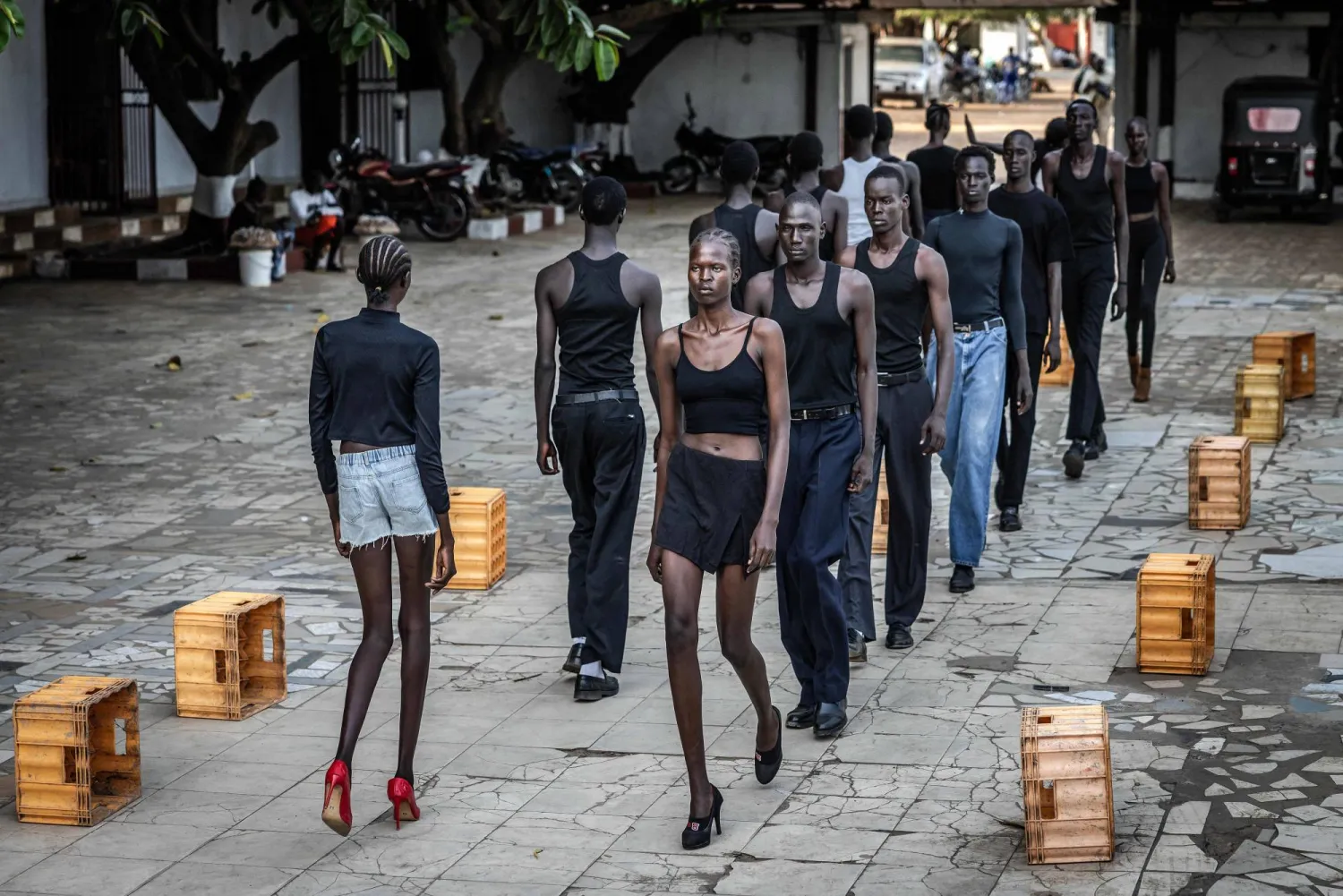
Professional models from the Juba-based modelling agency Jubalicious practice their catwalking during a modelling training session at a hotel in Juba on February 19, 2026.  (Photo by Luis TATO / AFP)
Professional models from the Juba-based modelling agency Jubalicious practice their catwalking during a modelling training session at a hotel in Juba on February 19, 2026. (Photo by Luis TATO / AFP)
TT

South Sudan Models Dominate Global Catwalks but Visas a Problem

Professional models from the Juba-based modelling agency Jubalicious practice their catwalking during a modelling training session at a hotel in Juba on February 19, 2026.  (Photo by Luis TATO / AFP)
Professional models from the Juba-based modelling agency Jubalicious practice their catwalking during a modelling training session at a hotel in Juba on February 19, 2026. (Photo by Luis TATO / AFP)

Heels click on cracked paving stones as fantastically long-limbed men and women practice moves they hope will whisk them away from South Sudan, one of the fashion world's favorite scouting locations.

Many hope to follow in the footsteps of their compatriot Awar Odhiang, who went from a refugee camp in Ethiopia to closing Chanel's Paris Fashion Week show last year.

South Sudan has been mired in conflict, poverty and corruption since its independence in 2011, but the success of its models has been a ray of positivity.

No less than nine of the top 50 models currently listed on Models.com are originally from the east African country.

"Paris, Milan, London -- the fashion industry is dominated by South Sudanese boys and girls at the moment," said Doris Sukeji, founder of the Jubalicious modelling agency in the capital Juba.

"Mostly it's the skin color. That is how most of the South Sudanese get signed. They are looking for very dark models," she said.

One of the first to blaze a trail was Alek Wek, scouted in London in the 1990s after her family fled an earlier war.

It was an image of Wek on her mother's Facebook feed that inspired Yar Agou, 19, now signed with Jubalicious.

"Damn! I saw her and I thought that is me one day if God is there. I want to make it like her," she told AFP in Juba.

All skinny-long limbs and charming attitude, Agou has what it takes for the runway, but politics is standing in the way of her dream.

She was supposed to be working at the recent Milan Fashion Week, but her visa was rejected at the last minute. For now, she is working as a cleaner, hoping there will be more opportunities.

- 'Heartbroken' –

Successful models can earn tens of thousands of dollars in a season, a life-changing amount in South Sudan where 92 percent live under the poverty line.

But Sukeji said seven men and women had been rejected for visas in recent months despite having work sponsors, as the climate against immigrants hardens in the West.

"You get heartbroken," she said.

Bichar Hoah, 24, raised by a single mother in Kakuma refugee camp in neighboring Kenya, was recently rejected for a European visa.

"There are some people who discourage us by saying that we tried and failed... (but) I want to represent South Sudan as a model," he said, hoping to change the narrative around his country.

- 'A chance' –

But even those who make it abroad face immense challenges in an industry known for relentless turnover.

Clients constantly want "new faces," Sukeji said.

There are added challenges in a conservative country like South Sudan.

As well as physical requirements -- tall but not above 5 foot 11 (1 meter 80) for women -- Sukeji must also contend with families who view modelling as a cover for prostitution.

"I always ask them to give the boy or the girl a chance," she said.

She brings them in for free training, which can take up to three months, taking a 10-percent cut if they get work.

Her trainer, drilling the models with the precision of a military sergeant when AFP visited, said many were like "newborn babies" when they started.

But as the young models gathered on a Juba rooftop to practice their struts, there was hope for a future beyond South Sudan's poverty and ever-present threat of war.

"One day, really, South Sudan will change," said Agou.

All hope they can emulate the likes of Anyier Anei, who landed international modelling gigs and recently starred in French film "Coutures".

"Failure is less frightening than having dreams you never try to achieve," Anei told Harper's Bazaar recently. "Even with fear, you have to take that risk."

Dolce & Gabbana Appoints Ex-Gucci Boss Stefano Cantino as Co-CEO

17 January 2026, Italy, Milan: Stefano Gabbana (L) and Domenico Dolce wave and smile at Milan Fashion Week. Photo: Cinzia Camela/Alamy/Pa/PA Wire/dpa
TT

Dolce & Gabbana Appoints Ex-Gucci Boss Stefano Cantino as Co-CEO

17 January 2026, Italy, Milan: Stefano Gabbana (L) and Domenico Dolce wave and smile at Milan Fashion Week. Photo: Cinzia Camela/Alamy/Pa/PA Wire/dpa

Italian fashion house Dolce & Gabbana on Monday named former Gucci CEO Stefano Cantino as its Co-CEO, working alongside Chair and Chief Executive Officer Alfonso Dolce.

Dolce took on the additional role of ⁠chair this year following ⁠the resignation from the position of company co-founder Stefano Gabbana, who retained his creative role.

Cantino's appointment "follows Dolce & Gabbana's ⁠growth path, oriented towards the evolution of its organizational model from a Fashion Brand to a Lifestyle Company," Reuters quoted a statement as saying.

"I am delighted to have Stefano Cantino by my side in this new phase of ⁠growth ⁠and development of Dolce & Gabbana," Dolce said.

Alfonso Dolce is the brother of Domenico Dolce, who co-founded the fashion house with Gabbana in 1985. The pair are still in charge of creative direction.


Stefano Gabbana Resigns as Dolce & Gabbana Chair

Fashion designer Stefano Gabbana leaves Gritti Palace in Venice, Italy, June 27, 2025. REUTERS/Yara Nardi
TT

Stefano Gabbana Resigns as Dolce & Gabbana Chair

Fashion designer Stefano Gabbana leaves Gritti Palace in Venice, Italy, June 27, 2025. REUTERS/Yara Nardi

Stefano Gabbana, co-founder of Italian luxury fashion house Dolce & Gabbana, stepped down as chair in January, according to a company filing with the local chamber of commerce seen by Reuters on Friday.

The news was first reported by Bloomberg, which said the designer was also considering options for his roughly 40% stake in the ⁠company ahead of ⁠negotiations with its bank lenders.

Dolce & Gabbana’s lenders are seeking an injection of up to 150 million euros in fresh funds as part of a broader refinancing of 450 million euros ($525.7 ⁠million) of debt, Bloomberg reported, citing sources. It added that the company was considering the disposal of real estate and the renewal of licenses to raise money.

Dolce & Gabbana was not immediately available for comment.

Domenico Dolce and Stefano Gabbana founded the company in 1985 and they are still in charge of creative direction.

According ⁠to ⁠the filing, Gabbana, 63, informed the company in December that he intended to step down as chair effective January 1. Chief Executive Alfonso Dolce, the brother of co-founder Domenico Dolce, was appointed as the new chair.

In the past the company did not rule out the possibility of a minority investor or stock market listing.


Fashion Fund Unveils New Identity as Saudi Arabia's First Fashion Investment Fund

The Fashion Fund unveiled its new identity under the name “ZYA Fund. (SPA)
TT

Fashion Fund Unveils New Identity as Saudi Arabia's First Fashion Investment Fund

The Fashion Fund unveiled its new identity under the name “ZYA Fund. (SPA)

The Fashion Fund unveiled its new identity under the name “ZYA Fund,” marking Saudi Arabia's first private equity fund dedicated to the fashion sector. The fund was established through a partnership between the Cultural Development Fund (CDF) and Merak Capital.

The Fund's Board of Directors held its inaugural meeting, bringing together local and international leaders and experts from culture, fashion, investment, and the creative industries, the Saudi Press Agency said on Thursday.

The board is chaired by Vice Minister of Culture and Vice Chairman of the Fashion Commission Hamed Fayez, with CEO of the Cultural Development Fund Majed Alhugail serving as vice chairman.

Board members include Founder and Chief Executive of Merak Capital Abdullah Altamami, CEO of the Fashion Commission Burak Cakmak, and Chairman and Chief Executive of Turmeric Capital Ravi Thakran.

Altamami said the fund aims to channel capital into high-potential opportunities across the fashion value chain, supporting Saudi brands with the capacity to expand regionally and globally.

With a total investment size of SAR300 million, the fund is anchored by CDF, which holds a 40% stake, while Merak Capital acts as the fund manager.

ZYA Fund will invest across the fashion sector value chain, including design and production, supply chains, e-commerce, and beauty, enabling Saudi brands to scale and expand.

The initiative reflects efforts to build an integrated fashion ecosystem and enhance the sector's attractiveness as an investment destination. It also supports the objectives of the National Culture Strategy under Saudi Vision 2030.