


Stars Deliver Modern and Colorful Looks on Oscars Red Carpet

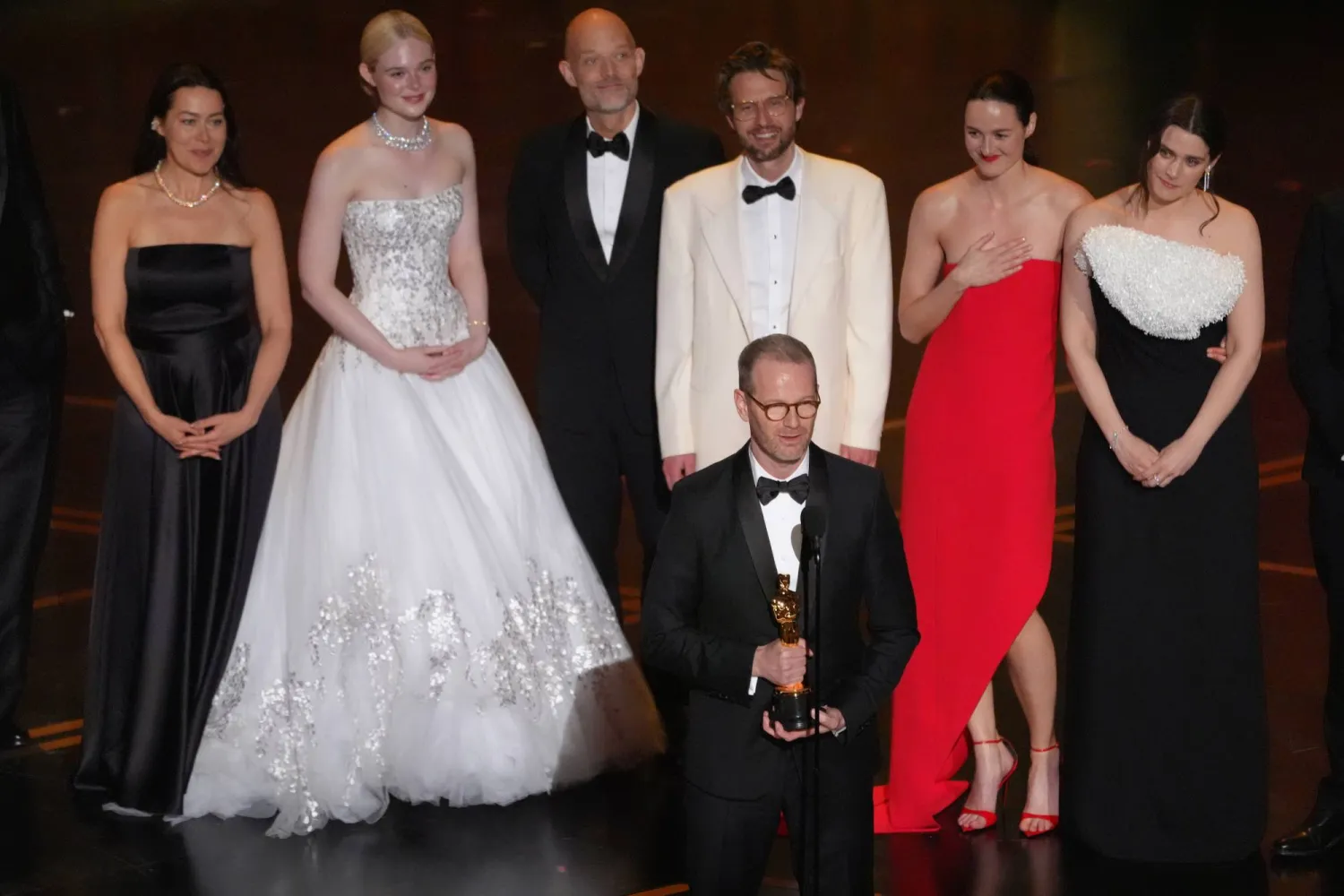
Maria Ekerhovel, from left, Elle Fanning, Joachim Trier, center, Eskil Vogt, Anders Danielsen Lie, Renate Reinsve, and Inga Ibsdotter Lilleaas accept the award for interntional feature film for "Sentimental Value" during the Oscars on Sunday, March 15, 2026, at the Dolby Theatre in Los Angeles. (AP Photo/Chris Pizzello)
TT

Stars Deliver Modern and Colorful Looks on Oscars Red Carpet

Maria Ekerhovel, from left, Elle Fanning, Joachim Trier, center, Eskil Vogt, Anders Danielsen Lie, Renate Reinsve, and Inga Ibsdotter Lilleaas accept the award for interntional feature film for "Sentimental Value" during the Oscars on Sunday, March 15, 2026, at the Dolby Theatre in Los Angeles. (AP Photo/Chris Pizzello)

Pops of color dominated the Oscars red carpet as stars like Renate Reinsve to Chase Infiniti stunned in colorful gowns that put a modern twist on traditional Oscar’s red carpet dressing.

Reinsve radiated on the carpet in a bright red Louis Vuitton strapless dress with a high side slit and curved train. She paired the look with a red lip and her hair slicked back. For her first Academy Award ceremony, Infiniti opted for a pale lavender mermaid-style ruffle dress also by Louis Vuitton that she wore with a shimmering jeweled choker. The Hollywood darling has delivered strikingly stylish looks across award show season for her role in “One Battle After Another.”

For cinema’s biggest night, some stars marked their moment with designs that evoked old Hollywood glamour.

Rose Byrne arrived in a timeless custom black Dior gown embroidered with colorful beaded flowers. Actor Wunmi Mosaku of “Sinners” showcased classic elegance in an off-the-shoulder teal sequined Louis Vuitton dress while also showing off her baby bump.

Inspired by Grace Kelly's 1956 Oscar's dress, Jessie Buckley wore a color-blocked Chanel dress with a light pink skirt and lipstick-red shawl over her shoulders.

“This was a much more colorful carpet than past events throughout the awards season,” Halie LeSavage, Marie Claire’s senior fashion news editor, said. ”It feels like the nominees and the presenters are loosening up and really getting into a celebratory mood for the last big show of the season.”

In keeping with their colorful animated film, the cast of “KPop Demon Hunters” delivered a splash of eye-catching colors to the red carpet in their regal gowns.

Arden Cho chose Korean designer Miss Sohee with a structured black lace mermaid gown and an opulent vibrant green silk stole designed with an intricate nature scene. Co-star Ji-young Yoo posed in a two-toned blue Carolina Herrera ball gown with a romantic sweetheart-shaped neckline.

Cloud Dancers Balanced among all the colorful attire, the Pantone color of the year, Cloud Dancer, once again had its moment. Actors in off-white gowns glistened in front of the cream backdrop of the carpet. Emma Stone sparkled in her simple yet captivating opalescent paillette dress with its low back and scoop neckline, The Associated Press reported.

Elle Fanning added a romantic touch to the carpet in her white Givenchy by Sarah Burton dramatic ball gown adorned with wisteria flowers. Fanning accented her scene-stealing dress with a Cartier wisteria-shaped necklace from 1903.

Like Fanning, ELLE’s Beauty Director, Kathleen Hou said the red carpet stars sported polished and slicked back updos to draw the attention to their gowns.
Gwyneth Paltrow kept it minimalist and sexy with her Giorgio Armani Privé ivory silk strapless gown that revealed one long cut out down the sides of her dress.

Red carpet risk-taker Timothée Chalamet stayed on trend in an off-white Givenchy by Sarah Burton suit with matching white shirt, tie and shoes. He accessorized his looks with rings and sunglasses. Chalamet famously wore a butter yellow suit by the same designer last year.

“For his whole Oscars campaign, Timothée has really used fashion to tell a story, to promote his role in ‘Marty Supreme’,” Hine said. “All white suggests he’s at the end of the tour.”

Stars take flight with feathers Gowns on the carpet featured luxurious fabrics, textures and even feathers. Demi Moore emerged on the carpet in a whimsical, fully feathered, green-toned Gucci dress. Moore, who was not nominated for an Oscar, certainly stole the spotlight from her peers with her dramatic gown.

Actor Pedro Pascal integrated feathers in a more subtle way with a large, feathered brooch fastened to his custom Chanel look by Matthieu Blazy.

The latest designer to helm the French house has been the talk of the town with fashionistas lining up at Chanel stores to buy his collection.

Fashion trailblazer Teyana Taylor wore a fitted feathered white and black sheer dress on the carpet by Blazy.

“Teyana’s dress is also my front-runner for best dressed of the night because it took a lot of those Chanel codes that fashion fans really love and made them feel so fresh and so Teyana,” LeSavage said. “They’re a house that doesn’t do a lot of bodycon or sheer. It tapped into a whole bunch of different elements that felt very glamorous and very Oscars but also aligned with all of the risks that Teyana has been taking throughout her awards season run this year.”

In another take on feathers by Blazy, Nicole Kidman wore an off-white feathered gown with a corseted peplum bodice that was dipped into a cream color at the hem.

Men follow suit with tailoring While the women flaunted vivid colors on the carpet, the men subverted traditional codes of black-tie attire with their suiting.

Oscar night performer Shaboozey rarely disappoints on the carpet with his modern takes on black tie attire. The red-carpet style maven sported a Balenciaga tailcoat look with a vest and a pearl pocket chain and matching pearl earrings.

“Sinners” star Michael B Jordan brought out a golden pocket chain that accentuated his Louis Vuitton suit. His costar Miles Caton was one of the few male actors to add color to the carpet. Caton walked the carpet in an all-plum colored look from AMIRI with a matching plum jacket, tie and trousers.

“What we have been seeing in recent years is men embracing designer fashion spins on the traditional tuxedo, especially younger actors,” Samuel Hine, GQ’s global fashion correspondent said. “Their participation in the fashion world is an important part of the promotion of their personal brands.”

“Sinners” director Ryan Coogler and actor Jacob Elordi were some of the few Oscar attendees that donned the traditional black tie look of a bow tie.

Fashion made political Oscar attendees sometimes make more than fashion statements. Actors chose to make political statements on the carpet by calling for a ceasefire in Gaza with their ‘Artists4Ceasefire’ pins. The organization issued new pins with a design by Shepard Fairey that now feature a dove and a lotus flower wrapped with a barbed wire. Actor Charithra Chandran added the pin on the carpet to her lush, bright-green ball gown.

Saja Kilani of “The Voice of Hind Rajab” wore the pin with her chic black dress on the carpet.

“Our struggles are all connected, so is our liberation,” she told The Associated Press.

After the US invasion of Iraq in 2003, Javier Bardem said he wore a pin to protest the war. On Sunday he re-wore the pin, which read, “No a la Guerra” or “No to war” on the carpet. Onstage while presenting, Bardem spoke out against the current global turmoil, saying, “No to war and free Palestine.”




Jeweller Pandora Raises 2026 Guidance as New Designs Draw in Shoppers

A view of the Pandora sign on one of the branches of the Danish jewellery maker Pandora in central Copenhagen, Denmark, August 13, 2025. (Reuters)
TT

Jeweller Pandora Raises 2026 Guidance as New Designs Draw in Shoppers

A view of the Pandora sign on one of the branches of the Danish jewellery maker Pandora in central Copenhagen, Denmark, August 13, 2025. (Reuters)

Jeweller Pandora raised its 2026 guidance for organic growth and profit margin on Wednesday, saying new designs and marketing were helping attract shoppers, and also reported second-quarter operating profit (EBIT) above analysts' expectations.

Pandora said EBIT for the April-June period came in at 1.46 billion Danish crowns ($225.35 million), against an average estimate of 1.10 billion expected by analysts in a company-compiled poll, reflecting partial refunds of previously paid ‌U.S. tariffs.

"We are ‌making progress in re-energizing Pandora's ‌growth engine," ⁠CEO Berta de ⁠Pablos-Barbier said in a statement.

"There is more work ahead, but we are moving in the right direction and raising our 2026 guidance for both growth and profitability," she added.

The company now expects organic growth at between 0% and 3% in ⁠2026, up from a previous range ‌of -1% to 2%, ‌and an operating profit margin between 22% and 23%, up ‌from 21% to 22%.

In the top job ‌since January, de Pablos-Barbier is leading a drive to release new designs, with its Pandora Wonders line - featuring pearl charms shaped like a frog, a pufferfish, or ‌a mushroom - launching in July in Paris during Haute Couture week.

Pandora's share price ⁠has ⁠been highly volatile over the past two years as the price of silver surged, prompting de Pablos-Barbier to announce in February a shift towards platinum-plated jewellery as a way of reducing its reliance on silver.

Pandora said on Wednesday it started pilot testing a limited range of platinum-plated jewellery in the Netherlands in July, and would do broader tests across markets in the fourth quarter, before scaling up the rollout next year.


Armani Stake Sale Could Be Delayed Beyond March 2027 Deadline

FILE PHOTO: People walk past a Giorgio Armani store in Galleria Vittorio Emanuele II, following Giorgio Armani's death at the age of 91, in Milan, Italy, September 5, 2025. REUTERS/Gonzalo Fuentes//File Photo
TT

Armani Stake Sale Could Be Delayed Beyond March 2027 Deadline

FILE PHOTO: People walk past a Giorgio Armani store in Galleria Vittorio Emanuele II, following Giorgio Armani's death at the age of 91, in Milan, Italy, September 5, 2025. REUTERS/Gonzalo Fuentes//File Photo

The planned sale of ‌a 15% stake in Italian fashion group Giorgio Armani may not be completed until after a March 2027 deadline set by the late designer's will, an Italian newspaper reported on Tuesday.

Citing company sources, the Corriere della Sera said market conditions for the luxury industry were still challenging and negotiating a deal could require time, said Reuters.

The indications on timing in the will are not binding, the sources said, adding the need to reach the best possible terms for a sale took precedence.

The company did not immediately ‌respond to ‌a request for comment.

Giorgio Armani, who died on ‌September ⁠4, 2025, instructed the ⁠eponymous foundation that controls the fashion house to sell an initial 15% stake within 18 months, giving priority to French luxury goods group LVMH, beauty giant L'Oreal and Franco-Italian eyewear maker EssilorLuxottica .

Corriere cited board documents from the Giorgio Armani Foundation as saying the process was still at an early stage and unlikely to ⁠be completed before 2027.

Evaluations over the stake ‌sale are under way but ‌remain preliminary because the transaction is complex, Rothschild & Co banker and foundation director ‌Irving Bellotti told an April board meeting, Corriere reported.

Bellotti said ‌that work on the deal would begin this year but was expected to be completed during 2027.

The group has also not ruled out a potential stock market listing, which would leave management in ‌the hands of the family and current executives under the foundation's strategic oversight, Corriere said, citing the ⁠sources.

Corriere also ⁠cited Chief Executive Giuseppe Marsocci as telling the foundation's board in April that net group sales in the first two months of 2026 fell 7.5% at current exchange rates and 3.9% at constant exchange rates from a year earlier.

The company adopted measures to cut operating costs by €25 million ($28.84 million), Marsocci added.

The drop, he explained, was driven by the wholesale channel where sales declined 10.7% year-on-year at constant exchange rates, while direct-to-consumer sales rose 3.5% net of currency effects, Corriere reported.

Giorgio Armani will approve first-half results on September 8, Corriere said, adding they should broadly confirm January-February trends.


From Uniqlo to Zara, Clothing Brands Try to Win Over Gen Z with a Needle and Thread

Shoppers walk past a Zara clothes store, part of the Spanish group Inditex, in Las Palmas de Gran Canaria, Spain, December 13, 2022. REUTERS/Borja Suarez
TT

From Uniqlo to Zara, Clothing Brands Try to Win Over Gen Z with a Needle and Thread

Shoppers walk past a Zara clothes store, part of the Spanish group Inditex, in Las Palmas de Gran Canaria, Spain, December 13, 2022. REUTERS/Borja Suarez

Encouraging customers to mend worn clothes instead of buying new ones might seem like a self-defeating sales strategy. But in-store repairs and sewing workshops are becoming essential retail services for clothing brands as they try to appeal to young consumers who want to save money and the planet.

While luxury fashion houses and select specialty retailers like Patagonia and L.L. Bean have offered product repairs for decades, the concept has caught on. Jeans giant Levi Strauss & Co., casual wear chain Uniqlo and budget retailer Primark are a few of the apparel companies hoping to win over Generation Z shoppers with a needle and thread.

Levi's created a handstitching course for high school students after determining that many members of Gen Z lacked the sewing skills to match their interest in thrift store shopping and sustainability. Employees spend 90 minutes instructing teenagers on four tasks: sewing on a button, hemming, patching a hole and fixing a tear.

The Wear Longer program, which the San Francisco-based company is expanding across the US, builds on the repair and customization services Levi's offers at hundreds of stores worldwide.

“We think it’s important to empower the people who buy our clothes with the skill sets to maintain them, to get them to that second life,” The Associated Press quoted Paul Dillinger, Levi's head of global design innovation, as saying.

Detroit resident Chloe Halprin, 25, is the kind of consumer retailers hope to attract with a “fix it, don’t ditch it” message.

In high school, Halprin shopped at inexpensive, trendy stores. Fixing a big rip felt beyond her limited sewing ability. If she damaged a top or skirt from Forever 21, “I might just throw it away."

These days, Halprin buys most of her clothes secondhand. She recently learned to hem with a sewing machine and hopes to tackle projects like turning a skirt into a shirt.

“I try to be conscientious of my carbon footprint,” Halprin, a nonprofit grant writer, said. "I really don’t like waste. I’m trying to save money as well.”

The evolution of mending from an economic necessity and traditional craft to a method for cultivating customers didn't happen overnight. The fashion industry as a whole has come under intensifying pressure to reduce its contributions to environmental pollution and climate change.

Textile waste — which includes manufacturing remnants, unwanted clothes and linens, and unsold products — is one of the industry's most pressing challenges. Each year, the world generates fabric waste at a rate equivalent to a garbage truck's worth getting dumped or incinerated every second, the United Nations Environment Program estimates.

Researchers broadly agree that repairing and reselling clothes can reduce a garment’s environmental impact, especially if it delays or replaces a new purchase. But many caution the practices remain too limited to offset continued growth in clothing production and consumption.

Clothing production roughly doubled between 2000 and 2015, while the average number of wearings per garment declined by about 36%, according to figures compiled by the Ellen MacArthur Foundation. The sustainability nonprofit estimated that less than 1% of discarded clothing material got recycled into new apparel.

Enter Generation Z, the cohort born between 1997 and 2012. It's the generation that grew up with fast fashion and e-commerce, then had school years and young adulthoods shaped by the coronavirus pandemic and post-pandemic inflation.

Whether due to limited budgets or a rejection of materialism, Gen Z has helped the preowned clothing market grow much faster than retail apparel sales in the US, independent market intelligence firm GlobalData estimated in a report with resale platform ThredUp.

For companies that make new clothes, mending programs and classes address “some deeper consumer needs and consumer behaviors at the moment," GlobalData retail analyst Neil Saunders said.

“It puts a halo on the brand,” he said.

The hands-on response from mass-market retailers, especially fast-fashion chains like Primark, Zara and H&M, has generated interest as well as skepticism.

Zara, which has its headquarters in Spain, launched a digital platform in 2022 for customers to resell their used pieces and to request basic alterations and repairs. The program is available in 17 of the nearly 100 countries where the trend-driven retailer operates.

Ireland-based Primark has focused more on customer education. The value-focused retailer hosts free “Love It For Longer” events where customers are taught skills like replacing zippers and buttons.

“Learning how to repair and care for clothing is probably one of the most simplest but absolutely totally effective ways that we can reduce waste and also extend the lifetime of whatever we buy,” Vicki Swain, Primark’s product longevity & partnership lead, said.

The company has held the workshops — more than 730 altogether — in nine of the 17 countries where Primark has stores, including the US Primark also tested in-store repairs at three UK locations this year.

Swain argues that affordable clothes can be just as durable and repair-worthy as more expensive ones. Half the items Primark sells annually are basics like socks, underwear, T-shirts, and jeans, she said.

“There is nothing throw away about our products,” Swain said.

Uniqlo, which focuses on timeless wardrobe staples, offers a range of aftercare services, including repairs, decorative sashiko mending, embroidery and creative restyling.

Available in 75 of the Japanese mass-market retailer’s roughly 2,500 stores worldwide, the services are promoted as a national extension of the product life cycle. Providing them also strengthens Uniqlo’s connection with customers, said Jean-Emmanuel Shein, director of global corporate responsibility at Uniqlo USA.

Kate Fletcher, a professor of sustainability, design and fashion systems at Manchester Metropolitan University in England, said she thinks the repair initiatives of popular retailers are well-meaning, but she doubts they will have much environmental impact.

“The fashion sector’s primary source of impact is due to the overproduction of pieces and growing volumes of garments created,” Fletcher said. “Repairing a garment in store happens in addition to these growing production volumes, not instead of them.”

The question facing the fashion industry is whether repairs can evolve from niche service to commercially viable.

Sweden's H&M Group, which has more than 4,000 stores in over 80 countries, has been unusually candid about one of the biggest obstacles: the economics. The company has argued that repair and resale are desirable goals, but manufacturing new garments costs businesses less than keeping existing ones in use.

H&M experimented with mending and redesign studios in several European flagship stores over the past decade. The company also is majority owner of a secondhand clothing platform called Sellpy.

In May, H&M joined Primark, ThredUp and dozens of other fashion and textile businesses in signing a statement that urged governments in North America and the European Union to adopt tax policies that would make repairing and reselling clothes profitable.

Making mending work in retail is challenging because it's labor intensive and must be priced low enough to entice customers, Saunders, of GlobalData, said. Signals from consumers also are mixed, he said.

“I think younger shoppers still shop fast fashion because even though it goes against some of their principles, it is one of the most accessible parts of the market," Saunders said. "But what they’re doing as well, though, is they’re buying into alternative channels like resale. And they’re having things repaired.”