


Wimbledon Clings onto Fashion Traditions, with a Twist

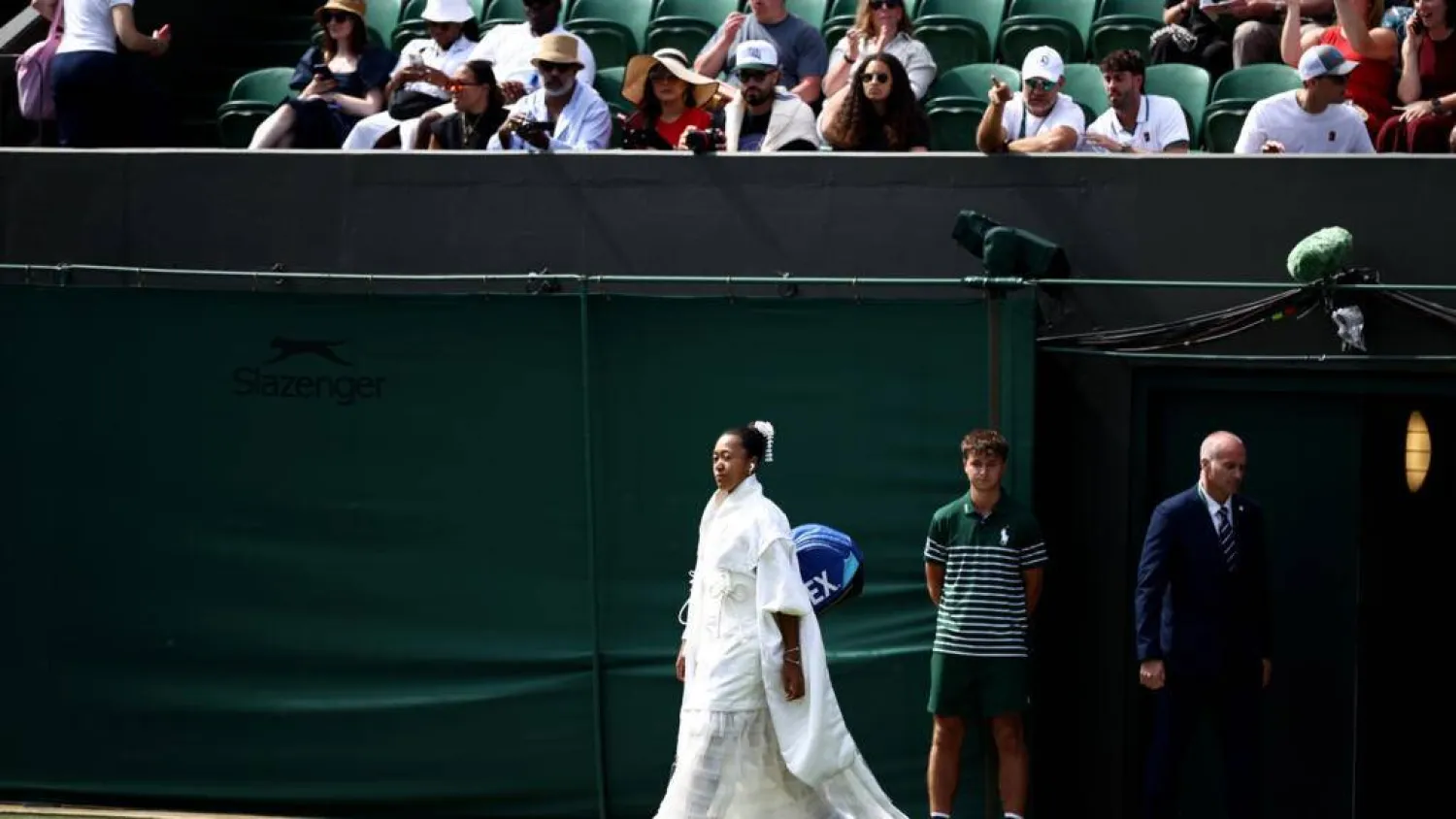
Japan's Naomi Osaka, known for her flamboyant outfits, arrived on Monday in a kimono-inspired white dress. Henry NICHOLLS / AFP
TT

Wimbledon Clings onto Fashion Traditions, with a Twist

Japan's Naomi Osaka, known for her flamboyant outfits, arrived on Monday in a kimono-inspired white dress. Henry NICHOLLS / AFP

Amid fast-changing fashion trends, Wimbledon has remained a bastion of "classy" style, with players and attendees donning their finest whites at the London tennis tournament which some say is reminiscent of traditional British high society.

"This is Wimbledon! You've got to dress up," Jari Hedman, 65, said with a smile.

The Finnish tennis coach had bought an Italian-made white linen suit for the occasion, paired with a navy blue jacket and a flourish of color with an orange tie.

He had picked the "classy" attire "in honor of the tournament", Hedman told AFP.

The Wimbledon tennis championships, which runs from June 29 to July 12 this year and is the oldest of the Grand Slam tournaments, will celebrate its 150th anniversary next year.

The royals are regular attendees, especially Princess Kate, who is often praised for her elegant fashion choices.

Ahead of the tournament, the BBC published an article on "etiquette" or unwritten rules for attendees, while other newspapers chimed in with fashion tips.

"With its mix of royalty, A-listers and diehard fans, Wimbledon always has a sense of occasion, so why not make an effort?" advised The Times.

And what should one wear to the stands? "White, white, white. And light colors," said Lucie Ta, a 29-year-old engineer from Prague.

She was wearing a long white dress with black polka dots, a white jacket slung over her arm in case the weather cooled.

Anne Freeman, an American from Houston, donned a pearl-colored floral dress and a sleek Panama hat. "It's a way to be respectful of the tradition," she said.

'Insight' into UK's past

Wimbledon has the strictest dress code in the circuit for players, who are required to wear "suitable tennis attire that is almost entirely white" from "the point at which the player enters the court surround".

"White does not include off-white or cream," the dress code dictates.

The rules are rooted in the sport's aristocratic history, with white the color of choice for hiding sweat stains, which were considered improper.

Players have found ways, both subtle and unconventional, to bring their individual style to court within the dress code.

Japan's Naomi Osaka, known for her flamboyant outfits, arrived on Monday in a kimono-inspired white dress with embroidered motifs of cranes and cherry blossoms, by Japanese designer Hana Yagi.

She paired the outfit with a traditional kanzashi hair ornament featuring white flowers before removing both to reveal a white Nike dress.

Osaka revealed she had the idea for the outfit after watching the Quentin Tarantino film "Kill Bill".

"I think about my cultures, my heritage, which is Japanese and Haitian. Then if I dive deeper into like Japanese culture, I think about the most iconic silhouette, which for me is a kimono," she said.

Serbia's Novak Djokovic wore a white Lacoste jacket with a green trimming, which, according to the brand, was inspired by those worn by "great champions" -- including Rene Lacoste -- in the 1920s.

Going to Wimbledon is "fascinating" as it gives "an insight into what the past of British society looked like," according to Daniel-Yaw Miller, a sports and fashion journalist.

The grass-court tournament "always was seen as a social scene" like the Ascot horse races, explained Elizabeth Wilson, who has penned a book on the history of tennis.

"Therefore people wanted to dress up, to look smart," she added.

In the 1950s, women wore formal hats, while in the 60s, they still wore gloves. "It has got very much more relaxed," said Wilson.

While spectators can dress however they like, Wimbledon still has a "very distinct aesthetic" and very "revered traditions," said Miller.

"I think the athletes and the fans really buy into the fact that it is unique."

Miller, a British man living in New York, enjoys comparing Wimbledon and the US Open: "You go from the most English thing imaginable to the most American thing imaginable in every sense of the word."

The US Open feels like "one big party," with entertainment, where it's sometimes even "hard to focus" on the tennis.

When he attended the Grand Slam across the pond, he wore shorts and a T-shirt. For Wimbledon, however, he opted for a polo shirt and smart trousers.



Naomi Osaka Shows off Another Fashion Creation Before Reaching 3rd Round at Wimbledon

Naomi Osaka of Japan arrives in court for her Women's Singles second round match against Anastasia Gasanova of Russia at the Wimbledon Championships in London, Britain, 01 July 2026. (EPA)
TT

Naomi Osaka Shows off Another Fashion Creation Before Reaching 3rd Round at Wimbledon

Naomi Osaka of Japan arrives in court for her Women's Singles second round match against Anastasia Gasanova of Russia at the Wimbledon Championships in London, Britain, 01 July 2026. (EPA)

Naomi Osaka had a new look to show off before winning her second-round match at Wimbledon.

Osaka, whose fashion reveals have become an event of their own at Grand Slam tournaments, wore a less elaborate outfit for her walk-on than the “Kill Bill” inspired kimono for her opening-round match on Monday.

This all-white outfit featured a wide belt and a long train behind her. It drew plenty of attention as she made the walk from the locker room to No. 2 Court, trailed by photographers and fans wanting to take their own photos. The four-time major winner took off the latest ensemble as she began warming up for her match against qualifier Anastasia Gasanova.

She went on to quickly dispatch Gasanova 6-3, 6-2.

“I'm just trying to mix it up a little bit,” Osaka said about her outfit, adding she had been worried that a loss might have ruined her daughter Shai's third birthday on Thursday.

“I just wanted to be here for longer, I didn't want to make her get on a plane on her birthday,” Osaka said.

Osaka's match was among the early starts on the outside courts as the second round got underway.


Nike Stumbles as China Woes, Cautious Outlook Temper Turnaround Hopes

World Cup uniform kits designed by Nike are displayed at its headquarters in Beaverton, Ore., on June 22, 2026. (AP)
TT

Nike Stumbles as China Woes, Cautious Outlook Temper Turnaround Hopes

World Cup uniform kits designed by Nike are displayed at its headquarters in Beaverton, Ore., on June 22, 2026. (AP)

Nike shares fell ‌3.5% in pre-market trading on Wednesday after its latest quarterly results failed to revive investor hopes of a swift turnaround under CEO Elliot Hill.

A cautious sales outlook and weak China demand overshadowed a modest fourth-quarter revenue beat, which also dragged down shares of European peers Adidas and Puma, dropping more than 1% each.

Investors were awaiting Nike's results to see if Hill's nearly two-year turnaround was reaping significant results.

The world's largest sportswear maker has been struggling to regain momentum after losing market share to rivals, as ‌well as rebuild ‌wholesale relationships, and clear older lifestyle inventory. The ‌stock ⁠has already fallen ⁠about 35% this year.

The sportswear giant's fourth-quarter revenue fell 1%, with double-digit sales declines in China, which did little to reassure investors.

Nike also projected a further revenue drop through the first half of fiscal 2027 as it navigates tariff pressures, geopolitical uncertainty and cautious consumer spending.

"Revenue declines through H1 mean no ⁠earnings growth until at least H2'27 as Nike prioritizes ‌marketplace health over near-term sales — a ‌good decision for the company but not for rapid recovery of ‌the stock," Bernstein analysts said.

CHINA REMAINS A DRAG

China revenue ‌would likely stay under pressure as Nike works with retail partners to clear excess inventory, outgoing finance chief Matthew Friend said.

Greater China accounts for about 15% of Nike's annual revenue and is its third-largest market ‌after North America and Europe, the Middle East, and Africa.

Some analysts said Nike's China reset ⁠shows some ⁠signs of progress, but near-term sales are likely to remain subdued as the company focuses on rebuilding growth through a more premium, sports-led approach.

Nike plans to launch more than a dozen footwear styles, Hill said, adding that it will take time for those products to deliver consistent results, which some analysts expect to help the company's turnaround in 2027.

The company, however, pointed to early progress, citing stronger World Cup marketing, faster product launches and improving football demand after an April slowdown, while forecasting a slightly positive first-quarter gross margin.

The company's forward price-to-earnings multiple is 21.95, compared with 16.81 for Adidas, according to LSEG data.


French Parliament Adopts Bill to Regulate Fast Fashion

This photograph shows the logo of Asian e-commerce giant Shein in its stall at the Bazar de l'Hotel de Ville (BHV) department store in Paris on November 4, 2025, on the eve of the opening of its first physical store at BHV in Paris. (AFP)
TT

French Parliament Adopts Bill to Regulate Fast Fashion

This photograph shows the logo of Asian e-commerce giant Shein in its stall at the Bazar de l'Hotel de Ville (BHV) department store in Paris on November 4, 2025, on the eve of the opening of its first physical store at BHV in Paris. (AFP)

The French parliament on Monday passed a bill aimed at curbing the rise of fast fashion, targeting major Asian e-commerce platforms, such as Shein and Temu.

The legislation, first tabled two-and-a-half years ago, seeks to regulate so-called "ultra-fast fashion" companies, known for selling large volumes of lower quality clothing at rock-bottom price.

Easy to order and replace, fast fashion items contribute to pollution from the textile industry, which accounts for nearly 10 percent of global greenhouse gas emissions.

The Senate passed the bill Monday after the lower house National Assembly did last week.

It imposes a per-item fee for producing textile en masse that will increase over time, and a ban on advertising for ultra-fast fashion brands, including by social media influencers.

Lawmakers hope to rein in Asian e-commerce companies that have exploded in popularity in France in recent years.

Trade Minister Serge Papin last week said the bill would target the main players, including three companies, which he said are driving the surge in ultra-fast fashion.

"Their names, which were still unknown three years ago... are now on everyone's lips in France: Temu, Shein and AliExpress," he said at the time.

But some have criticized the legislation for sparing European and French companies, such as Zara and Kiabi, with some leftist lawmakers in both chambers abstaining during the vote.

Green Party lawmaker Charles Fournier said last week the original bill had been "considerably scaled back", arguing that brands, such as Zara and H&M "have not become models of sustainable fashion".

Stop Fast Fashion, a coalition of organizations, also criticized what it called as a "greatly watered-down" version compared to the one originally put forward.

- Advertising ban doubts -

Anne-Cecile Violland, the center-right member of parliament who proposed the bill, said they needed legislation that could be passed "very quickly and be operational".

"We're coming down very hard on Shein, and that's the first step," she told AFP, adding she understood the disappointment.

The legislation targets ultra-fast fashion based on two criteria: the volume of clothing placed on the market and the cost of repairing garments relative to their purchase price.

The per-item fee will vary on a set scale according to how each brand scores on both these standards.

The levy could reach up to 20 euros ($23) per item by 2030, though the cap remains at 50 percent of the product's pre-tax price.

Part of these penalties will go towards collection and recycling infrastructure.

The legislation also requires ultra-fast fashion companies to display messages on their websites promoting more moderate consumption, including reusing and repairing clothing.

A ban on advertising, including by influencers, is a central plank of the bill, though questions remain over how it could be enforced.