


As Fashion Stumbles, Jewelry Will Help Shape Luxury's Winners

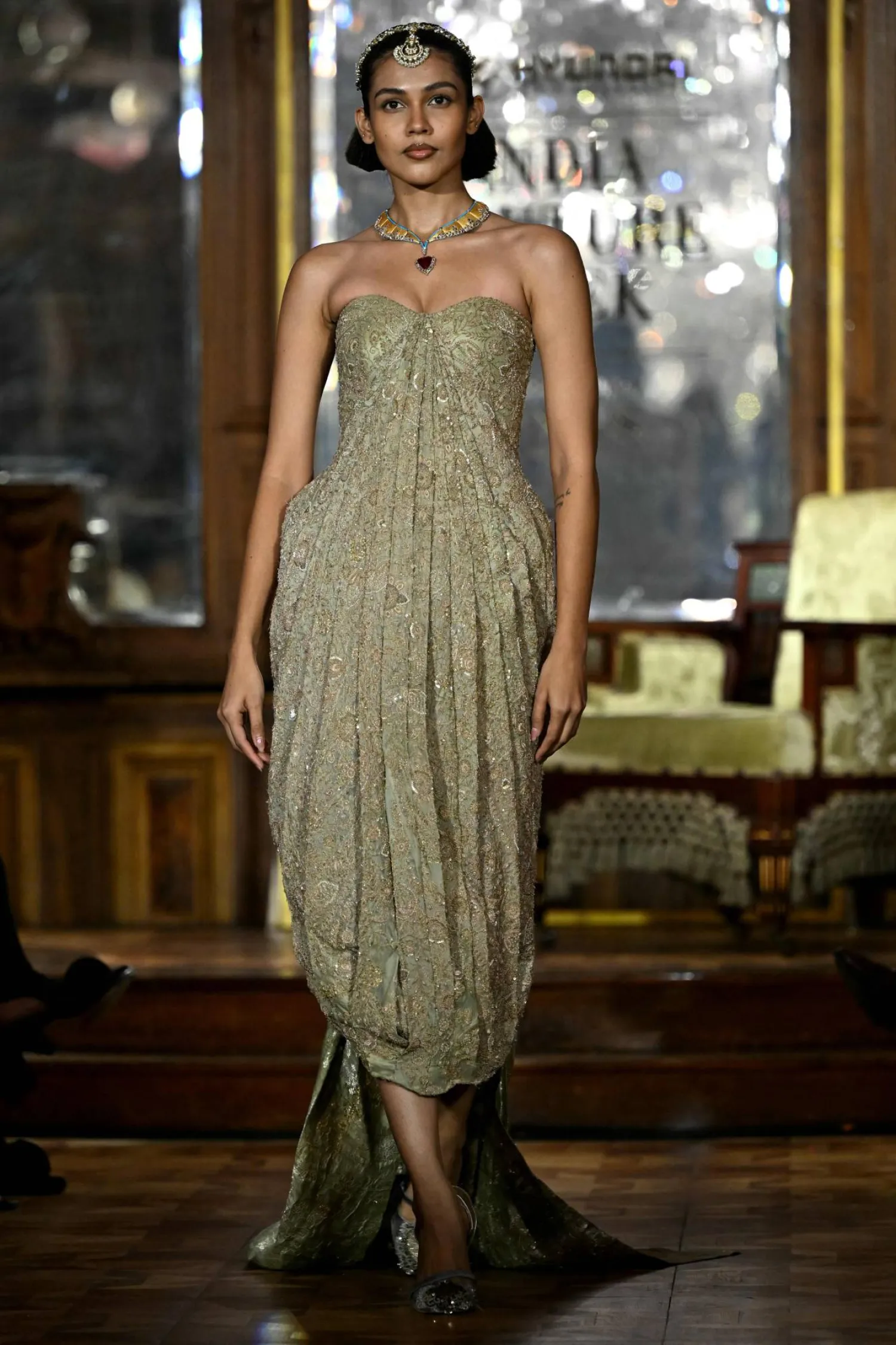
A model presents a creation by Indian designer Anamika Khannna during the opening show of the Hyundai India Couture week 2026 at the Falaknuma Palace in Hyderabad on July 23, 2026. (Photo by Noah SEELAM / AFP)
TT

As Fashion Stumbles, Jewelry Will Help Shape Luxury's Winners

A model presents a creation by Indian designer Anamika Khannna during the opening show of the Hyundai India Couture week 2026 at the Falaknuma Palace in Hyderabad on July 23, 2026. (Photo by Noah SEELAM / AFP)

As luxury groups grapple with weak fashion sales and a hit to spending from the Middle East conflict, investors are increasingly focused on one question: who sells enough jewels?

The answer may help determine the $400 billion industry's next winners and losers. The luxury goods sector was expected to return to growth in 2026 after contracting for two consecutive years, but the conflict was still curtailing spending in the first quarter and the impact is set to be greater in the three months to June, industry analysts say.

Leather bags, a traditional driver of profitability, are not offering enough support, viewed as too pricey and unattractive to younger consumers. But jewelry is doing better.

While still representing a relatively modest share of sales for most luxury players, the segment "punches well above its weight" in ⁠terms of steady ⁠growth and stronger margins, Vontobel analysts said earlier this year.

GOLD RALLY 'ADDS TO APPEAL'

Interest in the category was piqued as shoppers began to tire of a lack of innovation in high-end fashion during a period of designer changes, and a rally in gold has added to its appeal as an investment, said Carole Madjo, head of European luxury research at Barclays.

"All these points combined together were making jewelry a bit more attractive compared to soft luxury," she said. Sales of jewelry at Cartier and Van Cleef & Arpels owner Richemont soared ⁠by 24% in the quarter to June 30, far outpacing analyst estimates.

LVMH, owner of Bulgari and Tiffany, is also expected to improve its hard luxury sales.

Barclays analysts last month raised growth expectations for its Watches and Jewelry division from 7% to 8% for 2026, well above the 3% growth it posted last year. The division, LVMH's third largest, accounted for 13% of its €81 billion turnover in 2025.

LVMH reports second-quarter sales on Monday, Gucci owner Kering on Tuesday, and Hermes on Wednesday.

JEWELRY DRIVES INNOVATION

While Richemont and LVMH own the largest jewelry brands, smaller labels are doing well too, prompting renewed interest by traditional fashion-focused players.

Kering, owner of Pomellato and Boucheron, said in April sales of its new jewelry division grew 22% on a comparable basis in the first quarter, outperforming all other segments.

Hermes' jewelry segment has shown a ⁠compound annual growth rate of ⁠almost 30% since 2019, according to Vontobel analysts, albeit from a very small base.

"Even at soft luxury players like Hermes, Prada, Gucci, everybody's putting a bit more emphasis on jewelry because that's where the growth is coming from right now. So you want to be exposed to that," Madjo said.

BAGS AND SHOES LOSE FAVOR

The switch in consumer focus to jewelry from items such as high-end bags and shoes could pose a challenge for players like Hermes, whose global appeal has long rested on its tightly controlled Birkin bag franchise.

Its stock fell about 10% after it missed first-quarter growth estimates, raising questions about the strength of its scarcity-driven model.

"Bags and shoes are facing meaningful headwinds, as both have experienced significant softening in consumer desirability, particularly among younger audiences," said Claudia D'Arpizio, senior partner at consultancy Bain & Company.

"These categories, especially bags, have historically been strong contributors to revenues and margin growth; however, post-COVID dynamics have created a more challenging environment. So players need to find a winning formula for these."

Birkenstock Raises Annual Revenue Forecast on Strong Demand

Shares of the German sandal maker were up ‌7% in ‌premarket trading.  (Getty Images)
Shares of the German sandal maker were up ‌7% in ‌premarket trading. (Getty Images)
TT

Birkenstock Raises Annual Revenue Forecast on Strong Demand

Shares of the German sandal maker were up ‌7% in ‌premarket trading.  (Getty Images)
Shares of the German sandal maker were up ‌7% in ‌premarket trading. (Getty Images)

Birkenstock raised its full-year sales growth forecast on Wednesday, banking on resilient full-price demand for its premium sandals from affluent shoppers.

Shares of the German sandal maker were up ‌7% in ‌premarket trading.

A pullback in ‌US ⁠discretionary spending has ⁠weighed on much of the apparel and footwear sector, but brands such as Birkenstock catering to wealthier consumers have largely held up, benefiting from ⁠strong pricing power and ‌brand loyalty.

While ‌the Middle East conflict continues ‌to create uncertainty in the Gulf ‌region, the impact on the quarter was more contained than initially anticipated, the company said.

It now ‌expects fiscal year 2026 revenue growth of 15% ⁠on ⁠a constant currency basis, compared with its earlier forecast of a 13% to 15% rise.

The company posted third-quarter revenue of 719.5 million euros ($829.08 million), compared with analysts' estimate of 713.4 million euros, according to data compiled by LSEG.


Jeweller Pandora Raises 2026 Guidance as New Designs Draw in Shoppers

A view of the Pandora sign on one of the branches of the Danish jewellery maker Pandora in central Copenhagen, Denmark, August 13, 2025. (Reuters)
TT

Jeweller Pandora Raises 2026 Guidance as New Designs Draw in Shoppers

A view of the Pandora sign on one of the branches of the Danish jewellery maker Pandora in central Copenhagen, Denmark, August 13, 2025. (Reuters)

Jeweller Pandora raised its 2026 guidance for organic growth and profit margin on Wednesday, saying new designs and marketing were helping attract shoppers, and also reported second-quarter operating profit (EBIT) above analysts' expectations.

Pandora said EBIT for the April-June period came in at 1.46 billion Danish crowns ($225.35 million), against an average estimate of 1.10 billion expected by analysts in a company-compiled poll, reflecting partial refunds of previously paid ‌U.S. tariffs.

"We are ‌making progress in re-energizing Pandora's ‌growth engine," ⁠CEO Berta de ⁠Pablos-Barbier said in a statement.

"There is more work ahead, but we are moving in the right direction and raising our 2026 guidance for both growth and profitability," she added.

The company now expects organic growth at between 0% and 3% in ⁠2026, up from a previous range ‌of -1% to 2%, ‌and an operating profit margin between 22% and 23%, up ‌from 21% to 22%.

In the top job ‌since January, de Pablos-Barbier is leading a drive to release new designs, with its Pandora Wonders line - featuring pearl charms shaped like a frog, a pufferfish, or ‌a mushroom - launching in July in Paris during Haute Couture week.

Pandora's share price ⁠has ⁠been highly volatile over the past two years as the price of silver surged, prompting de Pablos-Barbier to announce in February a shift towards platinum-plated jewellery as a way of reducing its reliance on silver.

Pandora said on Wednesday it started pilot testing a limited range of platinum-plated jewellery in the Netherlands in July, and would do broader tests across markets in the fourth quarter, before scaling up the rollout next year.


Armani Stake Sale Could Be Delayed Beyond March 2027 Deadline

FILE PHOTO: People walk past a Giorgio Armani store in Galleria Vittorio Emanuele II, following Giorgio Armani's death at the age of 91, in Milan, Italy, September 5, 2025. REUTERS/Gonzalo Fuentes//File Photo
TT

Armani Stake Sale Could Be Delayed Beyond March 2027 Deadline

FILE PHOTO: People walk past a Giorgio Armani store in Galleria Vittorio Emanuele II, following Giorgio Armani's death at the age of 91, in Milan, Italy, September 5, 2025. REUTERS/Gonzalo Fuentes//File Photo

The planned sale of ‌a 15% stake in Italian fashion group Giorgio Armani may not be completed until after a March 2027 deadline set by the late designer's will, an Italian newspaper reported on Tuesday.

Citing company sources, the Corriere della Sera said market conditions for the luxury industry were still challenging and negotiating a deal could require time, said Reuters.

The indications on timing in the will are not binding, the sources said, adding the need to reach the best possible terms for a sale took precedence.

The company did not immediately ‌respond to ‌a request for comment.

Giorgio Armani, who died on ‌September ⁠4, 2025, instructed the ⁠eponymous foundation that controls the fashion house to sell an initial 15% stake within 18 months, giving priority to French luxury goods group LVMH, beauty giant L'Oreal and Franco-Italian eyewear maker EssilorLuxottica .

Corriere cited board documents from the Giorgio Armani Foundation as saying the process was still at an early stage and unlikely to ⁠be completed before 2027.

Evaluations over the stake ‌sale are under way but ‌remain preliminary because the transaction is complex, Rothschild & Co banker and foundation director ‌Irving Bellotti told an April board meeting, Corriere reported.

Bellotti said ‌that work on the deal would begin this year but was expected to be completed during 2027.

The group has also not ruled out a potential stock market listing, which would leave management in ‌the hands of the family and current executives under the foundation's strategic oversight, Corriere said, citing the ⁠sources.

Corriere also ⁠cited Chief Executive Giuseppe Marsocci as telling the foundation's board in April that net group sales in the first two months of 2026 fell 7.5% at current exchange rates and 3.9% at constant exchange rates from a year earlier.

The company adopted measures to cut operating costs by €25 million ($28.84 million), Marsocci added.

The drop, he explained, was driven by the wholesale channel where sales declined 10.7% year-on-year at constant exchange rates, while direct-to-consumer sales rose 3.5% net of currency effects, Corriere reported.

Giorgio Armani will approve first-half results on September 8, Corriere said, adding they should broadly confirm January-February trends.