Alarm Over New 'War Crimes' in Sudan's Darfur Region

Adam Gamar an asylum seeker from Darfur in Sudan points to El Geneina on a map, a city in which there is intense violence targetting his tribespeople, in the Masalit tribe community center in southern Tel Aviv, Israel June 24, 2023. REUTERS/Amir Cohen
TT

Alarm Over New 'War Crimes' in Sudan's Darfur Region

Adam Gamar an asylum seeker from Darfur in Sudan points to El Geneina on a map, a city in which there is intense violence targetting his tribespeople, in the Masalit tribe community center in southern Tel Aviv, Israel June 24, 2023. REUTERS/Amir Cohen

Sudan's war has brought painful memories back to the troubled Darfur region where armed groups are accused of ethnically targeting civilians, sparking fears of a new "genocide".

"They burned every house in the neighborhood and killed my brother in front of me," recounted one survivor, Inaam, who fled the western region for neighboring Chad.

Her harrowing escape took her through streets "littered with bodies", said the human rights defender who, like others interviewed by AFP, used a pseudonym for fear of retaliation against relatives.

Such testimonies have sparked alarm about a repeat of the bloody history of Darfur, where former strongman Omar al-Bashir in 2003 unleashed Arab tribal militia in a scorched-earth campaign to quash a non-Arab rebellion against perceived inequalities.

The unrest killed at least 300,000 people and displaced 2.5 million, according to the UN, and sparked international charges of genocide, crimes against humanity and war crimes against Bashir and others.

The paramilitary Rapid Support Forces (RSF) later emerged from the notorious Janjaweed militia which spearheaded Bashir's deadly onslaught.

Against that background, Darfuris watched with terror when the RSF went to war in mid-April with the Sudanese army and fighting quickly spread from the capital Khartoum back to their home region.

Inaam said that, nine days after hostilities erupted, the RSF and allied Arab militias descended on her hometown of El Geneina, capital of West Darfur state.

After they torched her neighborhood, she fled on "detours to avoid RSF and Arab tribal fighters" and managed to cross the border to Chad about 30 kilometers away.

Another refugee, who asked to be identified only as Mohammed, also recounted passing through terrifying checkpoints.

At every stop, "Arab militia fighters asked us our names and our tribe," he told AFP. Depending on the answers, he said, some "were executed".

The RSF and their allies, Mohammed charged, "are specifically targeting Massalit," a non-Arab ethnic minority whom he said "the army has supported" in the current round of fighting.

"An old conflict is re-awakening in El Geneina."

Sudan's war has killed nearly 2,800 people nationwide and uprooted roughly 2.8 million as battles rage between the forces of army chief Abdel Fattah al-Burhan and his former deputy, RSF commander Mohamed Hamdan Daglo.

Much of the worst fighting has hit Darfur in unrest that Washington has labelled an "ominous reminder" of the past "genocide".

The Massalit are one of the major non-Arab ethnic groups in Darfur, which is also home to Arab tribes such as the Rizeigat, the pastoralist camel-herding people from which Daglo hails.

Volker Perthes, head of the United Nations mission to Sudan, warned in mid-June that "there is an emerging pattern of large-scale targeted attacks against civilians based on their ethnic identities, allegedly committed by Arab militias and some armed men" in RSF uniform.

"These reports are deeply worrying and, if verified, could amount to crimes against humanity."

On Tuesday, the United States, Norway and Britain said targeted ethnic violence and other abuses in Darfur are "mostly attributed" to RSF and allied militias.

Power blackouts and severed phone and internet access have severely hampered reporting from the region the size of France that is home to about a quarter of Sudan's 48 million people.

The UN has also said that "RSF and allied militias are reportedly surrounding the cities" of El Fasher in North Darfur and Nyala in South Darfur.

Amnesty International warned of "terrifying similarity with the war crimes and crimes against humanity" perpetrated in Darfur since 2003.

According to the United States State Department, up to 1,100 people have been killed in El Geneina alone, but the Massalit tribal leadership says the real toll is even higher.

They charged in a statement that more than 5,000 people were killed, 8,000 injured and hundreds of thousands displaced by June 12.

People have suffered "the worst crimes against humanity, murder, ethnic cleansing and looting", they said, reporting that "snipers have spread out on rooftops" and police "have joined RSF ranks".

Mohammed said families quickly learnt that "only the women could go out to fetch water, because the snipers would target every man".

Army soldiers meanwhile "have not left their bases since the war began," he said, echoing the situation in much of Khartoum.

A tribal leader told AFP that "the RSF and the Arabs have killed, looted and burned" everything in their path.

In El Geneina, "the house of the Massalit sultan" has been under "constant attack," he said.

Tribal leaders and activists have been killed in their homes, according to the West Darfur lawyers' union.

In mid-June, the sultan's brother Tarek Bahr El-Din was killed, as was West Darfur Governor Khamis Abdullah Abakar, who had hours earlier accused the RSF of "genocide.”.

The RSF denied killing Abakar and blamed forces it said were acting "against the background of an old tribal conflict".

RSF general Abdel Rahman Gumma Barak Allah accused the army of having armed minority groups, including "1,000 Aringa men and 1,500 Massalit" and charged they had attacked police in El Geneina.

The fighting has deepened a long-running humanitarian crisis, say aid groups, after clinics were raided and food warehouses ransacked in Darfur.

"The conflict has not only endangered lives through direct violence but has also severely hindered access to health care," Doctors Without Borders (MSF) told AFP.

Another refugee, teacher Ibrahim Issa, told AFP he had made it "out of the hell" of El Geneina, where the fighting had brought back dark memories "of 2003 and 2004, when you were killed for your ethnicity".

Mohammed said the conflict between the army and RSF "has turned into a civil war and a genocide".

MSF medics in Chad reported treating refugees with bullet wounds who were targeted "as they tried to leave the city".

The group also reported sexual violence including the rape of a 15-year-old girl by "six armed men in a bus" while she was fleeing to Chad with her 18-year-old sister.

Alice Nderitu, the UN Special Adviser on the Prevention of Genocide, also warned of the threat of "renewed campaigns of rape, murder and ethnic cleansing".

The latest Darfur violence has again raised the question of whether those responsible will one day face justice.

"In principle, many of the crimes documented to date in Darfur likely constitute at least crimes against humanity, if not war crimes," human rights lawyer Emma DiNapoli told AFP.

But proving them will depend on what evidence activists can gather while dodging bullets and arson attacks.

"Activists on the ground should be documenting evidence to the highest standard possible, particularly taking the details of eyewitnesses to violations and documenting evidence of command and control or perpetrator information," DiNapoli said.

Since the UN Security Council referred the situation in Darfur to the International Criminal Court with no end date, the court "in theory" has "jurisdiction over crimes committed in the present day," she added.

But Sudan's past does not offer much hope. Khartoum never handed over any suspects wanted by the ICC, and some have escaped prison since the new war broke out.

Four suspects including Bashir remain at large. One, who voluntarily surrendered elsewhere in Africa, is on trial in The Hague.

Gaza Wedding Cheers Drown Out Sound of Israeli Airstrikes

Palestinians gather at a wedding in the Al-Nasser neighborhood, west of Gaza City, in April. (Asharq Al-Awsat)
TT

Gaza Wedding Cheers Drown Out Sound of Israeli Airstrikes

Palestinians gather at a wedding in the Al-Nasser neighborhood, west of Gaza City, in April. (Asharq Al-Awsat)

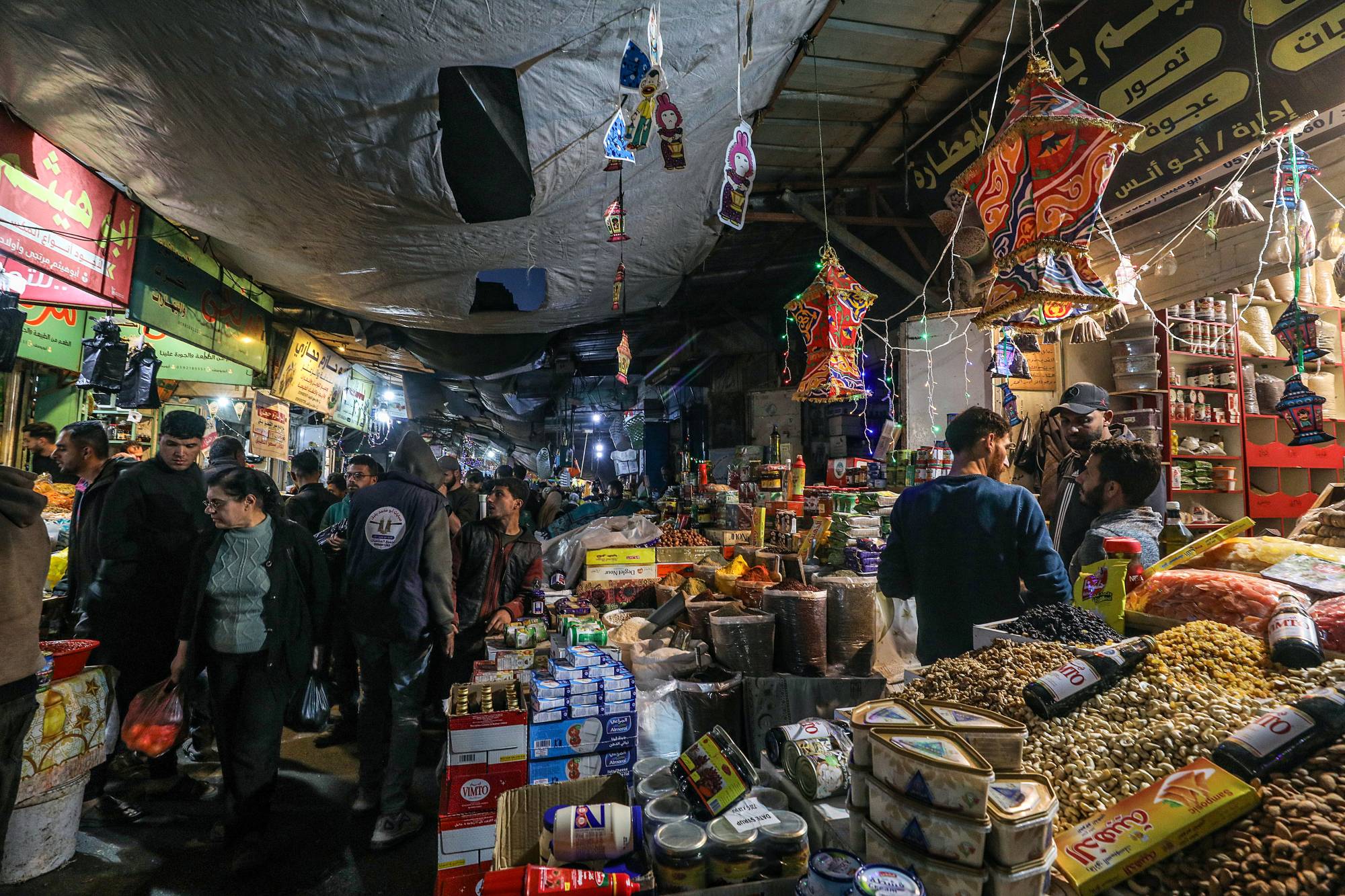
Since the announcement of a ceasefire agreement in Gaza last October, Israeli violations have continued and the toll of dead and wounded has climbed. Yet, that has not stopped residents of the Palestinian enclave — almost entirely devastated by war — from breaking into celebratory wedding cheers that, if only briefly, cut through the buzz of drones and the thunder of airstrikes.

In recent weeks, residents in Khan Younis, Al-Shati refugee camp, Shujaiya and other areas have held public wedding celebrations attended by relatives and neighbors, reviving scenes absent from Gaza throughout more than two years of war.

Alaa Moussa, 33, from the Sheikh Nasser area of Khan Younis in southern Gaza, lost her husband in an Israeli strike in mid-2024. She said she married in late April a man four years older than her who had also lost his wife and two children in a strike that hit displaced persons’ tents in the Al-Mawasi area of the same city.

“I accepted only a symbolic dowry of no more than 1,500 Jordanian dinars ($2,100), because it has become insignificant under these difficult circumstances,” Moussa told Asharq Al-Awsat.

She held what she described as a “modest wedding” among the tents of displaced families in Al-Mawasi, where one of the tents has become the couple’s new home.

“The war has not stopped, yet like many others we are searching for moments of joy despite all the pain we have endured and continue to endure in Gaza amid unrelenting attacks,” she remarked.

Moussa, who had no children with her late husband, said she saw no issue in marrying a man with three children “despite some criticism” from relatives and those around her.

“I will raise them as though they were my own,” she added.

Palestinians gather at a wedding in the Al-Nasser neighborhood, west of Gaza City, in April. (Asharq Al-Awsat)

‘Social criticism’

Israel has imposed restrictions and a tight blockade on Gaza since the early 1990s, tightening them further after Hamas seized control of the enclave nearly 19 years ago. Unemployment rose from 29.7 percent in 2007 to 45 percent in 2023, the year the war erupted at its close.

Abdullah Farhat, 29, from Al-Shati refugee camp west of Gaza City, was among those whose hopes of marriage and starting a family were delayed for years by Gaza’s harsh economic conditions.

Farhat told Asharq Al-Awsat he recently married a woman two years older than him who had lost her husband at the start of the current war.

He said he paid little attention to what he described as “social criticism” over “marrying a widow or the age difference.”

“My convictions did not change, especially after we found mutual acceptance,” he stated.

Return of wedding halls

Months after the ceasefire, wedding gatherings gradually returned in some areas. Youth parties have also resurfaced, and some wedding halls have reopened to customers.

Ayman Muhaysin, 26, from the Shujaiya neighborhood east of Gaza City, who is displaced in a school turned shelter in the Rimal district, held his wedding last month in a wedding hall in his neighborhood.

He said he paid 4,000 shekels (about $1,300) for the venue and a similar amount for a separate gathering for male relatives and friends, in keeping with Gaza traditions in which the groom’s celebration is held one day with male relatives and friends, followed the next day by a reception attended by women inside the hall, while close male relatives from both families gather outside.

Ayman Muhaysin celebrates his wedding in the Rimal neighborhood of Gaza City in April. (Photo provided by Muhaysin)

Muhaysin works in a shop earning 1,500 shekels a month. After the wedding, he moved into a classroom where he had been living with his four brothers, who relocated to a neighboring classroom to stay with their parents and three sisters.

Muhaysin said he had to borrow heavily to finance the wedding but did not regret it.

“I lost my brother during the war, along with many relatives, but this is life. We are searching for whatever brings joy to our hearts despite the hardships we face,” he told Asharq Al-Awsat.

Exorbitant prices

Dozens of wedding halls built along Gaza’s Mediterranean coast were destroyed by Israeli forces during the war. Some restaurants and investors have since opened new venues west of Gaza City, though many residents consider their prices exorbitant.

Mohammed Ghanem, an owner of a wedding hall in Gaza City, explained that prices are high because of the cost of constructing these halls.

“The lack of electricity, operating private generators and securing fuel for them all add to expenses, in addition to the salaries of male and female employees providing wedding services,” he underlined.

Ghanem said prices were “close to what wedding halls charged before the war,” but noted that the new venues “do not have the same level of amenities and equipment that halls once had.”

Recently, Arab and Islamic charitable organizations have begun sponsoring mass wedding ceremonies in Gaza and providing financial support to newlyweds as part of efforts “to ease the burden on young people, tens of thousands of whom rushed to register for such an opportunity.”


Caspian Sea Provides Lifeline for Iran amid Sanctions, Blockade

An Iranian man walks past the map of Iran, with its citizens holding hands, painted on a wall in the capital Tehran on May 9, 2026. (AFP)
TT

Caspian Sea Provides Lifeline for Iran amid Sanctions, Blockade

An Iranian man walks past the map of Iran, with its citizens holding hands, painted on a wall in the capital Tehran on May 9, 2026. (AFP)

Amid the regional tensions and western sanctions, a complex network of supply routes is beginning to emerge, underscoring the alliances between Russia, Iran and China in confronting mounting US pressure on Iran’s military program and its ability to maintain its production.

In March, Israel carried out a “one of the most significant” strikes on Iran targeting its naval command center at the port of Bandar Anzali, located on the Caspian Sea.

The Caspian Sea, a huge body of water hundreds of miles north of the Gulf. Routinely overlooked, the Caspian has taken on new significance as a trade route linking Russia and Iran, reported The New York Times on Saturday.

For two allies that have been embroiled in wars and facing more Western sanctions than any other country, the waterway provides a passageway for both overt and covert trade — shipments that have helped Iran persist as an adversary to the United States despite overwhelming American military superiority.

Russia is shipping drone components to Iran via the Caspian Sea, US officials say, helping Iran rebuild its offensive abilities after losing roughly 60 percent of its drone arsenal during recent fighting. The officials spoke anonymously to divulge private military assessments.

Russia also provides goods that would typically pass through the Strait of Hormuz, now blockaded by the US Navy, as part of global trade.

Bigger than Japan, the Caspian is considered the largest lake in the world. Much of the trade passing through it is opaque. It has proved difficult to monitor from afar, not least because ships plying the route between Russian and Iranian ports habitually turn off the transponders that allow for satellite tracking, according to maritime tracking groups.

“If you’re thinking about the ideal place for sanction evasion and military transfers, it’s the Caspian,” said Nicole Grajewski, a professor specializing in Iran and Russia at Sciences Po in Paris, according to NYT.

While both Russia and Iran are public about trade in commodities like wheat, trade in weapons systems is a different issue.

Drone shipments show the close defense partnership between Moscow and Tehran. While it is unlikely the Russian parts play a decisive role in Iran’s war with the United States and Israel, they help bolster Tehran’s drone arsenal. If the shipments continue, they will help Iran to quickly rebuild that arsenal, the US officials said.

The trade flowed in both directions in years past, the officials said, with Iran shipping drones to Russia for use in Ukraine even as Russia sent parts to Iran. The need for supplies from Iran diminished after July 2023 however, when Russia, under license from Iran, began producing its own model of the Shahed drone at a factory in Tatarstan.

Asian networks

The US Treasury on Friday announced sanctions against 10 individuals and companies, including several in China and Hong Kong, over accusations they aided Iran's efforts to secure weapons and the raw materials needed to build its Shahed drones and ballistic missiles.

The Treasury move, first reported by Reuters, comes days before US President Donald Trump plans to travel to China for a meeting with President Xi Jinping and as efforts to end the war with Iran have stalled.

In a statement, Treasury said it remained ready to take economic action against Iran's military industrial base ‌to prevent Tehran ‌from reconstituting its production capacity.

The Treasury said it was ‌also ⁠prepared to act ⁠against any foreign company supporting illicit Iranian commerce, including airlines, and could impose secondary sanctions on foreign financial institutions that aid Iran's efforts, including those connected to China's independent "teapot" oil refineries.

Brett Erickson, managing principal at Obsidian Risk Advisors, said Treasury's actions were aimed at cracking down on Iran's ability to threaten ships operating in the Strait of Hormuz and regional allies.

Iran shut the ⁠Strait of Hormuz, a narrow chokepoint between Iran and ‌Oman through which a fifth of ‌the world's crude oil and liquefied natural gas passes, after the US and Israel attacked ‌a large number of targets in Iran on February 28. Shipping ‌through the crucial waterway has ground to a near halt since the war began, sending energy prices sharply higher.

Iran is a major drone manufacturer and has the industrial capacity to produce around 10,000 a month, according to the British government-fund ‌Centre for Information Resilience.

Erickson said the sanctions were still narrowly focused, giving Iran more time to adapt ⁠and reroute ⁠procurement to other suppliers. The Treasury was also not yet going after Chinese banks that were keeping Iran's economy going, he added.

The companies facing sanctions include the China-based Yushita Shanghai International Trade Co Ltd for facilitating acquisition efforts for Iran to purchase weapons from China; Elite Energy FZCO for transferring millions of dollars to a Hong Kong company to aid the procurement effort; and Hong Kong-based HK Hesin Industry Co Ltd and Belarus-based Armory Alliance LLC for working as intermediaries in the procurements.

The sanctions also targeted Hong Kong-based Mustad Ltd for facilitating weapon procurement by Iran's Revolutionary Guard Corps; Iran-based Pishgam Electronic Safeh Co for procuring motors used in drones; and China-based Hitex Insulation Ningbo Co Ltd for supplying materials used in ballistic missiles.


Marathon Marks Turning Point for Palestinian Runner Released from Israeli Prison

 Palestinian Mohamad Al-Assi, who was released from Israeli detention six months ago, runs past Israel's separation wall as he trains ahead of the Palestine Marathon in the West Bank city of Bethlehem, Thursday, May 7, 2026. (AP)
Palestinian Mohamad Al-Assi, who was released from Israeli detention six months ago, runs past Israel's separation wall as he trains ahead of the Palestine Marathon in the West Bank city of Bethlehem, Thursday, May 7, 2026. (AP)
TT

Marathon Marks Turning Point for Palestinian Runner Released from Israeli Prison

 Palestinian Mohamad Al-Assi, who was released from Israeli detention six months ago, runs past Israel's separation wall as he trains ahead of the Palestine Marathon in the West Bank city of Bethlehem, Thursday, May 7, 2026. (AP)
Palestinian Mohamad Al-Assi, who was released from Israeli detention six months ago, runs past Israel's separation wall as he trains ahead of the Palestine Marathon in the West Bank city of Bethlehem, Thursday, May 7, 2026. (AP)

Mohamad Al-Assi ran beneath the concrete wall as the sun rose over Bethlehem. His Nikes pounded the gravel, his breath fogging the air as graffiti and paint splatter blurred past with each stride.

The road along the barrier separating Israel from the occupied West Bank makes up a stretch of a marathon route that Al-Assi and thousands of others ran on Friday. The event is open to people in other parts of the world running in solidarity with the Palestinians and another, shorter race was happening in Gaza.

The race, known as the Palestine Marathon, was held for the first time in three years and was among the first big international events in the West Bank since the start of the Israel-Hamas war. Festivals, conferences and holiday festivities that once drew thousands have been scaled back or canceled because of the war in Gaza and heightened Israeli restrictions.

It marked a turning point for Al-Assi, 27, who was released from Israeli detention six months ago. Video from that day shows him gaunt-faced and hollow-eyed, his once muscular legs weakened after more than two-and-a-half years of prison.

He began training in December, gradually upping his mileage every month since. He ran 62 miles (100 kilometers) that first month, and in April reached 135 miles (217 kilometers), according to his account on the tracking app Strava.

He jogs in the morning after his mother wakes him up in their home in Dheisheh, a Palestinian refugee camp made up of graffiti-covered cinderblock homes in tangled alleyways.

“The main difficulties we face are the cars on the roads and the presence of Israeli security forces along the route where I train,” Al-Assi said.

He had to suspend his training several times because of military operations in the camp.

“I would return home feeling hopeless because I couldn't do what I had intended to do,” Al-Assi said.

Running where roads are blocked

In the West Bank, runners cannot complete a 26.2-mile (42.2-kilometer) course without hitting a checkpoint or military gate, which is why Friday's marathon route looped around the same circuit twice.

They ran up through the narrow streets of two Palestinian refugee camps and down to a farming town next to Bethlehem where fields are divided by the concrete wall, barbed wire and cameras. The course hooked back to finish at Bethlehem’s Manger Square.

Organizers say the race highlights restrictions facing Palestinians in the occupied West Bank, where checkpoints can disrupt even routine commutes and where open land for hiking, biking and running is increasingly taken by Israeli settlements and outposts.

“Marathon runners anywhere may ‘hit a wall’ under the physical and emotional strain of completing the 42-kilometer race course," they said on the marathon's website.

But in the West Bank, they added, "runners literally hit the Wall.”

At a time when the West Bank’s economy is struggling and in the shadow of Gaza's fragile ceasefire and stalled rebuilding efforts, the atmosphere in Bethlehem was celebratory. Crowds gathered near the Church of the Nativity to cheer runners at the race's early morning start and finish. Bagpipes blared and drummers pounded out traditional rhythms through streets along the route.

On a beachside road in Nuseirat in central Gaza — which is roughly the length of a marathon — 15 disabled people, including amputees, ran a 2K, and a couple of thousand of people ran a 5K. Thirteen years after the UN agency for Palestinian refugees, known as UNRWA, canceled a 2013 marathon because Hamas forbade women from participating, the women were back.

Haya Alnaji, a 22-year-old woman who ran in the 5K, said the number of people taking part reflected that Palestinians in Gaza were determined to live and persevere despite the devastation wrought by more than two years of war.

“All of Gaza loves sports,” she said.

Rebuilding body and spirit

Al-Assi was arrested in April 2023, and imprisoned under administrative detention, which allows Israel to hold detainees for months without charge. Between 3,000 and 4,000 Palestinians are being held under that system, according to Israeli rights groups and the Palestinian Prisoners Society.

In October 2023, Al-Assi was sentenced for transferring money to suspicious entities, a charge he denies. Israel closely monitors money transfers — particularly to Gaza — for fear that funds could end up in the hands of fighters. Palestinians, however, say donations and charitable contributions are often swept up in the dragnet. Israel’s military, Shin Bet and Prison Service did not answer questions about Al-Assi's charges.

In Israeli prisons, where detainees routinely complain of inadequate diets, Al-Assi said nearly everyone goes hungry. The weight he lost eroded the endurance built through 10 years of training.

“I have more muscle mass than fat, so when I lost weight, the loss came from my muscles rather than fat,” he said. “This had a major impact on my physical fitness.”

He also had to regain the mental fortitude to run a marathon.

“I was emotionally shattered after spending such a long period in prison,” he said.

On Friday, he collapsed to his knees, bowing and thanking God after finishing second overall, as supporters and journalists encircled him. He dedicated his run to Palestinians still in Israeli detention.

“After 32 months in prison, Mohamad Al-Assi is first in his class!” he shouted through tears, raising his hands and looking up to the sky.