
Caspian Sea Provides Lifeline for Iran amid Sanctions, Blockade

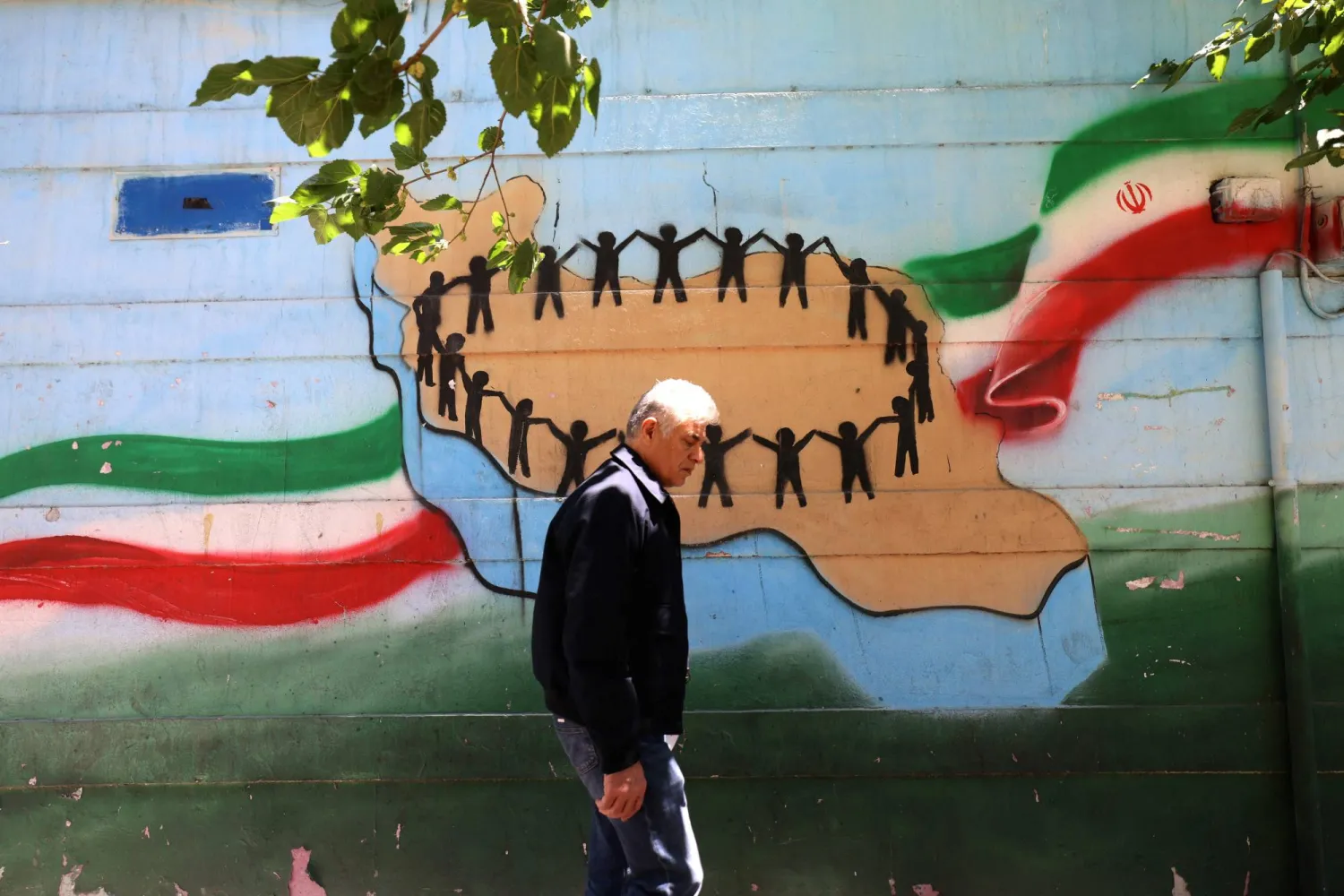
An Iranian man walks past the map of Iran, with its citizens holding hands, painted on a wall in the capital Tehran on May 9, 2026. (AFP)
TT

Caspian Sea Provides Lifeline for Iran amid Sanctions, Blockade

An Iranian man walks past the map of Iran, with its citizens holding hands, painted on a wall in the capital Tehran on May 9, 2026. (AFP)

Amid the regional tensions and western sanctions, a complex network of supply routes is beginning to emerge, underscoring the alliances between Russia, Iran and China in confronting mounting US pressure on Iran’s military program and its ability to maintain its production.

In March, Israel carried out a “one of the most significant” strikes on Iran targeting its naval command center at the port of Bandar Anzali, located on the Caspian Sea.

The Caspian Sea, a huge body of water hundreds of miles north of the Gulf. Routinely overlooked, the Caspian has taken on new significance as a trade route linking Russia and Iran, reported The New York Times on Saturday.

For two allies that have been embroiled in wars and facing more Western sanctions than any other country, the waterway provides a passageway for both overt and covert trade — shipments that have helped Iran persist as an adversary to the United States despite overwhelming American military superiority.

Russia is shipping drone components to Iran via the Caspian Sea, US officials say, helping Iran rebuild its offensive abilities after losing roughly 60 percent of its drone arsenal during recent fighting. The officials spoke anonymously to divulge private military assessments.

Russia also provides goods that would typically pass through the Strait of Hormuz, now blockaded by the US Navy, as part of global trade.

Bigger than Japan, the Caspian is considered the largest lake in the world. Much of the trade passing through it is opaque. It has proved difficult to monitor from afar, not least because ships plying the route between Russian and Iranian ports habitually turn off the transponders that allow for satellite tracking, according to maritime tracking groups.

“If you’re thinking about the ideal place for sanction evasion and military transfers, it’s the Caspian,” said Nicole Grajewski, a professor specializing in Iran and Russia at Sciences Po in Paris, according to NYT.

While both Russia and Iran are public about trade in commodities like wheat, trade in weapons systems is a different issue.

Drone shipments show the close defense partnership between Moscow and Tehran. While it is unlikely the Russian parts play a decisive role in Iran’s war with the United States and Israel, they help bolster Tehran’s drone arsenal. If the shipments continue, they will help Iran to quickly rebuild that arsenal, the US officials said.

The trade flowed in both directions in years past, the officials said, with Iran shipping drones to Russia for use in Ukraine even as Russia sent parts to Iran. The need for supplies from Iran diminished after July 2023 however, when Russia, under license from Iran, began producing its own model of the Shahed drone at a factory in Tatarstan.

Asian networks

The US Treasury on Friday announced sanctions against 10 individuals and companies, including several in China and Hong Kong, over accusations they aided Iran's efforts to secure weapons and the raw materials needed to build its Shahed drones and ballistic missiles.

The Treasury move, first reported by Reuters, comes days before US President Donald Trump plans to travel to China for a meeting with President Xi Jinping and as efforts to end the war with Iran have stalled.

In a statement, Treasury said it remained ready to take economic action against Iran's military industrial base ‌to prevent Tehran ‌from reconstituting its production capacity.

The Treasury said it was ‌also ⁠prepared to act ⁠against any foreign company supporting illicit Iranian commerce, including airlines, and could impose secondary sanctions on foreign financial institutions that aid Iran's efforts, including those connected to China's independent "teapot" oil refineries.

Brett Erickson, managing principal at Obsidian Risk Advisors, said Treasury's actions were aimed at cracking down on Iran's ability to threaten ships operating in the Strait of Hormuz and regional allies.

Iran shut the ⁠Strait of Hormuz, a narrow chokepoint between Iran and ‌Oman through which a fifth of ‌the world's crude oil and liquefied natural gas passes, after the US and Israel attacked ‌a large number of targets in Iran on February 28. Shipping ‌through the crucial waterway has ground to a near halt since the war began, sending energy prices sharply higher.

Iran is a major drone manufacturer and has the industrial capacity to produce around 10,000 a month, according to the British government-fund ‌Centre for Information Resilience.

Erickson said the sanctions were still narrowly focused, giving Iran more time to adapt ⁠and reroute ⁠procurement to other suppliers. The Treasury was also not yet going after Chinese banks that were keeping Iran's economy going, he added.

The companies facing sanctions include the China-based Yushita Shanghai International Trade Co Ltd for facilitating acquisition efforts for Iran to purchase weapons from China; Elite Energy FZCO for transferring millions of dollars to a Hong Kong company to aid the procurement effort; and Hong Kong-based HK Hesin Industry Co Ltd and Belarus-based Armory Alliance LLC for working as intermediaries in the procurements.

The sanctions also targeted Hong Kong-based Mustad Ltd for facilitating weapon procurement by Iran's Revolutionary Guard Corps; Iran-based Pishgam Electronic Safeh Co for procuring motors used in drones; and China-based Hitex Insulation Ningbo Co Ltd for supplying materials used in ballistic missiles.


Iran's Strongest Card in Nuclear Talks: Its Highly Enriched Uranium

Centrifuges at the Fordow nuclear facility before the June 2025 attacks (Reuters)
TT

Iran's Strongest Card in Nuclear Talks: Its Highly Enriched Uranium

Centrifuges at the Fordow nuclear facility before the June 2025 attacks (Reuters)

Iran and the United States are in discussions to extend ‌their ceasefire so as to start negotiations on issues including Tehran's nuclear program, where Washington insists Iran must not be able to make a nuclear weapon.

While much of Iran's uranium enrichment infrastructure was destroyed or badly damaged when Israel and the US bombed it in June, a large part of the highly enriched uranium it amassed is thought to have survived. That is the biggest US concern ahead of nuclear talks.

On Friday Trump said in a social media post that Iran must agree that the enriched uranium buried underground after earlier US strikes be "unearthed" and destroyed in coordination with Iran and the UN nuclear watchdog.

WHAT IS HIGHLY ENRICHED URANIUM?

One of two fissile materials, along with plutonium, with which one can make the core of a nuclear bomb. While plutonium is usually extracted from the spent fuel of a nuclear reactor, requiring large and highly visible infrastructure, uranium can be enriched using centrifuges that have a much smaller footprint. Two of Iran's three enrichment sites that are known to have been operating when Israel and the ‌US attacked in ‌June were underground. The above-ground one was clearly destroyed.

Uranium is highly enriched when it ‌has ⁠reached 20% purity, and ⁠weapons-grade as of around 90%.

Modern reactors generally use fuel enriched to up to 5%, but some use fuel enriched to higher levels. The ones that power US nuclear submarines reportedly use fuel enriched beyond 90%.

HOW MUCH DOES IRAN HAVE?

Iran has not informed the UN nuclear watchdog of the fate of its enriched uranium since the June attacks or let its inspectors return to the sites where it was stored.

The International Atomic Energy Agency estimates Iran had these amounts when the first Israeli bombs fell on June 13:

- 440.9 kg enriched to up to 60%

- 184.1 kg enriched to up to 20%

- 6,024.4 kg enriched to ⁠up to 5%

- 2,391.1 kg enriched to up to 2%

According to an IAEA yardstick, ‌the amount at 60% is enough, if enriched further, for 10 nuclear weapons. ‌The 20% stock would be enough for one and the 5% could produce 12. How much has survived is unclear. IAEA chief ‌Rafael Grossi has said his agency believes "a bit more than 200 kg" of the 60% stock is stored at a ‌tunnel complex in Isfahan that appears to have been largely unharmed by the June attacks. Some was also at the Natanz nuclear site, he said.

WHY THE CONCERN? US concern has been focused on the 60% material because that would be easiest and thus quickest to make a bomb with. Washington wants it gone. Iran denies seeking nuclear weapons.

As the enrichment level of uranium increases, it becomes exponentially easier to enrich ‌further. Getting from 60% to 90% is easier than getting from unenriched to 5%.

President Donald Trump pulled the United States out of a nuclear deal between Iran and ⁠major powers that kept Tehran ⁠at a far greater distance from being able to produce an atom bomb than it is at now. The US withdrawal in 2018 caused the deal to unravel, and Iran quickly expanded its atomic program.

Under that 2015 deal, Iran did not enrich beyond 3.67%.

Even at 90%, however, it takes more steps to produce the core of a bomb. When it is enriched, the uranium is in gas form. It must then be turned into metal for use in a weapon.

CAN YOU MOVE IT?

Yes. Iran moved enriched material between sites under IAEA monitoring before the June attacks.

Under the 2015 deal and a precursor to it, Iran's stocks of uranium enriched to up to 20% were diluted or turned into reactor fuel plates and shipped out of the country.

Moving nuclear material like highly enriched uranium internationally is a sensitive but relatively routine procedure.

"It requires some precaution but it can be moved," Grossi told PBS in March when asked about the 60% material.

WILL IRAN GIVE IT UP? Iran's supreme leader has issued a directive that the 60% material should not be sent abroad, two senior Iranian sources said last week.

Iranian sources say Tehran might agree to send half of it to a third country, receiving uranium enriched to 5% in return, and dilute the other half inside Iran.


Beaufort Castle: Israel’s Geographic Gateway to South Lebanon

 Smoke rises near the Beaufort Castle, as seen from Marjeyoun, southern Lebanon, May 29, 2026. (Reuters)
Smoke rises near the Beaufort Castle, as seen from Marjeyoun, southern Lebanon, May 29, 2026. (Reuters)
TT

Beaufort Castle: Israel’s Geographic Gateway to South Lebanon

 Smoke rises near the Beaufort Castle, as seen from Marjeyoun, southern Lebanon, May 29, 2026. (Reuters)
Smoke rises near the Beaufort Castle, as seen from Marjeyoun, southern Lebanon, May 29, 2026. (Reuters)

Repeated Israeli strikes on the medieval Beaufort Castle and its surroundings east of Nabatieh have revived debate over one of southern Lebanon’s most sensitive sites due to its elevated position overlooking Palestinian territories, Syria and Lebanon.

For decades, the Crusader fortress was a commanding military position and a battlefield etched into Israeli and Lebanese memory. Now, as fighting escalates in the south, it is back at the center of events. Military assessments say its battlefield value remains, despite major changes in warfare over recent decades.

The renewed focus on Beaufort Castle comes as Israel intensifies strikes around the site and the heights overlooking Nabatieh. The attacks have raised fresh questions about the military value of a position that has remained present in major confrontations in southern Lebanon since Israel's 1982 invasion.

Heritage landmark

Beaufort Castle, known in Arabic as Qalaat al-Shaqif, is one of southern Lebanon’s most prominent historical and heritage landmarks, and among the most important Crusader castles in the Levant.

The Crusaders named it Beaufort, meaning “beautiful fortress.” It later fell to Salaheddine after a long siege. The Crusaders then retook it for a period, and the Knights Templar inhabited it, before the Mamluks, led by Sultan al-Zahir Baybars, seized it in 1268.

Smoke rises from Beaufort Castle following strikes, as seen from Marjeyoun, southern Lebanon, May 27, 2026. (Reuters)

Although the Romans first built initial fortifications at the strategic site, the Crusaders greatly expanded it and built most of its existing structures.

Since 2024, the castle has held “enhanced protection” status under the Second Protocol to the Hague Convention for the Protection of Cultural Property in the Event of Armed Conflict, Lebanon's Arnoun municipality said in a statement.

The municipality warned that repeated Israeli strikes could damage the castle and urged Lebanese authorities and relevant international organizations to act to protect the landmark and prevent further harm.

Battlefield advantage

Claiming the castle has long been seen as a battlefield advantage. In the 1970s, it came under heavy Israeli airstrikes after the Palestine Liberation Organization used it as a position to fire at Israel. In 1982, it was the scene of one of the fiercest battles between Israeli forces and Palestinian fighters and their Lebanese allies. Israel occupied it until 2000.

Retired Brigadier General Bassam Yassine said Beaufort Castle’s importance today is little different from the value that made it a focus of battles since the 1982 invasion. The site, he said, remains one of southern Lebanon’s most prominent commanding military positions.

“Beaufort Castle has been present in all wars and battles with Israel from 1982 until today because of its strategic location,” Yassine told Asharq Al-Awsat, saying it offers a commanding view over wide areas of southern Lebanon and northern occupied Palestine.

“Beaufort Castle overlooks the settlement of Metula, which is less than four kilometers away. It overlooks the area between the Litani and Zahrani rivers and is considered the highest hill in this sector,” he said.

The site gives whoever controls it a major military advantage, Yassine said.

“From Beaufort Castle, one can observe Taybeh, Deir Seryan and Qantara, where the Israeli army is present today. That is why it cannot leave it outside its control if it wants to remain in the area where it is deployed,” he said.

Yassine said this importance is not new. Before Israel withdrew from southern Lebanon in 2000, it controlled hills and heights around the area, including Beaufort Castle, to secure battlefield superiority and maintain observation over its surroundings.

Destroyed buildings are pictured in the village of Kfar Kila in southern Lebanon as seen from across the border in the Upper Galilee region of northern Israel on May 29, 2026, with the Crusader-period Beaufort Castle pictured in Lebanon in the background. (AFP)

Asked which sectors the castle exposes, he said: “It directly overlooks Yohmor al-Shaqif, eastern Zawtar, western Zawtar, Kfar Tebnit and Nabatieh al-Fawqa. All these areas are exposed from the castle.”

“It also protects forces on the Yohmor and Zawtar axes, and provides cover for troops deployed in Taybeh, Deir Seryan and Qantara, and across this entire sector,” he added.

Yassine said the castle’s military value also lies in its defensive terrain.

“If any resistance force managed to infiltrate the castle and possess anti-armor missiles there, it would become very difficult to remove it from the site or destroy it because of the geography of the location,” he explained.

He said Israel had faced that problem before, during the period of Palestinian armed presence in the south.

“The Israelis tried many times to destroy the castle during the Palestinian period, but they did not succeed because of its geography,” he said.

Yassine said the site includes old historical passages and tunnels.

“The castle has tunnels that reach the Litani River below. They have existed since the Crusader era and are not newly built tunnels, which gives the site additional defensive value,” he said.

Control of the castle does not mean control of the area

Retired Brig. Gen. Dr. Bahaa Halal said Beaufort Castle is one of southern Lebanon’s most important military and geopolitical sites because of its strategic location.

“Israeli military doctrine views Beaufort Castle as a key point for achieving visual and intelligence superiority, which forms part of fire superiority, as it allows the monitoring of movements between south and north of the Litani, the tracking of routes toward the western Bekaa and Iqlim al-Tuffah, as well as monitoring the operational environment of attack drones and FPV aircraft,” Halal told Asharq Al-Awsat.

Any “resistance force that is able to deploy freely around Beaufort Castle gains a tactical advantage in missile maneuvering, managing ambushes and concealing combat infrastructure inside the mountainous terrain,” he added, making the area a constant Israeli security concern.

“Israel can theoretically reach the surroundings of Beaufort Castle through air cover, prior destruction and special forces. But there is a major difference between reaching the area and maintaining stable control,” he remarked.

Holding it, he said, would require secure supply lines, fire control over the castle’s surroundings, preventing flanking moves and ambushes, and ensuring permanent superiority in observation.

Such conditions are difficult to secure in an area geographically connected to Arnoun, Yohmor, Zawtar, Iqlim al-Tuffah and the valleys leading to the Litani, he stressed.


US and Iran Standoff at Sea: A Test of ‘Who Will Blink First’

A woman walks past an anti-US and anti-Israel mural depicting missiles hitting an aircraft carrier in Tehran on May 26, 2026. (AFP)
TT

US and Iran Standoff at Sea: A Test of ‘Who Will Blink First’

A woman walks past an anti-US and anti-Israel mural depicting missiles hitting an aircraft carrier in Tehran on May 26, 2026. (AFP)

Naval blockades, military history has shown, require patience. That is not the leading attribute of the officials in Washington.

“So when President Trump imposed a blockade of Iranian ports in April, the quick result he was looking for — a reopening of the Strait of Hormuz to commercial traffic — was not in the cards. Wearing down an enemy with a blockade can take months or years, military experts say, and certainly not weeks,” reported the New York Times on Friday.

“Iran, with thousands of miles of land borders with seven neighbors, and a trade lifeline to its ally Russia across the Caspian Sea, had alternatives. The standoff persisted.”

“It’s difficult to rapidly bring an adversary to its knees with a blockade,” said Michael Connell, a specialist on the Iranian military at the Center for Naval Analyses in Virginia. “It’s the kind of thing that works well over time but it’s not a quick solution.”

Now, as the United States appears closer to a peace agreement with Iran, dropping the American blockade and reopening the strait are among the top priorities. If a deal can be reached, it would end one of the more unique naval standoffs in modern times: a tense stalemate that is neither peace nor raging conflict, between two mismatched adversaries who have exercised their leverage at sea.

It has featured an increasingly familiar pattern of conflict in an era of technological disruption — the ability of Iran’s speedboats, drones, mines and missiles to hold off America’s arsenal of nuclear-powered aircraft carriers with advanced fighter jets and populations the size of small towns.

The stalemate at sea has also underscored an old imperative of war. Swift victory without gaining and controlling territory on land is difficult to accomplish. A naval standoff is an attempt at economic and commercial strangulation on the water — seemingly bloodless but with hidden costs and risks for both sides, reported the NYT.

Indeed, Adm. Brad Cooper, the leader of US Central Command, which directs military operations in the Middle East, emphasized the value of economic pressure in testimony before the House Armed Services Committee last week. There had been “zero trade” in or out of Iranian ports, he said, “squeezing Iran economically and creating powerful leverage for the ongoing negotiations.”

Iran can also inflict economic pain. Because the world economy relies on a global supply chain, it means that Iran’s blocking of exports like fertilizer, helium and most importantly oil and gas has been felt worldwide.

“It has become a contest of wills, to see who blinks first,” Connell said.

A blockade is an act of war under international law; escalation, purposeful or not, is always a risk. That point was driven home on Wednesday when Iran launched four one-way attack drones over the Strait of Hormuz and the US military conducted airstrikes against a drone ground-control station in the port city of Bandar Abbas. It was the second time in three days that American forces conducted strikes in southern Iran, including against Iranian boats trying to emplace mines.

Vessels anchored at the Strait of Hormuz, as seen from Musandam, Oman, May 29, 2026. (Reuters)

The war at sea also imposes burdens. For Iran, the constriction of goods flowing in and out of the country puts enormous pressure on an economy that was reeling even before the war began — despite the alternative paths it has for trade.

“For the United States, sending ships to patrol waters far from home not only is expensive, but also risks overtaxing the ships and the crews. The USS Gerald R. Ford aircraft carrier, for instance, limped home this month after a grueling 10 months in the North Atlantic, the Mediterranean, the Caribbean and the Red Sea, demonstrating how wear and tear can impose costs on a superpower overextending itself,” said the report.

“The US Navy can do some phenomenal things for a phenomenal amount of time,” said Mike Franken, a retired vice admiral who served as commodore of a destroyer squadron. “Around the edges things get tattered, and we’ve been at a very high op tempo.”

There are also strategic opportunities lost. The ships used to blockade Iran, and the sailors that operate them, cannot be used for other missions. Trump’s recent trip to China served as a reminder that East Asia remains a region of strategic significance, with allies like South Korea, Japan and especially Taiwan relying at least to some extent on a US naval deterrent.

Finally, having two adversaries in static tension creates the risk of accidental escalation, through a misreading of circumstances caused by anxiety, confusion or a lapse in concentration.

The US Central Command said this week it had redirected 111 commercial vessels and disabled four ships bound for Iranian ports thus far. Iranian forces have attacked American guided-missile destroyers crossing the Strait of Hormuz with missiles, drones and small boats. Central Command said the American warships successfully fended off the attack. Iran has also fired on ships from other countries trying to pass through the strait, causing some damage.

The United States has some two dozen warships involved in the blockade, which includes two aircraft carriers, the USS George H.W. Bush and the USS Abraham Lincoln, as well as guided-missile destroyers, amphibious ships, littoral combat ships and minesweepers, and refueling and supply ships to keep them provisioned and combat ready.

One precedent for the current stalemate in the Strait of Hormuz is the so-called Tanker War of the 1980s, when the war between Iran and Iraq spilled into the Gulf. Though the United States was not one of the combatants, it was drawn into the fray as it began to escort civilian oil tankers through the strait.

If the current standoff continues, the tactic has direct costs in terms of keeping ships in the region supplied with food, fuel and ammunition. There’s also the need to keep drones, helicopters, fighters and surveillance planes in the air. Sailors, Marines and airmen receive imminent danger pay.

For sailors, the combination of long stretches of dullness punctuated by moments of stress and tension can be a grind. “A blockade is a very boring thing to do,” said Andrew Lambert, professor of naval history in the department of war studies at King’s College. “You’re just hanging around waiting for something to happen.”

“There is a ripple effect from keeping large numbers of assets on station for protracted periods of time,” said James R. Holmes, chair of maritime strategy at the Naval War College.

He cited the USS Gerald R. Ford and its long deployment and posited that the carrier could encounter unexpected engineering problems when undergoing maintenance. While at sea, the ship endured mechanical problems with the gear that launches and recovers warplanes on the flight deck. A major fire destroyed the sleeping area for hundreds of sailors. There were also complaints about food shortages and delays in receiving mail that led to a decline in morale.

It will be difficult for the United States to reopen trade through the strait without coming to terms with Iran, Holmes said. “All Iran needs to keep its chokehold on the Strait is enough of its mosquito fleet, including shore-based missiles and drones, to keep shipping firms and insurers jittery,” he said. “And seldom if ever does a military campaign fully disarm an antagonist short of regime change.”

Lambert, the King’s College professor, said costs will mount as the standoff persists. “Because nothing particularly violent is happening on a large scale, the temptation to let it roll on is a real problem,” he said.

* Nicholas Kulish and John Ismay for the New York Times