
Harris, Endorsed by Biden, Could Become First Woman, Second Black Person to Be President

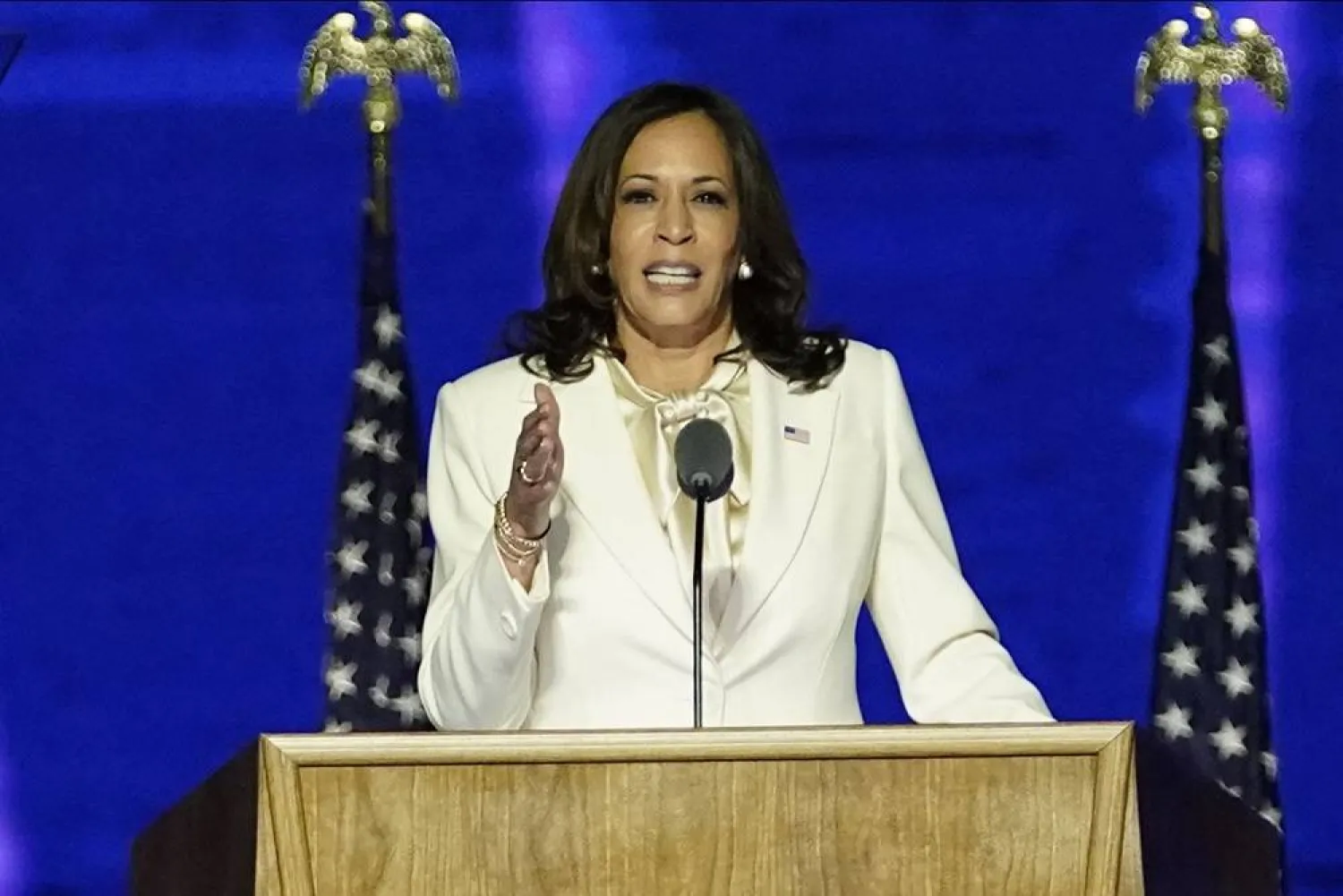
Vice President-elect Kamala Harris delivers remarks in Wilmington, Delaware, on November 7, 2020, after being declared the winners of the presidential election. (AFP)
TT

Harris, Endorsed by Biden, Could Become First Woman, Second Black Person to Be President

Vice President-elect Kamala Harris delivers remarks in Wilmington, Delaware, on November 7, 2020, after being declared the winners of the presidential election. (AFP)

She's already broken barriers, and now Kamala Harris could shatter several more after President Joe Biden abruptly ended his reelection bid and endorsed her.

Biden announced Sunday that he was stepping aside after a disastrous debate performance catalyzed fears that the 81-year-old was too frail for a second term.

Harris is the first woman, Black person or person of South Asian descent to serve as vice president. If she becomes the Democratic nominee and defeats Republican candidate Donald Trump in November, she would be the first woman to serve as president.

Biden said Sunday that choosing Harris as his running mate was “the best decision I've made" and endorsed her as his successor.

“Democrats — it’s time to come together and beat Trump,” he wrote on X, the social media platform formerly known as Twitter. “Let’s do this.”

Harris described Biden's decision to step aside as a “selfless and patriotic act,” saying he was “putting the American people and our country above everything else.”

“I am honored to have the President’s endorsement and my intention is to earn and win this nomination," Harris said. “Over the past year, I have traveled across the country, talking with Americans about the clear choice in this momentous election.”

Prominent Democrats followed Biden's lead by swiftly coalescing around Harris on Sunday. However, her nomination is not a foregone conclusion, and there have been suggestions that the party should hold a lightning-fast “mini primary” to consider other candidates before its convention in Chicago next month.

A recent poll from the AP-NORC Center for Public Affairs Research found that about 6 in 10 Democrats believe Harris would do a good job in the top slot. About 2 in 10 Democrats don’t believe she would, and another 2 in 10 say they don’t know enough to say.

The poll showed that about 4 in 10 US adults have a favorable opinion of Harris, whose name is pronounced “COMM-a-la,” while about half have an unfavorable opinion.

A former prosecutor and US senator from California, Harris' own bid for the 2020 Democratic presidential nomination imploded before a single primary vote was cast. She later became Biden's running mate, but she struggled to find her footing after taking office as vice president. Assigned to work on issues involving migration from Central America, she was repeatedly blamed by Republicans for problems with illegal border crossings.

However, Harris found more prominence as the White House's most outspoken advocate for abortion rights after the US Supreme Court overturned Roe v. Wade in 2022. She has also played a key role in reaching out to young people and voters of color.

In addition, Harris' steady performance after Biden's debate debacle solidified her standing among Democrats in recent weeks.

Even before Biden's endorsement, Harris was widely viewed as the favorite to replace him on the ticket. With her foreign policy experience and national name recognition, she has a head start over potential challengers, including California Gov. Gavin Newsom, Michigan Gov. Gretchen Whitmer and Pennsylvania Gov. Josh Shapiro.

Harris will seek to avoid the fate of Hubert Humphrey, who as vice president won the Democratic nomination in 1968 after President Lyndon Johnson declined to run for reelection amid national dissatisfaction over the Vietnam War. Humphrey lost that year to Republican Richard Nixon.

Nixon resigned in 1974 during the Watergate scandal and was replaced by Vice President Gerald Ford. Ford never won a term of his own.

Vice presidents are always in line to step into the top job if the president dies or is incapacitated. However, Harris has faced an unusual level of scrutiny because of Biden’s age. He was the oldest president in history, taking office at 78 and announcing his reelection bid at 80. Harris is 59.

She addressed the question of succession in an interview with The Associated Press during a trip to Jakarta in September 2023.

“Joe Biden is going to be fine, so that is not going to come to fruition,” she stated. “But let us also understand that every vice president — every vice president — understands that when they take the oath they must be very clear about the responsibility they may have to take over the job of being president.”

“I’m no different.”

Harris was born Oct. 20, 1964, in Oakland, California, to parents who met as civil rights activists. Her hometown and nearby Berkeley were at the heart of the racial and social justice movements of the time, and Harris was both a product and a beneficiary.

She spoke often about attending demonstrations in a stroller and growing up around adults “who spent full time marching and shouting about this thing called justice.” In first grade, she was bused to school as part of the second class to integrate Berkeley public education.

Harris’ parents divorced when she was young, and she was raised by her mother alongside her younger sister, Maya. She attended Howard University, a historically Black school in Washington, and joined the Alpha Kappa Alpha sorority, which became a source of sisterhood and political support over the years.

After graduating, Harris returned to the San Francisco Bay Area for law school and chose a career as a prosecutor, a move that surprised her activist family.

She said she believed that working for change inside the system was just as important as agitating from outside. By 2003, she was running for her first political office, taking on the longtime San Francisco district attorney.

Few city residents knew her name, and Harris set up an ironing board as a table outside grocery stores to meet people. She won and quickly showed a willingness to chart her own path. Months into her tenure, Harris declined to seek the death penalty for the killer of a young police officer slain in the line of duty, fraying her relationship with city cops.

The episode did not stop her political ascent. In late 2007, while still serving as district attorney, she was knocking on doors in Iowa for then-candidate Barack Obama. After he became president, Obama endorsed her in her 2010 race for California attorney general.

Once elected to statewide office, she pledged to uphold the death penalty despite her moral opposition to it. Harris also played a key role in a $25 billion settlement with the nation’s mortgage lenders following the foreclosure crisis.

As killings of young Black men by police received more attention, Harris implemented some changes, including tracking racial data in police stops, but didn’t pursue more aggressive measures such as requiring independent prosecutors to investigate police shootings.

Harris’ record as a prosecutor would eventually dog her when she launched a presidential bid in 2019, as some progressives and younger voters demanded swifter change. But during her time on the job, she also forged a fortuitous relationship with Beau Biden, Joe Biden’s son who was then Delaware’s attorney general. Beau Biden died of brain cancer in 2015, and his friendship with Harris figured heavily years later as his father chose Harris to be his running mate.

Harris married entertainment lawyer Douglas Emhoff in 2014, and she became stepmother to Emhoff’s two children, Ella and Cole, who referred to her as “Momala.”

Harris had a rare opportunity to advance politically when Sen. Barbara Boxer, who had served more than two decades, announced she would not run again in 2016.

In office, Harris quickly became part of the Democratic resistance to Trump and gained recognition for her pointed questioning of his nominees. In one memorable moment, she pressed now-Supreme Court Justice Brett Kavanaugh on whether he knew any laws that gave government the power to regulate a man’s body. He did not, and the line of questioning galvanized women and abortion rights activists.

A little more than two years after becoming a senator, Harris announced her campaign for the 2020 Democratic presidential nomination. But her campaign was marred by infighting and she failed to gain traction, ultimately dropping out before the Iowa caucuses.

Eight months later, Biden selected Harris as his running mate. As he introduced her to the nation, Biden reflected on what her nomination meant for “little Black and brown girls who so often feel overlooked and undervalued in their communities.”

“Today, just maybe, they’re seeing themselves for the first time in a new way, as the stuff of presidents and vice presidents,” he said.

Israeli Settler Outpost Becomes a Settlement within a Month

Israeli finance minister Bezalel Smotrich, center, strides through the newly-legalized Jewish settlement of Yatziv, adjacent to the Palestinian town of Beit Sahour, in the West Bank, Jan. 19, 2026. (AP)
TT

Israeli Settler Outpost Becomes a Settlement within a Month

Israeli finance minister Bezalel Smotrich, center, strides through the newly-legalized Jewish settlement of Yatziv, adjacent to the Palestinian town of Beit Sahour, in the West Bank, Jan. 19, 2026. (AP)

Celebratory music blasting from loudspeakers mixed with the sounds of construction, almost drowning out calls to prayer from a mosque in the Palestinian town across this West Bank valley.

Orthodox Jewish women wearing colorful head coverings and with babies on their hips, shared platters of fresh vegetables as soldiers encircled the hilltop, keeping guard.

The scene Monday reflected the culmination of Israeli settlers’ long campaign to turn this site overlooking the Palestinian town of Beit Sahour into a settlement. Over the years they fended off plans to build a hospital for Palestinian children on the land, always holding to the hope it would one day become theirs.

That moment is now, they say.

Smotrich goes on settlement spree

After two decades of efforts, it took just a month for their new settlement, called “Yatziv,” to go from an unauthorized outpost of a few mobile homes to a fully recognized settlement. Fittingly, the new settlement's name means “stable” in Hebrew.

“We are standing stable here in Israel,” Finance Minister and settler leader Bezalel Smotrich told The Associated Press at Monday’s inauguration ceremony. “We’re going to be here forever. We will never establish a Palestinian state here.”

With leaders like Smotrich holding key positions in Israel’s government and establishing close ties with the Trump administration, settlers are feeling the wind at their backs.

Smotrich, who has been in charge of Israeli settlement policy for the past three years, has overseen an aggressive construction and expansion binge aimed at dismantling any remaining hopes of establishing a Palestinian state in the occupied West Bank.

While most of the world considers the settlements illegal, their impact on the ground is clear, with Palestinians saying the ever-expanding construction hems them in and makes it nearly impossible to establish a viable independent state. The Palestinians seek the West Bank, captured by Israel in 1967, as part of a future state.

Emboldened

Settlers had long set their sights on the hilltop, thanks to its position in a line of settlements surrounding Jerusalem and because they said it was significant to Jewish history. But they put up the boxy prefab homes in November because days earlier, Palestinian attackers had stabbed an Israeli to death at a nearby junction.

The attack created an impetus to justify the settlement, settlement council chair, Yaron Rosenthal, told the AP. With the election of Israel’s far-right government in late 2022, Trump’s return to office last year and the November attack, conditions were ripe for settlers to make their move, Rosenthal said.

“We understood that there was an opportunity,” he said. “But we didn’t know it would happen so quickly.”

“Now there is the right political constellation for this to happen."

Smotrich announced approval of the outpost, along with 18 others, on Dec. 21. That capped 20 years of effort, said Nadia Matar, a settler activist.

“Shdema was nearly lost to us,” said Matar, using the name of an Israeli military base at the site. “What prevented that outcome was perseverance.”

Back in 2006, settlers were infuriated upon hearing that Israel's government was in talks with the US to build a Palestinian children's hospital on the land, said Hagit Ofran, a director at Peace Now, an anti-settlement watchdog group, especially as the US Agency for International Development was funding a “peace park” at the base of the hill.

The mayor of Beit Sahour urged the US Consulate to pressure Israel to begin hospital construction, while settlers began demonstrations at the site calling on Israel to quash the project, according to consulate files obtained through WikiLeaks.

It was “interesting” that settlers had “no religious, legal, or ... security claim to that land,” wrote consulate staffer Matt Fuller at the time, in an email he shared with the AP. "They just don’t want the Palestinians to have it — and for a hospital no less — a hospital that would mean fewer permits for entry to Jerusalem for treatment.”

The hospital was never built. The site was converted into a military base after the Netanyahu government came to power in 2009. From there, settlers quickly established a foothold by creating a makeshift cultural center at the site, putting on lectures, readings and exhibits.

Speaking to the AP, Ehud Olmert, the Israeli prime minister at the time the hospital was under discussion, said that was the tipping point.

“Once it is military installation, it is easier than to change its status into a new outpost, a new settlement and so on,” he said.

Olmert said Netanyahu — who has served as prime minister nearly uninterrupted since then — was “committed to entirely different political directions from the ones that I had,” he said. “They didn’t think about cooperation with the Palestinians.”

Palestinians say the land is theirs

The continued legalization of settlements and spiking settler violence — which rose by 27% in 2025, according to Israel’s military — have cemented a fearful status quo for West Bank Palestinians.

The land now home to Yatziv was originally owned by Palestinians from Beit Sahour, said the town’s mayor, Elias Isseid.

“These lands have been owned by families from Beit Sahour since ancient times,” he said.

Isseid worries more land loss is to come. Yatziv is the latest in a line of Israeli settlements to pop up around Beit Sahour, all of which are connected by a main highway that runs to Jerusalem without entering Palestinian villages. The new settlement “poses a great danger to our children, our families," he said.


Respiratory Virus Claims Lives in Gaza amid Limited Capacity for Testing

A Palestinian man carries the body of his three-month-old daughter on Tuesday after she died from the cold in Gaza City. (AFP)
TT

Respiratory Virus Claims Lives in Gaza amid Limited Capacity for Testing

A Palestinian man carries the body of his three-month-old daughter on Tuesday after she died from the cold in Gaza City. (AFP)

Gaza resident Yusra al-Hajjar, 32, went through harrowing moments after she was shocked by a sharp rise in the temperature of her five-month-old infant, Nidal, prompting her to rush him to a clinic at the Al-Shifa Medical Complex in Gaza City as his condition worsened.

Initial medical examinations failed to determine the exact cause of the infant’s illness, forcing the medical team to resort to basic measures such as intravenous fluids and fever-reducing medication in an attempt to control the symptoms.

The treatment was temporarily successful, and the baby’s condition improved after several hours.

“We left the clinic in a better condition, but less than a day later, we brought him back after a new deterioration,” al-Hajjar told Asharq Al-Awsat.

“As of this morning, Tuesday, five days have passed since my baby fell ill. I am still trying basic methods, such as cooling his forehead with cold water and giving him some medication to reduce the fever and stop the vomiting and weakness, while doctors have been unable to determine the cause,” she added.

The infant’s case is not the only one. Residents of Gaza have been struggling in recent weeks with what medical officials describe as a widespread outbreak of identical symptoms, particularly among the elderly and children, according to Mohammed Abu Salmiya, director of the Al-Shifa Medical Complex.

Abu Salmiya said that for nearly a month, new deaths have been recorded on an almost daily basis due to the spread of what he described as a dangerous and deadly virus.

He said the virus causes severe pneumonia, leading to fatalities primarily among vulnerable patients with weakened immune systems, and secondarily among individuals with stronger immunity, including some young people whose deaths were recorded in recent days.

No capacity for testing

Abu Salmiya said Gaza’s health system lacks even the most basic laboratory capabilities needed to identify the virus, suggesting it could be a new COVID variant spreading in the world.

Earlier on Tuesday, a seven-month-old infant, Shaza Abu Jarrad, died due to extreme cold and a lack of adequate shelter and heating, raising the number of child deaths from similar conditions to about 10.

Abu Salmiya said the current cold weather has fueled the spread of the virus, contributing to a high number of deaths amid the harsh living conditions in Gaza following the Israeli war.

He said there is a direct link between the war and weakened immunity among Gaza’s population, who have endured repeated bouts of hunger, alongside water contamination.

He added that this comes amid severe shortages of medicines and medical supplies, leaving health authorities unable to mount an effective and rapid response to the current health crisis.

The United Nations Relief and Works Agency for Palestine Refugees, UNRWA, said in a post on X that despite the collapse of Gaza’s health system, it continues to provide primary health care to thousands of people every day, but faces an acute shortage of medicines.

UNRWA accused Israel of preventing its aid supplies stuck in warehouses in Jordan and Egypt from entering Gaza since March 2 last year, stressing the urgent need to allow its assistance into the territory.

It said harsh winter conditions are compounding the suffering of families in Gaza who have been exhausted by war and repeated displacement, calling for large-scale access for humanitarian aid.

Mahmoud Bassal, spokesman for Gaza’s Civil Defense, warned of a rise in deaths, particularly among young children, due to the severe cold wave coinciding with the deterioration of humanitarian conditions in the enclave.

He said field and health conditions are extremely harsh, especially for infants, the sick, and the elderly, as most families live in dilapidated tents that offer little protection from the cold, rain, and other environmental conditions.


Khartoum Markets Back to Life but 'Nothing Like Before'

Men walk along a street past destroyed high-rise building, as efforts to restore the city's infrastructure resumes after nearly three years of devastation caused by war, in the Sudanese capital Khartoum on January 17, 2025. (AFP)
TT

Khartoum Markets Back to Life but 'Nothing Like Before'

Men walk along a street past destroyed high-rise building, as efforts to restore the city's infrastructure resumes after nearly three years of devastation caused by war, in the Sudanese capital Khartoum on January 17, 2025. (AFP)

The hustle and bustle of buyers and sellers has returned to Khartoum's central market, but "it's nothing like before," fruit vendor Hashim Mohamed told AFP, streets away from where war first broke out nearly three years ago.

On April 15, 2023, central Khartoum awoke to battles between the Sudanese army and the paramilitary Rapid Support Forces, who had been allies since 2021, when they ousted civilians from a short-lived transitional government.

Their war has since killed tens of thousands and displaced millions. In greater Khartoum alone, nearly 4 million people -- around half the population -- fled the city when the RSF took over.

Hashim Mohamed did not.

"I had to work discreetly, because there were regular attacks" on businesses, said the fruit seller, who has worked in the sprawling market for 50 years.

Like him, those who stayed in the city report living in constant fear of assaults and robberies from fighters roaming the streets.

Last March, army forces led an offensive through the capital, pushing paramilitary fighters out and revealing the vast looting and destruction left behind.

"The market's not what it used to be, but it's much better than when the RSF was here," said market vendor Adam Haddad, resting in the shade of an awning.

In the market's narrow, dusty alleyways, fruits and vegetables are piled high, on makeshift stalls or tarps spread on the ground.

- Two jobs to survive -

Khartoum, where entire neighborhoods were once under siege, is no longer threatened by the mass starvation that stalks battlefield cities and displacement camps elsewhere in Sudan.

But with the economy a shambles, a good living is still hard to provide.

"People complain about prices, they say it's too expensive. You can find everything, but the costs keep going up: supplies, labor, transportation," said Mohamed.

Sudan has known only triple-digit annual inflation for years. Figures for 2024 stood at 151 percent -- down from a 2021 peak of 358.

The currency has also collapsed, going from trading at 570 Sudanese pounds to the US dollar before the war to 3,500 in 2026, according to the black market rate.

One Sudanese teacher, who only a few years ago could provide comfortably for his two children, told AFP he could no longer pay his rent with a monthly salary of 250,000 Sudanese pounds ($71).

To feed his family, pay for school, and cover healthcare, he "works in the market or anywhere" on his days off.

"You have to have another job to pay for the bare minimum of basic needs," he said, asking for anonymity to protect his privacy.

For Adam Haddad, the road to recovery will be a long one.

"We don't have enough resources or workers or liquidity going through the market," he said, adding that reliable electricity was still a problem.

"The government is striving to restore everything, and God willing, in the near future, the power will return and Khartoum will become what it once was."