


How Syria Opposition’s Stars Aligned for Assad’s Ouster

People celebrate holding a large Syrian opposition flag at Umayyad Square in Damascus on December 9, 2024. (AFP)
TT

How Syria Opposition’s Stars Aligned for Assad’s Ouster

People celebrate holding a large Syrian opposition flag at Umayyad Square in Damascus on December 9, 2024. (AFP)

After 13 years of civil war, Syria's opposition militias sensed an opportunity to loosen President Bashar al-Assad's grip on power when, about six months ago, they communicated to Türkiye plans for a major offensive and felt they had received its tacit approval, two sources with knowledge of the planning said.

Launched barely two weeks ago, the operation's speedy success in achieving its initial goal - seizing Syria's second city, Aleppo - took almost everybody by surprise. From there, in a little more than a week, the opposition alliance reached Damascus and on Sunday put an end to five decades of Assad family rule.

The lightning advance relied on an almost perfect alignment of stars for the forces opposed to Assad: his army was demoralized and exhausted; his main allies, Iran and Lebanon's Hezbollah, were severely weakened by conflict with Israel; and his other key military supporter, Russia, was distracted and losing interest.

There was no way the anti-government fighters could go ahead without first notifying Türkiye, which has been a main backer of the Syrian opposition from the war's earliest days, said the sources, a diplomat in the region and a member of the Syrian opposition.

Türkiye has troops on the ground in northwest Syria, and provides support to some of the opposition who were intending to take part, including the Syrian National Army (SNA) - though it considers the main faction in the alliance, Hayat Tahrir al-Sham (HTS), to be a terror group. The opposition’s bold plan was the brainchild of HTS and its leader Ahmed al-Sharaa, better known as Abu Mohammed al-Golani, the diplomat said.

Turkish President Recep Tayyip Erdogan's government, which struck a deal with Russia in 2020 to de-escalate fighting in northwestern Syria, has long opposed such a major opposition offensive, fearing it would lead to a new wave of refugees crossing its border.

An opposition fighter sits on a truck mounted with a weapon, after the opposition seized the capital and ousted President Bashar al-Assad, in Damascus, Syria, December 9, 2024. (Reuters)

However, the opposition sensed a stiffening of Ankara's stance towards Assad earlier this year, the sources said, after he rebuffed repeated overtures from Erdogan aimed at advancing a political solution to the military stalemate, which has left Syria divided between the regime and a patchwork of opposition groups with an array of foreign backers.

The Syrian opposition source said the opposition had shown Türkiye details of the planning, after Ankara's attempts to engage Assad had failed.

The message was: "That other path hasn't worked for years - so try ours. You don't have to do anything, just don't intervene." Reuters was unable to determine the exact nature of the communications.

Hadi Al-Bahra, head of the internationally-recognized Syrian opposition abroad, told Reuters last week that HTS and SNA had had "limited" planning together ahead of the operation and agreed to "achieve cooperation and not clash with each other". He added that Türkiye's military saw what the armed groups were doing and discussing.

Turkish Foreign Minister Hakan Fidan, speaking in Doha on Sunday, said Erdogan’s effort in recent months to reach out to Assad failed and Ankara "knew something was coming".

However, Türkiye's deputy minister for foreign affairs, Nuh Yilmaz, told a conference on Middle Eastern affairs in Bahrain on Sunday that Ankara was not behind the offensive, and did not provide its consent, saying it was concerned about instability.

Türkiye's foreign and defense ministries did not respond directly to Reuters questions about an HTS-Ankara understanding about the Aleppo operation. In reply to questions about Türkiye's awareness of battlefield preparations, a Turkish official told Reuters that the HTS "does not receive orders or direction from us (and) does not coordinate its operations with us either."

The official said that "in that sense" it would not be correct to say that the operation in Aleppo was carried out with Türkiye approval or green light. Turkish intelligence agency MIT did not immediately respond to a request for comment.

Reuters was unable to reach a representative for HTS.

VULNERABLE

The opposition fighters struck when Assad was at his most vulnerable.

Distracted by wars elsewhere, his military allies Russia, Iran, and Lebanon's Hezbollah failed to mobilize the kind of decisive firepower that had propped him up for years.

Syria's weak armed forces were unable to resist. A regime source told Reuters that tanks and planes were left with no fuel because of corruption and looting - an illustration of just how hollowed out the Syrian state had become.

Over the past two years morale had severely eroded in the army, said the source, who requested anonymity because of fear of retribution.

Aron Lund, a fellow at Century International, a Middle-East focused think-tank, said the HTS-led coalition was stronger and more coherent than any previous opposition force during the war, "and a lot of that is Abu Mohammed al-Golani’s doing". But, he said, the regime's weakness was the deciding factor.

"After they lost Aleppo like that, regime forces never recovered and the more the opposition advanced, the weaker Assad’s army got," he said.

The pace of the opposition advances, with Hama being captured on Dec. 5 and Homs falling on or around Sunday at the same time government forces lost Damascus, exceeded expectations.

"There was a window of opportunity but no one expected the regime to crumble this fast. Everyone expected some fight," said Bassam Al-Kuwatli, president of the Syrian Liberal Party, a small opposition group, who is based outside Syria.

A US official said on condition of anonymity that while Washington had been aware of Türkiye's overall support for the opposition, it was not informed of any tacit Turkish approval for the Aleppo offensive. The White House National Security Council did not immediately respond to a request for comment on Türkiye's role.

US President-elect Donald Trump on Sunday said that Russia's abandonment of Assad led to his downfall, adding that Moscow never should have protected him in the first place and then lost interest because of a war in Ukraine that never should have started.

Israeli President Benjamin Netanyahu on Sunday noted his country's role in weakening Hezbollah, which sources told Reuters withdrew its remaining troops from Syria on Saturday.

A defaced portrait of ousted Syrian President Bashar al-Assad stands in a ransacked government security facility, in Damascus, on December 8, 2024. (AFP)

GAZA FALLOUT

Sources familiar with Hezbollah deployments said the Iran-backed group, which propped up Assad early in the war, had already withdrawn many of its elite fighters from Syria over the last year to support the group as it waged hostilities with Israel - a conflict that spilled over from the Gaza war.

Israel dealt Hezbollah heavy blows, particularly after launching an offensive in September, killing the group's leader Hassan Nasrallah and many of its commanders and fighters.

The opposition offensive in Syria began the same day as a ceasefire came into effect in the Lebanon conflict on Nov. 27. The sources familiar with Hezbollah said it did not want to engage in big battles in Syria as the group focused on starting a long road to recovery from the heavy blows.

For the opposition alliance, the withdrawal of Hezbollah presented a valuable opportunity. "We just wanted a fair fight between us and the regime," the Syrian opposition source said.

Assad's fall marks a major blow to Iranian influence in the Middle East, coming so swiftly after the killing of Nasrallah and the damage done by Israel to Hezbollah.

Türkiye, on the other hand, now appears to be Syria's most powerful external player, with troops on the ground and access to the opposition leaders.

In addition to securing the return of Syrian refugees, Türkiye's objectives include curbing the power of Syrian Kurdish groups that control wide areas of northeast Syria and are backed by the United States. Ankara deems them to be terrorists.

As part of the initial offensive, the Türkiye-backed SNA seized swathes of territory, including the city of Tel Refaat, from US-backed Kurdish forces. On Sunday, a Turkish security source said the opposition entered the northern city of Manbij after pushing the Kurds back again.

"Türkiye is the biggest outside winner here. Erdogan turned out to be on the right - or at least winning - side of history here because his proxies in Syria won the day," said Birol Baskan, Türkiye-based political scientist and former non-resident scholar at Middle East Institute.



What Safe Havens Remain for the Islamic Jihad?

The late Iranian Supreme Leader Ali Khamenei receives the late «Hamas» leader Ismail Haniyeh and the leader of the «Jihad» movement, Ziad al-Nakhala, in Tehran, July 2024 (AFP)
TT

What Safe Havens Remain for the Islamic Jihad?

The late Iranian Supreme Leader Ali Khamenei receives the late «Hamas» leader Ismail Haniyeh and the leader of the «Jihad» movement, Ziad al-Nakhala, in Tehran, July 2024 (AFP)

The US-Israeli war against Iran has reshaped the landscape for Palestinian factions aligned with Tehran, with the Palestinian Islamic Jihad among the most affected. The group has faced financial and security setbacks in both Syria and Lebanon, even as fighting continues in the Gaza Strip.

Sources in the movement told Asharq Al-Awsat that the regional security changes and the war against Iran have further complicated the organization’s remaining safe havens.

While Hamas maintains close ties with Tehran, Islamic Jihad’s relationship with Iran runs deeper. The connection dates back to the group’s founding in the 1980s by Fathi Shaqaqi.

For decades, Islamic Jihad maintained a military and human presence in both Syria and Lebanon, gaining additional protection as Iranian influence expanded in the two countries over the past ten years.

However, the assassination of Ismail Haniyeh, the head of Hamas’ political bureau, in Tehran in July 2024, followed by an attempted attack on Hamas leaders in Doha in September, served as a major warning to Palestinian faction leaders, particularly Islamic Jihad.

Three countries

According to sources in the group, Secretary-General Ziad al-Nakhalah has sharply reduced his visits to Iran, traveling there only three times since Haniyeh’s assassination. One visit involved a joint delegation from Islamic Jihad and Hamas and lasted several days, while the other two were brief.

Previously, Nakhalah and several senior figures — particularly Akram al-Ajouri, who oversees the group’s armed wing, the Al-Quds Brigades — considered Iran a key safe haven, along with other capitals, such as Beirut. In recent years, however, the group has also expanded its contacts with Qatar and strengthened ties with Egypt.

A source close to Nakhalah said the leader has recently been moving between Doha and Cairo, staying for extended periods, especially in Doha, where his deputy Mohammed al-Hindi is based almost permanently.

Hindi also travels between Qatar, Egypt and Türkiye, with his role in Egypt largely focused on Gaza-related discussions with Egyptian intelligence officials.

Sources declined to confirm whether Ajouri, who had been based in Beirut’s southern suburbs in recent years, has left the area because of security concerns.

Israel recently killed Adham al-Othman, a commander in the Al-Quds Brigades in Lebanon, in a strike on an apartment used by Hezbollah in Beirut’s southern suburbs. He was known to be close to Ajouri.

Pressure in Syria

Israel had already tightened pressure on the Islamic Jihad in Syria before the fall of Bashar al-Assad’s government. A November 2024 airstrike on a group facility in Damascus killed senior figures Abdul Aziz al-Minawi and Rasmi Abu Issa, along with other members.

After the regime’s collapse in December 2024, the pressure intensified. Syria’s new authorities arrested the Islamic Jihad’s representative in the country, Khaled Khaled, and his deputy Abu Ali Yasser in April 2025, holding them for several months.

Movement sources say many of its members in Syria were detained and later released, with interrogations focusing on their weapons and where they were stored.

Some Israeli strikes in recent months have also targeted senior operatives, including field commanders in the Al-Quds Brigades who had previously been wounded in Gaza and remained in Damascus for treatment.

Facing continued Israeli pressure, some Islamic Jihad activists have relocated from Syria to Lebanon or Türkiye. Others have joined Hezbollah fighters in southern Lebanon.

All of this comes as the Islamic Jihad faces a severe financial crisis. Iranian support has largely stopped, affecting salary payments for fighters and limiting the group’s operational budgets both inside Gaza and abroad.


Syrians on Alert to Prevent Accommodation of Displaced Hezbollah Supporters from Lebanon

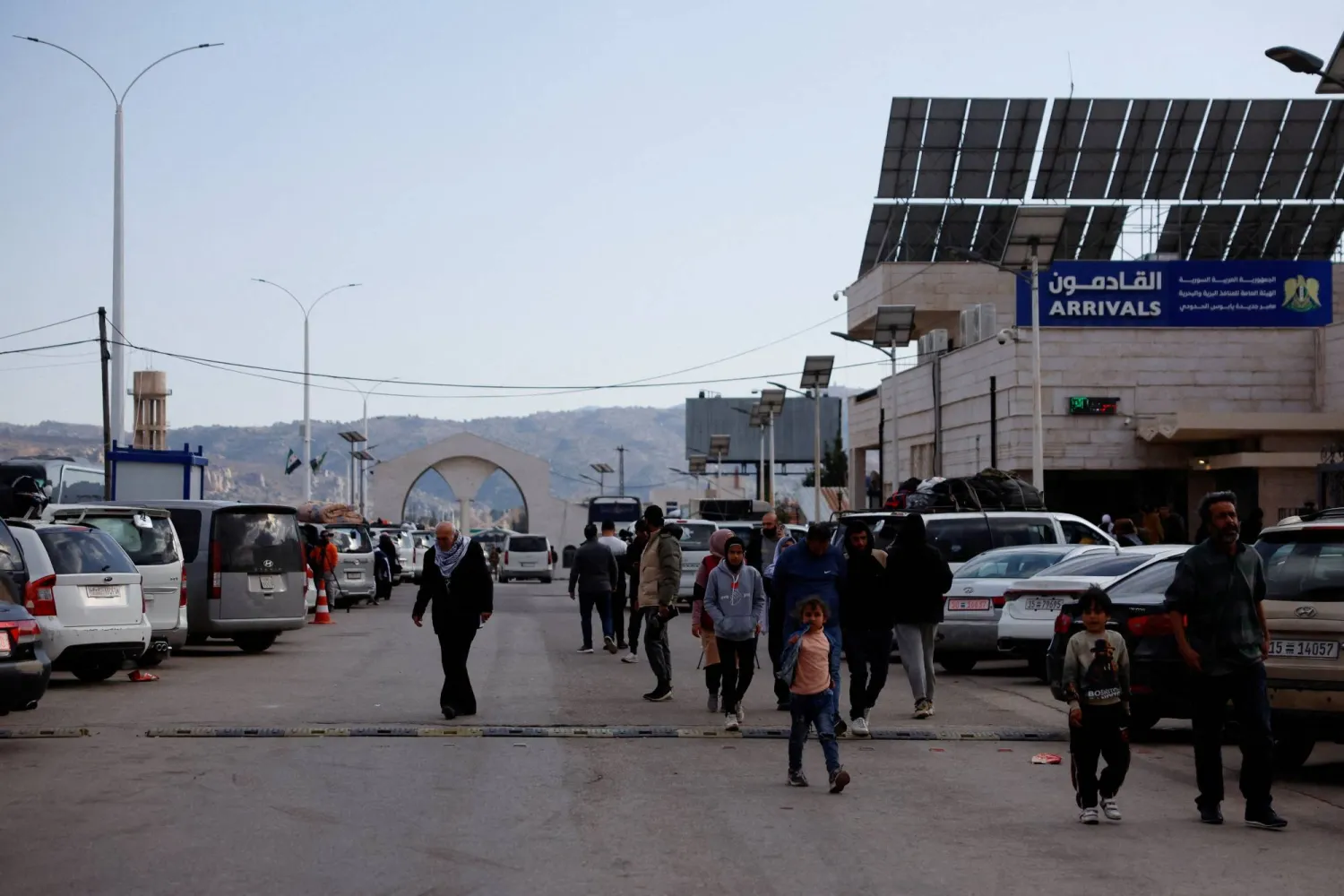
 Syrians living in Lebanon wait outside the Ministry of Interior Immigration and Passports Department, at the Syrian-Lebanese border, as they return to Syria due to ongoing hostilities between Hezbollah and Israeli forces, amid the US-Israeli conflict with Iran, in Jdaydet Yabous, Syria, March 3, 2026. (Reuters)
Syrians living in Lebanon wait outside the Ministry of Interior Immigration and Passports Department, at the Syrian-Lebanese border, as they return to Syria due to ongoing hostilities between Hezbollah and Israeli forces, amid the US-Israeli conflict with Iran, in Jdaydet Yabous, Syria, March 3, 2026. (Reuters)
TT

Syrians on Alert to Prevent Accommodation of Displaced Hezbollah Supporters from Lebanon

 Syrians living in Lebanon wait outside the Ministry of Interior Immigration and Passports Department, at the Syrian-Lebanese border, as they return to Syria due to ongoing hostilities between Hezbollah and Israeli forces, amid the US-Israeli conflict with Iran, in Jdaydet Yabous, Syria, March 3, 2026. (Reuters)
Syrians living in Lebanon wait outside the Ministry of Interior Immigration and Passports Department, at the Syrian-Lebanese border, as they return to Syria due to ongoing hostilities between Hezbollah and Israeli forces, amid the US-Israeli conflict with Iran, in Jdaydet Yabous, Syria, March 3, 2026. (Reuters)

Syrians in Damascus, its countryside, and western Homs countryside are on alert to prevent displaced Lebanese supporters of Hezbollah from entering Syrian territory or being hosted by locals.

The stance marks a sharp departure from previous Israeli wars on Lebanon, when Syrian cities received tens of thousands of Lebanese fleeing the fighting.

As Israel broadened its strikes in the region to include Hezbollah, not just Iran, displacement from southern Lebanon and Beirut's southern suburbs has resumed. This time, however, those fleeing include not only Lebanese but also Syrians who had been living as refugees in Lebanon.

The scene in and around Damascus appears markedly different from past years. No private cars carrying Lebanese displaced people have been seen in the capital Damascus and its outskirts, unlike during earlier Israeli wars on southern Lebanon under the rule of ousted leader Bashar al-Assad.

In previous waves of displacement, tens of thousands of Lebanese fled to Damascus. Some stayed in hotels, others rented apartments, while a small number were housed in shelters.

The same pattern now applies to Eastern Ghouta. Hezbollah and Iran had turned the area into a strategic rear base while fighting alongside Assad's government during the years of the Syrian uprising.

Hezbollah also housed large numbers of fighters' families there during its war with Israel.

Omar Mohammad Safi, known as Abu Firas, from the town of Beit Sahm in Eastern Ghouta, said the town has not seen the arrival of any Lebanese during the current war, whether Hezbollah supporters or others.

“When Israel attacked Hezbollah the last time, large numbers of fighters' families came and stayed in homes the party had seized in Ghouta, Sayeda Zeinab and elsewhere, but in this war, we have not seen any of them at all in any town,” he told Asharq al-Awsat.

Over the past two days, activists circulated a statement purportedly issued by residents of Damascus and its countryside, especially Eastern Ghouta, warning against renting property to or hosting strangers from southern Lebanon, or Lebanese individuals or families, particularly those linked to Hezbollah.

The statement said Hezbollah, during its support for the former regime, had “committed crimes and massacres,” adding: “We will not forget the massacres of Eastern Ghouta and the chemical massacre.

“Whoever dared to kill us and gloat over us will have no place among us, and we will expel him from the area immediately, along with anyone who shelters him, by all means,” it warned.

During the war in Syria, Hezbollah turned the western Qalamoun area in the Damascus countryside, adjacent to Lebanon's Bekaa region, into a strategic regional rear base.

During the previous war with Israel, the area also hosted tens of thousands of displaced people from Beirut's southern suburbs and southern Lebanon, with facilitation from Assad's government.

But Mahmoud Qusaibiya, known as Abu Alaa, from the town of Jarjir in western Qalamoun, said the town has not seen the arrival of any displaced Lebanese Hezbollah supporters.

“A warning was circulated by elders and prominent figures telling residents not to receive anyone from Hezbollah or their families, because we supported the revolution and they stood with the former government and its remnants,” he told Asharq al-Awsat.

The clearest development has been in the city of Qusayr in western Homs countryside, which Hezbollah seized during the Syrina war.

Rashid Jammoul, known as Abu Mohammad, who comes from the city, said Syrians at the border with Lebanon around Qusayr were on high alert to prevent Hezbollah members, their families, or people linked to them from entering Syrian territory.

“There have been some attempts, but there is an alert by the army and by residents at all legal and illegal crossings,” the man in his sixties told Asharq al-Awsat.

“We will not allow any of them or anyone linked to them to enter or be received after they committed massacres against us, destroyed our villages, and burned our homes.”

Since Israel launched its new war on southern Lebanon, more than 25,000 Syrians have returned to their country.

Syria’s General Authority for Ports and Customs denied that families of Hezbollah members were among those arriving from Lebanon.

Mazen Alloush, director of relations at the authority, said two days ago that since the first day families began fleeing from Lebanon to Syria, social media had been flooded with rumors claiming that families of Hezbollah fighters and supporters were entering Syrian territory through border crossings.

As the rumors spread, some buses leaving the Jousieh border crossing were stopped by young men in the city of Qusayr and attacked on that pretext.

Seeking to clarify the situation, Alloush said all the passengers on those buses were Syrians who had been living in Lebanon and who came from different Syrian provinces.

He said they had entered the country legally.


This Is How Ukraine Has Countered Russia’s Iran-Designed Drones

An Iranian Shahed exploding drone launched by Russia flies through the sky seconds before it struck buildings in Kyiv, Ukraine, on Oct. 17, 2022. (AP)
TT

This Is How Ukraine Has Countered Russia’s Iran-Designed Drones

An Iranian Shahed exploding drone launched by Russia flies through the sky seconds before it struck buildings in Kyiv, Ukraine, on Oct. 17, 2022. (AP)

Ukraine is preparing to dispatch military drone specialists to Gulf states to help them fend off Iranian-designed drones -- something the Ukrainian army has been doing since the start of Russia's invasion.

The military assault launched in February 2022 spawned a cat-and-mouse game of aerial drone warfare that has forced both sides to constantly innovate -- or perish.

Moscow has dramatically scaled-up the production and sophistication of its drones, based on Iranian-designed Shaheds drones that Tehran has launched at Israel and Gulf states over the last week.

That has forced Ukraine to develop cheap and versatile defense systems that allows it to down hundreds of drones in a single barrage -- experience Kyiv says is unmatched anywhere in the world.

- Interceptors vs Shaheds -

Private Ukrainian arms companies have spearheaded the development of drone interceptors -- cheap, light single-use drones that are designed to knock Russian unmanned aerial vehicles out of the sky.

The interceptors -- usually winged or propeller-like helicopters -- are mainly controlled with inbuilt cameras that beam real-time images to pilots on the ground.

Late last year, President Volodymyr Zelensky released grainy, black-and-white images recorded from interceptors as they crashed into Shaheds. He has instructed manufacturers to produce up to 1,000 a day.

This method of air defense is becoming increasingly prevalent: Ukraine's commander-in-chief Oleksandr Syrsky said this week that some 70 percent of all drones launched by Russia at Kyiv and its surrounding region in February were downed by interceptors.

Individual interceptors can cost around as little as $700 or as much as $12,000. But even the most expensive varieties are a fraction of the price of a single missile fired from US Patriot air defense batteries, which are estimated to cost more than $1 million.

"The warfare shifted a lot. First it was drones against humans, soldiers and tanks. Now it's mostly drones against drones," Konstantyn, a deputy commander of an anti-aerial unit deployed in eastern Ukraine recently explained to AFP.

- Anti-aircraft guns, pick-ups -

Ukrainian air defense units also deploy traditional, tried-and-tested weapons: anti-aircraft guns.

These come both in the form of heavy machine guns set on wheels, and make-shift solutions, where troops attach any high-caliber weapon they have onto the back of a pick-up truck.

AFP journalists in Kyiv have seen -- and heard -- these air defense units work during nighttime Russian attacks.

Ukrainian troops also deploy man-portable air-defense systems: guided surface-to-air missiles that are shoulder-launched and originally designed to take down low flying aerial targets.

These portable weapons are used alongside tracking and radar systems.

- F-16s, choppers, Yaks -

Ukraine lobbied its Western allies for supplies of advanced fighter jets for months before finally receiving its first batch of F-16s in mid-2024.

Kyiv has not received many F-16s and there have been reports of issues in training Ukrainian pilots but they are among the aerial arsenal that Ukraine uses to down Shaheds.

The Ukrainian air force also deploys ageing Soviet-era aircraft to down Russian drones, including helicopters like the Mi-24 and Mi-8 or the Yak-52 plane.

- Electronic jamming -

Ukraine has for years deployed a variety of electronic systems that disorientate the navigation systems used by Shaheds to lock onto and fly towards their targets.

By scrambling the networks used by Shaheds inside Ukraine's borders, these means of electronic warfare force Moscow's drones to alter their course and fly back towards Russia.

According to Ukraine air force data, the military has been consistently intercepting or shooting down more than 80 percent of all incoming Russian drones -- hundreds of which are fired every night.