
Syrians on Alert to Prevent Accommodation of Displaced Hezbollah Supporters from Lebanon

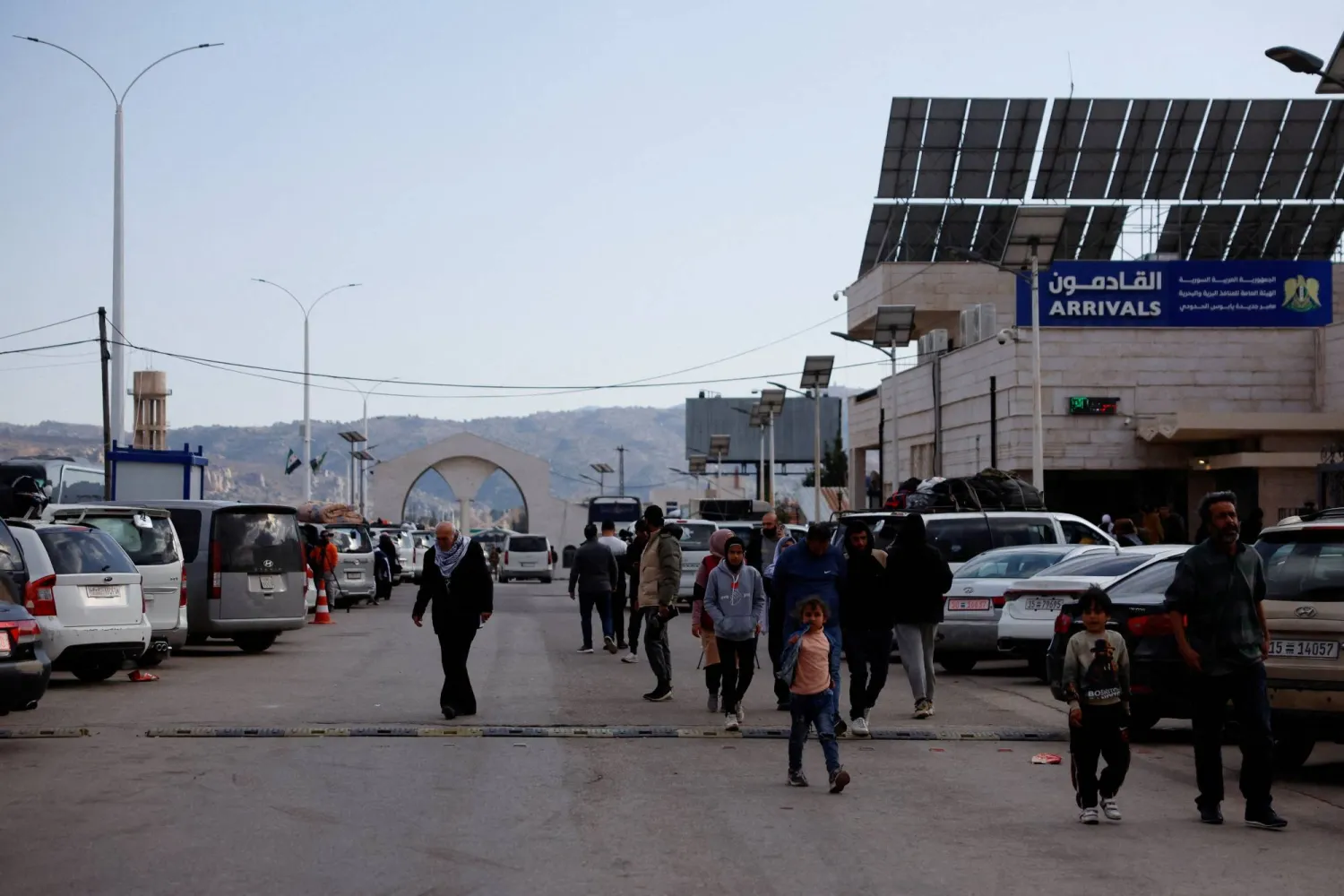
 Syrians living in Lebanon wait outside the Ministry of Interior Immigration and Passports Department, at the Syrian-Lebanese border, as they return to Syria due to ongoing hostilities between Hezbollah and Israeli forces, amid the US-Israeli conflict with Iran, in Jdaydet Yabous, Syria, March 3, 2026. (Reuters)
Syrians living in Lebanon wait outside the Ministry of Interior Immigration and Passports Department, at the Syrian-Lebanese border, as they return to Syria due to ongoing hostilities between Hezbollah and Israeli forces, amid the US-Israeli conflict with Iran, in Jdaydet Yabous, Syria, March 3, 2026. (Reuters)
TT

Syrians on Alert to Prevent Accommodation of Displaced Hezbollah Supporters from Lebanon

 Syrians living in Lebanon wait outside the Ministry of Interior Immigration and Passports Department, at the Syrian-Lebanese border, as they return to Syria due to ongoing hostilities between Hezbollah and Israeli forces, amid the US-Israeli conflict with Iran, in Jdaydet Yabous, Syria, March 3, 2026. (Reuters)
Syrians living in Lebanon wait outside the Ministry of Interior Immigration and Passports Department, at the Syrian-Lebanese border, as they return to Syria due to ongoing hostilities between Hezbollah and Israeli forces, amid the US-Israeli conflict with Iran, in Jdaydet Yabous, Syria, March 3, 2026. (Reuters)

Syrians in Damascus, its countryside, and western Homs countryside are on alert to prevent displaced Lebanese supporters of Hezbollah from entering Syrian territory or being hosted by locals.

The stance marks a sharp departure from previous Israeli wars on Lebanon, when Syrian cities received tens of thousands of Lebanese fleeing the fighting.

As Israel broadened its strikes in the region to include Hezbollah, not just Iran, displacement from southern Lebanon and Beirut's southern suburbs has resumed. This time, however, those fleeing include not only Lebanese but also Syrians who had been living as refugees in Lebanon.

The scene in and around Damascus appears markedly different from past years. No private cars carrying Lebanese displaced people have been seen in the capital Damascus and its outskirts, unlike during earlier Israeli wars on southern Lebanon under the rule of ousted leader Bashar al-Assad.

In previous waves of displacement, tens of thousands of Lebanese fled to Damascus. Some stayed in hotels, others rented apartments, while a small number were housed in shelters.

The same pattern now applies to Eastern Ghouta. Hezbollah and Iran had turned the area into a strategic rear base while fighting alongside Assad's government during the years of the Syrian uprising.

Hezbollah also housed large numbers of fighters' families there during its war with Israel.

Omar Mohammad Safi, known as Abu Firas, from the town of Beit Sahm in Eastern Ghouta, said the town has not seen the arrival of any Lebanese during the current war, whether Hezbollah supporters or others.

“When Israel attacked Hezbollah the last time, large numbers of fighters' families came and stayed in homes the party had seized in Ghouta, Sayeda Zeinab and elsewhere, but in this war, we have not seen any of them at all in any town,” he told Asharq al-Awsat.

Over the past two days, activists circulated a statement purportedly issued by residents of Damascus and its countryside, especially Eastern Ghouta, warning against renting property to or hosting strangers from southern Lebanon, or Lebanese individuals or families, particularly those linked to Hezbollah.

The statement said Hezbollah, during its support for the former regime, had “committed crimes and massacres,” adding: “We will not forget the massacres of Eastern Ghouta and the chemical massacre.

“Whoever dared to kill us and gloat over us will have no place among us, and we will expel him from the area immediately, along with anyone who shelters him, by all means,” it warned.

During the war in Syria, Hezbollah turned the western Qalamoun area in the Damascus countryside, adjacent to Lebanon's Bekaa region, into a strategic regional rear base.

During the previous war with Israel, the area also hosted tens of thousands of displaced people from Beirut's southern suburbs and southern Lebanon, with facilitation from Assad's government.

But Mahmoud Qusaibiya, known as Abu Alaa, from the town of Jarjir in western Qalamoun, said the town has not seen the arrival of any displaced Lebanese Hezbollah supporters.

“A warning was circulated by elders and prominent figures telling residents not to receive anyone from Hezbollah or their families, because we supported the revolution and they stood with the former government and its remnants,” he told Asharq al-Awsat.

The clearest development has been in the city of Qusayr in western Homs countryside, which Hezbollah seized during the Syrina war.

Rashid Jammoul, known as Abu Mohammad, who comes from the city, said Syrians at the border with Lebanon around Qusayr were on high alert to prevent Hezbollah members, their families, or people linked to them from entering Syrian territory.

“There have been some attempts, but there is an alert by the army and by residents at all legal and illegal crossings,” the man in his sixties told Asharq al-Awsat.

“We will not allow any of them or anyone linked to them to enter or be received after they committed massacres against us, destroyed our villages, and burned our homes.”

Since Israel launched its new war on southern Lebanon, more than 25,000 Syrians have returned to their country.

Syria’s General Authority for Ports and Customs denied that families of Hezbollah members were among those arriving from Lebanon.

Mazen Alloush, director of relations at the authority, said two days ago that since the first day families began fleeing from Lebanon to Syria, social media had been flooded with rumors claiming that families of Hezbollah fighters and supporters were entering Syrian territory through border crossings.

As the rumors spread, some buses leaving the Jousieh border crossing were stopped by young men in the city of Qusayr and attacked on that pretext.

Seeking to clarify the situation, Alloush said all the passengers on those buses were Syrians who had been living in Lebanon and who came from different Syrian provinces.

He said they had entered the country legally.


This Is How Ukraine Has Countered Russia’s Iran-Designed Drones

An Iranian Shahed exploding drone launched by Russia flies through the sky seconds before it struck buildings in Kyiv, Ukraine, on Oct. 17, 2022. (AP)
TT

This Is How Ukraine Has Countered Russia’s Iran-Designed Drones

An Iranian Shahed exploding drone launched by Russia flies through the sky seconds before it struck buildings in Kyiv, Ukraine, on Oct. 17, 2022. (AP)

Ukraine is preparing to dispatch military drone specialists to Gulf states to help them fend off Iranian-designed drones -- something the Ukrainian army has been doing since the start of Russia's invasion.

The military assault launched in February 2022 spawned a cat-and-mouse game of aerial drone warfare that has forced both sides to constantly innovate -- or perish.

Moscow has dramatically scaled-up the production and sophistication of its drones, based on Iranian-designed Shaheds drones that Tehran has launched at Israel and Gulf states over the last week.

That has forced Ukraine to develop cheap and versatile defense systems that allows it to down hundreds of drones in a single barrage -- experience Kyiv says is unmatched anywhere in the world.

- Interceptors vs Shaheds -

Private Ukrainian arms companies have spearheaded the development of drone interceptors -- cheap, light single-use drones that are designed to knock Russian unmanned aerial vehicles out of the sky.

The interceptors -- usually winged or propeller-like helicopters -- are mainly controlled with inbuilt cameras that beam real-time images to pilots on the ground.

Late last year, President Volodymyr Zelensky released grainy, black-and-white images recorded from interceptors as they crashed into Shaheds. He has instructed manufacturers to produce up to 1,000 a day.

This method of air defense is becoming increasingly prevalent: Ukraine's commander-in-chief Oleksandr Syrsky said this week that some 70 percent of all drones launched by Russia at Kyiv and its surrounding region in February were downed by interceptors.

Individual interceptors can cost around as little as $700 or as much as $12,000. But even the most expensive varieties are a fraction of the price of a single missile fired from US Patriot air defense batteries, which are estimated to cost more than $1 million.

"The warfare shifted a lot. First it was drones against humans, soldiers and tanks. Now it's mostly drones against drones," Konstantyn, a deputy commander of an anti-aerial unit deployed in eastern Ukraine recently explained to AFP.

- Anti-aircraft guns, pick-ups -

Ukrainian air defense units also deploy traditional, tried-and-tested weapons: anti-aircraft guns.

These come both in the form of heavy machine guns set on wheels, and make-shift solutions, where troops attach any high-caliber weapon they have onto the back of a pick-up truck.

AFP journalists in Kyiv have seen -- and heard -- these air defense units work during nighttime Russian attacks.

Ukrainian troops also deploy man-portable air-defense systems: guided surface-to-air missiles that are shoulder-launched and originally designed to take down low flying aerial targets.

These portable weapons are used alongside tracking and radar systems.

- F-16s, choppers, Yaks -

Ukraine lobbied its Western allies for supplies of advanced fighter jets for months before finally receiving its first batch of F-16s in mid-2024.

Kyiv has not received many F-16s and there have been reports of issues in training Ukrainian pilots but they are among the aerial arsenal that Ukraine uses to down Shaheds.

The Ukrainian air force also deploys ageing Soviet-era aircraft to down Russian drones, including helicopters like the Mi-24 and Mi-8 or the Yak-52 plane.

- Electronic jamming -

Ukraine has for years deployed a variety of electronic systems that disorientate the navigation systems used by Shaheds to lock onto and fly towards their targets.

By scrambling the networks used by Shaheds inside Ukraine's borders, these means of electronic warfare force Moscow's drones to alter their course and fly back towards Russia.

According to Ukraine air force data, the military has been consistently intercepting or shooting down more than 80 percent of all incoming Russian drones -- hundreds of which are fired every night.


A Son of Iran’s Late Supreme Leader Is a Possible Candidate to Replace His Father as War Rages

Mojtaba Khamenei, the son of Iranian Supreme Leader Ali Khamenei, center, attends the annual Quds, or Jerusalem Day rally in Tehran, Iran, on May 31, 2019. (AP)
TT

A Son of Iran’s Late Supreme Leader Is a Possible Candidate to Replace His Father as War Rages

Mojtaba Khamenei, the son of Iranian Supreme Leader Ali Khamenei, center, attends the annual Quds, or Jerusalem Day rally in Tehran, Iran, on May 31, 2019. (AP)

Mojtaba Khamenei, a son of Iran's late Supreme Leader Ali Khamenei has long been considered a contender to the post of the country's next paramount ruler — even before an Israeli strike killed his father at the start of the war last week and despite the fact he's has never been elected or appointed to a government position.

A secretive figure within the Islamic Republic, Mojtaba Khamenei has not been seen publicly since Saturday, when the Israeli airstrike targeting the supreme leader's offices killed his 86-year-old father. Also killed were the younger Khamenei's wife, Zahra Haddad Adel, who came from a family long associated with the country's theocracy.

Khamenei is believed to still be alive and has likely has gone into hiding as American and Israeli airstrikes continue to pound Iran, though state-run Iranian media have not reported on his whereabouts.

Profile of Khamenei's son rises after airstrike

Mojtaba Khamenei's name continues to circulate as a possible candidate to replace his father, something that had been criticized in the past as potentially creating a theocratic version of Iran's former hereditary monarchy.

But now with his father and wife considered by hard-liners as martyrs in the war against America and Israel, Khamenei's stock likely has risen with the aging clerics of the 88-seat Assembly of Experts who will select the country's next supreme leader.

Whoever becomes the leader will gain control of an Iranian military now at war and a stockpile of highly enriched uranium that could be used to build a nuclear weapon — should he choose to decree it.

Khamenei had occupied a similar role to that of Ahmad Khomeini, a son of Iran's first Supreme Leader Khomeini — "a combination of aide-de-camp, confidant, gatekeeper and power broker,” according to United Against Nuclear Iran, a US-based pressure group.

Born into dissent

Born in 1969 in the city of Mashhad, some 10 years before the 1979 revolution that would sweep Iran, Khamenei grew up as his father agitated against Shah Mohammad Reza Pahlavi of Iran.

An official biography on Ali Khamenei's life recounts one moment when the shah's secret police, the SAVAK, broke into their home and beat the cleric. Woken up after, Mojtaba and the rest of Khamenei's children were told their father was going on vacation.

“But I told them, ‘There is no need to lie.’ I told them the truth,” the elder Khamenei was quoted as saying.

After the fall of the shah, Khamenei's family moved to Tehran, Iran's capital. Khamenei would go on to fight in the Iran-Iraq war with the Habib ibn Mazahir Battalion, a division of Iran's paramilitary Revolutionary Guard that would see several of its members ascend to powerful intelligence positions within the force, likely with the backing of the Khamenei family.

His father became supreme leader in 1989 and soon Mojtaba Khamenei and his family had access to the billions of dollars and business assets spread across Iran's many bonyads, or foundations funded from state industries and other wealth once held by the shah.

Power rises with his father's

His own power rose alongside his father's, working within his offices in downtown Tehran. US diplomatic cables published by WikiLeaks in the late 2000s began referring to the younger Khamenei as “the power behind the robes.” One recounted an allegation that Khamenei actually tapped his own father's phone, served as his “principal gatekeeper” and had been forming his own power base within the country.

Khamenei “is widely viewed within the regime as a capable and forceful leader and manager who may someday succeed to at least a share of national leadership; his father may also see him in that light,” a 2008 cable read, also noting his lack of theological qualifications and age.

“Mojtaba is, however, due to his skills, wealth, and unmatched alliances, reportedly seen by a number of regime insiders as a plausible candidate for shared leadership of Iran upon his father’s demise, whether that demise is soon or years in the future,” it said.

Khamenei has worked closely with Iran's paramilitary Revolutionary Guard, both with commanders of its expeditionary Quds Force and its all-volunteer Basij that violently suppressed nationwide protests in January, the US Treasury has said.

The United States sanctioned him in 2019 during the first term of USPresident Donald Trump over working to “advance his father’s destabilizing regional ambitions and oppressive domestic objectives.”

That includes allegations that Khamenei from behind the scenes supported the election of hard-line President Mahmoud Ahmadinejad in 2005 and his disputed re-election in 2009 that sparked the Green Movement protests.

Mahdi Karroubi, who was a presidential candidate in 2005 and 2009, denounced Khamenei as “a master's son” and alleged he interfered in both votes. His father reportedly at the time said Khamenei was “a master himself, not a master’s son."

Powers of supreme leader at stake

There has been only one other transfer of power in the office of supreme leader of Iran, the paramount decision-maker since the country’s 1979 revolution. Khomeini died at age 86 after being the figurehead of the revolution and leading Iran through its eight-year war with Iraq.

Now the new leader will come on board after the 12-day war with Israel and as a US-Israeli war with Iran is seeking to eliminate Iran's nuclear threat and military power, hoping also the Iranian people will rise up against the Iranian theocracy.

The supreme leader is at the heart of Iran’s complex power-sharing theocracy and has final say over all matters of state. He also serves as the commander-in-chief of the country’s military and the Guard, a paramilitary force that the United States designated a terrorist organization in 2019, and which his father empowered during his rule.

The Guard, which has led the self-described “Axis of Resistance,” a series of militant groups and allies across the Middle East meant to counter the US and Israel, also has extensive wealth and holdings in Iran. It also controls the country's ballistic missile arsenal.


Iran's 'Axis of Resistance' under Threat after US-Israeli War

Members of Iraq's pro-Iran paramilitary group Kataib Hezbollah march with the group's banners in a funeral for slain fighters killed in a US-Israeli airstrike on their headquarters in al-Qaim near the border with Syria, during a ceremony in Baghdad on March 2, 2026. (AFP)
TT

Iran's 'Axis of Resistance' under Threat after US-Israeli War

Members of Iraq's pro-Iran paramilitary group Kataib Hezbollah march with the group's banners in a funeral for slain fighters killed in a US-Israeli airstrike on their headquarters in al-Qaim near the border with Syria, during a ceremony in Baghdad on March 2, 2026. (AFP)

Iran once boasted that it controlled four Arab capitals: Baghdad, Damascus, Beirut and Sanaa in an alliance dubbed the "Axis of Resistance".

But the network -- long used as a regional force against Israel -- has been weakened since the Gaza war and now risks collapse, upending the regional balance, analysts said.

"The axis of resistance is over," said Atlantic Council researcher Nicholas Blanford.

Two days after Hamas launched its October 7, 2023 attack on Israel, Prime Minister Benjamin Netanyahu said his country's response would "change the Middle East".

Backed by Israel's powerful ally, the United States, the Israeli leader did not just intend to defeat the Iran-backed Palestinian group, but the entire axis.

The weakening of Lebanon's Hezbollah after its 2024 war with Israel and the fall of Syrian ruler Bashar al-Assad paved the way for Israel to aim directly at Iran.

Since Saturday, the country has been the target of a major US-Israeli offensive, which even killed Iran's supreme leader Ali Khamenei.

Most of the axis's members like Hezbollah, Yemen's Houthis or Iraqi Shiite groups are "trying to understand how to survive", Renad Mansour, senior research fellow at the Chatham House international affairs think-tank, told AFP.

- 'Defensive approach' -

Since deciding to enter the war by launching rockets at Israel on Monday, Hezbollah brought a major Israeli retaliation, which saw bombings across Lebanon and an Israeli ground incursion to create a buffer zone.

"Naim Qassem doesn't want to get involved in this fight," Blanford, who wrote a book on Hezbollah, said, referring to the group's chief.

However, the analyst said Tehran may have forced Qassem to intervene.

Iraq, a longtime battlefield between Washington and Tehran, saw Iran-backed groups claim dozens of drone attacks on US bases, though many were downed.

To Mansour, these groups lack "the necessary military capabilities to inflict significant damage" while the most prominent ones are now "intertwined in the Iraqi state".

The Houthis in Yemen have so far stayed away from the conflict.

"The Houthis are in a calculated holding pattern, or perhaps a defensive approach," said Ahmed Nagi, senior analyst at the International Crisis Group.

However, Nagi believes that while the axis "is facing an existential threat, that does not necessarily mean it will disintegrate".

"The network operates on more than a military level; its political, social and religious ties remain deeply rooted among its groups and are unlikely to unravel because of battlefield setbacks alone."

The regional upheavals will depend on the outcome of this war, particularly the collapse or survival of the Iranian regime.