From Haftar to Dbeibah: The Map of Control and Influence in Libya

Haftar visits a military manufacturing facility (Libyan National Army) 
TT

From Haftar to Dbeibah: The Map of Control and Influence in Libya

Haftar visits a military manufacturing facility (Libyan National Army) 

Libya, once held together under the iron grip of Muammar Gaddafi, exploded into chaos after his ouster in 2011. Fourteen years later, the country remains fractured, yet a new map of military, political, and territorial control has emerged. It reflects not stability but shifting alliances, entrenched divisions, and the tug-of-war between rival powers vying for supremacy, from Khalifa Haftar in the east to Abdul Hamid Dbeibah in the west.

In 2014, General Khalifa Haftar, a former Gaddafi-era officer, launched a campaign to rebuild Libya’s disbanded army. As Tripoli and other western cities welcomed Islamist factions and extremist militias, Haftar began consolidating forces under a new banner -the Libyan National Army. Backed by the eastern-based House of Representatives, he was formally appointed commander-in-chief in 2015 by Speaker Aguila Saleh and was promoted to Field Marshal the following year.

Haftar’s supporters, such as Khaled Al-Turjuman, view this effort as a revival of the national military. What began as a force of just over 300 personnel has reportedly grown to more than 120,000 officers and soldiers. A recent military parade in Benghazi put this strength on full display, showcasing a broad arsenal of advanced weaponry. Haftar took the opportunity to issue a warning to rivals: “In the critical moment, the army will have the final word.”

Haftar’s influence extends beyond eastern Libya. His forces have consolidated control from Benghazi through Sirte and Jufra in the center, down to the southern borders with Sudan, Chad, Niger, and Algeria. One of the most strategically vital areas under his command is the oil crescent along the northeastern coast, encompassing Ras Lanuf, Sidra, Brega, and Zueitina, essential hubs for Libya’s oil exports.

Since 2019, Haftar has shifted his focus further south, targeting key cities such as Sabha, Brak al-Shati, and Ubari, and extending his reach to the far southwest in Ghat. He also controls southeastern border areas like Kufra, Al-Jawf, Al-Uwaynat, and the Tibesti Mountains near Chad. This southern push, some analysts argue, is part of a calculated strategy to project power beyond the traditional east-west divide. While Tripoli remains home to key sovereign institutions such as the Central Bank and National Oil Corporation, Haftar’s growing territorial grip has led critics to accuse him of attempting to militarize the state.

Military analyst Adel Abdul Kafi notes that most of Libya’s southern borders are now under Haftar’s effective control. He also points to a US-backed initiative involving joint forces from the east and west to secure Libya’s frontiers and coastlines.

Control over Libya’s energy resources remains a central pillar of Haftar’s power. Beyond the oil ports along the coast, he oversees several major oilfields in the south. The Sharara field in Ubari, producing approximately 315,000 barrels per day, and the El Feel (Elephant) field, with around 70,000 barrels daily, are among the most significant. Though these fields are managed by the National Oil Corporation headquartered in Tripoli, protection on the ground often comes from a patchwork of facility guards and local militias -- some loyal to Haftar, others to Dbeibah, and some switching sides as needed.

Haftar commands a network of military bases that support his campaigns in the east, center, and south. These include the Jufra Airbase, used as a launchpad during his failed 2019 offensive on Tripoli; Al-Khadim (also known as Al-Kharouba), where drone operations have been reported; Al-Abrag and Gamal Abdel Nasser airbases in the east; the Tamanhent base near Sabha; and Brak Al-Shati, which secures critical southern supply lines. Another strategic base, Ma’tan al-Sarra near Kufra, is rumored to host Russian forces, giving Moscow a potential gateway to the African Sahel.

Haftar’s military strength is matched by political clout. Though the eastern-based government of Osama Hammad is not internationally recognized, it operates with Haftar’s backing and funds development projects through the Libya Development and Reconstruction Fund, headed by Qassem Haftar, the commander’s son. Despite their expired mandates, the House of Representatives and the High Council of State continue to pass legislation and negotiate over the formation of a new government—deepening Libya’s institutional deadlock.

The Presidential Council, headed by Mohamed al-Menfi, was established under the 2020 Geneva agreement and holds formal international legitimacy. However, its actual power is limited. Though it is nominally the commander-in-chief of the armed forces, internal divisions and political agreements strip it of much of its authority. Even in the west, where it is based, the Council is overshadowed by the Government of National Unity under Abdul Hamid Dbeibah.

Dbeibah’s legitimacy has come under increasing scrutiny, especially after violent clashes erupted in Tripoli in May, sparked by the killing of militia leader Abdul Ghani Al-Kikli (Ghneiwa). These confrontations exposed the fragility of the security landscape in the capital and significantly weakened Dbeibah’s position. Though his term officially ended after being appointed in early 2021, he refuses to step down without elections, leaning on continued international support.

Despite controlling public spending and state institutions, Dbeibah’s grip on security is largely dependent on a volatile network of militias. Previously aligned with powerful groups like the Stability Support Apparatus and the Special Deterrence Force, Dbeibah has since fallen out with many of these factions. Following Ghneiwa’s death, he disbanded the SSA and entered into open conflict with Abdul Rauf Kara’s Deterrence Force, escalating tensions across Tripoli.

Today, Dbeibah relies primarily on the 444th Combat Brigade, led by Major General Mahmoud Hamza, who also heads Military Intelligence in western Libya. He is supported by the Joint Operations Force in Misrata and other militia groups, including Battalion 55 under Muammar Al-Dawi. These forces benefit from extensive support from Türkiye, which provides Bayraktar TB2 drones, limited radar systems, and military training facilities under prior agreements signed with former Prime Minister Fayez al-Sarraj.

Western Libya’s military infrastructure includes several important bases. Al-Watiya Airbase, southwest of Tripoli near the Tunisian border, is vital for control over the western region. Mitiga Airbase in Tripoli, currently controlled by the Deterrence Force, serves as a civilian and military airport. Abu Sitta Naval Base in Tripoli functions as the headquarters of the General Staff, with strong Turkish naval ties. Misrata Airbase, among the country’s most fortified, hosts Turkish personnel and hardware. Other key sites include Yarmouk Camp in Tripoli -- now reportedly housing Syrian mercenaries --April 7 Camp in Bab Ben Ghashir, and the Khums Naval Base near the city of Khums.

Tripoli remains the nerve center of Libya’s institutional framework, hosting the Unity Government, the Presidential Council, the High Council of State, the Central Bank, and the National Oil Corporation. Yet, control over western Libya’s border regions with Tunisia, Algeria, and Niger remains tenuous. In areas like Ubari, Ghat, and Murzuq -home to Tuareg and Tebu communities - authority shifts frequently among competing forces.

The frontline between the rival eastern and western coalitions lies just west of Sirte. Haftar’s forces control the city, while Dbeibah’s militias are stationed in its outskirts, near Misrata. Buwairat al-Husun marks the main demarcation line. Periodic troop mobilizations and skirmishes in the area fuel ongoing fears of a new confrontation.



Khartoum Markets Back to Life but 'Nothing Like Before'

Men walk along a street past destroyed high-rise building, as efforts to restore the city's infrastructure resumes after nearly three years of devastation caused by war, in the Sudanese capital Khartoum on January 17, 2025. (AFP)
TT

Khartoum Markets Back to Life but 'Nothing Like Before'

Men walk along a street past destroyed high-rise building, as efforts to restore the city's infrastructure resumes after nearly three years of devastation caused by war, in the Sudanese capital Khartoum on January 17, 2025. (AFP)

The hustle and bustle of buyers and sellers has returned to Khartoum's central market, but "it's nothing like before," fruit vendor Hashim Mohamed told AFP, streets away from where war first broke out nearly three years ago.

On April 15, 2023, central Khartoum awoke to battles between the Sudanese army and the paramilitary Rapid Support Forces, who had been allies since 2021, when they ousted civilians from a short-lived transitional government.

Their war has since killed tens of thousands and displaced millions. In greater Khartoum alone, nearly 4 million people -- around half the population -- fled the city when the RSF took over.

Hashim Mohamed did not.

"I had to work discreetly, because there were regular attacks" on businesses, said the fruit seller, who has worked in the sprawling market for 50 years.

Like him, those who stayed in the city report living in constant fear of assaults and robberies from fighters roaming the streets.

Last March, army forces led an offensive through the capital, pushing paramilitary fighters out and revealing the vast looting and destruction left behind.

"The market's not what it used to be, but it's much better than when the RSF was here," said market vendor Adam Haddad, resting in the shade of an awning.

In the market's narrow, dusty alleyways, fruits and vegetables are piled high, on makeshift stalls or tarps spread on the ground.

- Two jobs to survive -

Khartoum, where entire neighborhoods were once under siege, is no longer threatened by the mass starvation that stalks battlefield cities and displacement camps elsewhere in Sudan.

But with the economy a shambles, a good living is still hard to provide.

"People complain about prices, they say it's too expensive. You can find everything, but the costs keep going up: supplies, labor, transportation," said Mohamed.

Sudan has known only triple-digit annual inflation for years. Figures for 2024 stood at 151 percent -- down from a 2021 peak of 358.

The currency has also collapsed, going from trading at 570 Sudanese pounds to the US dollar before the war to 3,500 in 2026, according to the black market rate.

One Sudanese teacher, who only a few years ago could provide comfortably for his two children, told AFP he could no longer pay his rent with a monthly salary of 250,000 Sudanese pounds ($71).

To feed his family, pay for school, and cover healthcare, he "works in the market or anywhere" on his days off.

"You have to have another job to pay for the bare minimum of basic needs," he said, asking for anonymity to protect his privacy.

For Adam Haddad, the road to recovery will be a long one.

"We don't have enough resources or workers or liquidity going through the market," he said, adding that reliable electricity was still a problem.

"The government is striving to restore everything, and God willing, in the near future, the power will return and Khartoum will become what it once was."


Trump Heads into Davos Storm, with an Eye on Home

FILE - President Donald Trump is illuminated by a camera flash as he gestures while walking across the South Lawn of the White House, Nov. 2, 2025, in Washington, after returning from a trip to Florida. (AP Photo/Mark Schiefelbein, File)
TT

Trump Heads into Davos Storm, with an Eye on Home

FILE - President Donald Trump is illuminated by a camera flash as he gestures while walking across the South Lawn of the White House, Nov. 2, 2025, in Washington, after returning from a trip to Florida. (AP Photo/Mark Schiefelbein, File)

Donald Trump returns to the Davos ski resort next week after unleashing yet another avalanche on the global order. But for the US president, his main audience is back home.

Trump's first appearance in six years at the gathering of the world's political and global elite comes amid a spiraling crisis over his quest to acquire Greenland.

Fellow leaders at the mountain retreat will also be eager to talk about other shocks from his first year back in power, from tariffs to Venezuela, Ukraine, Gaza and Iran.

Yet for the Republican president, his keynote speech among the Swiss peaks will largely be aimed at the United States.

US voters are angered by the cost of living despite Trump's promises of a "golden age," and his party could be facing a kicking in crucial midterm elections in November.

That means Trump will spend at least part of his time in luxurious Davos talking about US housing.

A White House official told AFP that Trump would "unveil initiatives to drive down housing costs" and "tout his economic agenda that has propelled the United States to lead the world in economic growth."

The 79-year-old is expected to announce plans allowing prospective homebuyers to dip into their retirement accounts for down payments.

Billionaire Trump is keenly aware that affordability has become his Achilles' heel in his second term. A CNN poll last week found that 58 percent of Americans believe his first year back in the White House has been a failure, particularly on the economy.

Trump's supporters are also increasingly uneasy about the "America First" president's seemingly relentless focus on foreign policy since his return to the Oval Office.

But as he flies into the snowy retreat, Trump will find it impossible to avoid the global storm of events that he has stirred since January 20, 2025.

Trump will be alongside many of the leaders of the same European NATO allies that he has just threatened with tariffs if they don't back his extraordinary quest to take control of Greenland from Denmark.

Those threats have once again called into question the transatlantic alliance that has in many ways underpinned the western economic order celebrated at Davos.

- 'Economic stagnation' -

So have the broader tariffs Trump announced early in his second term, and he is set to add to the pressure on Europe in his speech.

Trump will "emphasize that the United States and Europe must leave behind economic stagnation and the policies that caused it," the White House official said.

The Ukraine war will also be on the cards.

Ukrainian President Volodymyr Zelensky is hoping for a meeting with Trump to sign new security guarantees for a hoped-for ceasefire deal with Russia, as are G7 leaders.

But while the largest-ever US Davos delegation includes Secretary of State Marco Rubio, special envoy Steve Witkoff and son-in-law Jared Kushner, who have all played key roles on Ukraine, no meeting is assured.

"No bilateral meetings have been scheduled for Davos at this time," the White House told AFP.

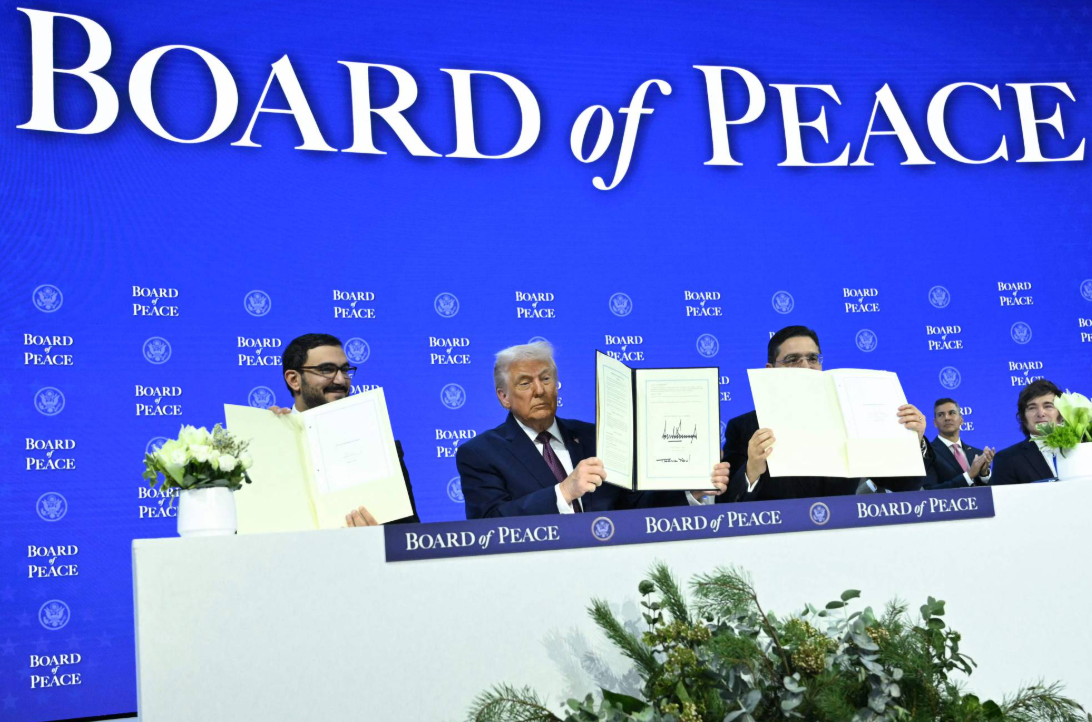
Trump is meanwhile reportedly considering a first meeting of the so-called "Board of Peace" for war-torn Gaza at Davos, after announcing its first members in recent days.

Questions are also swirling about the future of oil-rich Venezuela following the US military operation to topple its leader Nicolas Maduro, part of Trump's assertive new approach to his country's "backyard."

But Trump may also pause to enjoy his time in the scenic spot he called "beautiful Davos" in his video speech to the meeting a year ago.

The forum has always been an odd fit for the former New York property tycoon and reality TV star, whose brand of populism has long scorned globalist elites.

But at the same time, Trump relishes the company of the rich and successful.

His first Davos appearance in 2018 met occasional boos but he made a forceful return in 2020 when he dismissed the "prophets of doom" on climate and the economy.

A year later he was out of power. Now, Trump returns as a more powerful president than ever, at home and abroad.


Russia, China Unlikely to Back Iran Against US Military Threats

A man stands by the wreckage of a burnt bus bearing a banner (unseen) that reads "This was one of Tehran’s new buses that was paid for with the money of the people’s taxes,” in Tehran's Sadeghieh Square on January 15, 2026. (AFP)
TT

Russia, China Unlikely to Back Iran Against US Military Threats

A man stands by the wreckage of a burnt bus bearing a banner (unseen) that reads "This was one of Tehran’s new buses that was paid for with the money of the people’s taxes,” in Tehran's Sadeghieh Square on January 15, 2026. (AFP)

While Russia and China are ready to back protest-rocked Iran under threat by US President Donald Trump, that support would diminish in the face of US military action, experts told AFP.

Iran is a significant ally to the two nuclear powers, providing drones to Russia and oil to China. But analysts told AFP the two superpowers would only offer diplomatic and economic aid to Tehran, to avoid a showdown with Washington.

"China and Russia don't want to go head-to-head with the US over Iran," said Ellie Geranmayeh, a senior policy expert for the European Council on Foreign Relations think tank.

Tehran, despite its best efforts over decades, has failed to establish a formal alliance with Moscow and Beijing, she noted.

If the United States carried out strikes on Iran, "both the Chinese and the Russians will prioritize their bilateral relationship with Washington", Geranmayeh said.

China has to maintain a "delicate" rapprochement with the Trump administration, she argued, while Russia wants to keep the United States involved in talks on ending the war in Ukraine.

"They both have much higher priorities than Iran."

- Ukraine before Iran -

Despite their close ties, "Russia-Iranian treaties don't include military support" -- only political, diplomatic and economic aid, Russian analyst Sergei Markov told AFP.

Alexander Gabuev, director of Carnegie Russia Eurasia Center, said Moscow would do whatever it could "to keep the regime afloat".

But "Russia's options are very limited," he added.

Faced with its own economic crisis, "Russia cannot become a giant market for Iranian products" nor can it provide "a lavish loan", Gabuev said.

Nikita Smagin, a specialist in Russia-Iran relations, said that in the event of US strikes, Russia could do "almost nothing".

"They don't want to risk military confrontation with other great powers like the US -- but at the same time, they're ready to send weaponry to Iran," he said.

"Using Iran as a bargaining asset is a normal thing for Russia," Smagin said of the longer-term strategy, at a time when Moscow is also negotiating with Washington on Ukraine.

Markov agreed. "The Ukrainian crisis is much more important for Russia than the Iranian crisis," he argued.

- Chinese restraint -

China is also ready to help Tehran "economically, technologically, militarily and politically" as it confronts non-military US actions such as trade pressure and cyberattacks, Hua Po, a Beijing-based independent political observer, told AFP.

If the United States launched strikes, China "would strengthen its economic ties with Iran and help it militarize in order to contribute to bogging the United States down in a war in the Middle East," he added.

Until now, China has been cautious and expressed itself "with restraint", weighing the stakes of oil and regional stability, said Iran-China relations researcher Theo Nencini of Sciences Po Grenoble.

"China is benefiting from a weakened Iran, which allows it to secure low-cost oil... and to acquire a sizeable geopolitical partner," he said.

However, he added: "I find it hard to see them engaging in a showdown with the Americans over Iran."

Beijing would likely issue condemnations, but not retaliate, he said.

Hua said the Iran crisis was unlikely to have an impact on China-US relations overall.

"The Iranian question isn't at the heart of relations between the two countries," he argued.

"Neither will sever ties with the other over Iran."