
The Vanishing Act: How Assad’s Top Henchmen Fled Syria, and Justice

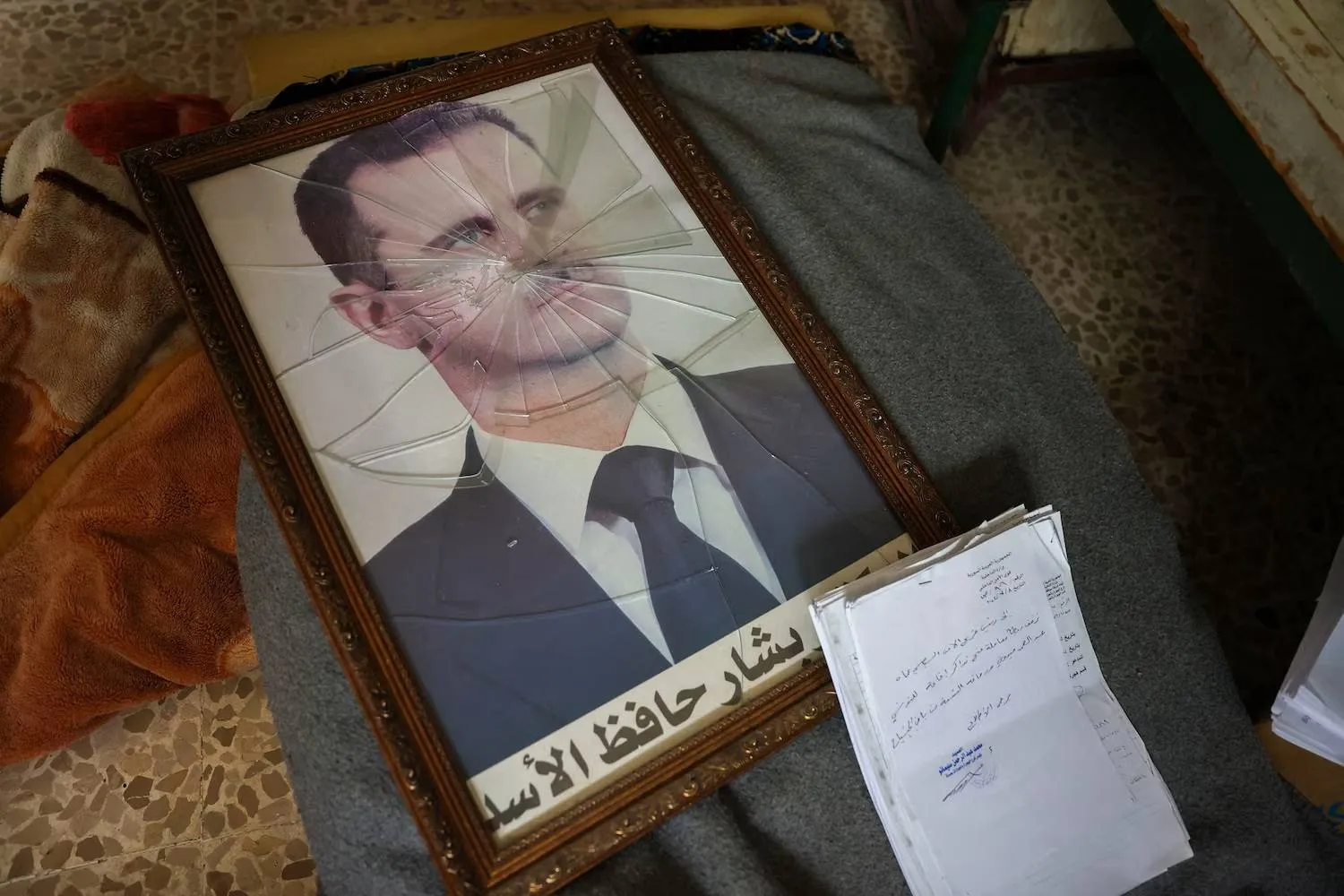
A portrait of ousted Syrian President Bashar al-Assad is pictured with its frame broken, in a Syrian regime's Political Security Branch facility on the outskirts of the central city of Hama, following the capture of the area by anti-government forces, on December 7, 2024. (AFP via Getty Images)
TT

The Vanishing Act: How Assad’s Top Henchmen Fled Syria, and Justice

A portrait of ousted Syrian President Bashar al-Assad is pictured with its frame broken, in a Syrian regime's Political Security Branch facility on the outskirts of the central city of Hama, following the capture of the area by anti-government forces, on December 7, 2024. (AFP via Getty Images)

Not long after midnight on December 8, 2024, dozens of people gathered in the darkness outside the military section of the Damascus International Airport. Carrying whatever they could pack, they piled into a small Syrian Air jet.

Only an hour earlier, they were part of an elite cadre that formed the backbone of one of the world’s most brutal regimes. Now, in the wake of President Bashar al-Assad’s sudden fall and escape from the country, they were fugitives, scrambling with their families to flee.

Among the passengers was Qahtan Khalil, director of Syria’s air force intelligence, who was accused of being directly responsible for one of the bloodiest massacres of the country’s 13-year civil war.

He was joined by Ali Abbas and Ali Ayyoub, two former ministers of defense facing sanctions for human rights violations and atrocities carried out during the conflict.

There was also the military chief of staff, Abdul Karim Ibrahim, accused of facilitating torture and sexual violence against civilians.

The presence of these and other regime figures was recounted to The New York Times by a passenger and two other former officials with knowledge of the flight.

As a whirlwind opposition offensive encroached on the Syrian capital, Assad’s furtive flight out of Damascus earlier that night took his innermost circle by surprise and became the symbol of his regime’s stunning fall.

His henchmen quickly followed suit. In a matter of hours, the pillars of an entire system of repression had not simply collapsed. They had vanished.

Some caught flights. Others rushed to their coastal villas and roared away on luxury speed boats.

Some fled in convoys of expensive cars, as opposition fighters at freshly installed checkpoints unwittingly waved them on. A few hid out in the Russian Embassy, which assisted in their escapes to Moscow, Assad’s most important ally.

To the thousands of Syrians who lost loved ones, or were tortured, imprisoned or displaced by the Assad regime, their homeland had become a crime scene from which the top suspects disappeared en masse.

Ten months after the regime’s collapse, a nation shattered by war not only faces the immense challenge of rebuilding, but also the daunting task of scouring the globe to find and hold to account the people who committed some of the worst state-sponsored crimes of this century.

Former opposition fighters and Syria’s fledgling government are trying to locate them through informants, computer and phone hacks, or clues gathered from abandoned regime headquarters. Prosecutors in Europe and the United States are building or revisiting cases. And Syrian civil society groups and United Nations investigators are collecting evidence and witnesses, preparing for a future in which they hope justice can be served.

Their targets are some of the most elusive people in the world. Many of them wielded immense power for decades, yet remained public enigmas: Their real names, ages and, in some cases, even appearances were unknown.

The dearth of information has repeatedly led to inaccuracies in media reports, and on sanctions and law enforcement lists. It likely has helped some of the regime’s most notorious bad actors evade Syrian and European authorities since Assad’s fall.

The means to disappear

Over the past several months, a New York Times reporting team has been working to fill in the blanks about 55 of these regime officials’ roles and true identities, all former high-ranking government and military figures who appear on international sanctions lists and are linked to the deadliest chapters of Syria’s recent history.

The investigation has involved everything from tracing digital trails and family social media accounts, to scouring abandoned properties for old phone bills and credit card information.

Reporters interviewed dozens of former regime officials, many of whom spoke on condition of anonymity for their safety, as well as Syrian human rights lawyers, European law enforcement, civil society groups and members of the new Syrian government. They visited dozens of abandoned villas and businesses connected to regime figureheads and reconstructed some of their escape routes.

The current whereabouts of many of these 55 former key officials who enabled Assad’s dictatorship remain unknown, but among the dozen The Times has found, their fates vary widely.

Assad himself is in Russia and appears to have cut off contact with most of his formal circle, according to former Syrian officials, relatives and associates.

Maher al-Assad, who was second only to his brother Bashar in power over regime-era Syria, has been spending time living a life of exiled luxury in Moscow, along with some of his former senior commanders, like Jamal Younes, according to accounts by regime-era officials and business associates in contact with them, as well as video evidence verified by The Times.

Others, like Ghiath Dalla, a brigadier general whose forces were involved in violent repression of protests, are among several former officers plotting sabotage from Lebanon, according to ex-military commanders, who also shared text message exchanges with The Times. Dalla is coordinating with former regime leaders like Suhail al-Hassan and Kamal al-Hassan from Moscow, the same commanders said.

Some officials have struck murky deals to remain in Syria, according to an ex-military commander and people working with the new government. And one official, Amr al-Armanazi, who oversaw Assad’s chemical weapons program, was discovered by Times reporters to still be living in his own home in Damascus.
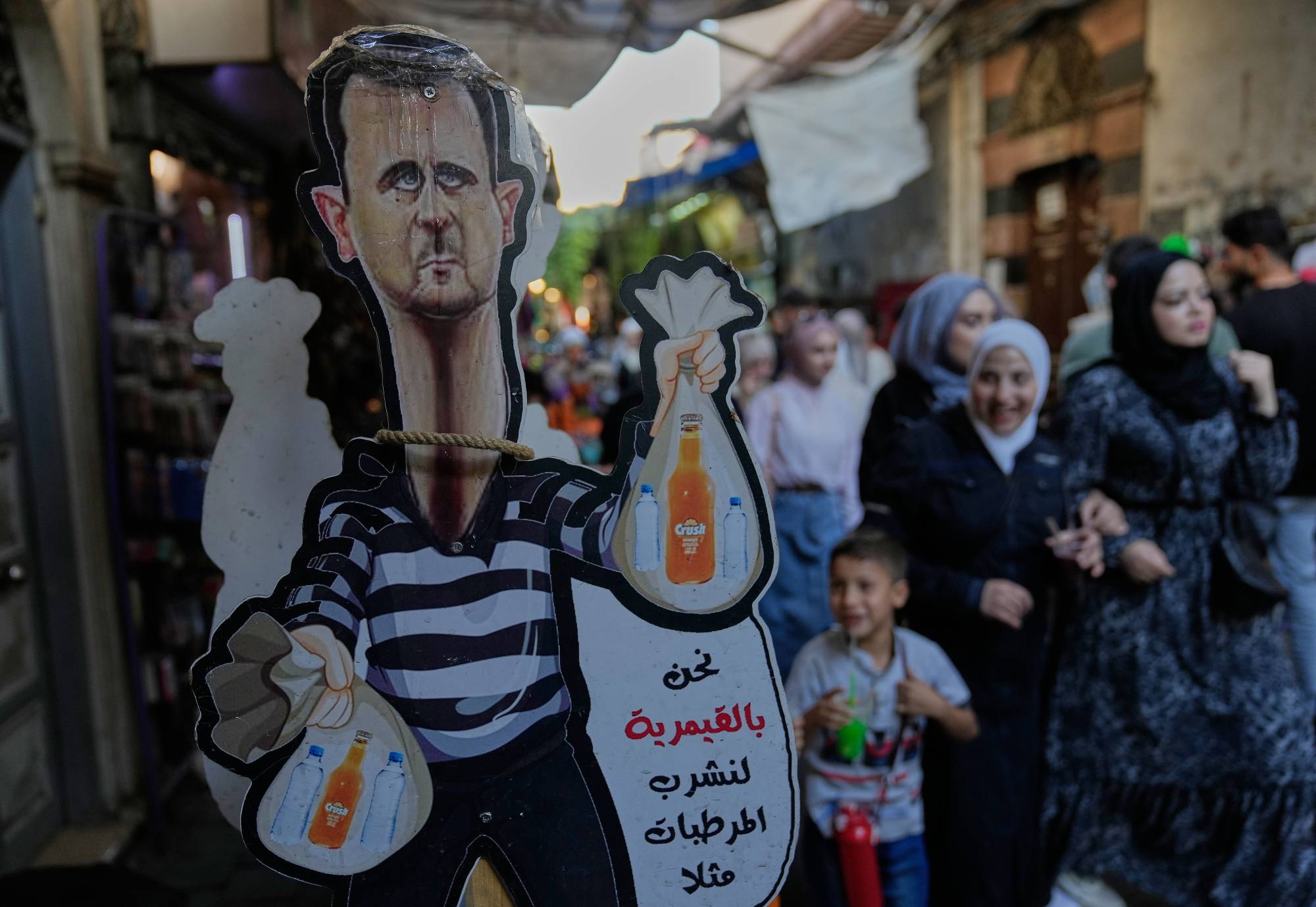
A cutout caricature shows the former Syrian President Assad sells soft drinks in the old city of Damascus, Syria, Thursday, Oct. 2, 2025. (AP)

Keeping track of such a large group of figures poses a massive challenge for those seeking justice. There are criminal cases to build and the daunting task of finding a way to actually prosecute such cases.

But at the heart of this challenge lies the question of how best to coordinate global search efforts for people who don’t want to be found.

Many of them had easy access to government offices that enabled them to obtain genuine Syrian passports with fake names, according to former employees and regime figures. That, in turn, enabled them to obtain passports to Caribbean countries, they said.

“Some of these individuals have purchased new identities by acquiring citizenship through real estate investments or financial payments. They use these new names and nationalities to hide,” said Mazen Darwish, head of the Syrian Center for Media and Freedom of Expression, a Paris-based group at the forefront of justice efforts on Syria.

“These people have the financial means to move freely, to buy new passports, to disappear.”

‘He’s gone.’

The mass exodus began late on the night of Dec. 7, 2024, after a moment of stark realization.

For hours, several of Assad’s top aides waiting near his office in the presidential palace had confidently fielded calls from their colleagues and relatives, several regime-era officials in contact with them that night said. The palace officials assured them the president was there, hashing out a plan with his military and Russian and Iranian advisers to confront the advancing opposition forces.

But that plan never materialized. And neither did Assad.

Realizing he was gone, the senior aides quickly tracked him to his home, according to three former palace officials. Shortly after, guards outside the president’s house informed them Russian officials had whisked Assad away in a convoy of three SUVs, along with his son and personal assistant.

According to the former palace aides, the only officials the president would summon to flee with him were two financial advisers. Assad would need their help, two regime insiders later explained, to access his assets in Russia.

The erstwhile president and his entourage got on a jet that flew them to Hmeimim, a coastal air base controlled by Russia, which had been his most critical backer in the war.

When they learned of the flight, the abandoned aides began frantically calling security officials and loved ones. The opposition fighters had reached the suburbs of Damascus and there was not a moment to lose.

“He’s gone,” was all that one senior aide said when he called a close relative, recounting that night to The Times. The aide ordered his family to pack their bags and go to the defense ministry in the capital’s central Umayyad Square.

There, the senior aide and his family joined several other security officers who had gathered with their families, and linked up with Khalil, the air force intelligence director. Khalil had arranged an escape flight, the one transporting many high-ranking officials, to Hmeimim. The plane, a Yak-40 private jet, left the Damascus airport around 1:30 a.m. on December 8, a passenger, who was one of the former palace officials, said.

Satellite-imagery analysis comports with this, showing that a Yak-40 was on the tarmac in Damascus in the days prior, vanishes on the night in question and seems to have reappeared at Hmeimim soon after.

The passengers who packed into the plane “were freaking out,” the former palace official recalled. The flight is only 30 minutes, he said, “but that night, it felt like we were flying forever.”

In another part of the city, Assad’s brother Maher, head of Syria’s feared 4th Division, was rushing to arrange his own escape. He called a family friend and one of his business cronies, according to two close associates. Maher al-Assad urged the men to leave their houses as quickly as possible and wait outside. Shortly after, he careened up the street in his car, then sped off with them to catch his own flight.

Swiping safes, dodging ambushes

Back in Damascus, some 3,000 members of the General Intelligence services were still inside the sprawling security compound in the capital’s southwest, unaware that regime elites had already fled. They nervously waited on high alert under their director, Hossam Louka — an official who oversaw mass detention and systemic torture.

One of Louka’s senior officers described him as someone extremely deferential to Assad. “He wouldn’t even move an ashtray from here to there without asking Bashar for permission,” he said.

The officer recalled that they had been ordered to ready themselves for a counterattack. The order never came.

A friend of Louka said he repeatedly called the intelligence director that night for updates and was always reassured that there was nothing to fear. Then, at 2 a.m., he said, Louka hurriedly answered the phone only to say he was packing to flee.

An hour later, Louka’s officers entered his office to discover he had abandoned them without uttering a word — and that, on his way out, Louka had ordered the intelligence service’s accountant to open the headquarters safe, according to one of Louka’s officers present at the time. Louka then took all the cash inside, an estimated $1,360,000. Three former regime officials say they believe Louka has since made it to Russia, though The Times has not yet verified their account.

In that same security compound, Kamal al-Hassan, another high-ranking former official, also raided his office headquarters. He took a hard drive as well as the money inside his administrative office’s safe, according to a friend and a senior regime-era figure in contact with one of al-Hassan’s deputies.

Al-Hassan, the head of military intelligence, is accused of overseeing mass arrests, torture and the execution of detainees.

His escape did not go as smoothly as the others. Al-Hassan was wounded in a gunfight with opposition fighters as he attempted to leave his home in a Damascus suburb formerly known as Qura al-Assad, or “Assad’s Villages,” an area where many regime elites lived in lavish villas.

He fled by hiding from house to house, the friend and regime-era official said, before eventually making his way to the Russian Embassy, which took him in.

The Times contacted al-Hassan through an interlocutor, who spoke to him by phone, but he would not divulge his location or agree to an interview. He did, however, recount his escape under fire, and said that he was sheltered at “a diplomatic mission,” before departing Syria.

Another official who sought refuge at the Russian Embassy was the retired national security director Ali Mamlouk, who helped orchestrate the system of mass arrest, torture and disappearance that was emblematic of five decades of Assad rule.

According to both a friend who said he had been in touch with him, and a relative, Mamlouk only learned of the regime collapse from a phone call around 4 a.m. As he attempted to join other officials fleeing to the airport, his convoy of cars was attacked by what the sources described as an ambush.

Though it was unclear who attacked him, they said he would have had many enemies.

As an intelligence director not only for Assad, but the dictator’s father and predecessor, Hafez, he knew the government’s secrets.

“He was the black box of the regime — not just since the days of Bashar, since the days of Hafez,” one of his friends said. “He knew everything.”

Mamlouk managed to get away unscathed and raced to the Russian Embassy, according to three people familiar with his escape.

Mamlouk and al-Hassan hunkered down there until Russian officials arranged a guarded convoy to get them to the Hmeimim base. Both men later reached Russia, the three people told The Times.
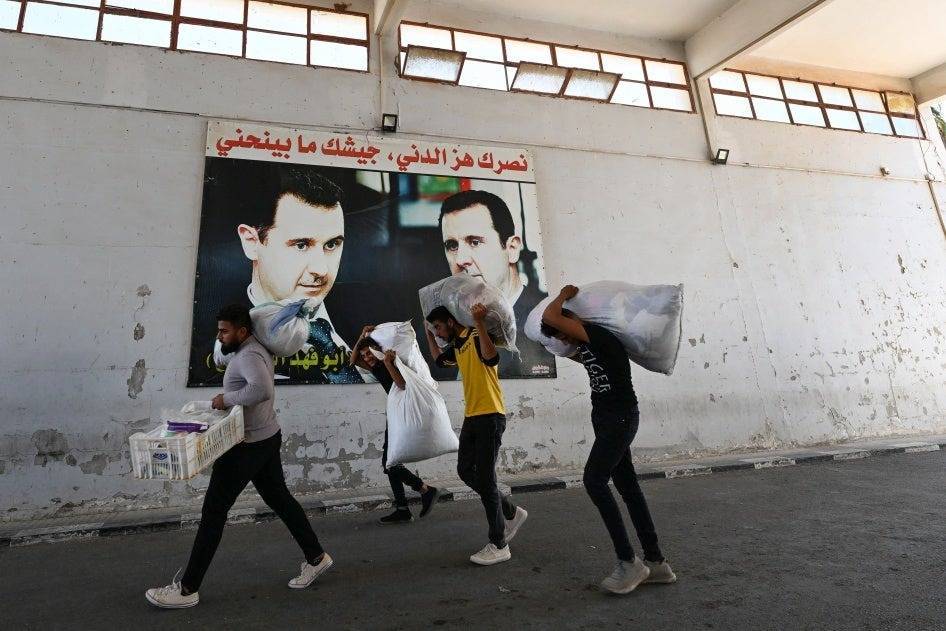
Syrian refugees return to their homeland from Lebanon in October. (AFP)

Close encounters

Several ex-regime figures said that, in an effort to minimize the regime’s resistance, there was a tacit understanding that opposition commanders would turn a blind eye to most Assad loyalists fleeing toward Syria’s Mediterranean coast, home of the Alawite minority sect to which Assad belonged, and where the Assad regime had recruited many of its security forces.

But it is unlikely such leniency would have been granted to the former Maj. Gen. Bassam Hassan. Few from Assad’s inner circle were more feared than Hassan, accused of a litany of crimes, including coordinating the regime’s chemical weapons attacks to the kidnapping of the American journalist Austin Tice.

Yet Hassan managed to escape undetected, despite sleeping through the first hectic hours of the regime’s fall. He was alerted sometime before 5 a.m., when one of his top commanders roused him from sleep, according to three people familiar with his story.

Hassan quickly arranged a convoy of three cars carrying his wife, adult children and bags stuffed with money, according to two of the people familiar with his story. He was so concerned about an attack that he had his wife and children ride in different cars, one associate said, to avoid the entire family being struck at once.

When their convoy approached the city of Homs, about 100 miles north of Damascus, fighters waved down the first car, an SUV, and forced Hassan’s wife and daughter out. They were ordered to leave everything, even their purses, inside the vehicle, according to a witness.

The fighters, apparently satisfied with their loot, paid no mind as the women got into the second car, joining one of the Assad regime’s most notorious henchmen.

The fighters had a scant chance of recognizing him. Bogus photos of Hassan have long circulated in the media. Even the United States and British governments do not use the right name or birth year for Hassan in their sanctions documents. The Times has obtained and verified perhaps the only recent photograph of Hassan.

Having cleared the checkpoint, Hassan eventually made his way to Lebanon and then Iran with the help of Iranian officials, according to interviews with officials from the Assad regime, Lebanon and the US.

He has since returned to Beirut as part of a deal to provide information to American intelligence officials. Associates said he had been spending his time at cafes and fancy restaurants with his wife. When reached on a Lebanese WhatsApp number, he declined to give an interview.

A bitter reality

For the tens of thousands of Syrians who were victims of the Assad regime, the pursuit of justice looks aimless.

It remains an open question whether the current government, under Ahmed al-Shara, has the capacity, or the will to aggressively pursue Assad officials accused of war crimes — that would, in turn, put some of his own officials’ alleged crimes under the spotlight, too.

And with foreign powers long divided over the war in Syria and the uprising against its former dictator, there is little hope for an international tribunal either.

For those fighting to ensure the regime’s crimes are not allowed to fade into history, a bitter reality remains: Assad’s top enforcers are still living large, and still one step ahead of their pursuers.


*Erika Solomon, Christiaan Triebert, Haley Willis, Ahmad Mhidi and Danny Makki for The New York Times


Mass Wedding in Gaza Celebrates New Life After Years of War and Tragedy 

Palestinian couples participate in a mass wedding ceremony in Hamad City in Khan Younis, Gaza Strip, Tuesday, Dec. 2, 2025. (AP)
TT

Mass Wedding in Gaza Celebrates New Life After Years of War and Tragedy 

Palestinian couples participate in a mass wedding ceremony in Hamad City in Khan Younis, Gaza Strip, Tuesday, Dec. 2, 2025. (AP)

Eman Hassan Lawwa was dressed in traditional Palestinian prints and Hikmat Lawwa wore a suit as they walked hand-in-hand past the crumbled buildings of southern Gaza in a line of other couples dressed in exactly the same way.

The 27-year-old Palestinians were among 54 couples to get married Tuesday in a mass wedding in war-ravaged Gaza that represented a rare moment of hope after two years of devastation, death and conflict.

"Despite everything that has happened, we will begin a new life," Hikmat Lawwa said. "God willing, this will be the end of the war," he said.

Weddings are a key part of Palestinian culture that have become rare in Gaza during the war. The tradition has begun to resume in the wake of a fragile ceasefire, even if the weddings are different from the elaborate ceremonies once held in the territory.

As roaring crowds waved Palestinian flags in the southern city of Khan Younis, the celebrations were dampened by the ongoing crisis across Gaza.

Most of Gaza's 2 million residents, including Eman and Hikmat Lawwa, have been displaced by the war, entire areas of cities have been flattened and aid shortages and outbursts in conflict continue to plague the daily lives of people.

The young couple, who are distant relatives, fled to the nearby town of Deir al-Balah during the war and have struggled to find basics like food and shelter. They said they don’t know how they’re going to build their lives together given the situation around them.

"We want to be happy like the rest of the world. I used to dream of having a home, a job, and being like everyone else," Hikmat said. "Today, my dream is to find a tent to live in."

"Life has started to return, but it's not like we hoped it would," he added.

Palestinians watch and celebrate a mass wedding ceremony in Hamad City in Khan Younis Tuesday, Dec. 2, 2025. (AP)

The celebration was funded by Al Fares Al Shahim, a humanitarian aid operation backed by the United Arab Emirates. In addition to holding the event, the organization offered couples a small sum of money and other supplies to start their lives together.

For Palestinians, weddings are often elaborate dayslong celebrations, seen as both an important social and economic choice that spells out the future for many families. They include joyful dances and processions through the streets by massive families in fabric patterns donned by the couple and their loved ones and heaping plates of food.

Weddings can also be a symbol of resilience and a celebration of new generations of families carrying on Palestinian traditions, said Randa Serhan, a professor of sociology at Barnard College who has studied Palestinian weddings.

"With every new wedding is going to come children and it means that the memories and the lineages are not going to die," Serhan said. "The couples are going to continue life in an impossible situation."

On Tuesday, a procession of cars carrying the couples drove through stretches of collapsed buildings. Hikmat and Eman Lawwa waved Palestinian flags with other couples as families surrounding them danced to music blaring over crowds.

Eman, who was cloaked in a white, red and green traditional dress, said the wedding offered a small moment of relief after years of suffering. But she said it was also marked by the loss of her father, mother, and other family members who were killed during the war.

"It’s hard to experience joy after such sorrow," she said, tears streaming down her face. "God willing, we will rebuild brick-by-brick."


‘Some Took Part in Israeli Captive Handover’…How Hamas Fighters Hid in Rafah Tunnels ?

Israeli captive Avera Mengistu stands on the handover platform as part of a prisoner exchange agreement between Hamas and Israel in Rafah in February (Reuters)
TT

‘Some Took Part in Israeli Captive Handover’…How Hamas Fighters Hid in Rafah Tunnels ?

Israeli captive Avera Mengistu stands on the handover platform as part of a prisoner exchange agreement between Hamas and Israel in Rafah in February (Reuters)

A series of Israeli military statements reporting the killing or capture of members of Hamas’s Izz al Din al Qassam Brigades inside Rafah’s tunnel network has sharpened scrutiny of who these fighters were and how long they had remained hidden underground.

The operations targeted men who had spent months beneath a city Israel moved to occupy in May 2024 and later brought under full control.

For more than a month, indirect contacts had sought to arrange the fighters’ safe withdrawal from the tunnels unarmed, an effort that helped expedite the handover of the body of Israeli officer Hadar Goldin on November 9.

But Israel later backed away from informal understandings with the United States, which had been engaging on the issue with Türkiye, over allowing the fighters to exit safely.

As weeks passed, Israel began hunting them down, killing and capturing them in groups through airstrikes or direct pursuit once they emerged from tunnels or ambush positions.

The pressure mounted as the fighters became confined to the last pockets of tunnels in Rafah’s eastern al-Jneina neighborhood.

Eight months in tunnels and ambush positions

Field sources from Hamas told Asharq Al-Awsat that the fighters had spent most of the two year war inside the city’s tunnels despite the presence of Israeli forces above ground and despite Israel’s entry into many of the passageways.

The sources said the tunnels had been built in ways that made them difficult for Israel to uncover fully even now.

They said that during the first truce which lasted seven days in November 2023, the fighters surfaced, then returned underground when the fighting resumed.

They alternated between staying in the tunnels and emerging into ambush positions above ground. Communication with their commanders continued until a second truce was reached in January of this year which lasted until March 18.

One source said that before the fighting resumed, and despite Israel’s deployment in Rafah, the fighters managed to emerge above ground, reach Khan Yunis, meet their commanders and take part in the handover of Israeli captives.

Some participated in the February release of Avera Mengistu, who had been held in Gaza since the 2014 war.

After the war resumed and diplomatic efforts to halt it failed, Qassam fighters returned to Rafah through the tunnels and resumed their ambush positions above ground.

From late March until August, the fighters remained in touch with their command and carried out a string of attacks that inflicted casualties on Israeli forces even after Israel declared it had brought Rafah under full control.

The Qassam Brigades at the time launched a series of attacks named Gates of Hell that killed about six Israeli soldiers.

The attacks involved detonating military vehicles, booby trapped houses and tunnel openings. In one incident in May, Qassam fighters attempted to seize an Israeli soldier.

Hamas, which was then engaged in negotiations to halt the war, sought through these operations to show that the Rafah Brigade remained active at a time when Israeli military sources were claiming the brigade had been dismantled after its battalions were destroyed.

According to information obtained by Asharq Al-Awsat, Rafah fighters and their immediate commanders spent more than eight months inside tunnels and in above ground ambush positions.

How did they obtain food and water

Field sources in the factions told Asharq Al-Awsat that the tunnels had been stocked with limited supplies of food and water.

One source who had experienced a similar shortage in a previous Gaza war said the fighters had likely relied on whatever food they could find.

This included leftover supplies from Israeli soldiers in some of the houses they had occupied or food in homes of residents that had not been destroyed.

The source cited social media posts from months earlier showing handwritten notes left by Hamas and Islamic Jihad fighters apologizing to homeowners for taking food.

The sources said duties differed inside the Qassam Brigades. Some fighters handled logistics, others manned ambush positions and others moved between units while maintaining direct coordination with field commanders.

Senior commanders

Among those whose photos Israeli media circulated after they were killed were the commander of Rafah’s eastern battalion, Mohammad al-Bawab, and his deputy, Ismail Abu Labda. Al-Bawab was married to Abu Labda’s sister.

Another senior figure killed was Tawfiq Salem, commander of the battalion’s elite company, according to the sources.

Abu Labda appeared in the February handover of Mengistu and was in direct contact with the International Committee of the Red Cross during the transfer. The sources said al-Bawab monitored the process from a distance but did not take part directly.

The sources added that al-Bawab and Abu Labda were among those who oversaw the capture of Israeli officer Hadar Goldin during the 2014 war.

Israel also killed Abdullah Hamad, the son of senior Hamas political bureau member Ghazi Hamad and a member of the movement’s negotiating delegation.

Field sources said the younger Hamad had been active in the Qassam Brigades and had graduated from the Rabat Military College run by the Hamas government before the war, later becoming an instructor.

He was killed alongside his cousin Ahmed Saeed Hamad, the son of Ghazi Hamad’s brother, while they were in a tunnel with Qassam commanders and other fighters.

The sources said Saeed Hamad had lost three daughters in Israeli strikes on their homes. The daughters were killed after their husbands took part in the October 7, 2023 attack and in other operations during the war.


Israeli Settler Outposts Spread Among West Bank Villages and Fuel Fear of More Attacks

An Israeli settler outpost stands in the middle of a valley next to olive trees in the West Bank town of Turmus Ayya, Wednesday, Nov. 12, 2025. (AP)
TT

Israeli Settler Outposts Spread Among West Bank Villages and Fuel Fear of More Attacks

An Israeli settler outpost stands in the middle of a valley next to olive trees in the West Bank town of Turmus Ayya, Wednesday, Nov. 12, 2025. (AP)

The fear is palpable in this Palestinian village. It’s clear in how farmers gather their harvests quickly, how they scan the valley for movement, how they dare not stray past certain roads. At any time, they say, armed Israeli settlers could descend.

“In a matter of minutes, they get on their phones. They gather themselves, and they surprise you,” said Yasser Alkam, a Palestinian-American lawyer and farmer from the village of Turmus Ayya. “They hide between the trees. They ambush people and beat them up severely.”

In recent months, Alkam says Turmus Ayya has weathered near-daily attacks by settlers, especially after they set up an outpost that the anti-settlement watchdog group Peace Now says is on his village’s land.

Alkam says he can’t reach his own fields for fear of being assaulted. In a particularly gruesome attack, he watched a settler beat a Palestinian woman unconscious with a spiky club.

The fear is shared throughout the West Bank. During October's olive harvest, settlers across the territory launched an average of eight attacks daily, according to the United Nations humanitarian office, the most since it began collecting data in 2006. The attacks continued in November, with the UN recording at least 136 more by Nov. 24.

Settlers burned cars, desecrated mosques, ransacked industrial plants and destroyed cropland. Israeli authorities have done little beyond issuing occasional condemnations of the violence.

Prime Minister Benjamin Netanyahu described the attackers as a minority that did not represent most settlers in the West Bank, where settlements are considered illegal by most of the international community. But their continued expansion of outposts — conducted in public with seemingly few legal repercussions — and the violence have cemented a fearful status quo for their Palestinian neighbors.

A brutal assault on a grandmother

While driving in fields east of Turmus Ayya on Oct. 19, Alkam saw Afaf Abu Alia, a grandmother from a nearby village, harvesting a grove of olive trees. They were loaned to her after the Israeli military bulldozed her own 500 trees this year, she said.

She worked until she heard yelling in Hebrew. Settlers descended on the road nearby. Suddenly, one ran toward her with a club.

“The monsters started beating me,” she told The Associated Press three weeks after the attack. “After that, my memories get all blurry.”

Video of the attack obtained by the AP shows a settler beating Alia with the jagged club, even after she was motionless. She was hospitalized for four days, requiring 20 stitches on her head, she said.

Asked for comment on the attack, the military said its troops and police had “defused” a confrontation in which Israeli civilians were torching vehicles and using violence.

In rare move, Israel charges settler responsible Police arrested a man named Ariel Dahari for beating Abu Alia. An Israeli court charged him later with terrorism.

Dahari is being represented by Honenu, an organization that provides legal aid to settlers, who say the West Bank is part of the biblical Jewish homeland and often cast attacks as self-defense. According to an article about Dahari on the group's website, he has received at least 18 administrative orders since 2016 that included house arrest and confinement to his town in Israel.

He told the Israeli news site Arutz Sheva in 2023 that he had been kicked out of the territory twice. It is not clear how he was able to return.

Palestinians and human rights workers say Israeli soldiers and police routinely fail to prosecute attacks by violent settlers. Their sense of impunity has deepened under Israel's far-right National Security Minister Itamar Ben-Gvir, a settler, and Defense Minister Israel Katz, who in January released settlers from administrative detention, Israel’s practice of detaining individuals without charge or trial.

The number of investigations opened into settler violence since 2023, Ben-Gvir's first year in office, has plummeted, according to a report by Israel's Channel 12 TV that cited official police data. Police opened only 60 investigations into settler violence in 2024, compared with 150 cases in 2023 and 235 cases in 2022, the report said.

About 94% of all investigation files opened by Israeli police into settler violence from 2005 to 2024 ended without an indictment, according to Israeli rights group Yesh Din. Since 2005, just 3% of those investigations led to convictions.

Dahari told Arutz Sheva that he was determined to stay in the West Bank.

“We will not give up our grip on our land because of one order or another. We will continue to build it and make it flourish everywhere,” he said, adding that he hoped “the security establishment” would “invest all its resources in the war against the Arab enemy, who is the real enemy of us all.”

When reached by the AP, Dahari’s lawyer, Daniel Shimshilashvili, sent a statement from Honenu, saying there was “slim evidence” against Dahari.

Threats are reinforced by settler outposts

The villagers from Turmus Ayya say it's not enough to arrest one settler — the threat of violence is reinforced by the outpost in the nearby valley called Emek Shilo.

Emek Shilo was founded this year on private Palestinian land, according to Peace Now. It was started by a well-known settler named Amishav Melet, said three Palestinians living in Turmus Ayya and Yair Dvir, the spokesperson for Israeli rights group B'tselem. On his personal X account, Melet posted videos of the outpost’s construction.

Villagers alleged that Melet travels the valley in an all-terrain vehicle, surveilling their activities. He’s frequently armed, they said.

Usually little more than a few sheds and a pen for livestock, such outposts can impose control on nearby land and water sources. They often turn into authorized settlements, spelling the end of Palestinian communities.

Israeli police did not comment when asked about Melet.

Abdel Nasser Awwad had to halt construction of a new family home when the outpost was established. In security camera footage he shared with AP, masked figures showed up at the construction site, smashing his truck with a club and appearing to cut piping. He said they have stoned three of his workers.

When AP visited the village, groups of settlers were visible around the outpost and a settler tractor patrolled the area. Drones hummed in the air.

Melet was convicted of assaulting police in 2014, according to court records. In an interview with Israel's Ynet news in 2015, Melet said he had received administrative orders barring him from the West Bank.

In response to questions from the AP, Melet said he was a “peace activist.”

“Any claim against me that I am active or connected to violence or terrorism or any illegal action is a lie and a falsehood!” he wrote.

He called the AP’s questions “part of a cruel and false campaign” against Zionism that “reeks” of antisemitism.

In video from Oct. 20 shared with the AP by Alkam, a man who Alkam said was Melet was recorded telling a farmer picking olives to leave. The farmer responded, “The army allowed us to be here today.”

“Where is the army?” the man identified as Melet said. “I am the army.”

When settlers descend on Turmus Ayya, the mosque emits a loud siren. Young men dash quickly to the village entrance, forming a barrier between their families and the settlers.

During the harvest, many villagers brought cameras into the fields, hoping footage showing assaults would help hold settlers accountable.

It’s a far cry from past olive harvests, when families spent all day in the groves, picnicking beneath the trees.

Abu Alia, the grandmother, said nothing will prevent her from returning.

“I’ll be back next year.”