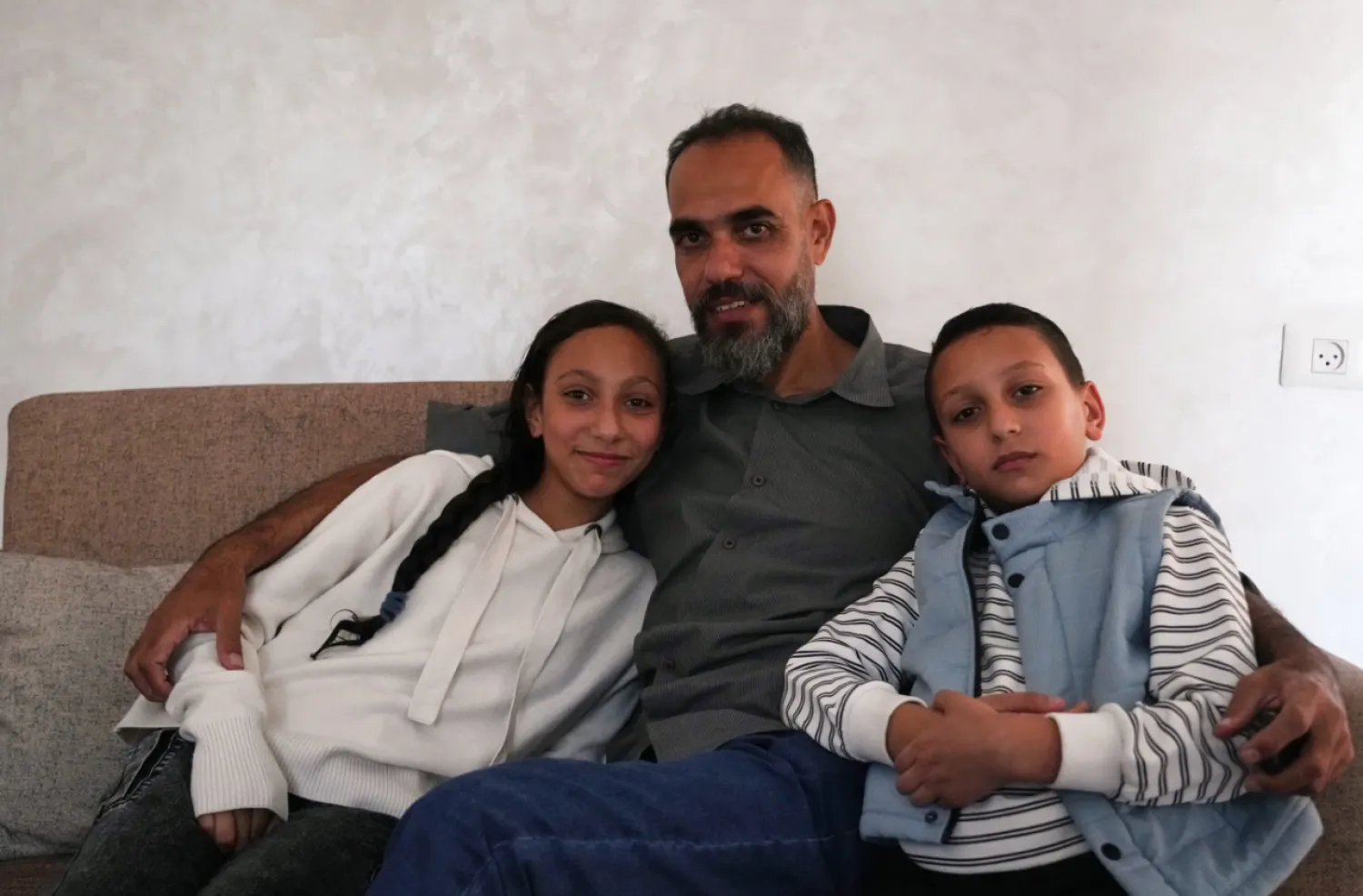

A Father Returns from Israeli Detention to Find Gaza and His Family Shattered


Mohammed Abu Moussa, 45, who was released from Israeli detention after 20 months, poses for a photo with his children, Jourie and Hamid, in Deir al-Balah, Gaza, Saturday, Oct, 18, 2025. (AP Photo/Abdel Kareem Hana)
TT

A Father Returns from Israeli Detention to Find Gaza and His Family Shattered


Mohammed Abu Moussa, 45, who was released from Israeli detention after 20 months, poses for a photo with his children, Jourie and Hamid, in Deir al-Balah, Gaza, Saturday, Oct, 18, 2025. (AP Photo/Abdel Kareem Hana)

Amid the joy of being released after 20 months of suffering in Israeli prisons, Mohammed Abu Moussa could tell something was wrong.

Descending from the bus that brought him and other released Palestinian detainees to Gaza last week, the 45-year-old medical technician was reunited with his wife and two young children. But when he asked about his mother, his brother wouldn’t look him the eye.

Finally they sat him down and told him: His mother, his younger sister Aya, Aya’s children and his aunt and uncle had all been killed by an Israeli airstrike that hit their shelter in central Gaza in July, The AP news reported.

More than 1,800 Palestinians seized from Gaza by Israeli troops during the two-year war were freed this week under the ceasefire deal that brought Hamas' release of the last living hostages. Israel also freed around 250 Palestinian prisoners convicted over the past decades, who mainly returned to the occupied West Bank or were exiled abroad, though a few were sent to Gaza.

Those released back to Gaza were met by the shock of how their homeland had been destroyed and families shattered by Israeli bombardment and offensives while they were locked away, with little news of the war.

Recounting his return, Abou Moussa said the grief hit even before the freed detainees got off the bus on Monday. Some shouted out the bus windows to people they knew in the cheering crowd welcoming them and asked about brothers, mothers and fathers.

Often, he said, their reply was terse: “God rest their souls.”

Taken as his family fled Abu Moussa suffered his first loss soon after Israel launched its campaign aiming to destroy Hamas after the militants' Oct. 7, 2023, attack on Israel.

Eight days later, an airstrike hit his family’s home in the city of Khan Younis in southern Gaza, while he was on duty in Nasser Hospital, where he worked as a radiology technician. Video circulating online at the time showed him and his wife, Rawan Salha, rushing around the hospital in search of their son, Youssef, among the casualties. “He’s 7 years old, curly hair, fair-skinned and beautiful,” Salha cried.

The boy had been brought in dead. Also killed in the strike were the wife of one of Abu Moussa’s brothers and their two children.

In the next months, Abu Moussa worked constantly as wounded flowed into the hospital, where Salha and his two surviving children were also sheltering along with hundreds of others driven from their homes. In February 2024, Israeli forces surrounded the hospital, preparing to storm the facility to search for suspected militants. They demanded everybody leave but staff and patients too critical to move.

But Salha refused to leave without Abu Moussa, he said. So they set out walking with their children. At a nearby Israeli military checkpoint, Abu Moussa was called aside with others for interrogation in a nearby stadium.

It was the start of his long separation from his family.

Abuse in prisons Abu Moussa says his months in Israeli prisons were filled with abuse. Like the other detainees released back to Gaza on Monday, he was never charged.

It began in the stadium, where he said he was beaten with sticks and fists during interrogation. All those taken from the checkpoint were kept with their hands bound in zip ties for three days, given no water and not allowed to use a bathroom. “Almost all of us soiled ourselves,” Abu Moussa said.

He was taken to Sde Teiman, a military prison camp inside Israel, where he would be held two months. Every day, he said, detainees were forced to kneel for hours without moving – “it’s exhausting, you feel your back is broken,” he said. Guards would pull some aside for beatings, said Abu Moussa, adding that his rib was broken in one beating.

He was moved to Negev Prison, run by civilian authorities. There, he said, beatings were less frequent, taking place mainly when guards conducted weekly searches of the cells, he said.

But conditions were harsh, he said. Nearly all the detainees had scabies, an infestation by mites that dig into the skin. “People were rubbing themselves up against the walls trying to get rid of the itching,” he said. Despite requests, prison officials did not give detainees creams to treat it until a few weeks before his release, he said.

Bedding was filthy, and detainees were allowed no change of clothes. Cuts often became infected, he said. When they washed their one set of clothing, they had to strip naked and wrap themselves in a blanket – but if guards saw, “they took away the blanket and made you sleep without it,” he said.

Sick detainees or those with chronic conditions asked for medicines but were refused, he said. One man, Mohammed al-Astal, suffered a colon blockage that worsened and he eventually died, Abu Moussa said.

“They treated us like animals,” he said.

Asked about Abou Moussa’s account, the Israeli Prison Service, which operates Negev Prison, said it was not aware of it. It said it operates in accordance with the law and that prisoners’ rights to medical care and proper living conditions are upheld.

Also in response, the military denied systematic abuse takes place in its facilities and said it acts in accordance with Israeli and international law. It said it investigates any concrete complaints.

Abu Moussa’s account mirrors those of many previously released Palestinians. At least 75 Palestinians have died in Israeli prisons and detention facilities during the war, the UN said in a report last month, saying conditions in the facilities amounted to torture that contributed to deaths. One 17-year-old Palestinian who died in prison in March was found to have wasted away from starvation and had colon inflammation and scabies, according to an Israeli doctor who observed the autopsy.

Returning to devastation Crossing the border from Israel into Gaza after the release, “the first shock was the destruction,” Abu Moussa said.

His home city of Khan Younis was unrecognizable. Entire neighborhoods were razed. He and his fellow passengers searched for landmarks among the shattered buildings.

The buses pulled into Nasser Hospital, where the crowd awaited them. Panicked at not seeing them in the crowd, Abu Moussa asked a hospital co-worker where his wife and children were. He assured him they were inside, waiting.

He asked one of his brothers about his mother. The brother couldn't look Abu Moussa in the eye, saying only, “She’s coming.”

“He wasn't being straight with me,” Abu Moussa said. After being reunited with his wife and children, he asked again about his mother and his sister, Aya. Finally, they told him.

Recounting what happened, Abu Moussa fell silent for long moments, overcome with emotion. His voice breaking with tears, he recalled how his mother had always been strong, refusing to cry after one of his brothers was killed during the 2009 Israel-Hamas war.

“She always kept a grip on herself, so we all wouldn’t weaken,” he said.

He wondered if the joy would have broken his mother's reserve if she’d be able to see him return from his imprisonment.

“I miss her. I want to see her,” he cried. “I want to kiss her hand, her head.”


Sheibani, an Iranian Diplomat with Intelligence Clout

 Iranian ambassador to Lebanon Mohammad Reza Sheibani (Iranian media)
Iranian ambassador to Lebanon Mohammad Reza Sheibani (Iranian media)
TT

Sheibani, an Iranian Diplomat with Intelligence Clout

 Iranian ambassador to Lebanon Mohammad Reza Sheibani (Iranian media)
Iranian ambassador to Lebanon Mohammad Reza Sheibani (Iranian media)

Only weeks after Iranian diplomat Mohammad Reza Sheibani returned to Beirut as ambassador, his name has become the focus of a diplomatic crisis.

Lebanon’s Foreign Ministry withdrew its approval and declared him “persona non grata”, reflecting rising tensions between Beirut and Tehran and drawing renewed attention to a career tied to some of the Middle East’s most complex issues.

The decision swiftly ended the mission of a diplomat Tehran had sent back to Beirut, relying on his long experience on Lebanon and Syria.

His return had collided with a Lebanese political climate increasingly sensitive to the limits of foreign diplomatic roles.

War experience and regional role

Sheibani is no stranger to Lebanon. He served as Iran’s ambassador to Beirut from 2005 to 2009, a period that coincided with the 2006 war between Hezbollah and Israel, giving him direct experience managing ties under complex security and political conditions.

His reappointment in early 2026 reflected an Iranian preference for seasoned diplomats in areas where politics and security overlap.

He replaced former ambassador Mojtaba Amani, who was injured in a pager explosion in Beirut, at a time of regional escalation, giving his return added weight beyond routine diplomacy.

Between Beirut and Damascus

Born in 1960, Sheibani joined Iran’s Foreign Ministry in the 1980s and rose through its ranks, focusing on Middle East affairs.

He served as chargé d’affaires in Cyprus and as head of Iran’s interests section in Egypt, before being appointed ambassador to Lebanon and later to Syria from 2011 to 2016, during which he covered the early years of the war.

He later served as ambassador to Tunisia and non-resident ambassador to Libya, and as assistant foreign minister for Middle East affairs.

He also worked as a senior adviser and researcher at the Institute for Political and International Studies at the Foreign Ministry, before returning to the forefront amid rising regional tensions.

Roles during escalation

In October 2024, he was named special representative of the Iranian foreign minister for West Asia, and in January 2025, he was appointed special envoy to Syria following developments in Damascus, including the closure of Iran’s embassy.

He was also tasked with following the Lebanese file as a special envoy during a sensitive phase, reinforcing his role as a crisis diplomat.

His career reflects a distinction within Iran’s diplomatic structure, as he is linked to the Ministry of Intelligence rather than the Quds Force of the Revolutionary Guard Corps, highlighting a division of roles in foreign policy.

Legal and constitutional debate

The move by Lebanon’s Foreign Ministry has also sparked legal debate over how such decisions are made and enforced.

Constitutional expert Saeed Malek said the decision is based on Article 9 of the Vienna Convention on Diplomatic Relations, which allows a state to declare a diplomat persona non grata without a specific procedure.

He said the measure does not amount to a break in diplomatic ties but falls within the management of diplomatic representation, adding that such decisions fall within the foreign minister’s authority under Article 66 of the constitution.

Malek said the decision is binding, and once the deadline to leave Lebanon expires, the ambassador’s presence becomes unlawful.

He added that security forces are required to enforce the decision and remove him once located.

However, he said enforcement remains bound by international rules, as the ambassador’s presence inside the embassy prevents Lebanese forces from entering under diplomatic immunity, meaning his expulsion can only be carried out once he leaves the premises.


Mohammad Baqer Zolghadr: A Man with Strong Connections at the Heart of Iran’s Revolutionary Guards

Zolghadr speaks in an interview with the Tasnim News Agency, December 2020.
TT

Mohammad Baqer Zolghadr: A Man with Strong Connections at the Heart of Iran’s Revolutionary Guards

Zolghadr speaks in an interview with the Tasnim News Agency, December 2020.

Mohammad Baqer Zolghadr was not an unfamiliar figure when he was appointed on Tuesday as secretary of Iran’s Supreme National Security Council. One week after the killing of Ali Larijani, and amid a war that has thinned the ranks of Iran’s top leadership, authorities turned to a man shaped within one of the deepest layers of the “Islamic Republic’s” power structure.

Mehdi Tabatabaei, the Iranian president’s deputy communications director, said on Tuesday that General Zolghadr had been appointed to replace Larijani. He wrote on X that Iran’s new Supreme Leader Mojtaba Khamenei had approved the decision.

The Supreme National Security Council, formally headed by President Masoud Pezeshkian, coordinates security and foreign policy. It includes senior military, intelligence and government officials, as well as representatives of the Supreme Leader, who has final authority in state affairs.

Zolghadr’s appointment appears to reflect state priorities in a time of crisis. A further decree is expected to name him as the Supreme Leader’s representative on the council, allowing him to vote under the constitution.

Unlike politicians who rise through elections or public platforms, Zolghadr belongs to a different category: a figure who boasts internal networks that predate the state and later embedded themselves within it. He accumulated power within the agencies instead of confronting them. His career resembles less a sequence of administrative posts and more a continuous thread linking some of the most entrenched centers of power in Iran.

His elevation to one of the country’s top security posts is significant not only for the positions he has held, but for the role he has played within the system. A veteran of the Iran-Iraq war, he developed expertise in organization and network-based operations, consolidating his position within the Iranian Revolutionary Guard Corps (IRGC) and later extending his influence through the interior ministry, judiciary and Expediency Council.

The appointment signals a broader logic within Iran’s ruling establishment: in moments of heightened pressure, figures rooted in institutional networks tend to take precedence over those with a public political profile.

Early career

Zolghadr’s career is closely tied to the political environment from which he emerged. He belongs to a generation associated with the “Mansouroun” network, an early group that later produced influential figures within the IRGC, including Mohsen Rezaei, Ali Shamkhani, Gholam Ali Rashid, and Mohammad and Ahmad Forouzandeh.

The significance of this affiliation lies not only in early organizational ties, but in the nature of the group itself: an ideologically driven pre-revolutionary network that repositioned itself within the state through the IRGC.

Zolghadr’s rise was not an individual climb through institutional ranks, but growth within a web of relationships and loyalties embedded at the core of the system. He emerged not simply as a professional military officer, but as part of a generation that viewed security and politics as intertwined domains in safeguarding the regime. This gave him the rare ability to “reposition” himself and retain power as successive government ruled Iran.

War and the ‘Ramadan’ headquarters

After the fall of the Shah, Zolghadr, like other members of Mansouroun, initially operated through revolutionary committees before joining the IRGC. His most defining wartime role was leading the “Ramadan Headquarters,” a key unit during the Iran-Iraq war.

This post was central to his political and security development. The Ramadan Headquarters served as a nucleus for external operations, coordinating cross-border activities with Iraqi Kurdish and Shiite groups opposed to Saddam Hussein and managing operations inside Iraq. It later evolved into what became the Quds Force, the IRGC’s current foreign arm.

There, Zolghadr developed a hallmark approach: operating at the intersection of military, intelligence and political spheres. The role involved not only managing battlefield operations, but also building networks, cultivating allies and leveraging conflict to generate long-term influence.

This model — combining military structure, indirect operations and proxy management — became a defining feature of Iran’s regional strategy. Within this environment, Zolghadr gained a reputation as a manager and strategist rather than a public-facing commander.

Rise within the IRGC

Following the end of the war in the late 1980s, Zolghadr spent 16 years at the top of the IRGC hierarchy: eight years as chief of the joint staff and eight years as deputy commander-in-chief.

These roles emphasized administration, coordination and institutional discipline rather than field command. His influence was rooted not in public charisma but in his position within the IRGC’s internal machinery.

Over time, he became firmly aligned with Iran’s conservative camp. His political role became more visible during the reformist presidency of Mohammad Khatami, when tensions between reformists and hardline institutions intensified.

Reform era

During the late 1990s, Zolghadr was among military figures associated with the conservative bloc within the IRGC. His name was linked to a letter sent by IRGC commanders to President Khatami, widely seen as a signal of military intervention in political affairs at a time of unrest. He was also associated with hardline opposition to the reform movement and the student protests of that period.

This phase highlighted a structural aspect of his career: his political role did not begin after leaving the military, but was embedded within the IRGC itself as it became increasingly politicized during its confrontation with reformists.

Interior Ministry under Ahmadinejad

When Mahmoud Ahmadinejad became president in 2005, Zolghadr was appointed deputy interior minister for security affairs. The position placed him at the heart of internal security, overseeing provincial governors and managing crises, protests and local tensions. It marked a transition from military service to the executive branch, while maintaining a focus on security.

His move illustrated a broader pattern: shifting from protecting the system through force to safeguarding it through security bureaucracy, expanding his network within the state apparatus.

Basij

Zolghadr left the interior ministry in 2007 amid reports of differences with Ahmadinejad, but his departure did not signal a loss of influence. In December of that year, Supreme Leader Ali Khamenei appointed him deputy chief of staff of the armed forces for Basij affairs, a newly created role.

The Basij, a paramilitary force, plays a key role in ideological mobilization and maintaining the IRGC’s presence in Iranian society. The decree emphasized strengthening and expanding the Basij’s reach, underlining the importance of Zolghadr’s assignment.

Judiciary and expanding influence

In 2010, Zolghadr moved to the judiciary, serving first as deputy for social prevention and crime reduction, and later as strategic deputy to the head of the judiciary until 2020.

The shift did not represent a departure from security work, as Iran’s judiciary operates closely under the authority of the Supreme Leader. Instead, it broadened his influence across another pillar of the state.

In September 2021, he was appointed secretary of the Expediency Council, succeeding Mohsen Rezaei. The role involves overseeing the council’s committees and acting as a link to the highest levels of decision-making.

Zolghadr also has family ties that extend his influence. He is the father-in-law of Kazem Gharibabadi, Iran’s deputy foreign minister for legal and international affairs and a prominent figure in nuclear negotiations.

Gharibabadi previously served as Iran’s ambassador to international organizations in Vienna, including the International Atomic Energy Agency.

From Larijani to Zolghadr

Larijani’s death deprived Iran of a political figure skilled in navigating between power centers. The choice of Zolghadr suggests a shift in priorities.

While Larijani represented balance and negotiation, Zolghadr embodies institutional discipline and internal cohesion. His selection follows speculation over other candidates, including former defense minister Hossein Dehghan, who was ultimately not appointed.

The decision reflects the system’s preference, in wartime conditions, for figures trusted by security networks over those known for political flexibility.

He may not be a prominent public figure, but he represents a type of official often relied upon in times of crisis: a man with internal networks, brought back to the forefront as Iran faces one of its most challenging periods.


Expulsion of Iran Ambassador Tests Diplomacy between Beirut and Tehran

Iranian Ambassador to Syria Mohammad Reza Sheibani, shows his ink-stained finger as he votes in the first round of the Iranian presidential election on June 14, 2013 at the Iranian embassy in the Syrian capital, Damascus. (AFP)
TT

Expulsion of Iran Ambassador Tests Diplomacy between Beirut and Tehran

Iranian Ambassador to Syria Mohammad Reza Sheibani, shows his ink-stained finger as he votes in the first round of the Iranian presidential election on June 14, 2013 at the Iranian embassy in the Syrian capital, Damascus. (AFP)

Diplomatic relations between Lebanon and Iran have entered a new phase with Beirut’s unprecedented withdrawal on Tuesday of its approval of the accreditation of Tehran’s new ambassador Mohammad Reza Sheibani.

The Foreign Ministry said in a statement that it had summoned the Iranian charge d'affaires in Lebanon and informed him of “the Lebanese state's decision to withdraw approval of the accreditation of the appointed Iranian ambassador, Mohammad Reza Sheibani, and declare him persona non grata, demanding that he leave Lebanese territory no later than next Sunday.”

The ministry said it had also summoned Lebanon's ambassador to Iran “in light of what the Lebanese state described as Tehran's violation of diplomatic norms and established practices between the two countries”, after Beirut accused Iran's Revolutionary Guards of commanding Hezbollah's operations in its war against Israel.

The government has accused Hezbollah of dragging Lebanon to war after it fired rockets at Israel on March 2 in wake of the killing of Iran's supreme leader Ali Khamenei at the beginning of the conflict.

Crisis

After three decades of calm, relations between Lebanon and Iran started to grow strained after the 2024 war between Hezbollah and Israel.

Iranian parliament Speaker Mohammad Bagher Ghalibaf declared at the time that Tehran was ready to negotiate with Paris about the implementation of United Nations Security Council resolution 1701 in Lebanon, sparking condemnation from Lebanon.

Then Prime Minister Najib Mikati slammed it as flagrant meddling in Lebanon’s sovereign affairs. He informed the foreign minister at the time to summon Iran’s charge d’affaires to file a formal complaint.

Relations became more strained in 2025 after Ambassador Mojtaba Amani’s suitcases were searched at Beirut’s Rafik Hariri International Airport.

Youssef Raggi, who became Lebanon’s foreign minister in 2025, summoned the Iranian ambassador for the first time since the 1990s last year. In April, he summoned Amani after he posted that the “project to disarm Hezbollah is an obvious conspiracy.”

The Lebanese government had issued a decision on the disarmament of Iran-backed Hezbollah last year.

In December, media close to Hezbollah reported that Raggi had suspended procedures on approving the accreditation of the new Iranian ambassador.

Last week, he summoned the charge d’affaires over statements attributed to the Iranian mission in Beirut and Iranian officials over security and military developments in Lebanon.

Ties between Raggi and Iranian officials have been strained for months. Last year he declined an official invitation from his Iranian counterpart Abbas Araqhchi to visit Tehran, suggesting that they meet in a third neutral country.

The withdrawal of accreditation is rare and it effectively means that a country refuses to welcome a diplomatic representative, reflecting deep political disapproval of the concerned country’s behavior.

The withdrawal was the latest Lebanese measure against Iran.

On March 5, the government took a series of steps that reflect a hardening approach towards Tehran. It imposed visas on visiting Iranians that had been suspended since 2011 in an effort to encourage trade and tourism between Beirut and Tehran.

The government also banned any activity by the Iranian Revolutionary Guards in Lebanon. Dozens of Iranians have since been deported from Lebanon.

‘Correcting’ relations

Lebanon had in the early 1990s launched a phase to “correct” relations with Iran after the end of the Lebanese civil war.

Then Foreign Minister Fares Boueiz was responsible for “reorganizing diplomatic work in line with the Vienna Convection”, said Lebanese sources.

During the 1975-90 civil war, Iranian officials would move freely to Lebanon through Syria and meet with Hezbollah officials in Beirut. Lebanese authorities had opposed the behavior.

In previous statements to Asharq Al-Awsat, Boueiz said Iranian delegations would travel to Lebanon through Syria without coordinating with the state.

The situation was later addressed through official diplomatic channels, he added.

The Iranian ambassador at the time was informed of the authorities’ objection and the stance was relayed to then Iranian FM Ali Akbar Velayati, said Boueiz.

Two days later, the Lebanese Foreign Ministry received an approval to “correct relations”, leading to an exchange in official visits and the signing of agreements that “regulated” the ties.