


French Migrant Unit Faces Quiet Standoff With Damascus

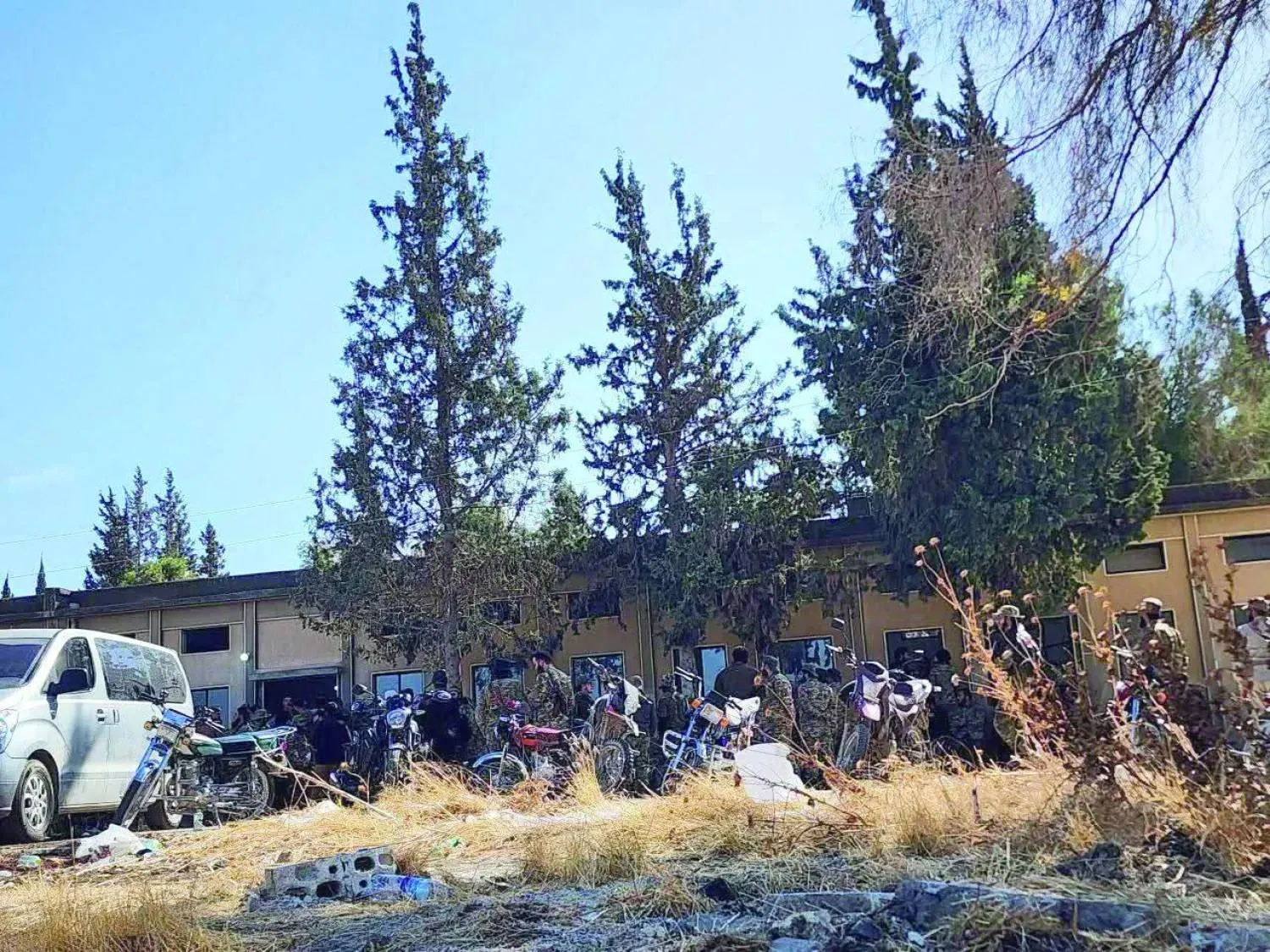
A circulated image shows the Ghuraba camp in Harem in Idlib’s countryside
TT

French Migrant Unit Faces Quiet Standoff With Damascus

A circulated image shows the Ghuraba camp in Harem in Idlib’s countryside

The latest clashes in Idlib’s countryside between a French armed faction known as the Ghuraba and Syrian government forces have revived one of the most sensitive and contentious questions in Syria’s new landscape.

In the Harem area north of Idlib, the fighting was not a standalone security incident. It appeared instead to be a test of Damascus’s approach to thousands of foreign fighters who remained on Syrian territory after years of war.

The clearest reading among analysts is that the events marked the start of a more serious engagement with the foreign fighters file.

The issue has returned to the forefront after the emerging Syrian state moved to build trust with the international community by preventing foreigners from assuming leadership posts in the new Syrian army.

How the Story Began

The incident began on October 22 when internal security forces moved into a camp in the town of Harem, where French fighters under the command of Omar Diaby, known as Omar Omsen, live.

The raid was carried out after complaints of serious violations, including the kidnapping of a girl by a group led by Diaby. Officials said Diaby refused to surrender. The operation, according to the official narrative, aimed to enforce the law and assert state authority over the camp.

Diaby’s Response

Diaby, a French commander of African origin, denied the accusations. He accused French intelligence of orchestrating what he described as political targeting. Paris views Diaby as one of the main recruiters of French-speaking jihadists. Washington designated him a global terrorist in 2016.

Ceasefire and Mediation

The clashes ended after a reconciliation meeting mediated by Uzbek, Tajik and Turkestan faction leaders inside the Harem camp. The Ghuraba announced on Telegram that it had reached a ceasefire and thanked what it called migrant and local brothers who supported them.

The Ghuraba’s Composition

The Ghuraba comprises about 70 French fighters living with their families in a fortified camp directly on the Turkish border.

This made the security raid difficult. The six-point agreement reached after the clashes required a ceasefire, opening the camp to the government, referring Diaby’s case to the Sharia court under the justice ministry, withdrawing heavy weapons and guaranteeing that participants in the clashes would not be pursued.

Foreign Fighters in the New State

The number of foreign fighters is estimated at more than five thousand. Most have joined the ministry of defense within the 84th Division. The Syrian government faces pressure from western capitals to keep them away from senior positions. Officials have sought to reassure global partners that these fighters pose no threat to regional or international stability.

Syrian President Ahmed Al Sharaa said fighters who once fought with the opposition are part of the new society and that Syria will deal with them through reconciliation rather than exclusion.

A number of them have already received military ranks and official posts in the army as part of an integration policy. Military officials later stressed that the Harem incident does not signal a change in this policy.

The Military’s Position

A Syrian army official, who requested anonymity, told Asharq Al-Awsat that what happened in Harem did not target foreign fighters who stood with the revolution. He said relations with them are based on mutual commitment. Many of them have formally joined the ministry of defense.

He denied that the operation was a campaign against them. It was simply enforcement of the law. He added that the new Syrian army operates under a clear system of discipline and military orders that applies to all personnel, whether Syrian or migrant.

The Debate Over Terminology

Away from the official version, observers and former military commanders said the crisis reflects deeper questions about state-building and identity.

Abu Yahya Al Shami, a former commander in an Islamic faction, told Asharq Al-Awsat that the core issue is terminology. He argued that describing the fighters as foreigners is neither accurate nor fair because the term carries negative implications.

He prefers calling them migrants, saying this acknowledges the legitimacy they earned through their sacrifices. He believes they have already integrated socially and politically, and that their concerns mirror those of Syrians.

He said the handling of the Harem incident was flawed. The media and security escalation was a mistake. Reconciliation prevented the situation from sliding into a dangerous confrontation. He stressed the need for calm, noting that migrants have legitimate fears of prosecution, deportation or marginalization after the war.

Al Shami rejected describing what happened as a revolt. He said the French fighters are part of the Syrian army. Dialogue and mediation, he added, strengthen state authority more than armed confrontation.

Structural Challenges

Researcher Wael Alwan said the episode revealed deep structural challenges for the Syrian state. He told Asharq Al-Awsat that integration of migrants into state institutions remains incomplete and that the coming phase will test whether the integration is genuine.

Some foreign fighters may never integrate. The state may have to either facilitate their organized departure or prevent them from becoming a threat to stability. Alwan said the authorities will need to balance security and stability with the goals of integration and disbanding armed formations.

He said the government has no option but to dismantle armed groups, Syrian or migrant, because this is necessary for reasserting state authority. The reconciliation approach in Harem, he said, was deliberate and meant to contain the crisis with minimal cost.

Alwan added that some segments of fighters, Syrian and migrant, are dissatisfied with state policies. He said the state now needs a new religious narrative that speaks to these groups, and that steps in this direction have recently begun.

Diverging Views Among Migrant Fighters

To understand the ideological differences among migrants themselves, Asharq Al-Awsat interviewed two commanders serving under the defense ministry. Their views reflected a clear divide.

Abu Muhajir, an Arab national, said he is part of the ministry and fights under its banner. He said migrants came to defend Syrians, not to rule them. With the revolution victorious and the new state established, he said their role is now to follow state policy. They are now part of the Syrian army and abide by all ministry decisions.

In contrast, Abu Muthanna, also a ministry member, expressed reservations about the state’s direction. He said the state had kept regime loyalists in influential positions and tolerated public wrongdoing.

He said this is the opposite of the goals for which many fighters died. Still, he insisted they would not rebel. Their duty, he said, is to advise and warn from within, not to bear arms against the state.

The Ideological Layer

Abdullah Khaled, a former Sharia official in Hayat Tahrir Al Sham and now an adviser in the new Syrian army, explained the divide between these two camps.

Migrants, he said, are driven by convictions deeply rooted in their faith. This commitment is what led them to leave comfortable lives in Europe for what was once one of the most dangerous places in the world.

During the war, factional religious discourse was emotional and mobilizing, suited to fighting and confrontation. But after the fall of the regime and the transition from revolution to state, the discourse of governance naturally changed.

Khaled said the new approach fits the logic of governing a population rather than commanding a fighting group.

This shift, however, clashes with the deeply held beliefs of many migrants and some Syrians. For those who reject the new direction, the options are limited. According to Khaled, they must choose between confrontation, withdrawal into silence, or acceptance and adaptation. The state will not permit a return to the old factional model.


What Safe Havens Remain for the Islamic Jihad?

The late Iranian Supreme Leader Ali Khamenei receives the late «Hamas» leader Ismail Haniyeh and the leader of the «Jihad» movement, Ziad al-Nakhala, in Tehran, July 2024 (AFP)
TT

What Safe Havens Remain for the Islamic Jihad?

The late Iranian Supreme Leader Ali Khamenei receives the late «Hamas» leader Ismail Haniyeh and the leader of the «Jihad» movement, Ziad al-Nakhala, in Tehran, July 2024 (AFP)

The US-Israeli war against Iran has reshaped the landscape for Palestinian factions aligned with Tehran, with the Palestinian Islamic Jihad among the most affected. The group has faced financial and security setbacks in both Syria and Lebanon, even as fighting continues in the Gaza Strip.

Sources in the movement told Asharq Al-Awsat that the regional security changes and the war against Iran have further complicated the organization’s remaining safe havens.

While Hamas maintains close ties with Tehran, Islamic Jihad’s relationship with Iran runs deeper. The connection dates back to the group’s founding in the 1980s by Fathi Shaqaqi.

For decades, Islamic Jihad maintained a military and human presence in both Syria and Lebanon, gaining additional protection as Iranian influence expanded in the two countries over the past ten years.

However, the assassination of Ismail Haniyeh, the head of Hamas’ political bureau, in Tehran in July 2024, followed by an attempted attack on Hamas leaders in Doha in September, served as a major warning to Palestinian faction leaders, particularly Islamic Jihad.

Three countries

According to sources in the group, Secretary-General Ziad al-Nakhalah has sharply reduced his visits to Iran, traveling there only three times since Haniyeh’s assassination. One visit involved a joint delegation from Islamic Jihad and Hamas and lasted several days, while the other two were brief.

Previously, Nakhalah and several senior figures — particularly Akram al-Ajouri, who oversees the group’s armed wing, the Al-Quds Brigades — considered Iran a key safe haven, along with other capitals, such as Beirut. In recent years, however, the group has also expanded its contacts with Qatar and strengthened ties with Egypt.

A source close to Nakhalah said the leader has recently been moving between Doha and Cairo, staying for extended periods, especially in Doha, where his deputy Mohammed al-Hindi is based almost permanently.

Hindi also travels between Qatar, Egypt and Türkiye, with his role in Egypt largely focused on Gaza-related discussions with Egyptian intelligence officials.

Sources declined to confirm whether Ajouri, who had been based in Beirut’s southern suburbs in recent years, has left the area because of security concerns.

Israel recently killed Adham al-Othman, a commander in the Al-Quds Brigades in Lebanon, in a strike on an apartment used by Hezbollah in Beirut’s southern suburbs. He was known to be close to Ajouri.

Pressure in Syria

Israel had already tightened pressure on the Islamic Jihad in Syria before the fall of Bashar al-Assad’s government. A November 2024 airstrike on a group facility in Damascus killed senior figures Abdul Aziz al-Minawi and Rasmi Abu Issa, along with other members.

After the regime’s collapse in December 2024, the pressure intensified. Syria’s new authorities arrested the Islamic Jihad’s representative in the country, Khaled Khaled, and his deputy Abu Ali Yasser in April 2025, holding them for several months.

Movement sources say many of its members in Syria were detained and later released, with interrogations focusing on their weapons and where they were stored.

Some Israeli strikes in recent months have also targeted senior operatives, including field commanders in the Al-Quds Brigades who had previously been wounded in Gaza and remained in Damascus for treatment.

Facing continued Israeli pressure, some Islamic Jihad activists have relocated from Syria to Lebanon or Türkiye. Others have joined Hezbollah fighters in southern Lebanon.

All of this comes as the Islamic Jihad faces a severe financial crisis. Iranian support has largely stopped, affecting salary payments for fighters and limiting the group’s operational budgets both inside Gaza and abroad.


Syrians on Alert to Prevent Accommodation of Displaced Hezbollah Supporters from Lebanon

 Syrians living in Lebanon wait outside the Ministry of Interior Immigration and Passports Department, at the Syrian-Lebanese border, as they return to Syria due to ongoing hostilities between Hezbollah and Israeli forces, amid the US-Israeli conflict with Iran, in Jdaydet Yabous, Syria, March 3, 2026. (Reuters)
Syrians living in Lebanon wait outside the Ministry of Interior Immigration and Passports Department, at the Syrian-Lebanese border, as they return to Syria due to ongoing hostilities between Hezbollah and Israeli forces, amid the US-Israeli conflict with Iran, in Jdaydet Yabous, Syria, March 3, 2026. (Reuters)
TT

Syrians on Alert to Prevent Accommodation of Displaced Hezbollah Supporters from Lebanon

 Syrians living in Lebanon wait outside the Ministry of Interior Immigration and Passports Department, at the Syrian-Lebanese border, as they return to Syria due to ongoing hostilities between Hezbollah and Israeli forces, amid the US-Israeli conflict with Iran, in Jdaydet Yabous, Syria, March 3, 2026. (Reuters)
Syrians living in Lebanon wait outside the Ministry of Interior Immigration and Passports Department, at the Syrian-Lebanese border, as they return to Syria due to ongoing hostilities between Hezbollah and Israeli forces, amid the US-Israeli conflict with Iran, in Jdaydet Yabous, Syria, March 3, 2026. (Reuters)

Syrians in Damascus, its countryside, and western Homs countryside are on alert to prevent displaced Lebanese supporters of Hezbollah from entering Syrian territory or being hosted by locals.

The stance marks a sharp departure from previous Israeli wars on Lebanon, when Syrian cities received tens of thousands of Lebanese fleeing the fighting.

As Israel broadened its strikes in the region to include Hezbollah, not just Iran, displacement from southern Lebanon and Beirut's southern suburbs has resumed. This time, however, those fleeing include not only Lebanese but also Syrians who had been living as refugees in Lebanon.

The scene in and around Damascus appears markedly different from past years. No private cars carrying Lebanese displaced people have been seen in the capital Damascus and its outskirts, unlike during earlier Israeli wars on southern Lebanon under the rule of ousted leader Bashar al-Assad.

In previous waves of displacement, tens of thousands of Lebanese fled to Damascus. Some stayed in hotels, others rented apartments, while a small number were housed in shelters.

The same pattern now applies to Eastern Ghouta. Hezbollah and Iran had turned the area into a strategic rear base while fighting alongside Assad's government during the years of the Syrian uprising.

Hezbollah also housed large numbers of fighters' families there during its war with Israel.

Omar Mohammad Safi, known as Abu Firas, from the town of Beit Sahm in Eastern Ghouta, said the town has not seen the arrival of any Lebanese during the current war, whether Hezbollah supporters or others.

“When Israel attacked Hezbollah the last time, large numbers of fighters' families came and stayed in homes the party had seized in Ghouta, Sayeda Zeinab and elsewhere, but in this war, we have not seen any of them at all in any town,” he told Asharq al-Awsat.

Over the past two days, activists circulated a statement purportedly issued by residents of Damascus and its countryside, especially Eastern Ghouta, warning against renting property to or hosting strangers from southern Lebanon, or Lebanese individuals or families, particularly those linked to Hezbollah.

The statement said Hezbollah, during its support for the former regime, had “committed crimes and massacres,” adding: “We will not forget the massacres of Eastern Ghouta and the chemical massacre.

“Whoever dared to kill us and gloat over us will have no place among us, and we will expel him from the area immediately, along with anyone who shelters him, by all means,” it warned.

During the war in Syria, Hezbollah turned the western Qalamoun area in the Damascus countryside, adjacent to Lebanon's Bekaa region, into a strategic regional rear base.

During the previous war with Israel, the area also hosted tens of thousands of displaced people from Beirut's southern suburbs and southern Lebanon, with facilitation from Assad's government.

But Mahmoud Qusaibiya, known as Abu Alaa, from the town of Jarjir in western Qalamoun, said the town has not seen the arrival of any displaced Lebanese Hezbollah supporters.

“A warning was circulated by elders and prominent figures telling residents not to receive anyone from Hezbollah or their families, because we supported the revolution and they stood with the former government and its remnants,” he told Asharq al-Awsat.

The clearest development has been in the city of Qusayr in western Homs countryside, which Hezbollah seized during the Syrina war.

Rashid Jammoul, known as Abu Mohammad, who comes from the city, said Syrians at the border with Lebanon around Qusayr were on high alert to prevent Hezbollah members, their families, or people linked to them from entering Syrian territory.

“There have been some attempts, but there is an alert by the army and by residents at all legal and illegal crossings,” the man in his sixties told Asharq al-Awsat.

“We will not allow any of them or anyone linked to them to enter or be received after they committed massacres against us, destroyed our villages, and burned our homes.”

Since Israel launched its new war on southern Lebanon, more than 25,000 Syrians have returned to their country.

Syria’s General Authority for Ports and Customs denied that families of Hezbollah members were among those arriving from Lebanon.

Mazen Alloush, director of relations at the authority, said two days ago that since the first day families began fleeing from Lebanon to Syria, social media had been flooded with rumors claiming that families of Hezbollah fighters and supporters were entering Syrian territory through border crossings.

As the rumors spread, some buses leaving the Jousieh border crossing were stopped by young men in the city of Qusayr and attacked on that pretext.

Seeking to clarify the situation, Alloush said all the passengers on those buses were Syrians who had been living in Lebanon and who came from different Syrian provinces.

He said they had entered the country legally.


This Is How Ukraine Has Countered Russia’s Iran-Designed Drones

An Iranian Shahed exploding drone launched by Russia flies through the sky seconds before it struck buildings in Kyiv, Ukraine, on Oct. 17, 2022. (AP)
TT

This Is How Ukraine Has Countered Russia’s Iran-Designed Drones

An Iranian Shahed exploding drone launched by Russia flies through the sky seconds before it struck buildings in Kyiv, Ukraine, on Oct. 17, 2022. (AP)

Ukraine is preparing to dispatch military drone specialists to Gulf states to help them fend off Iranian-designed drones -- something the Ukrainian army has been doing since the start of Russia's invasion.

The military assault launched in February 2022 spawned a cat-and-mouse game of aerial drone warfare that has forced both sides to constantly innovate -- or perish.

Moscow has dramatically scaled-up the production and sophistication of its drones, based on Iranian-designed Shaheds drones that Tehran has launched at Israel and Gulf states over the last week.

That has forced Ukraine to develop cheap and versatile defense systems that allows it to down hundreds of drones in a single barrage -- experience Kyiv says is unmatched anywhere in the world.

- Interceptors vs Shaheds -

Private Ukrainian arms companies have spearheaded the development of drone interceptors -- cheap, light single-use drones that are designed to knock Russian unmanned aerial vehicles out of the sky.

The interceptors -- usually winged or propeller-like helicopters -- are mainly controlled with inbuilt cameras that beam real-time images to pilots on the ground.

Late last year, President Volodymyr Zelensky released grainy, black-and-white images recorded from interceptors as they crashed into Shaheds. He has instructed manufacturers to produce up to 1,000 a day.

This method of air defense is becoming increasingly prevalent: Ukraine's commander-in-chief Oleksandr Syrsky said this week that some 70 percent of all drones launched by Russia at Kyiv and its surrounding region in February were downed by interceptors.

Individual interceptors can cost around as little as $700 or as much as $12,000. But even the most expensive varieties are a fraction of the price of a single missile fired from US Patriot air defense batteries, which are estimated to cost more than $1 million.

"The warfare shifted a lot. First it was drones against humans, soldiers and tanks. Now it's mostly drones against drones," Konstantyn, a deputy commander of an anti-aerial unit deployed in eastern Ukraine recently explained to AFP.

- Anti-aircraft guns, pick-ups -

Ukrainian air defense units also deploy traditional, tried-and-tested weapons: anti-aircraft guns.

These come both in the form of heavy machine guns set on wheels, and make-shift solutions, where troops attach any high-caliber weapon they have onto the back of a pick-up truck.

AFP journalists in Kyiv have seen -- and heard -- these air defense units work during nighttime Russian attacks.

Ukrainian troops also deploy man-portable air-defense systems: guided surface-to-air missiles that are shoulder-launched and originally designed to take down low flying aerial targets.

These portable weapons are used alongside tracking and radar systems.

- F-16s, choppers, Yaks -

Ukraine lobbied its Western allies for supplies of advanced fighter jets for months before finally receiving its first batch of F-16s in mid-2024.

Kyiv has not received many F-16s and there have been reports of issues in training Ukrainian pilots but they are among the aerial arsenal that Ukraine uses to down Shaheds.

The Ukrainian air force also deploys ageing Soviet-era aircraft to down Russian drones, including helicopters like the Mi-24 and Mi-8 or the Yak-52 plane.

- Electronic jamming -

Ukraine has for years deployed a variety of electronic systems that disorientate the navigation systems used by Shaheds to lock onto and fly towards their targets.

By scrambling the networks used by Shaheds inside Ukraine's borders, these means of electronic warfare force Moscow's drones to alter their course and fly back towards Russia.

According to Ukraine air force data, the military has been consistently intercepting or shooting down more than 80 percent of all incoming Russian drones -- hundreds of which are fired every night.
