
Escalation in Gaza: Will it Spur Mediators to Hasten Gaza Administration Committee?

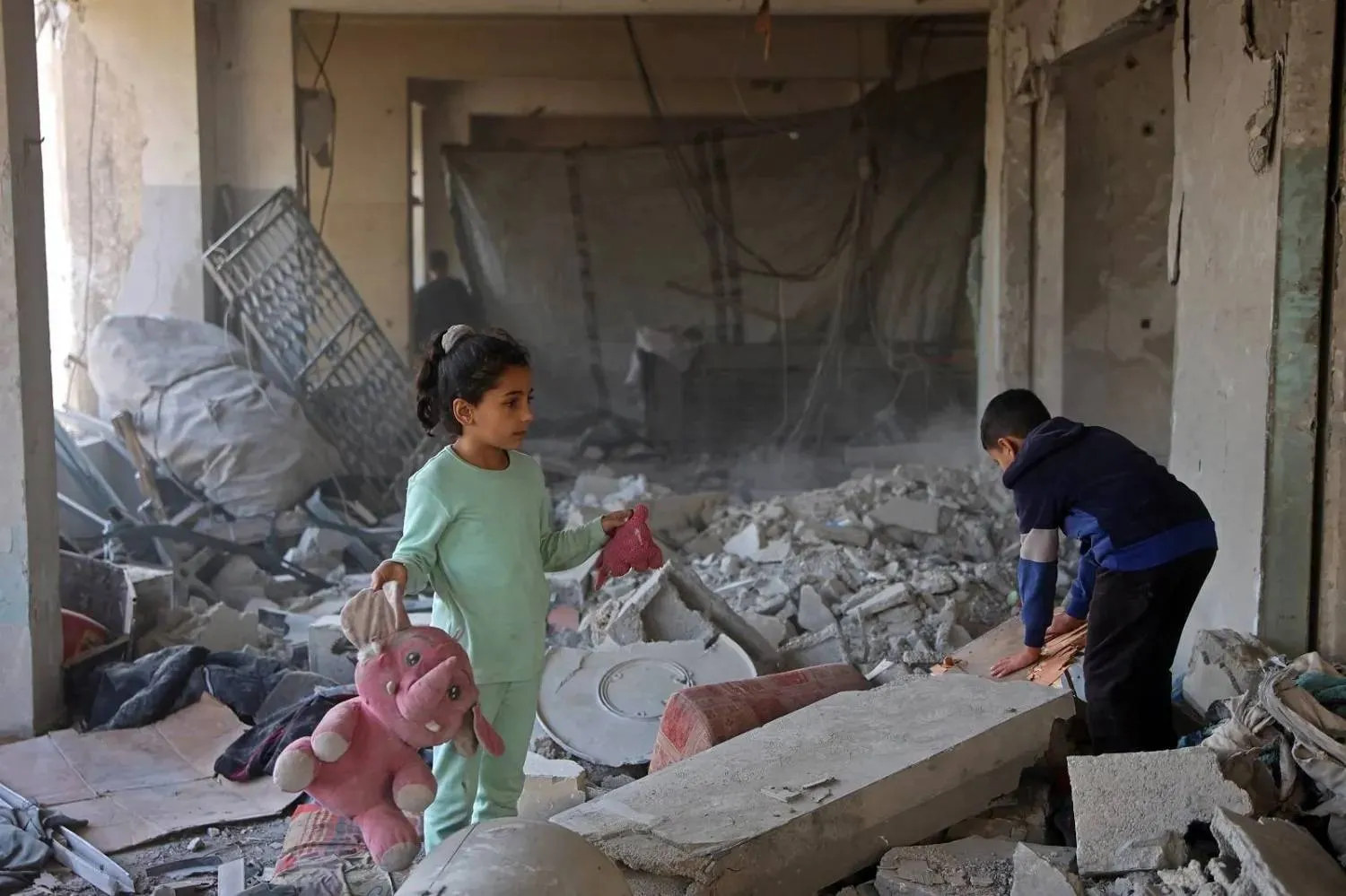
A Palestinian girl carries her toys amid the rubble of a destroyed Ministry of Awqaf building that had sheltered displaced families in Gaza City’s Zeitoun neighborhood (AFP)
TT

Escalation in Gaza: Will it Spur Mediators to Hasten Gaza Administration Committee?

A Palestinian girl carries her toys amid the rubble of a destroyed Ministry of Awqaf building that had sheltered displaced families in Gaza City’s Zeitoun neighborhood (AFP)

Israel has returned to its policy of escalation as mediators work to resolve the issue of the three remaining bodies in the first stage of the Gaza ceasefire swap deal, and as preparations begin for the second stage after the United Nations Security Council approved the deployment of international forces in the enclave.

The escalation, which has taken the form of assassinations and Israeli strikes tightening the noose around Hamas, comes as the formation of the Gaza Administration Committee remains stalled amid Palestinian Palestinian disputes.

Experts told Asharq Al-Awsat they expect mediators to move quickly to push for its formation to prevent Israel from escalating or using future pretexts to delay the transition to the second stage.

An Egyptian source told Asharq Al-Awsat that as of Friday there was no agreement on forming the Gaza Administration Committee despite its importance after the Security Council decision.

The source cited disagreements over whether to form an expanded committee of fifteen members or a proposed seven member committee, in addition to an overseeing minister from the government of Mohammad Mustafa.

A second Palestinian source confirmed on Friday that mediators are working to establish the long delayed technocratic committee, which requires full Palestinian consensus.

He said mediators may move to form the committee even without agreement so that it is in place alongside US President Donald Trump’s efforts to set up a Board of Peace to supervise it and prepare stabilization forces. Both steps require a functioning administrative body on the ground and could help prevent Israeli escalation.

The latest escalation followed an Israeli army statement on Thursday saying it had struck Hamas targets in Gaza and had killed Abdullah Abu Shamala, head of Hamas’s naval system in the enclave, and Fadi Abu Mustafa, tunnel commander in a Khan Younis battalion who took part in holding hostages.

Gaza’s Civil Defense said five people, including a one year old girl, were killed in Israeli airstrikes on the southern Gaza Strip at dawn on Thursday.

The fatalities raised the death toll from Israeli strikes to thirty two since Wednesday, as Israel and Hamas traded accusations of violating the ceasefire agreement.

Hamas’s media office in Gaza said on Thursday that the Israeli army had crossed the “yellow line,” established following the ceasefire agreement, by pushing into eastern Gaza City and shifting the positions of the yellow markers, extending the zone under Israeli control by about 300 meters along the streets of Al-Shaaf, Al-Nazaz and Baghdad. It described the move as a new violation and an assault on the agreement.

Israel’s renewed military violations come two years into the war and only days after the Security Council adopted, on November 18, a US sponsored resolution authorizing the creation of a “temporary international stabilization force in the Gaza Strip.”

The escalation prompted Qatar’s Foreign Ministry to issue a statement on Thursday condemning what it described as the Israeli occupation’s brutal attacks in the Gaza Strip that are killing civilians and wounded, warning that the serious escalation undermines the ceasefire agreement.

Egypt’s Foreign Ministry said in a statement that Cairo stressed the importance of effective implementation of Security Council Resolution 2803 in a way that consolidates the ceasefire, supports reconstruction efforts and opens a political horizon for a just and comprehensive resolution of the Palestinian issue.

Tarek Fahmy, a political science professor specializing in Palestinian and Israeli affairs, said Israel’s expansion of the yellow line and incursions into Hamas areas, along with its resumption of assassinations, signal a deliberate move to widen confrontation. He added that Hamas may respond only with symbolic operations at most or turn to mediators to press Washington for de-escalation.

Fahmy said he sees no near term possibility of moving beyond the first stage, noting that international forces may take two months to form and that there is still no breakthrough in Palestinian Palestinian talks on forming the Gaza Administration Committee.

Palestinian analyst Dr. Ayman al-Raqab said that with Israeli escalation continuing, mediators may intensify coordination with Washington to speed up the formation of the Gaza administration body and close the gap in Palestinian Palestinian differences.

Amid intensifying strikes and diplomatic efforts, progress in the first phase of the Gaza agreement remains blocked by the issue of three remaining Israeli bodies still under discussion among the factions.

Israel’s Yedioth Ahronoth quoted a senior Israeli official on Friday as saying there was “real effort and real difficulty in recovering the bodies.” Israel insists it must receive the bodies before moving to the next stage.

Despite this, Israeli Prime Minister Benjamin Netanyahu has appointed a six member ministerial team to manage the second phase of the Gaza ceasefire agreement, according to Israel’s Kan broadcaster on Friday.

The ministers are Defense Minister Israel Katz, Foreign Minister Gideon Sa’ar, Finance Minister Bezalel Smotrich, National Security Minister Itamar Ben Gvir and Justice Minister Yariv Levin.

Fahmy believes Netanyahu is determined to delay the transition to the second phase and is maneuvering by expanding military operations. “All scenarios remain open, including extending the first stage until the end of the year,” he said.

“That scenario benefits Israel in executing its plans, and benefits Hamas by remaining in power and keeping its military, service and security presence intact.”

Al-Raqab said Netanyahu’s moves aim to calm tensions with his coalition partners while obstructing progress to the second phase. “But the ball remains in Washington’s court,” he said, “as the United States is the only actor capable of exerting pressure on all parties to stop the escalation, push the second phase forward and accelerate the formation of the Gaza Administration Committee.”

What to Know About Iran’s Bushehr Nuclear Power Plant After Report of Projectile Hitting Its Complex

 A view of the containment dome of Bushehr Nuclear Power Plant in Bushehr, Iran. (AFP)
A view of the containment dome of Bushehr Nuclear Power Plant in Bushehr, Iran. (AFP)
TT

What to Know About Iran’s Bushehr Nuclear Power Plant After Report of Projectile Hitting Its Complex

 A view of the containment dome of Bushehr Nuclear Power Plant in Bushehr, Iran. (AFP)
A view of the containment dome of Bushehr Nuclear Power Plant in Bushehr, Iran. (AFP)

Iran and Russia both allege a projectile struck the grounds of the Bushehr nuclear power plant in the country, raising the specter of a radiological incident as Tehran's war with Israel and the United States rages.

Neither Iran nor Russia say there was any release of nuclear material in the incident on Tuesday evening, but it again underlines a longtime worry of Iran's neighbors — that the power plant on the shores of the Gulf could be hit by either an attack or an earthquake.

Here's what to know about the incident, the plant itself and Iran's wider nuclear program, which remains a reason US President Donald Trump points to for starting the war alongside Israel against Iran on Feb. 28.

Reports of a projectile striking there

Russia’s state-run Tass news agency quoted Rosatom CEO Alexey Likhachev late Tuesday as claiming “a strike hit the area adjacent to the metrology service building located at the Bushehr Nuclear Power Plant site, in close proximity to the operating power unit.” Russian technicians from Rosatom operate the plant, using Russian-made, low-enriched uranium.

“There were no casualties among Rosatom State Corporation personnel,” Likhachev said. “The radiation situation at the site is normal.”

About 480 Russian nationals remain at the plant, Likhachev said, and authorities are preparing for another round of evacuations from there.

The Atomic Energy Organization of Iran later issued a statement saying “no financial, technical, or human damage occurred and no part of the plant was harmed.”

The International Atomic Energy Agency, which has had its inspections of Iran restricted over years of tensions over Tehran's program after Trump unilaterally withdrew America from the 2015 nuclear deal with world powers, issued a carefully worded statement early Wednesday.

“The IAEA has been informed by Iran that a projectile hit the premises of the Bushehr NPP on Tuesday evening,” the United Nations agency said, using an acronym for nuclear power plant. “No damage to the plant or injuries to staff reported.”

No other independent expert has seen the damage. Neither Iran nor Russia published images of the damage. Moscow has made claims about nuclear sites during its war on Ukraine that turned out not to be true, while Iran has been trying to use both force and coercive diplomacy to pressure its neighbors to in turn push the US to halt the war.

It remains unclear what the “projectile” that hit the complex was. The US military’s Central Command, which is in charge of forces launching airstrikes across southern Iran, did not immediately respond to a request for comment.

Shrapnel from missile interceptions and other air defense fire also have caused damage in the region since the war started. Bushehr, some 750 kilometers (465 miles) south of Iran’s capital, Tehran, is home to an Iranian navy base and a dual-use, civilian-military airport with air defense systems protecting the area.

Bushehr a long sought project by Iran Iran’s Shah

Mohammad Reza Pahlavi announced plans in the 1970s to build 23 nuclear reactors while also having full control of the nuclear fuel cycle — opening the door to being able to build atomic weapons. That rattled US officials, who imposed limits on American companies from selling to Iran. German firm Kraftwerk Union began construction of the Bushehr plant in 1975 as part of $4.8 billion deal for four reactors.

But the 1979 revolution halted the project. Iraq repeatedly bombed the site during its eight-year war with Iran in the 1980s, seeking to stop Tehran's program.

Russia ultimately signed onto the project, which saw the power plant connected to the Iranian grid in 2011, running a pressurized-water reactor that generates up to 1,000 megawatts of electricity, which can power hundreds of thousands of homes and other businesses and industries. But it contributes only 1% to 2% of Iran's power.

Iran has been trying to expand Bushehr to multiple reactors. In 2019, it began a project that ultimately plans to add two additional reactors to the site, each adding another 1,000 megawatts apiece. A satellite image from December from Planet Labs PBC showed the construction still ongoing at the site, with cranes over both sites.

The reactor currently running at Bushehr uses uranium from Russia enriched to 4.5%, a low level needed for power generation in such plants.

Bushehr was untouched in 12-day war in June

Bushehr, as a running, civilian nuclear power plant, was left untouched during the 12-day war in June between Israel and Iran. During that war, the US bombed three Iranian nuclear enrichment sites, destroying centrifuges and likely trapping Tehran's stockpile of highly enriched, 60% uranium underground. In the time since, Iran has blocked IAEA inspectors from visit those sites.

A possible strike on a nuclear power plant could see a leak of radiation into the environment. That's been a major concern in the years after Russia launched its full-scale invasion of Ukraine in 2022. Nuclear plants in Ukraine, built when the country was part of the Soviet Union, have come under attack and found themselves on the front lines of that war.


Askari, Iran Revolutionary Guards’ Shadow Envoy in Baghdad

Iraqi security personnel stand beside the coffin of a Popular Mobilization Forces member killed in an attack in al-Qaim district (AFP)
TT

Askari, Iran Revolutionary Guards’ Shadow Envoy in Baghdad

Iraqi security personnel stand beside the coffin of a Popular Mobilization Forces member killed in an attack in al-Qaim district (AFP)

Abu Ali al-Askari, whose death was recently announced by Iraq’s Kataib Hezbollah, may not have been a single man, but a full diplomatic apparatus representing Iran’s Revolutionary Guards in Baghdad.

Most likely, Askari, a covert account on X, functioned as a banner for a group rotating the role of a “shadow ambassador,” enforcing the policies of Iran’s Revolution in Baghdad, including setting a strict tempo for political decision-making.

Kataib Hezbollah, one of the Iran-aligned armed groups, said on March 16 that Askari had been killed, without giving details of time or place.

The announcement is believed to have followed a rocket strike on a house in Baghdad’s Karrada district, where influential figures from armed factions were holding an “operational” meeting. Security sources, however, said he may have been targeted in one of two attacks, one on a vehicle and another on a separate house east of the capital.

In a statement signed by Ahmad al-Hamidawi, who is the group’s leader, Askari was described as “the artery linking battlefields with media platforms.”

For about five years, this pseudonym issued a stream of hardline positions that helped entrench rigid policies in Iraq, often reflecting Iran’s unofficial stances, not those of its ambassador in Baghdad.

The account was repeatedly deleted or suspended and re-created, with its statements often circulating through media outlets or screenshots rather than directly from the source.

A lingering mystery

Askari remained an enduring enigma, the subject of constant speculation about his identity.

Iraqi researcher Hisham al-Hashimi, who was shot dead by a Kataib Hezbollah member in the summer of 2020, had said Askari was MP Hussein Moanes of the Huqooq Movement, the group’s political wing.

Many denied any link. Over time, a different narrative took hold, portraying Askari as a shadowy operative handling highly sensitive roles, while identifying himself online as “the security official of Kataib Hezbollah in Iraq.”

After the announcement of his death, conflicting accounts emerged. Initial reports said he was among those killed in the Karrada strike, naming him as Abu Ali al-Amiri, a special adviser and aide to the group’s leader.

Later, platforms close to armed factions said he was one of Abu Hussein al-Hamidawi's brothers. Other assessments suggested the group fabricated his death to cover up the killing of several faction leaders in precise strikes across Baghdad since the outbreak of the war with Iran.

In the end, Abu Ali al-Askari appears to be a collective identity. The multiplicity of personas fits a media strategy that mirrors the Revolutionary Guard’s use of ambiguity to project intimidation. It also raises the possibility that the reported death masks a significant internal development, since the death of a “virtual account” can be concealed.

Sources say the figure, or figures, behind the account likely included a security official within the group, a member of its shura council, and a military adviser trained by the Revolutionary Guard to shape both field and political strategies.

In all cases, Askari stands as one of the Guard’s most significant political investments in Baghdad.

An Iranian yardstick

Abu Ali al-Askari may not even be a pseudonym, but a functional title for one of Iran’s most sensitive roles in Iraq. By weight of influence, it acted as a tool steering political outcomes toward Tehran’s approach.

Days before his reported death, Askari wrote that “the appointment of the next prime minister will not take place without the fingerprint of the Islamic resistance.”

At a time when the Coordination Framework was deadlocked over the rejected nomination of Nouri al-Maliki, his position set the tone for Shiite political behavior and signaled a threshold aligned with Iran’s vision, including the selection of a premier approved by Tehran first.

He kept alive his drumbeat of criticism to the government of Mustafa al-Kadhimi, then softened rhetoric toward the government of Mohammed Shia al-Sudani, which emerged after violent clashes between supporters of Muqtada al-Sadr and security forces in the Green Zone. He had endorsed the current government early.

Over the years, Askari commented on nearly every domestic decision, including opposing plans to extend an Iraqi oil pipeline to Jordan.

With similar force, he helped derail the “majority government” project that Muqtada al-Sadr sought after the 2021 elections, calling it “exclusionary toward the factions’ weapons and aligned with the American vision.”

In 2019, when protesters demanding an end to Iranian influence were killed in operations attributed to a “third party,” Askari described them as infiltrators pursuing suspicious foreign agendas, rhetoric widely seen as incitement against hundreds of young demonstrators.

In that sense, identifying his true identity may matter less than understanding the scale of influence Kataib Hezbollah has built.

Askari’s role extended to setting rules of engagement, defining the political weight of Sunni and Kurdish actors, and signaling red lines in Iraq’s external relations, including ties with Arab, Gulf, and international actors. At one stage, he warned against “reintegrating Syria and rehabilitating its new leadership within the international community.”

Iran’s shadow ambassador

After the 2017 independence referendum in Iraq’s Kurdistan Region, Askari took a hardline stance against Kurdish leader Masoud Barzani, effectively giving an informal green light for punitive measures, calling the move a “division project backed by the United States and Israel.”

For Askari, the rise of Mohammed al-Halbousi to the speakership in 2018 reflected non-national balances in an externally backed deal. In his view, the Sunni leader of the Taqaddum party paid the price for what he described as an “intersection with a suspicious external project.”

In January 2020, after the killing of Qassem Soleimani and Abu Mahdi al-Muhandis, Askari wrote that “US forces in Iraq have become legitimate targets.”

Five years on, these positions read as if issued by a “shadow embassy” for Iran, articulating hardline stances that are acted upon literally, without being voiced by official diplomats.


Iran’s Larijani, the Man Whose Power Grew During Mideast War

06 February 2009, Bavaria, Munich: Ali Larijani, then chairman of the Iranian parliament, speaks at the 45th Munich Security Conference in Munich. (dpa)
TT

Iran’s Larijani, the Man Whose Power Grew During Mideast War

06 February 2009, Bavaria, Munich: Ali Larijani, then chairman of the Iranian parliament, speaks at the 45th Munich Security Conference in Munich. (dpa)

When Israeli and US strikes killed Ali Khamenei at the start of the Middle East war, Iran's security chief Ali Larijani became even more powerful than he had been for decades.

Israel's Defense Minister Israel Katz said on Tuesday that Larijani had been killed, though Iran's authorities have not confirmed his death.

Larijani had since the start of the war played a far more visible role than the new supreme leader, Mojtaba Khamenei, who has not been seen in public since he was appointed to replace his slain father.

The security chief, on the other hand, was seen walking with crowds at a pro-government rally last week in Tehran, in a sign of defiance against Israel and the US.

His killing, if confirmed, would be a major blow against Iran, undermining a key figure seen as capable of navigating both ideology and diplomacy.

- Pragmatist -

Adept at balancing ideological loyalty with pragmatic statecraft, Larijani was central prior to the war to Iran's nuclear policy and strategic diplomacy.

Bespectacled and known for his measured tone, the 68-year-old was believed to enjoy the confidence of the late Khamenei, after a long career in the military, media and legislature.

In 2025, after Iran's last war with Israel and the US, he was appointed head of Iran's top security body, the Supreme National Security Council -- a position he had held nearly two decades earlier -- coordinating defense strategies and overseeing nuclear policy.

He later became increasingly visible in the diplomatic arena, travelling to Gulf states such as Oman and Qatar as Tehran cautiously engaged in nuclear negotiations that were ultimately scuppered by the war.

- 'Canny operator' -

"Larijani is a true insider, a canny operator, familiar with how the system operates," Ali Vaez, the International Crisis Group's project director for Iran, said before the Middle East war began.

Born in Najaf, Iraq in 1957 to a prominent Shiite cleric who was close to the Islamic Republic's founder Khomeini, Larijani's family has been influential within Iran's political system for decades.

Some of his relatives have been the targets of corruption allegations over the years, which they denied.

He earned a PhD in Western Philosophy from the University of Tehran.

A veteran of the Iranian Revolutionary Guard Corps during the Iran-Iraq war, Larijani later headed state broadcasting IRIB for a decade from 1994 before serving as parliamentary speaker from 2008 to 2020.

In 1996, he was appointed as Khamenei's representative to the Supreme National Security Council (SNSC). He later became secretary of the SNSC and chief nuclear negotiator, leading talks with Britain, France, Germany and Russia between 2005 and 2007.

He ran in the 2005 presidential elections, losing to populist candidate Mahmoud Ahmadinejad, with whom he later had disagreements over nuclear diplomacy.

Larijani was then disqualified from running for president in both 2021 and 2024.

Observers viewed his return as the head of the SNSC as signaling a turn reflecting his reputation as a conservative capable of combining ideological commitment with pragmatism.

Larijani supported the landmark 2015 nuclear deal with world powers which unraveled three years later after US President Donald Trump withdrew from the agreement.

In March 2025, Larijani warned that sustained external pressure could alter Iran's nuclear posture.

"We are not moving towards (nuclear) weapons, but if you do something wrong in the Iranian nuclear issue, you will force Iran to move towards that because it has to defend itself," he told state television.

Larijani repeatedly insisted negotiations with Washington should remain confined to the nuclear file and defended uranium enrichment as Iran's sovereign right.

- Violent repression -

Larijani was among officials sanctioned by the US in January over what Washington described as "violently repressing the Iranian people", following nationwide protests which erupted weeks earlier due to the rising cost of living.

According to rights groups, thousands of people were killed in the government's brutal crackdown of the protests.

Larijani acknowledged that economic pressures had "led to the protests", but blamed the violence which ensued on foreign involvement by the United States and Israel.