Trump Wants More Economic Pressure on Iran. What Are his Options?

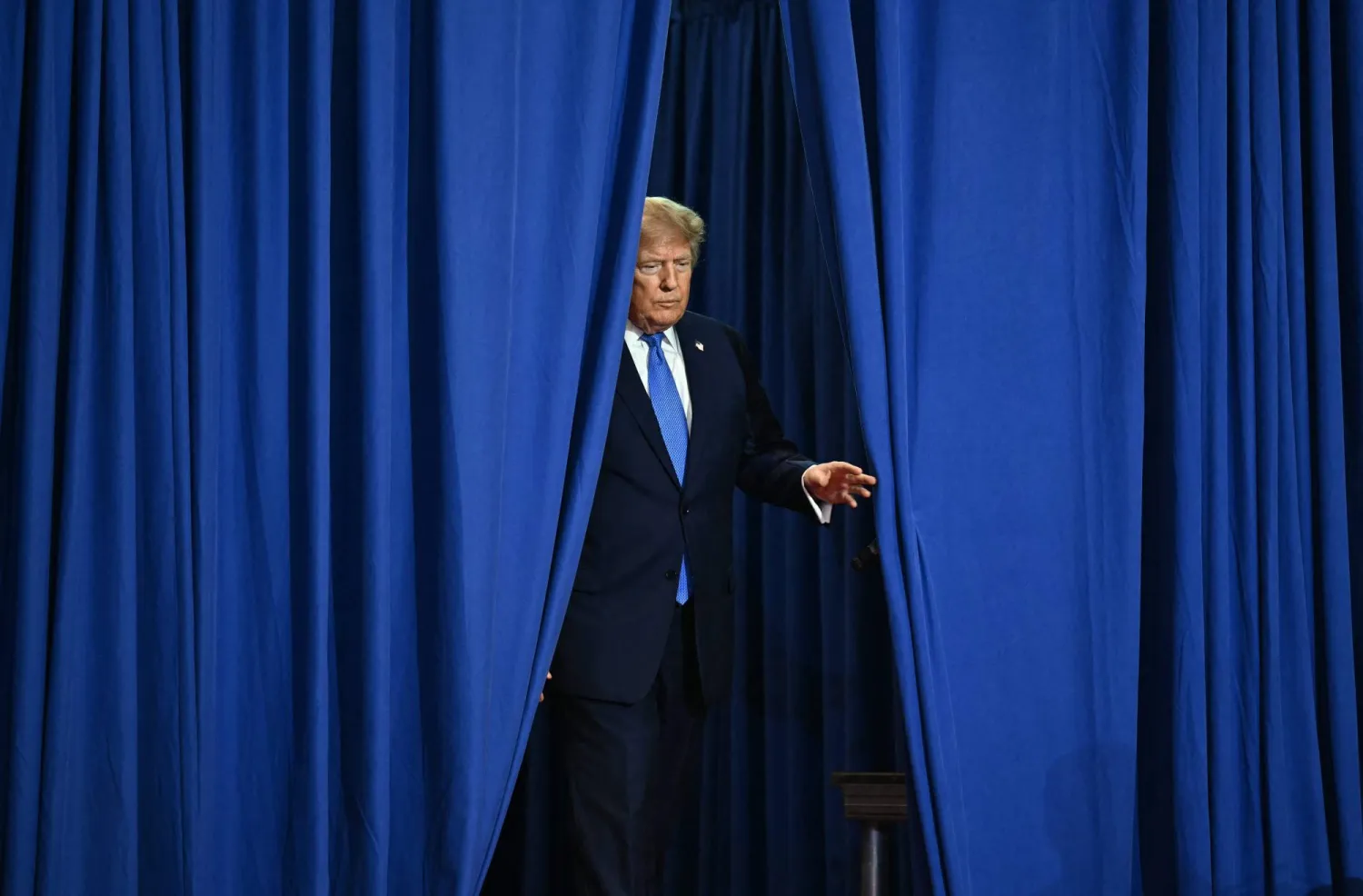
US President Donald Trump arrives to deliver remarks at the Nassau County Police Academy Center for Training and Intelligence in Garden City, New York, on August 14, 2026. (Photo by Kent NISHIMURA / AFP)
TT

Trump Wants More Economic Pressure on Iran. What Are his Options?

US President Donald Trump arrives to deliver remarks at the Nassau County Police Academy Center for Training and Intelligence in Garden City, New York, on August 14, 2026. (Photo by Kent NISHIMURA / AFP)

US President Donald Trump on Friday vowed to hit Iran hard economically, a day after Treasury Secretary Scott Bessent said that Washington would impose measures on Tehran that have "never been seen" as soon as next week.

The United States, United Nations and European Union have applied sanctions, implemented trade embargoes and frozen assets since the late 1970s over Iran's nuclear program, human rights violations and support for militant groups.

Since the Iran war began in February, Washington has levied additional maritime, energy and financial sanctions and started a naval blockade.

Data from the US Treasury Department's Office of Foreign Assets Control (OFAC) shows the agency has imposed sanctions on more than 1,000 people, vessels and aircraft since Trump began his second term.

Recent measures have targeted Iran's shadow oil fleet; shipping insurers; entities and people enabling Iran's acquisition of weapons; and digital exchanges, freezing an estimated $500 billion in Iran-linked cryptocurrency.

According to Reuters, experts say the Trump administration also can try these options:

SANCTIONS ON CHINESE 'TEAPOT' REFINERS

Chinese independent refineries known as "teapots" account for a quarter of Chinese refinery capacity. They operate with narrow and sometimes negative profit margins.

China buys more than 80% of Iran's shipped oil, according to 2025 data from analytics firm Kpler. Independent refiners absorb much of this trade, exposing them to so-called secondary measures that penalize entities helping a primary sanctions target.

Past ⁠US sanctions have ⁠deterred larger independent refiners from buying Iranian oil. But the independent refineries are somewhat immune since they have little exposure to the US financial system, sanctions experts say.

SANCTIONS ON CHINESE BANKS

OFAC has imposed secondary sanctions on smaller China- and Hong Kong-based entities accused of processing billions of dollars in Iranian oil and helping to fund weapons procurement.

Treasury has warned two larger Chinese banks they could face secondary sanctions if Iranian funds were found moving through their systems, but has stopped short of designating them.

Hitting those two banks, which US officials have not publicly identified, or imposing other sanctions could have a chilling effect on bigger financial institutions, sanctions experts said, although they warned it could ⁠also trigger retaliatory actions by Beijing.

Trump administration officials have sought to play down tensions between Washington and Beijing ahead of an expected meeting between Trump and President Xi Jinping later this year.

They worry that China could curtail exports of critical minerals that are essential to advanced technology production at a time when the US and Western allies are still trying to develop their own supplies.

'WHACK-A-MOLE'

The United States could continue targeting Iranian individuals and entities, as well as others in China and the Gulf, that are helping Tehran evade sanctions to collect revenues for its war effort.

Treasury recently issued sanctions against firms that are springing up to facilitate Iran's trading of oil revenue for imports. But such measures amount to a "whack-a-mole" approach that has not altered Iran's behavior, said Brett Erickson, managing principal of Obsidian Risk Advisors, noting that Tehran simply creates new entities to replace them.

Miad Maleki, a sanctions expert with the Foundation for Defense of Democracies, said Bessent was likely signaling a sharpened enforcement push against oil shippers, purchasers and currency exchangers who help Iran pay for ⁠its imports.

Further aviation sanctions were ⁠also possible, aimed at degrading Iran's ability to move trade now that the US has blockaded shipping via the Strait of Hormuz, he added.

LAND BLOCKADE

Some US and Israeli officials have floated the prospect of a land blockade, which would require assistance from Iran's neighbors: Iraq, Türkiye, Pakistan, Afghanistan, Turkmenistan, Azerbaijan and Armenia.

The Trump administration has varying degrees of closeness with all those countries except Afghanistan, but that border is mountainous and extremely difficult to patrol anyway.

SECONDARY TARIFFS

Trump has repeatedly threatened tariffs on goods from countries that do business with Iran, although the Supreme Court struck down the legal basis for such taxes.

The Senate passed a sweeping Russia sanctions bill last week that included new Iran sanctions and would give Trump new tariff powers that he could potentially use against countries that aid Iran's commerce and weapons procurement. That legislation must still pass the US House of Representatives, which could prove challenging given widespread concerns among Democrats and some Republicans about the tariff measures.


Israel Faces New Era of Sinking US Support After Election

Republican presidential nominee and former US President Donald Trump appears on a congratulatory billboard for the 2024 US Presidential Election, in Tel Aviv, Israel, November 6, 2024. (Reuters)
TT

Israel Faces New Era of Sinking US Support After Election

Republican presidential nominee and former US President Donald Trump appears on a congratulatory billboard for the 2024 US Presidential Election, in Tel Aviv, Israel, November 6, 2024. (Reuters)

Prime Minister Benjamin Netanyahu's brash campaign posters are still up on Israeli public buses -- images of him, US President Donald Trump and soaring warjets that laud the two leaders attacking Iran together.

Neither is now advertising the state of the two countries' alliance.

A week after an inconclusive election for Netanyahu, Americans overwhelmingly rejected Trump and chose a Congress led by Democrats who want a tougher approach to Israel, whether on Iran, Gaza or settler violence in the occupied West Bank.

The back-to-back elections look to many observers like a turning point, with Israel no longer able to take for granted the cover of the world's most powerful country.

"This is a new era. The confluence of the Gaza war and the war with Iran have really changed how mainstream Americans -- not people particularly concerned with the Israeli-Palestinian conflict -- see Israel," said Yael Sternhell, an expert on the United States at Tel Aviv University.

Vice President JD Vance, assessing why his Republicans fared poorly, listed four ways to bring voters back, including ending the Iran war and changing "our relationship with Israel".

Trump did not disagree. Just as voting was underway Tuesday, Trump said he had agreed with Netanyahu to end the $3.8 billion in annual US military aid to Israel by the end of this year, explicitly tying the decision to the US political mood.

Netanyahu, Israel's longest-serving prime minister who has served on and off for nearly two decades, had eagerly sought Trump's endorsement but also acknowledged his country's growing isolation.

In the final days of the campaign, he suggested Israel turn to cryptocurrencies to circumvent international sanctions he expected would intensify.

Netanyahu has not commented on the US election or Trump's aid remarks.

Amit Segal, a journalist known for his proximity to Netanyahu, posted that the political situation in the United States marked a "catastrophe" for Israel.

- Can Eisenkot restore the alliance? -

Opposition contender Gadi Eisenkot, who is trying to cobble together a coalition to oust Netanyahu, has cast himself as capable of repairing relations.

In an English-language statement, the former military chief said he believed in "liberal values" and also wanted to work "closely and constructively" with Trump.

Yair Golan, the main left-wing leader inside Eisenkot's bloc, called for Israel to restore a bipartisan approach destroyed by Netanyahu who he said promoted a "destructive Israeli narrative of eternal war and authoritarian rule".

Netanyahu boasted in his campaign about standing up to Democratic presidents including Barack Obama, who remains a hero for many Democrats. Netanyahu openly aligned with Republicans a decade ago to attack Obama's diplomacy on Iran.

"Netanyahu certainly rubs Democrats the wrong way and has made every effort to alienate them," Sternhell said.

"But Eisenkot can't just be a nicer man to receive a softer approach from this new Congress," she added. "He's going to need new policies."

She said Eisenkot would likely enjoy Israeli public support for cracking down on extremist settlers, who have attacked Palestinians in the West Bank with virtual impunity.

But Israel has shifted to the right, with wide initial support for the Gaza war.

- Broadening criticism of Israel -

The new Congress will include progressive Democrats such as Abdul El-Sayed, the first Muslim elected to the Senate, who describe the devastation in Gaza as genocide, an assertion rejected by Israel.

Netanyahu "made a bet not only on the Republicans but almost personally on Trump", said Eli Kowaz, senior policy director of the Economic Cooperation Foundation, an Israeli think tank that backs a two-state solution with the Palestinians.

"These results show that bet had an expiry date," Kowaz said. "Also, for the first time, really, I think there's a realization that it isn't only about the Democrats. It's a problem with the relationship with America."

Without US assistance, Israel still has its own major arms industry and retains a clear edge fighting non-state actors such as Hamas and Hezbollah, said Ehud Eilam, a former researcher for the Israeli defense ministry.

But he said Israel would need to rely more on cheaper artillery or non-sophisticated bombs, further increasing risks of civilian casualties that have enraged international opinion.

"Israel can adjust to a new strategic reality of losing much and even all US military aid, but it will be tough for Israel. It will require Israel to consider hard choices such as taking huge loans or raising taxes," Eilam said.

Kowaz said that Eisenkot, aware of politics in Washington, was trying to show he is interested in regional stability and strategic agreements and not just "an indefinite state of war".

"He is definitely laying out a different vision for Israel's relationship with the United States."


Trump Could Woo North Korea After Midterm Setback, but Kim May Not Respond

US President Donald Trump meets with North Korean leader Kim Jong Un at the demilitarized zone separating the two Koreas, in Panmunjom, South Korea, June 30, 2019. (Reuters)
TT

Trump Could Woo North Korea After Midterm Setback, but Kim May Not Respond

US President Donald Trump meets with North Korean leader Kim Jong Un at the demilitarized zone separating the two Koreas, in Panmunjom, South Korea, June 30, 2019. (Reuters)

The rebuke President Donald Trump suffered in the US midterm elections could prompt him to step up efforts to re-engage North Korea, but any willingness to make major concessions risks creating friction with regional allies.

Analysts and officials in Asia expect Trump to focus on foreign policy as he seeks to build his legacy in the final two years of his term. With efforts to resolve the wars in Ukraine and Iran yet to produce breakthroughs, he is likely to turn to Asia, where he believes he has room to maneuver.

North Korean leader Kim Jong Un, with whom Trump has been eager to restart talks, is likely to be a key part of that effort, they say.

"Trump is likely to devote significant effort to achieving foreign policy successes, especially if he faces greater constraints on the domestic front," said Ban Kil-joo, international relations professor at the Korea National Diplomatic Academy in Seoul.

"Given Trump would want a successor to win in 2028, there is a strong possibility that engagement with North Korea would be part of that agenda," he ‌said.

But there is ‌little incentive at the moment for Kim to respond, analysts say.

Asked about Trump's plans for diplomacy with North ‌Korea, the White ⁠House said Trump ⁠has restored American strength on the global stage and strengthened ties with world leaders.

"His foreign policy decisions have never been motivated by politics," White House spokeswoman Anna Kelly said in emailed comments to Reuters.

"The Commander-in-Chief will always act in the best interest of the American people and our national security."

Trump met Kim three times during his first term after a war of words that raised fears of military conflict.

But their 2019 summit ended without agreement after they failed to reach a deal on North Korea's nuclear weapons program and sanctions relief.

Seven years later, the stakes are higher. North Korea has expanded its nuclear and missile arsenal, while Pyongyang's ties with Russia and China are the best in years, giving Kim less incentive to negotiate and potentially increasing pressure on Trump to offer concessions.

TRUMP CALLS KIM 'GREAT GUY'

Trump has touted his relationship with Kim, ⁠calling him a "great guy" and saying that they "get along very well."

Nonetheless, US and South Korean officials see ‌fading chances of a meeting this year, with Washington receiving no response from Pyongyang ahead of a regional ‌summit in China this month where they might have met.

Kim's influential sister, Kim Yo Jong, has said dialogue remains a path to peace, but Pyongyang sees no need ‌for talks now. She denounced what she called Washington's "hostile policy" while denying US accusations that North Korea stole more than $6 billion in virtual assets from Binance ‌last week.

Her brother has previously said he was open to talks if Washington stopped insisting his country give up nuclear weapons. Regional allies South Korea and Japan are opposed to any such concession.

"A summit that shelves denuclearization would undermine deterrence and create policy friction among Washington, Seoul and Tokyo," said Leif-Eric Easley, professor of international studies at Ewha Womans University in Seoul.

Officials in Japan and South Korea are concerned they could be "cut out of the loop" if Trump deals directly with Kim, with the quiet blessing of Beijing and Moscow, a ‌senior Japanese official said, speaking on the condition of anonymity.

"(Japanese officials) are concerned about the lengths he will go to get a summit with North Korea’s Kim Jong Un, such as dropping the issue of denuclearization."

'BIGGEST CHANGE ⁠SINCE WORLD WAR TWO'

Trump has referred ⁠to North Korea as a nuclear power, a status that allies in the region and the West have refused to recognize despite the dozens of nuclear warheads Pyongyang is believed to have built and its stockpile of fissile material.

"If US-North Korea talks lead Washington to accept North Korea's nuclear status, the security environment in Asia would change dramatically," said Professor Kazuhiro Maeshima at Sophia University in Japan.

"The biggest change since World War Two could occur in the remaining two years of the Trump administration. It is a serious situation."

Kim now has a vastly more advanced arsenal than at the time of the 2018-2019 summits, including more weapons and missiles, hypersonic glide vehicles, a growing fleet of modern warships and submarines, and improved drone capabilities.

If Trump were to bring Kim back to the table, he might need to offer more than partial sanctions relief.

Such concessions could face hurdles at home from a Democratic-controlled Congress and Trump's limited time in office, said Moon Chung-in, a Yonsei University Professor in Seoul who served as a presidential adviser on national security.

"And what is important is North Korea's perception and calculation; if North Korea thinks that Trump has entered a lame-duck period and he cannot get the support from Congress... there's no reason for Kim Jong Un to come to dialogue," he said.

Former US Deputy Secretary of State Stephen Biegun, who led US negotiations with North Korea during Trump's first term, also said there were few incentives for Pyongyang currently.

"The North Koreans, I think, have very little upside to a meeting like this right now, and potentially some downside."


Is the MAGA Era Over?

President Donald Trump gestures while boarding Air Force One at Morristown Airport, Monday, Sept. 7, 2026, in Morristown, N.J. (AP Photo/Julia Demaree Nikhinson)
TT

Is the MAGA Era Over?

President Donald Trump gestures while boarding Air Force One at Morristown Airport, Monday, Sept. 7, 2026, in Morristown, N.J. (AP Photo/Julia Demaree Nikhinson)

Has MAGA fever finally begun to fade? Will the American right abandon the Make America Great Again slogan and Donald Trump's populist ideology in favor of a more traditional brand of conservatism?

Following a crushing defeat in midterm elections that revolved almost entirely around one man, many Republicans have begun questioning the party's future and what role, if any, Trump should play in shaping it.

The Wall Street Journal, whose editorial pages have long represented the establishment right, called for "soul-searching" and urged Republicans to move away from the ultranationalist, identity-driven rhetoric that helped return the 80-year-old Trump to power.

In an editorial titled "The Trump Reckoning Arrives," the newspaper argued that tariffs and mass deportations were no substitute for higher real incomes.

It added: "Playing to the bro MAGA base is no substitute for persuading Hispanics, independents and suburban swing voters who abandoned the party on Tuesday."

"Still Your President"

The White House, however, appeared far less inclined toward introspection.

Its first post on X on Wednesday featured a stern-looking Trump accompanied by the words "Trump is still your president," a reminder that he will remain in office until January 2029.

But the American political calendar never stands still. Wednesday also effectively marked the beginning of the 2028 presidential campaign, which will culminate in the election of Trump's successor.

The US Constitution bars Trump from seeking a third term.

There was no realistic scenario in which Trump could have emerged from the midterm elections in a stronger political position.

The scale of the Republican defeat on Tuesday night, which exceeded even some of the Democrats' most optimistic expectations, has accelerated the erosion of his political influence.

Eyes on 2028

Vice President JD Vance, widely regarded as a potential contender for the White House in 2028, was careful not to confront his boss directly.

In a lengthy, essay-like post on X on Wednesday, Vance wrote: "The reason we lost is the war."

He immediately added: "The president himself said so last night."

That was not entirely accurate. Trump had attributed the defeat partly to the war in the Middle East, while also arguing that Republicans had fielded weak candidates.

Florida Governor Ron DeSantis described the outcome as an "extinction-level event" for the Republican Party, suggesting Republicans might have to wait until 2032 to regain control of Congress.

Republican lawmaker Don Bacon wrote on X that the party "needs to reclaim our Reagan principles."

He added: "Voters rejected populism, chaos, Putin and tariffs."

Former congresswoman Marjorie Taylor Greene, a far-right figure who has turned against Trump, went further.

"If the GOP wants any chance in the future, it will have to kick Donald Trump out of the party," she said.

Matthew Boyle, a prominent figure at the far-right news outlet Breitbart, wrote on X that "Republicans need to get back to basics."

"No more endless wars," he said.

On the economy, which he identified as the top issue, Boyle called for policies that benefit ordinary Americans rather than special interests.

He also urged Republicans to "be sane with immigration enforcement."

Criticism Without Naming Trump

For now, however, criticism remains relatively muted. Only a handful of conservative figures, whether moderates or hardliners, have been willing to attack Trump by name.

After all, the Republican Party has tied its political fortunes almost entirely to Trump since 2016.

"The big question is, are some of these Republican leaders in the House and Senate going to distance themselves from Trump?" Amy Dacey, a former Democratic official who is now an expert at American University, told AFP.

The same question applies to far-right influencers whose prominence and financial success have been closely linked to Trump's popularity.

Dacey said a devastating electoral defeat could diminish their influence, but it would by no means eliminate those associated with the MAGA movement.

Some of MAGA's online supporters have already attempted to shift the blame elsewhere.

"Great work, neocons," Jack Posobiec wrote sarcastically on X, referring to the neoconservative wing of the Republican Party, known for its interventionist foreign policy and hawkish stance toward Iran.

Nevertheless, it may only be a matter of time before the divisions become more pronounced.

Former congressman Bob Good wrote on the same platform: "Gotta start by acknowledging that Trump was and is the problem. Quietly whispering it won't do it."