
Sudan’s Al-Manaqil Survives War, Holds Out Under Siege

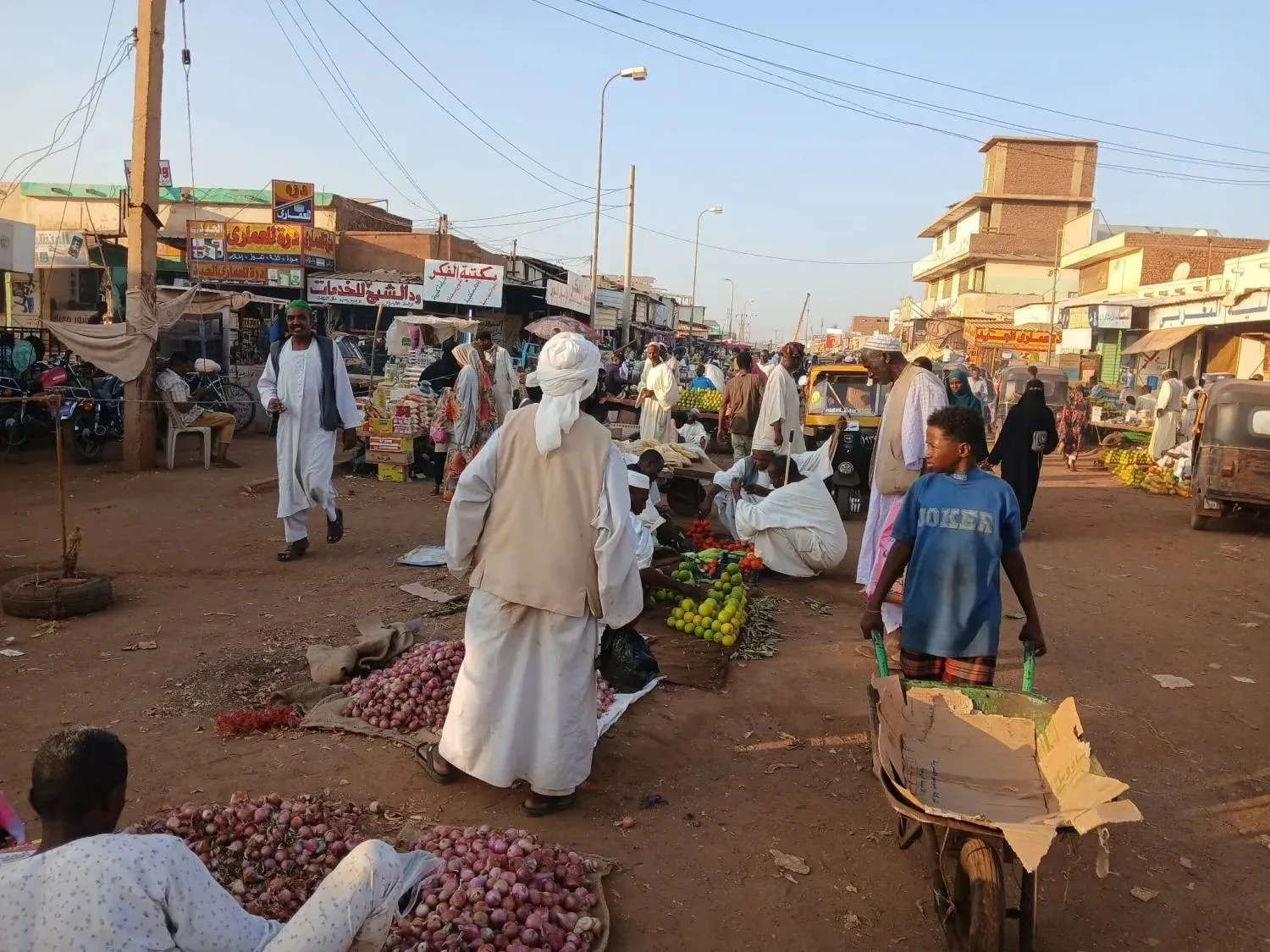
Shoppers crowd a market in al-Manaqil, Sudan (Asharq Al-Awsat)
TT

Sudan’s Al-Manaqil Survives War, Holds Out Under Siege

Shoppers crowd a market in al-Manaqil, Sudan (Asharq Al-Awsat)

Residents of al-Manaqil in central Sudan say their city came close to falling after the Rapid Support Forces seized Wad Madani in December 2023, raising fears that one of the region’s most important agricultural hubs would be next.

The capture of Wad Madani on December 19 opened what looked like a clear path to al-Manaqil, the second largest city in Gezira State, located about 156 kilometers from Khartoum. But despite its vulnerability and limited military presence, the city remained under the control of the Sudanese army.

Al-Manaqil sits in the heart of the al-Manaqil Extension Agricultural Project, which forms the largest part of the Al-Jazeera (Gezira) Project spanning nearly 2.2 million feddans. The city is a key artery for agricultural production and a vital link in Sudan’s food supply chain.

Residents say the city had almost no capacity for defense before the war. It hosted only a small branch of military intelligence and lightly armed police forces. When the RSF entered Wad Madani, al-Manaqil saw waves of displacement and a near halt in public services as tension rose with each new advance by the RSF in Gezira State.

Schools Close and Residents Improvise to Survive

Middle school teacher Musab Abdullah, 35, said he never imagined seeing his city completely shut down. Schools closed, institutions stopped operating and many families were left without income.

“I stayed home without work although I had to provide for my small family,” he said.

He tried manual construction work for a low wage, then worked as a daily farm laborer. When that was no longer possible, he turned his home into a private school to earn a living and prevent children in his neighborhood from losing access to education.

A Security Vacuum and a Tightening Siege

Before the war, al-Manaqil had no military units except for the intelligence branch and a few police forces. As battles expanded in Gezira State, fears grew that the city had been left exposed.

Mustafa al-Khalifa, the former deputy head of the Popular Resistance and Mobilization, said the commander of the First Infantry Division in Wad Madani, Major General Ahmed al-Tayeb, authorized the transfer of the Third Brigade to al-Manaqil.

A small force of 200 to 300 men carrying light weapons arrived under Brigadier Ahmed al-Mansi and settled at the local administration compound, he said.

Electricity and water were cut, fuel ran out and food became scarce. “The dead were taken to cemeteries in animal-drawn carts,” al-Khalifa said. Hospitals closed and medicine was unavailable, forcing residents to turn to natural herbs.

Fear of a Chain Collapse

According to al-Khalifa, RSF fighters entered villages in Gezira State in combat vehicles with heavy machine guns and “killed between 50 and 60 people in each village in full view of the population.”

Residents feared that the fall of al-Qurayshi locality, which includes al-Manaqil, would be followed by the collapse of remaining areas held by the army, opening the road to al-Obeid, the capital of North Kordofan.

The operations room believed al-Manaqil was close to falling after RSF took al-Hasahisa, al-Kamlin, Rufaa, Wad Madani and areas across eastern Gezira State. But the commander of ground forces, Major General Ahmed Hanan Sabeer, directed that withdrawing units be relocated to al-Manaqil with food supplies guaranteed.

Two days after Brigadier al-Mansi’s arrival, volunteers filled warehouses with food enough for seven months. Members of the Popular Resistance began acquiring weapons and combat vehicles. When the RSF announced a date for storming the city, al-Manaqil had almost no defensive units, so local businessmen financed an arming campaign that delivered about 25 new vehicles in one day. Defensive lines were set up eight kilometers around the city.

A City on the Brink

Panic after the fall of Wad Madani prompted many residents of al-Manaqil to flee, leaving the city nearly empty for a time.

Shawqi Bella, head of the financial committee of the Popular Resistance and Mobilization, said two steam-powered combat vehicles would have been enough for the RSF to seize the city because it had almost no military forces.

“But divine protection intervened, then the efforts of the Sudanese army, the mobilized volunteers, the Operations Authority and the forces that withdrew from al-Qutaynah, Rufa’a and other towns in Gezira that al-Manaqil received,” he said.

Residents formed Popular Resistance committees before a nationwide decision to create such bodies was announced. They collected money and received an airdrop of weapons, medicines and intravenous fluids. They then began purchasing weapons and registering them with the Operations Authority and military intelligence.

Bella said the battle of Wad Hussein, a village about 30 kilometers west of Wad Madani, marked a turning point. “After fierce battles we defeated the attacking forces and captured large amounts of equipment, including nine armored combat vehicles. It was a decisive battle that broke the back of the rebel forces.”

Hospitals in al-Manaqil were out of service and the city was crowded with wounded and sick people. Bella said he moved the solar power system from his house and his college to the Ila Specialized Hospital to allow doctors to perform surgeries and treat wounded fighters.

Lawyer Working Under Trees

Lawyer Youssef Abdullah said the authorities used his office and others to run daily operations when the siege intensified. “I carried my bag with my stamp and notarization papers and sat under a building or a tree to complete daily transactions,” he said.

He became a mobile lawyer handling paperwork in printing shops powered by solar energy. With no fuel or transport, he once walked 13 kilometers to al-Kuraymit to obtain insulin for his diabetic father.

“Despite the hardship, I continued working because the situation required endurance,” he said. “I refused to flee despite repeated calls from colleagues. I had great trust in the armed forces and their ability to manage the battle.”

Solidarity and a Haven for the Displaced

Fayad Mahmoud, supervisor of the Asoud al-Manaqil group, said the city’s resilience stemmed from rare social cohesion and coordinated roles played by all segments of society.

Residents provided money, weapons, manpower and logistical support to protect the city and repel threats. Popular backing strengthened security and created a unified front where official and community efforts converged.

al-Manaqil also received large numbers of displaced people from Gezira, White Nile State and Sennar. Families opened their homes before shelters were established, turning the city into a safe haven for those fleeing fighting.

Popular efforts extended to restoring hospitals, schools, clinics and roads through direct support from volunteers and local leaders, helping daily life continue despite the war.

“High morale and values of solidarity and compassion were essential to al-Manaqil’s resilience,” Mahmoud said. “Kind words, encouragement and strong social ties helped the community overcome hardship and remain united.”

‘If Ebola Comes, We’ll Be Wiped Out’: Fear Grips Camps in DR Congo

A staff member hangs up protective equipment to dry after washing them at the Ebola Treatment Center (ETC) in Munigi on June 2, 2026. (AFP)
TT

‘If Ebola Comes, We’ll Be Wiped Out’: Fear Grips Camps in DR Congo

A staff member hangs up protective equipment to dry after washing them at the Ebola Treatment Center (ETC) in Munigi on June 2, 2026. (AFP)

Dorcas Mapenzi fears the worst if Ebola comes to the Kingonze camp, where she lives alongside more than 25,000 other displaced people in the conflict-hit eastern Democratic Republic of Congo.

"If Ebola comes, we'll be wiped out as we're packed like sardines," the displaced woman told AFP at the sprawl of tarpaulin and tents on the outskirts of Bunia, the capital of the northeastern Ituri province, the epicenter of the latest outbreak.

Spread by close contact, the deadly viral disease has spread like wildfire in the vast central African country's east, where decades of armed conflicts have forced millions of people from their homes and into camps where they live cheek-by-jowl.

Nearly a million of those displaced are in Ituri -- among the provinces of the desperately impoverished DRC most prey to the east's litany of armed groups -- where the prospect of the epidemic spreading throughout the refugee camps has sparked alarm.

The World Health Organization's director general, Tedros Adhanom Ghebreyesus has warned that the eastern DRC "faces a catastrophic collision of disease and conflict", with the fighting hampering efforts to tackle the epidemic.

Visiting Bunia on Saturday, Tedros called for more international help and financial aid to combat the spread of Ebola.

He also said it was essential to assuage fears among affected communities who are deeply distrustful of authorities and halt the spread of false information about the virus.

The current outbreak was officially declared in the DRC and neighboring Uganda on May 15.

As of May 31, the WHO said 321 cases had been confirmed in the DR Congo, including 48 deaths. Thjere are nine confirmed cases in Uganda, including one fatality.

- 'Everyone will die' -

No infection has yet been recorded at the Kingonze displaced persons' camp, where Mapenzi now lives.

But conditions in the camp are ripe for a disease passed on through close physical contact and bodily fluids.

"I've already heard of Ebola and it's a disease that scares me a lot," Mapenzi said as she washed her laundry in a basin on the ground.

"We displaced people here have no hygiene.

"Our children play next to filthy toilets and even relieve themselves on the ground, in the middle of the tarpaulins that serve as our homes," the young woman said.

Deborah Nzale, a widow and head of her family, lives with nine people in a small tarpaulin shelter of barely three square meters (32 square feet).

"Given these conditions, how are we going to protect ourselves against this disease, when everyone tells us we need to distance ourselves to fight Ebola?" she asked.

No vaccine or treatment exists for the Bundibugyo strain of Ebola responsible for the latest outbreak.

So attempts to contain the virus's spread have had to rely mainly on protective measures and rapid contact tracing.

"We sleep piled on top of each other, with everyone's sweat," Nzale said.

"If a single person gets infected here in this camp, everyone will die."

- 'Ebola really kills' -

So far, Kingonze's displaced residents have not received any protective gear.

"Ebola really kills," a poster at the entrance warns.

"People looking to raise awareness come through here with messages but, surprisingly, we don't have the kit we need to protect ourselves," Budjo Amos complained.

"I don't even have soap to wash my hands," said Amos, who fled the province's common communal violence.

"The most urgent thing is to give us clean water," he insisted.

There is just a single borehole in Kigonze. Empty jerrycans pile up in front. Water flows from the tap for just a few hours a day.

"The state has to intervene urgently," Amos pleaded.

Already long absent from swathes of Ituri, the Congolese state has been criticized for its delayed response to the outbreak, which was declared several weeks after the first cases emerged.

Many hospitals in the region still lack essential equipment, especially isolation tents for patients.

According to Ituri's military governor, the province counts around 61 displaced persons camps housing nearly 970,000 people.

"We need to deploy equipment and qualified, specialist medical staff as quickly as possible," Lieutenant General Johnny Luboya Nkashama told AFP on Friday, "to spare this province from disaster".


Beirut Southern Suburbs Residents Live Between Displacement, Return

Vehicles drive on the highway as people leave Beirut's southern suburbs after Israel ordered strikes on Dahiyeh, in Beirut, Lebanon, 01 June 2026. EPA/WAEL HAMZEH
TT

Beirut Southern Suburbs Residents Live Between Displacement, Return

Vehicles drive on the highway as people leave Beirut's southern suburbs after Israel ordered strikes on Dahiyeh, in Beirut, Lebanon, 01 June 2026. EPA/WAEL HAMZEH

The latest Israeli threat threw Beirut’s southern suburbs into turmoil within hours. Schools were evacuated, parents rushed to pull their children out of classrooms, and many residents fled their homes in haste. Roads filled with a new wave of displacement, reviving scenes the Lebanese have endured repeatedly in recent months.

But the threat did not end when the warning did. The alert was lifted, but the anxiety stayed. Some people returned to work, but not to a sense of safety. For many, the question is no longer when the strike will come, but how to live under the constant expectation of the next warning.

The home that is no longer safe

Layla Hassan told Asharq Al-Awsat that the latest threat to the southern suburbs did not end for her when the warning expired. The feeling it left behind still follows her. The problem, as she sees it, is no longer tied to a single security incident, but to a permanent state of uncertainty.

She said the natural bond between people and their homes has changed radically. “The home, which once represented the safe space people turned to in fear or danger, has now become one of the sources of anxiety.”

The warning, she said, made returning more complicated than leaving, especially for those responsible for children or other family members.

Life in displacement, despite its hardship and lack of services, can sometimes feel less cruel than the anxiety of returning, she said. Electricity, water, cramped spaces and the strain of daily life become secondary details beside one overriding concern, keeping the family safe.

She added that repeated displacement gradually pushes people to adapt to abnormal conditions, until the mere feeling of safety becomes a goal in itself, even at the cost of the life they once knew.

People leave Beirut's southern suburbs after Israel ordered strikes on Dahiyeh, in Beirut, Lebanon, 01 June 2026. EPA/WAEL HAMZEH

Every day begins with fear

Fatima Shams has not returned to the southern suburbs since Monday’s threat. She told Asharq Al-Awsat that “the Lebanese are living today in a state of constant anticipation that has made fear part of the daily routine. Every morning begins with a different question, but the meaning is the same, will this day pass safely?”

She described how the latest threat disrupted the daily lives of families. Her sister was at school when exams were halted and students were urgently evacuated. Within minutes, parents had to leave work and head to schools, caught between traffic-clogged roads and fear of a sudden security development.

“The hardest thing people are living through is not only the fear of strikes, but the constant feeling of instability,” she said. “Families are no longer able to plan their day or their week, because any new warning can overturn everything.”

She said the danger no longer feels confined to one area after warnings and tensions spread to different parts of Lebanon, making insecurity more widespread than ever.

Anticipation is wearing people down

Ali Noureddine, from the southern town of Toul and a resident of Beirut’s southern suburbs, described life for residents as “deadly anticipation.”

He told Asharq Al-Awsat that “the crisis is no longer linked to the warning itself, but to the psychological state that follows it. After every threat, people remain trapped between the possibility of returning to normal life and the possibility of a new escalation.”

He said this constant anxiety drains residents more than direct security incidents, because it turns life into an open-ended wait that no one knows when it will end.

The anxiety, he added, is not limited to the southern suburbs. It reaches the south as well, where families follow news of their towns, homes and areas with no clarity over what comes next.

People leave Beirut's southern suburbs after Israel ordered strikes on Dahiyeh, in Beirut, Lebanon, 01 June 2026. EPA/WAEL HAMZEH

We carry our memories in a bag

Layan Abdullah has not returned to the southern suburbs since the latest threat. For the university student, campus life is no longer about lectures, exams and ambitions. It is about displacement and the search for safety.

She told Asharq Al-Awsat that “her life has become a matter of packing belongings into a bag, moving to a new place, then preparing for the possibility of doing it again.”

Her generation, she said, can no longer think about future projects or career plans. The priority has narrowed to getting through the day safely.

She spoke of the harsh feeling that accompanies each displacement, reducing an entire life to a single bag. “A person does not leave behind only walls and furniture, but memories, details and relationships tied to a place.”

She also pointed to the added suffering of families with patients who need continuous medical care. Every move brings new questions about safe roads, access to hospitals and securing treatment, adding another layer of pressure to the psychological burden everyone is carrying.

Displacement from the southern suburbs and fear of losing Bint Jbeil forever

Hassan Bazzi does not describe the latest threat to Beirut’s southern suburbs as a passing security incident. For him, it was a moment that revived deeper fears about his future and the future of his hometown, Bint Jbeil.

He told Asharq Al-Awsat that “he found himself, like thousands of others, facing the prospect of another displacement from the southern suburbs, while carrying the feeling that the distance between him and his southern town, where he had spent years planning to return and settle, is growing day by day.”

“After the latest threat to the southern suburbs, the same feeling returned, that our entire lives have become suspended,” he said. “It is no longer only about where we live today or tomorrow, but about an entire future that we do not know whether we will be able to reclaim.”

He said he owns land and property in Bint Jbeil that he had seen as his life project and source of stability after more than three decades of work. But with the war continuing and the political and military scene growing more complicated, he now feels those plans slipping farther away.

“I imagined I would return to live on my land and take care of what I had built over the years. I thought the hardship of 30 years would give me a chance to rest and settle down. Today, I feel all of that has been postponed indefinitely,” he said.

He said repeated threats and continued displacement from the southern suburbs and the south have left people in a state of accumulated psychological exhaustion, making it hard to think about the future or make any long-term plans.

“I fear our children will grow up not knowing these villages as we knew them, and I fear that waiting to return will become a permanent state,” he said. “That is why displacement from the southern suburbs alone is not what worries me. What worries me more is that a day may come when I feel Bint Jbeil has become just a memory.”


‘Life and Hope’: Lebanon Hospital Resilient After Israeli Attack

02 June 2026, Lebanon, Tyre: Debris and extensive damage are pictured inside the Jabal Amel Hospital in Tyre after Monday's Israeli strike. (dpa)
TT

‘Life and Hope’: Lebanon Hospital Resilient After Israeli Attack

02 June 2026, Lebanon, Tyre: Debris and extensive damage are pictured inside the Jabal Amel Hospital in Tyre after Monday's Israeli strike. (dpa)

In a south Lebanon hospital heavily damaged by deadly Israeli strikes nearby, Dr. Nasser al-Masri held a new-born baby, calling him "a message of life and hope" despite the war.

Israeli strikes near the Jabal Amel hospital in Tyre on Monday killed four people and wounded 127, including four doctors, 27 nurses, and eight administrative employees, Lebanon's health ministry said.

They also caused "severe and extensive damage" to the facility, it added.

"Despite everything that happened yesterday, there was a scheduled delivery today... (and) the mother insisted on delivering at the hospital," Masri said.

"This baby was born today, he's just a few minutes old... He brought us a message of life and a message of hope for the future."

Glass was scattered across some hospital rooms on Tuesday, while dust and debris covered beds and tables.

Medication was strewn on corridor floors, and staff tried to work as others cleaned up around them.

"We're taking in any patient that comes to us," Masri said, adding that "even two hours after the raids, we were able to work normally, and the administration is determined to stay and work".

Around the hospital, the devastation was stark: a nearby building had been levelled, others were severely damaged and debris was scattered round near parked ambulances.

The roof of the hospital's parking collapsed, crushing several vehicles. Bulldozers worked to clear away the rubble.

- 'Steadfast' -

Inspecting the damage, Mohammad Derbaj, head of the hospital's maintenance department, said that "the civilian buildings were not the intended target, but rather Jabal Amel was targeted in order to put it out of service, but we are steadfast".

"What happened has increased our determination and strength," he added, as the hospital administration "made a decision yesterday that the hospital will return... We will work day and night to restore the hospital to what it was".

Israeli strikes have not spared Lebanese hospitals since the start of the latest Israel-Hezbollah war on March 2.

The health ministry says 17 hospitals have been damaged, with three forced to close, and 128 rescuers and medical personnel have been killed.

The Lebanese Italian hospital in Tyre was also damaged by an Israeli attack in April.

A strike last month near the city's Hiram hospital wounded 13 staff and damaged it, according to the ministry.

At Jabal Amel hospital on Tuesday, Hussein Qassir, head of the intensive care unit, told AFP they transferred patients from one ICU ward after it sustained significant damage in the airstrikes.

"We were expecting a strike near or adjacent to the hospital... but I didn't expect that the intensive care unit would be this damaged (but) the situation could have been so much worse.

"Despite this, we continue... it is our duty."

- 'Criminality' -

Abdinasir Abubakar, World Health Organization Representative to Lebanon, said on Tuesday that "two out of three hospitals" in the Tyre district, Jabal Amel and Hiram, "are damaged although continuing to function, and the third hospital is overwhelmed as it deals with an influx of injured patients".

The historic city in southern Lebanon, which still hosts thousands of displaced people from nearby areas, has been subject to repeated Israeli strikes that have continued despite an April 17 ceasefire agreement that has not been respected by either Israel or Hezbollah.

Israel's military has repeatedly warned residents of Tyre and its surroundings to evacuate in preparation for what it said are operations against Hezbollah.

Staffer Khalil Mustapha, displaced from the border town of Aitaroun, took shelter in the hospital after losing his home.

"I no longer have a home. Israel destroyed it and I came to the hospital. I never expected their level of criminality would reach this point," he said.

Zainab Fakih, who works in the laboratory, was sitting with her colleagues when the attack came.

"We were terrified... We opened the doors and rubble rained down on us, but luckily no one was hurt," she said.

"We didn't think they would bomb the area around the hospital. But we come here because this is our job, even though our families object", fearing for their safety.