

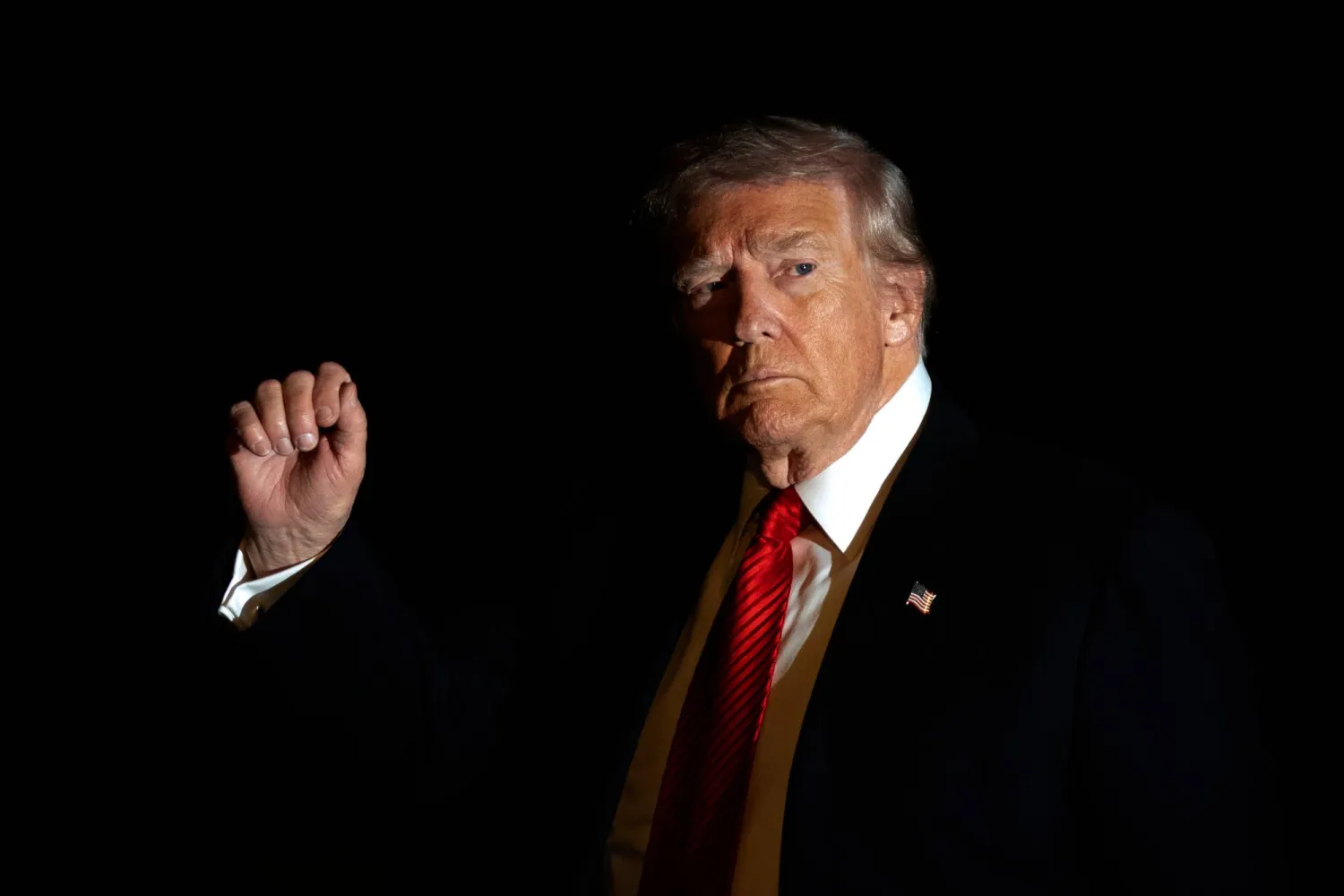

Trump Heads into Davos Storm, with an Eye on Home

FILE - President Donald Trump is illuminated by a camera flash as he gestures while walking across the South Lawn of the White House, Nov. 2, 2025, in Washington, after returning from a trip to Florida. (AP Photo/Mark Schiefelbein, File)
TT

Trump Heads into Davos Storm, with an Eye on Home

FILE - President Donald Trump is illuminated by a camera flash as he gestures while walking across the South Lawn of the White House, Nov. 2, 2025, in Washington, after returning from a trip to Florida. (AP Photo/Mark Schiefelbein, File)

Donald Trump returns to the Davos ski resort next week after unleashing yet another avalanche on the global order. But for the US president, his main audience is back home.

Trump's first appearance in six years at the gathering of the world's political and global elite comes amid a spiraling crisis over his quest to acquire Greenland.

Fellow leaders at the mountain retreat will also be eager to talk about other shocks from his first year back in power, from tariffs to Venezuela, Ukraine, Gaza and Iran.

Yet for the Republican president, his keynote speech among the Swiss peaks will largely be aimed at the United States.

US voters are angered by the cost of living despite Trump's promises of a "golden age," and his party could be facing a kicking in crucial midterm elections in November.

That means Trump will spend at least part of his time in luxurious Davos talking about US housing.

A White House official told AFP that Trump would "unveil initiatives to drive down housing costs" and "tout his economic agenda that has propelled the United States to lead the world in economic growth."

The 79-year-old is expected to announce plans allowing prospective homebuyers to dip into their retirement accounts for down payments.

Billionaire Trump is keenly aware that affordability has become his Achilles' heel in his second term. A CNN poll last week found that 58 percent of Americans believe his first year back in the White House has been a failure, particularly on the economy.

Trump's supporters are also increasingly uneasy about the "America First" president's seemingly relentless focus on foreign policy since his return to the Oval Office.

But as he flies into the snowy retreat, Trump will find it impossible to avoid the global storm of events that he has stirred since January 20, 2025.

Trump will be alongside many of the leaders of the same European NATO allies that he has just threatened with tariffs if they don't back his extraordinary quest to take control of Greenland from Denmark.

Those threats have once again called into question the transatlantic alliance that has in many ways underpinned the western economic order celebrated at Davos.

- 'Economic stagnation' -

So have the broader tariffs Trump announced early in his second term, and he is set to add to the pressure on Europe in his speech.

Trump will "emphasize that the United States and Europe must leave behind economic stagnation and the policies that caused it," the White House official said.

The Ukraine war will also be on the cards.

Ukrainian President Volodymyr Zelensky is hoping for a meeting with Trump to sign new security guarantees for a hoped-for ceasefire deal with Russia, as are G7 leaders.

But while the largest-ever US Davos delegation includes Secretary of State Marco Rubio, special envoy Steve Witkoff and son-in-law Jared Kushner, who have all played key roles on Ukraine, no meeting is assured.

"No bilateral meetings have been scheduled for Davos at this time," the White House told AFP.

Trump is meanwhile reportedly considering a first meeting of the so-called "Board of Peace" for war-torn Gaza at Davos, after announcing its first members in recent days.

Questions are also swirling about the future of oil-rich Venezuela following the US military operation to topple its leader Nicolas Maduro, part of Trump's assertive new approach to his country's "backyard."

But Trump may also pause to enjoy his time in the scenic spot he called "beautiful Davos" in his video speech to the meeting a year ago.

The forum has always been an odd fit for the former New York property tycoon and reality TV star, whose brand of populism has long scorned globalist elites.

But at the same time, Trump relishes the company of the rich and successful.

His first Davos appearance in 2018 met occasional boos but he made a forceful return in 2020 when he dismissed the "prophets of doom" on climate and the economy.

A year later he was out of power. Now, Trump returns as a more powerful president than ever, at home and abroad.



Researcher Owns 100 Rare Flags From Saudi State Eras

Saudi researcher Adnan Al-Tarif poses with two Saudi state flags (Asharq Al-Awsat)
TT

Researcher Owns 100 Rare Flags From Saudi State Eras

Saudi researcher Adnan Al-Tarif poses with two Saudi state flags (Asharq Al-Awsat)

Saudi Arabia marked Flag Day on March 11 for the fourth consecutive year, following a royal order issued on March 1, 2023, designating the date as an annual celebration of the national flag, whose current form was approved in 1937 by King Abdulaziz.

Saudi researcher Adnan Al-Tarif, who owns around 100 flags, says one of the most notable pieces in his collection is the original banner of the First Saudi State, along with dozens of other flags used during later phases of the Saudi state across its three historical eras.

According to historical sources, the banner that Al-Tarif proudly owns — and keeps in a bank vault to protect it from damage, loss, or theft — was “a green banner made of khazz and ibraism (the finest types of silk), bearing the phrase ‘There is no god but Allah, Muhammad is the Messenger of Allah’ in Arabic, and attached to a simple pole.”

The banner remained in that form during the reigns of Imam Muhammad bin Saud, founder of the First Saudi State, followed by his son, Imam Abdulaziz bin Muhammad, his son, Imam Saud bin Abdulaziz, and his son, Imam Abdullah bin Saud.

A banner that was never defeated

Al-Tarif said the first Saudi banner was raised in 1727 by the founding imam Muhammad bin Saud, whose rule lasted 40 years. The banner was either carried by him or entrusted to one of his sons.

Citing the historian Ibn Bishr, Al-Tarif said that Imam Abdulaziz bin Muhammad, the second ruler of the First Saudi State, and his son, Imam Saud, would send messengers to tribal leaders specifying a date and meeting point at a particular water source. The banner would be raised there in advance, and no tribal chief would fail to attend.

Ibn Bishr also wrote that Imam Saud “was granted success in his campaigns, and no banner of his was ever defeated.”

When Ibn Bishr described the life of Imam Turki bin Abdullah, founder of the Second Saudi State, he said that, when preparing for a campaign, Turki would write to the princes of towns and tribal leaders, specifying a time and place for assembly.

Military equipment, army supplies, and horse fodder would be sent out 15 days before departure. The banner would then be raised near the palace gate a day or two before the campaign began.

Imam Turki ordered the banner to be carried ahead of him, and his son Faisal later followed the same system of presenting or raising the banner before the palace.

Three centuries of development

Al-Tarif said the Saudi flag — also referred to as the banner or bayraq — has flown in green for three centuries, passing through several stages before settling into its final form in the later years of King Abdulaziz’s reign.

He also cited accounts from travelers and Orientalists who wrote about the Saudi banner.

During the height of the British-French rivalry, Domingo Badía y Leblich, a Spanish traveler later revealed to be a spy, pretended to convert to Islam and traveled under the name Ali Bey al-Abbasi to study the Saudi state.

He arrived in Makkah in January 1807, traveling from Morocco through North Africa, and witnessed the entry of Imam Saud’s army into the city.

He recorded that 45,000 followers of Saud, dressed in the garments of pilgrimage, entered to perform the rites, led by a green flag embroidered with large white letters reading “There is no god but Allah, Muhammad is the Messenger of Allah.”

Meanwhile, Swiss traveler Johann Ludwig Burckhardt, who adopted the name Ibrahim Abdullah after converting to Islam, wrote in observations from his travels in the East around 1810 about the military affairs of Imam Saud bin Abdulaziz bin Muhammad bin Saud and his authority across the Arabian Peninsula.

He noted that each prince had his own banner, and that Saud had several.

A new form of the flag

Al-Tarif said King Abdulaziz initially used the same banner employed during the first and second Saudi states before introducing modifications.

Writer Amin Al-Rihani recorded that the banner carried by King Abdulaziz early in his reign had a white section near the pole and a green section, and was square in shape, bearing the phrase “There is no god but Allah, Muhammad is the Messenger of Allah” in Arabic, with two crossed swords above it.

Its design later changed to include one sword beneath the inscription.

In 1925, King Abdulaziz ordered the creation of a new flag design. In 1937, the Shura Council approved official dimensions of 150 centimeters in length and 100 centimeters in width.

In the same year, decisions were issued concerning official flags, including those of the king, crown prince, army, air force, internal flag, royal naval flag, and merchant naval flag.

In 1952, the Shura Council issued decisions introducing other measurements and modifications. In 1973, the Council of Ministers approved the national flag law.

Later, during the reign of King Fahd, the Basic Law of Governance issued in 1991 defined the nature of the flag: green in color, with a width equal to two-thirds of its length, bearing the phrase “There is no god but Allah, Muhammad is the Messenger of Allah” with a sword beneath it.

A unique case

Al-Tarif said the symbolism of the current flag reflects guidance, justice, strength, growth, and prosperity.

The Islamic declaration of faith symbolizes the message of peace and Islam upon which the kingdom was founded. The sword represents strength, unity, wisdom, and security. The green color reflects the banner of Islam and symbolizes peace, generosity, tolerance, and water, while white symbolizes purity associated with Saudi Arabia.

He said the Saudi flag is unique, as it is the only flag that is never lowered to half-mast during mourning or disasters, and it cannot be used for advertising or commercial trademarks.

The flag must not touch the ground or water, be taken into impure places, or be sat upon. It also does not bow to guests during honor-guard ceremonies or mourning periods, according to Article 16 of the flag law, which also sets penalties for violations.

Families who carried the banner

In the First Saudi State, the banner was carried by Ibrahim bin Tuq and Abdullah Abu Nahiyah, who was killed during the siege of Diriyah in 1818.

In the Second Saudi State, it was carried by Al-Humaidi bin Salama, Saleh bin Hadyan, and Ibrahim Al-Dhafiri.

Under King Abdulaziz, the first to carry the banner was Abdul Latif Al-Maashouq during the recapture of Riyadh in 1902. He later took part in subsequent battles and was killed in the Battle of Bukayriyah in 1904.

His son Mansour Al-Maashouq then carried the banner and was killed in the same battle.

Afterward, Abdulrahman bin Mutrif and his sons assumed the role.

To this day, the responsibility of carrying the banner has been entrusted to the Al-Mutrif family, although many individuals and families have been honored to carry the Saudi flag in various battles and locations.

Sewing and calligraphy

Regarding the making of the flag, Al-Tarif cited historian Abdulrahman Al-Ruwaished, who wrote that sewing and writing the flag were entrusted to individuals from well-known families in Riyadh, including Abdullah bin Mohammed bin Shaheen and Saad bin Saeed.

Bin Saeed handled the preparation of the materials used for the flag, though he did not personally sew it.

Some documents indicate that King Abdulaziz tasked Sheikh Abdulrahman Al-Tubaishi with purchasing and securing certain materials for the banner.

Later in his reign, flags were manufactured in several countries using fabric-on-fabric techniques in the United States, Pakistan, and some Arab countries.

Among the earliest calligraphers of the Saudi flag during King Abdulaziz’s era was Sheikh Omar Asim Al-Hasani, from Al-Jumum in Wadi Fatimah near Makkah, who had worked in Kuwait at Al-Mubarakiyah School and later became its director.

He also wrote the script for the old Kuwaiti flag bearing the word “Kuwait.”

He was asked to inscribe the Saudi flag around 1911.

When King Abdulaziz ordered the opening of the Kiswah factory for the Kaaba in 1926, one of the first workers was calligrapher Abdul Rahim Amin Abdullah Bukhari, who was tasked with writing the inscriptions on the Kaaba’s covering and designing the calligraphy for its door.

He was also asked to write the Saudi flag and its decorative elements in Arabic Thuluth script.

Rare collections

Al-Tarif said one of the most notable parts of his collection is Saudi flags.

“I thank God that among my most prominent possessions are Saudi flags. I own more than 100 old and rare flags of different sizes, shapes, materials, and historical periods, including flags from the First and Second Saudi States that were used during campaigns to establish unity and security in this blessed land,” he said.

He said he also collected flags used during events attended by King Abdulaziz, including flags used on the king’s car.

His collection includes flags from the era of King Saud, as well as flags used during King Faisal’s visit to the United States in 1945, and others from the reigns of King Khalid and King Fahd during foreign visits.

Among the most important items he owns is the flag placed between King Fahd and King Salman bin Abdulaziz during a ceremony honoring King Saud when he assumed power in 1953.

Al-Tarif said he documented the flags through photographs and examined them at major international centers to verify their authenticity. They were also verified by individuals historically tasked with carrying the banner, including members of the Al-Mutrif family, as well as through the finials placed atop flagpoles.

He said he owns more than 10 finials made of silver, copper, and other metals used during the reign of King Abdulaziz, along with a rare document stamped by King Abdulaziz seven years after entering Riyadh, related to details about the Saudi flag.

Museums and heritage

Al-Tarif said that during his research career, he also established three private museums dedicated to camels, horses, and falcons, containing rare pieces, some of which are more than 300 years old.

He has also collected postage stamps related to these subjects from countries around the world, as well as newspaper articles published since 1850, photographs dating back more than 100 years, and museum artifacts, including utensils, incense burners, coffee pots, clocks, and license plates from the reigns of King Abdulaziz, King Saud, King Faisal, and King Khalid.

His collection also includes telephones used in royal palaces from the era of the founding king through later Saudi monarchs.

Diplomatic tensions over the flag

Al-Tarif also recounts an incident involving Saudi Arabia’s refusal to lower its flag following the death of King Faisal I of Iraq, which angered the British.

He said that after Sheikh Ibrahim bin Muammar was appointed Saudi minister plenipotentiary to Iraq in 1923, shortly after the Saudi legation opened in Baghdad, the appointment reflected the Saudi king’s confidence in his abilities.

Large Saudi communities lived in Iraq at the time, and Arab tribes inhabited the border regions between the two countries. Among his duties were caring for Saudi nationals, overseeing the implementation of newly signed border agreements, and managing arrangements for pilgrims traveling to perform the Hajj.


Tracing the US Military’s Learning Curve on Fighting Iran’s Drones: What to Know

A visitor of an exhibition takes a photo of parts of an Iranian made unmanned aerial vehicle (UAV) Shahed-131/136, which was launched on Ukrainian territories, amid Russia's attack on Ukraine, in Kyiv, Ukraine June 27, 2025. (Reuters)
TT

Tracing the US Military’s Learning Curve on Fighting Iran’s Drones: What to Know

A visitor of an exhibition takes a photo of parts of an Iranian made unmanned aerial vehicle (UAV) Shahed-131/136, which was launched on Ukrainian territories, amid Russia's attack on Ukraine, in Kyiv, Ukraine June 27, 2025. (Reuters)

The Iran war quickly tested America's ability to combat the swarms of cheap drones that have become a staple of the modern battlefield after Ukraine and Russia demonstrated how effective they could be.

Iran launched so many drones across the region at once that some slipped through the defenses, including a strike that killed six US soldiers at an operations center in Kuwait.

Experts and defense leaders stress that the US military has been able to shoot down the majority of Iran’s drones and take out much of its drone capabilities. But critics said too often missiles that cost millions of dollars were used to down small drones that cost tens of thousands.

The US is bringing an anti-drone system to the Middle East that has been tested in Ukraine, which had proposed a deal with the US last year to offer its drone expertise. Such an agreement is yet to be made, and American forces are facing a steep learning curve as they scramble to deploy more cost-efficient defenses against Iran's Shahed drones, which fly low and buzz like mopeds before smashing into their targets.

“We are crushing them — there’s no doubt about it — but if even one drone gets through our defenses and hurts an American, for me, that is enough to warrant fixing the problem,” said drone warfare expert Brett Velicovich, who operated Predator drones in the US Army and co-founded a drone manufacturing company.

Here’s what to know about Iran's drones and efforts by the US to shoot them down:

US says it's attacking the source of Iran's drones

Gen. Dan Caine, the chairman of the Joint Chiefs of Staff, said Tuesday that the number of drones launched by Iran had fallen 83% since the war began on Feb. 28. Iran launched more than 2,000 drones in the days after the initial US and Israeli attacks, other top military officials said.

Caine told reporters that US forces were striking military and industrial targets in Iran “to deny them the ability to continue to generate those one-way attack drones.”

Hundreds — if not thousands — of Patriot missiles have been used by the US and its allies across the Middle East to defend against Iranian missiles and drones. But now the US seems to be relying more on attack helicopters and machine guns as a more cost-effective way to shoot down Iranian drones, experts say, and President Donald Trump suggested as much.

“Now we have low-cost interceptors effectively combating Iranian drones,” the Republican president said Monday.

The military also is bringing in an American anti-drone system proven to work in Ukraine against Russian drones, which are similar to Iran's, The Associated Press has reported. Known as Merops, the system flies drones against drones, fits in the back of a pickup truck and uses artificial intelligence to navigate when electronic communications are jammed.

Ukrainian President Volodymyr Zelenskyy told journalists on Tuesday that his country proposed a deal with the US last year to provide cutting-edge and battle-tested drone technology, including interceptor drones.

“I do not know whether they refused it. I’m not sure, but it was definitely postponed,” Zelenskyy said, adding that Ukraine still hopes to sign such a deal.

Experts say the US military has been slow to overhaul its arsenal and tactics to respond to the new threat from fleets of drones.

“This is going to be a big wake-up call for how the US military defends its citizens and fights wars forever,” Velicovich said. “Because it’s sort of like we’re the best military on the planet, but stuff’s still getting by us.”

Travis Metz, the Pentagon’s drone dominance program manager, told senators last week that the Defense Department has committed $1.1 billion to buy drone systems over the next 18 months, including 30,000 small, one-way attack drones to be delivered to military units over the next five months.

US is leaning on knowledge from Ukraine

Pentagon officials have conceded in classified briefings to Congress that they initially struggled to stop the waves of Iranian drones, leaving US service members and allies vulnerable. High-profile targets like a Dubai skyscraper and airports across the region have been struck.

Defense Secretary Pete Hegseth said last week that “thousands of Iranian missiles and drones have been intercepted and vaporized.” But he conceded, “this does not mean we can stop everything.”

Available in big numbers, the Shahed drones have shown their capability to oversaturate air defenses and inflict painful damage. And while the Shahed flies slowly at 180 kph (just over 110 mph), it can range as far as 2,000 kilometers (1,240 miles) and carry a relatively big load of 40 kilograms (88 pounds) of explosives.

The US military has typically operated complicated reusable drones that fire off missiles and return to base, such as the Predator. But Ukraine has shown that relying on large numbers of cheap drones, which carry their payloads directly into the target and become warheads themselves, can be extremely effective.

“There is going to be a learning curve, but the more that the Ukrainians can provide us in terms of guidance and expertise I think the better off we all are,” said Brandon Blackburn, who is a former CIA targeting officer who conducted counterterrorism operations throughout the Middle East.

Ryan Brobst, a scholar focused on US defense strategy at the Foundation for Defense of Democracies, a hawkish Washington think tank, said social media posts by the US military and allies have indicated the use of relatively cheaper weapons, like aircraft machine guns or laser-guided rockets, to destroy drones in Iran.

“The United States has made significant strides in counter-UAS warfare over the past few years,” Brobst said, referring to unmanned aerial systems. “But it’s also true that we can still learn more from Ukraine.”

Looking ahead to focusing on the ‘cheap stuff’

Northwestern University professor William Reno, who researches Ukraine’s military training for the Pentagon and visits the country regularly, noted that Ukraine has found cheap ways to shoot down drones with .50-caliber machine guns mounted in the back of a pickup or other fast-moving drones.

“The long-run effect will probably be that it’s going to focus minds wonderfully on thinking more seriously about cheap stuff that comes through the air,” Reno said.

For decades, US military strategy has counted on dominating the airspace above any conflict it got involved in, but the focus was primarily at higher altitudes where fighters and bombers fly. Now drones will force the military to think about what it does to control low-altitude airspace.

“Ukraine was the wake-up call,” Reno said.

The US military already has some programs centered on inexpensive drones, according to Jerry McGinn, a former Defense Department official who was focused on manufacturing and industrial base policy and is now a scholar at the Center for Strategic and International Studies.

One of those programs is the Low-cost Uncrewed Combat Attack System, or LUCAS, which American forces are using in Iran. The US military said in a post on X that the American-made, one-way attack drones were “modeled after Iran’s Shahed drones.”

“It’s not public on how effective they’ve been or how they were used,” McGinn said. “But there’s very much a focus in the US of learning from the experience in Ukraine.”


Kharg Island: Iran’s Vital Oil Hub in the Crosshairs?

This handout image taken by the European Space Agency (ESA) captured by the Copernicus Sentinel-2 satellite shows a view of Iran's Kharg Island, which hosts the country's main crude export terminal and is responsible for the overwhelming majority of its oil shipments to the world, about 25 kilometers south of the mainland in the north of the Gulf, on March 2, 2026. (AFP / ESA)
TT

Kharg Island: Iran’s Vital Oil Hub in the Crosshairs?

This handout image taken by the European Space Agency (ESA) captured by the Copernicus Sentinel-2 satellite shows a view of Iran's Kharg Island, which hosts the country's main crude export terminal and is responsible for the overwhelming majority of its oil shipments to the world, about 25 kilometers south of the mainland in the north of the Gulf, on March 2, 2026. (AFP / ESA)

Kharg Island, a scrubby stretch of land in the northern Gulf, handles almost all of Iran's crude exports and any attempt to seize it would mark a major escalation in the conflict, analysts say.

The US and Israel have so far treaded carefully around the island, but an Axios report over the weekend cited Trump administration officials saying capturing Kharg was on the table as the war in the Middle East persists.

The island, located around 30 kilometers (19 miles) off the Iranian mainland, handles roughly 90 percent of Iran's crude exports, according to a JP Morgan note released Sunday.

Any move on the territory, which is about one-third the size of Manhattan, would have swift repercussions, experts say.

"A direct strike would immediately halt the bulk of Iran's crude exports, likely triggering severe retaliation in the Strait of Hormuz or against regional energy infrastructure," JP Morgan said.

Iranian strikes have all but halted maritime traffic in the Strait of Hormuz -- through which a fifth of global crude oil and liquefied natural gas normally pass -- and have also impacted oil infrastructure in other Gulf states.

But Iranian energy assets have not been degraded so far and targeting the island would be "a very risky move", Farzin Nadimi, senior fellow at the Washington Institute for Near East Policy, told AFP.

Iran is not only "experienced in using alternatives" in wartime, it could "cause a lot more damage on the Gulf oil and gas installations if they want to and they can do a lot more very quickly, and everybody knows that".

"I don't think that seizing the island will go any further than US Congressional debates," he added -- the prospect having been discussed in Washington since the hostage crisis that started in 1979 during the foundation of the Islamic republic.

Kharg underwent key developments during Iran's oil expansion in the 1960s and 1970s, with much of the country's coast too shallow for supertankers.

Iran has looked to diversify its export capabilities by opening the Jask terminal outside the Strait of Hormuz chokepoint in the Gulf of Oman in 2021, but Kharg remains "a critical vulnerability" for Iran, JP Morgan said.

"It is a cornerstone of Iran's economy and a major source of revenue for the Iranian Revolutionary Guard," JP Morgan added, referring to the well-resourced ideological branch of Iran's army.

- 'Very difficult' -

The war has sent oil prices soaring, although US President Donald Trump's suggestion on Monday that the conflict could end soon has calmed the market.

Over the weekend, the director of the White House National Energy Dominance Council Jarrod Agen told Fox News that "what we want to do is get such massive oil reserves in Iran out of the hands of terrorists".

Also in recent days, the Washington Post reported heightened speculation that US ground forces could be being prepared to deploy, citing analysts saying Kharg Island would be an early target.

Nadimi said Washington could move to seize the island when hostilities end, but that it was "not a wise move" during combat when Kharg is "almost an entire island of oil facilities and pipelines and tank farms".

"It is very difficult to wage a military operation on that particular island," he said.

But other oil infrastructure could be in the crosshairs, with Trump repeatedly referencing his operation to topple Venezuelan president Nicolas Maduro and gain access to the country's oil reserves in January as a blueprint.

Iran -- the fourth-biggest crude producer within the Organization of the Petroleum Exporting Countries (OPEC) -- vowed not one liter of oil would be exported from the Gulf while the war continues.

Any attack on its infrastructure would get an "eye for an eye" response, it said.

On Saturday, Israel launched its first attack of the war on oil facilities in Iran, but it said they were used "to operate military infrastructure".

The same day, Israeli opposition leader Yair Lapid argued for stronger steps, saying in an X post: "Israel needs to destroy all of Iran's oil fields and energy industry on Kharg Island; that's what will crush Iran's economy and bring down the regime."