


Possible ‘Emergency Exit’ for Iraqi Factions, But Not for Everyone

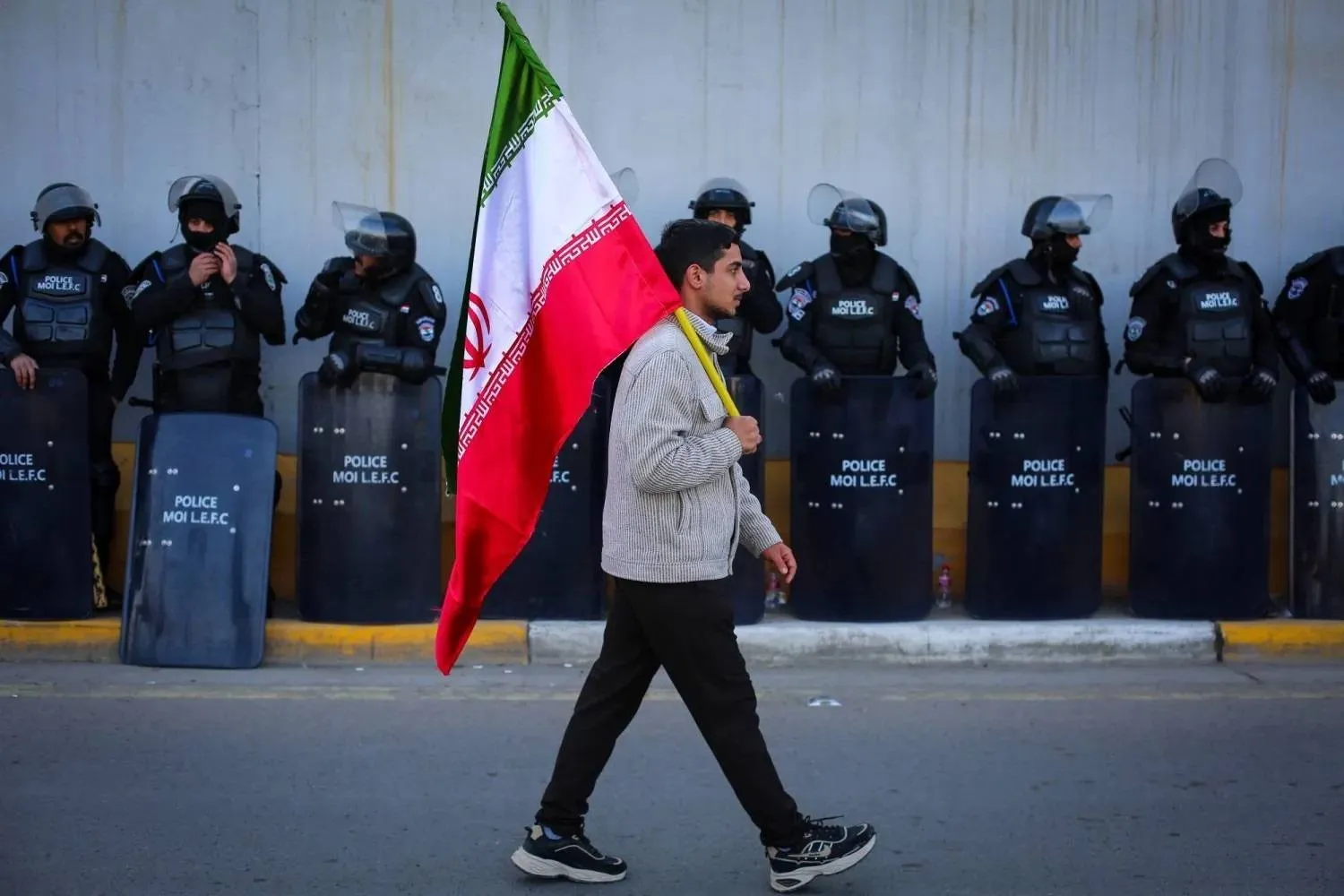
An Iraqi man carrying the Iranian flag passes in front of security forces outside the Iranian embassy in Baghdad during a demonstration to show solidarity against US threats (DPA). 
TT

Possible ‘Emergency Exit’ for Iraqi Factions, But Not for Everyone

An Iraqi man carrying the Iranian flag passes in front of security forces outside the Iranian embassy in Baghdad during a demonstration to show solidarity against US threats (DPA). 

Since protests erupted in Iran, political elites in Iraq have quietly debated whether the “Islamic Revolution” in Tehran might be nearing a rapid collapse. Yet the more cautious question circulating in Baghdad is different: what if the Iranian system survives, but weakened and stripped of its tools, for years to come?

This question now resonates within the corridors of the Coordination Framework, the coalition most closely tied to regional power dynamics. It appears to be repositioning itself amid shifting centers of influence, but not before paying a price.

Figures from Shiite parties and armed factions, as well as researchers interviewed by Asharq Al-Awsat, say anxiety over Iran’s trajectory is palpable in Baghdad, though rarely expressed openly for ideological reasons and because of what they describe as a chronic inability to produce independent national policies.

Pressure on Shiite forces has been building for months. Washington is pushing to dismantle militias and sever their operational and economic ties with Iran. Tehran is weighed down by sanctions and protests whose sparks have reached even the bazaars. Meanwhile, the Coordination Framework is attempting to engineer a governing formula capable of surviving these pressures.

It is widely believed that the heavy presence of armed factions’ representatives in parliament - holding more than about 80 seats - is part of a broader strategy to adapt to US pressure, whether Iran’s system collapses or remains weak for years.

Accordingly, Shiite political actors appear compelled to move from the era of militias toward the state, though only after establishing a strong central power within state institutions, in order to avoid confrontation with Washington and prepare for the possibility of Iran’s declining influence.

Over time, it has become clear that avoiding confrontation with the United States requires not only reducing Iranian influence but also constructing local power under the umbrella of a national political settlement.

A situation resembling Saddam Hussein

Since 2003, Shiite parties have rarely debated Iran’s future publicly. There is a prevailing belief that discussing the fate of a system led by Supreme Leader Ali Khamenei is ideologically taboo for those who profess absolute loyalty to him, according to a senior leader in the Coordination Framework.

Many also dismiss the possibility of Iran’s collapse altogether. But Hisham Dawood, a researcher at the French National Center, argues that the impact of maximum sanctions on Iranian society cannot be ignored. He said sanctions do not overthrow regimes as much as they reshape societies, shifting them from a culture of living to one of survival.

In private gatherings, Iraqi politicians have begun drawing an analogy that alarms Shiite groups. They note that Tehran’s system is approaching a condition similar to that of Saddam Hussein’s regime after the invasion of Kuwait and the subsequent economic embargo, a crushed social base and a leadership gradually stripped of its traditional tools.

Aqeel Abbas, a researcher on US affairs, does not believe Iran’s system will collapse but is convinced that its behavior will change. On that basis, Shiite forces may seek to adapt in order to weather the storm.

This trajectory, however, does not appear sufficient in Washington’s eyes. The United States is not searching for treasure but for the key. US presidential envoy Mark Savaya wrote that militias are merely a symptom of a deeper disease in Iraq. For months, he has been shaping among Shiite circles in Baghdad a narrative of sustained pressure within a broader American strategy.

Groups such as Asaib Ahl al-Haq have shown striking flexibility compared with their past. The faction that once fought the Americans now stands as one of the main pillars of government and parliament and is reportedly planning to dominate both in the next legislative cycle, according to associates of its leader, Qais al-Khazali.

During his election campaign months ago, al-Khazali welcomed US investments. Yet Washington continues to press for the removal of his representative in parliament from the post of deputy speaker, according to information leaked from meetings held by Acting Chargé d’Affaires Joshua Harris with Coordination Framework officials.

A Western diplomat who served in a mission between Baghdad and Damascus during the fight against ISIS explains US behavior toward Shiite factions: after months of “power diplomacy” in exchange for avoiding military targeting, the Americans are not seeking a truce but a decisive blow followed by a deal on their terms. Savaya’s role, he says, is likely to clarify and enforce those conditions.

More than weapons

Spokespersons for armed factions declined to comment on questions about their plans for dealing with US pressure. But a senior figure in an armed faction, speaking anonymously, said they had reached a stage of “confrontation without masks — no intermediaries, no maneuvering.”

Aqeel Abbas believes Shiite forces may attempt to transform existing militias into local forces under new names, limited to protecting the system inside Iraq without regional roles or provoking the United States and Israel.

Theoretically, such a shift could satisfy Washington. But the faction leader warned that the confrontation goes beyond weapons: the Americans, he said, want the core of influence and resistance. “We tried to confine the crisis to weapons, but now they are pressing on our existence, our economy, and our ideological ties. What room for maneuver remains except defending our dignity?”

He added that such questions are being raised in Baghdad faster than they are answered in Tehran.

Iran “that cannot be defeated”

Hisham Dawood divides Shiite reactions in Baghdad into three groups.

The first consists of pro-Iran forces with direct ideological ties to Tehran, which do not view the Iraqi state as the ultimate framework of political belonging but rather as a field of action within a transnational project. These forces, Dawood argues, are prepared to bear high costs - even if they affect the Iraqi state - so long as they serve what they consider a religious obligation toward Tehran.

Indeed, many factions place near-absolute confidence in Iran. A faction leader who was active in Syria before the collapse of Bashar al-Assad’s regime said some battles are managed according to logic that transcends local calculations, and that the final decision is not always in the hands of those who pay the price on the ground. He argued that without Iran, the Islamic Revolution would have no meaning.

The second group comprises forces that have governed Iraq since 2003 and occupy a more complex position. They are not overtly pro-Iran ideologically or organizationally, but they remain deeply influenced by Tehran for historical and sectarian reasons, and out of fear that Iranian influence could reshape internal Shiite alignments.

These forces seek to present themselves as holders of national legitimacy, yet in decisive moments they still defer to Tehran. Many observers believe this dynamic was reflected in what was described as Mohammed Shia al-Sudani’s “concession” to Nouri al-Maliki over the premiership - an attempt, according to a senior Shiite leader, to restore Maliki’s centrality through a new-old alliance.

Pro-Iran groups mobilized demonstrations in central and southern cities, carrying images of Khamenei and Iranian flags. But the Coordination Framework issued only one statement urging diplomatic solutions and warning of economic challenges and falling oil prices. This has revealed a leadership caught between traditional power calculations and growing risks.

The third group consists of a popular majority with weak political representation, which views the continuation of the Iranian model in Iraq as a source of political stagnation, economic crisis, social paralysis, and international isolation.

The Sadrist movement may represent part of this majority. Dawood argues that it is politically reduced to an image of Iranian extension, a simplification that imposes a heavy symbolic and political cost.

Most Iraqi Shiite forces - except some ideological actors - appear ready to strike deals with Washington, provided their interests within the Iraqi state are guaranteed, in a manner resembling the model the United States is testing in Syria.

Meanwhile, attempts to create a strong institutional umbrella to fill the vacuum have emerged through the prominent role of the Supreme Judicial Council. On the eve of the legislative elections, Judge Faiq Zaidan urged adherence to constitutional timelines for forming Iraq’s leadership. Weeks later, he began publicly naming factions that must limit weapons. Iraqi elites now speak of an alternative governing umbrella that could fill the vacuum with the force of law.

An emergency exit

A Western diplomat believes this is the first time in years that Shiite groups may be forced to reconsider options that appear unrealistic, not only for Washington but even for Tehran. He pointed to the fate of the Syrian Democratic Forces as a warning for those who bet on open and absolute hostility.

While these developments paint a suffocating picture for Shiite factions, they also open an emergency exit from the old game toward new alliances.

A former government adviser described such an exit as a search for new alliances during a period in which Iran remains an ideological umbrella but without claws. He argued that pressures on armed factions leave no luxury of choice: Shiite forces must first build sustainable local partnerships and then balance relations with emerging centers of power in the region and the Arab world.

Yet this emergency exit may not accommodate all Shiite players within what Dawood describes as a fragmented state. The central question remains open: will the United States seek to preserve pluralism among Shiite political and factional actors, or will it prefer to support a centralized authority with an authoritarian grip, as some actors in Baghdad now advocate?



Bandar Abbas, Iran’s Trade Hub on Hormuz Thrust to Frontline of US War

Fishermen check their nets and small boats on the seashore in the port city of Bandar Abbas, in southern Iran on August 10, 2026. (AFP)
TT

Bandar Abbas, Iran’s Trade Hub on Hormuz Thrust to Frontline of US War

Fishermen check their nets and small boats on the seashore in the port city of Bandar Abbas, in southern Iran on August 10, 2026. (AFP)

With a long shoreline on the Strait of Hormuz, Iran's southern trade hub of Bandar Abbas has found itself at the frontlines of the war with the United States, with residents struggling to revive livelihoods battered by months of fighting.

Like elsewhere in Iran, economic strain has squeezed households since US-Israeli strikes triggered the Middle East war on February 28. But unlike much of the country, the port city of around half a million people has remained exposed to fighting even after an April 8 ceasefire brought relief elsewhere.

But despite a lull in hostilities in July, residents still feel squeezed. Saeed Tajik, 42, used to work at a shipyard before losing his job and turning to driving a taxi.

"The prices of housing and food have become extremely high. Almost all the basics -- rice, yoghurt, and oil -- have doubled," said Tajik.

Fuel shortages have long been common in southern Iran, where authorities restrict supplies in an effort to curb widespread fuel smuggling.

But now, "the queues have become longer ... it happens that we wait in the long line for fuel only to get told 'there is none' upon arriving," Tajik said as he drove past a station where motorists waited under the punishing summer heat.

Hormuz has emerged as a central flashpoint after an April ceasefire and June framework deal failed to resolve disagreements between Washington and Tehran over the future management of the strait.

During the war, US strikes hit bridges, highways and railway infrastructure around Bandar Abbas until mid-July, in what analysts saw as attempts to cut off the city and disrupt Iranian military logistics in the south.

- 'Nothing left' -

Inside the city, under a towering concrete statue of two armed men with their arms trained towards Hormuz waters, economic strains play out in long queues snaking outside petrol stations and soaring prices squeezing shoppers in local markets.

The city's repeatedly hit airport remained largely closed until August 15, leaving travelers facing arduous road journeys, sometimes combined with flights and boat crossings.

Outside the city, construction crews still toil under the sweltering summer sun to repair the Gachin bridge, split by a US strike, as cars rumble along a dusty detour below.

Along the waterfront, traditional wooden vessels known as lenjes sit moored alongside fishing and commercial boats, part of a centuries-old trading network linking southern Iran with Arab states across the Gulf.

Arash Tondro, 45, used his lenj to carry Iranian fresh and dried fruit to the United Arab Emirates and return with household goods and other imports.

"My income dropped to zero at the beginning of the war," said Tondro, who later rerouted some trade through Oman's Khasab port as regional seaways were disrupted and "many of the lenjes were hit by drones".

After the UAE suspended trade with Iran on Tuesday following a missile attack on a ship that Tehran denied carrying out, Tondro said he was again unsure how his work would be impacted.

"People in the south mostly rely on trade or fishing. If you take the sea and trade away from them, there is practically nothing left. We don't have agriculture here; whatever there is comes from the sea," he said.

- 'No sales' -

As night falls and August's oppressive heat begins to ease, fish vendors set up along a busy street, laying out shark, tuna and shrimp as the smell of the day's catch hangs in the humid air.

Among them is 22-year-old Anoush Mallah, who recently moved onto the street after soaring rents forced him to close his shop in one of the city's bazaars.

"Business has been terrible since the war started. There are no sales, it's very weak," he told AFP.

"People are short of money. The fishermen aren't going fishing either."

Many fishermen around Bandar Abbas only began returning to sea in recent weeks, after months ashore for fear of being caught in the crossfire of US-Iran fighting.

Diplomatic efforts have so far failed to end the war. For Mallah, the uncertainty only adds to the strain.

"Let it (the war) start and get some result; right now, we're just left in limbo," he said.


The Ethiopian Dam Dispute and Egypt’s ‘Right to Self-Defense’

Egyptian Foreign Minister Badr Abdelatty. Photo: Foreign Ministry
TT

The Ethiopian Dam Dispute and Egypt’s ‘Right to Self-Defense’

Egyptian Foreign Minister Badr Abdelatty. Photo: Foreign Ministry

Over the past two weeks, Egypt has repeatedly stressed its right to prevent any actions by Addis Ababa on the Nile River that could harm its water interests, stressing that it possesses the “right to self-defense” over Ethiopia’s Grand Ethiopian Renaissance Dam (GERD).

According to experts who spoke to Asharq Al-Awsat, Egypt’s signaling means that it “will not hesitate to use all legitimate means to safeguard its water security.”

They explained that the message is a stern warning to Ethiopia and suggests that Cairo is seeking to shift from a policy of protesting Ethiopian measures to preventive deterrence, aimed at stopping the establishment of a new status quo on the Nile.

New Egyptian Warning

Egyptian Foreign Minister Badr Abdelatty said that “Egypt will not allow the construction of additional dams ... that affect its water interests,” stressing Cairo’s commitment to a legally binding agreement that guarantees its water rights.

In a television interview on Wednesday evening, Abdelatty said that Egypt does not oppose African countries’ right to development, noting Cairo’s participation in dam and infrastructure projects in several Nile Basin states. However, he stressed the need to balance the right to development with the rights of downstream countries.

He also underscored Egypt’s commitment to protecting its water interests. “We have the right to self-defense to protect our interests and water security,” said the minister. “We will not accept any agreement regarding the Nile River unless it is legally binding,” he reiterated.

Mohamed Hegazy, a member of the Egyptian Council for Foreign Affairs and a former assistant foreign minister, says the right of self-defense is protected under international law after all peaceful means have been exhausted.

According to Hegazy, the core message is that Cairo still prefers agreement and negotiation, but it no longer accepts using negotiations to impose a fait accompli.

He argued that the most significant aspect of Abdelatty’s statements is that they send three simultaneous messages - Rejection of unilateral measures, rejection of additional dams, and insistence on the right of self-defense to protect water security.

Hussein El-Behairy, an African affairs expert at the National Center for Middle East Studies, said the minister’s recent statements reaffirm Egypt’s right to defend its historical and water rights in the Nile by whatever means the Egyptian state deems appropriate to preserve what Egyptians view as a matter of life and death.

Ethiopia’s Grand Ethiopian Renaissance Dam (GERD). Reuters

Escalating Egyptian Position

This is the third time Egypt has signaled the possibility of using its “right to self-defense” and preventing dam construction on the Nile.

On August 16, Egypt’s state news agency quoted an unnamed Egyptian official as saying that Cairo “will neither accept nor allow any party to control the flow of Nile waters to downstream countries,” stressing that the Egyptian state possesses multiple tools capable of protecting its people’s interests in the Nile.

The statement came in response to remarks attributed to Ethiopian Minister of Water and Energy Habtamu Itefa concerning the construction of additional dams on the Nile and control over water flows to downstream states, namely Egypt and Sudan.

Earlier, on August 4, Egyptian Minister of Water Resources and Irrigation Hani Sewilam stated during a press conference that Egypt “will not allow the construction of new Ethiopian dams on the Nile River.”

He said: “It is well known that Ethiopia has plans to build additional dams, but will the Egyptian state allow this? No.”

According to Hegazy, the ball is now in Ethiopia’s court. If Addis Ababa agrees to resume serious negotiations leading to a legally binding agreement on GERD, the crisis can be contained.

However, if Ethiopia continues to create new realities on the Nile, the scope for a diplomatic solution will narrow, making risk management and deterrence a more prominent part of Egypt’s strategy.

El-Behairy does not expect the escalation to pave the way for new negotiations on GERD unless the Ethiopian government is willing to make concessions in response to Cairo’s demands. These demands include reaching a legally binding agreement that guarantees Egypt’s water rights during periods of drought and severe drought, and providing Egypt with information regarding the operation of the dam in a manner that does not harm its water interests.


Train to Nowhere? South Korea’s Lonely Push for Peace with the North

A locomotive is seen at the Woljeong-ri Station in Cheorwon, Gangwon Province, in South Korea, near the demilitarized zone separating North and South Korea on August 10, 2026. (AFP)
TT

Train to Nowhere? South Korea’s Lonely Push for Peace with the North

A locomotive is seen at the Woljeong-ri Station in Cheorwon, Gangwon Province, in South Korea, near the demilitarized zone separating North and South Korea on August 10, 2026. (AFP)

Near the heavily fortified frontier dividing the Korean peninsula, the abandoned Woljeong-ri station is being recast as a symbol of South Korea's hopes to reconcile with the North.

But plans to reconnect South Korea's northernmost station to the rail network come at an awkward moment, as Pyongyang ignores Seoul's overtures while the South's old ally Washington pursues its own talks with Pyongyang.

A turbulent few days have raised doubts about the role of South Korea in any diplomatic push, despite President Lee Jae Myung's dovish line on the North since taking power last year.

US President Donald Trump abruptly scaled back annual military drills with Seoul this week, calling them "inappropriate and hostile" towards the nuclear-armed North.

He also berated South Korea for not helping in his war against Iran and said he would meet the North's leader Kim Jong Un this year.

North Korea then fired around 10 short-range ballistic missiles on Thursday, while Kim's powerful sister mocked Seoul's "master-servant" relationship with Washington.

The developments have overshadowed the Lee administration's outreach, including the Woljeong-ri project aimed at "eventual" reconciliation.

The modest station -- originally located inside today's demilitarized zone (DMZ) -- once sat on a line linking Seoul to Wonsan, but was destroyed during the 1950-53 Korean War. It was reconstructed at its current site in the border town of Cheorwon in 1988.

It is now an attraction for visitors to the nearby DMZ separating the two countries, and the line's former terminus -- Wonsan -- lies in North Korea.

Its history, however, underscores how vulnerable such hopes are to the politics of the peninsula.

Work began in 2015 but ground to a halt just a year later after North Korea's fourth nuclear test.

The latest reboot inspires more skepticism than hope for some in Cheorwon.

"It seems like they keep trying to reconcile with North Korea (through the railway project), but from our point of view, it isn't really practical," said resident Moon Jae-yong, 70.

- Lonely push for peace -

South Korea's reconciliation program eventually aims to restore rail links, such as Woljeong-ri, with the North.

Lee has also said he is ready for talks with Pyongyang without preconditions, including on formally ending the Korean War, which concluded with an armistice.

His unification minister said in July that Seoul had shifted from prioritizing denuclearization to curbing the expansion of North Korea's nuclear program.

But Pyongyang -- emboldened by support from traditional ally China, and Russia, whose invasion of Ukraine it is backing -- has been unmoved.

It has repeatedly declared itself an "irreversible" nuclear state and labelled Seoul its "most hostile" enemy.

The US leader may be trying to revive diplomacy to record a foreign policy win ahead of November's midterm elections, with many voters disenchanted by his intervention in the Middle East.

That has sidelined Seoul, with Lee voicing respect for Trump's decision and pledging to "do his utmost" to support his peacemaking efforts.

South Korea is "reasonably afraid that it gets sidelined -- China, Russia and now America are all engaged with Pyongyang in different ways, while Seoul is not," Vladimir Tikhonov, Korean Studies professor at the University of Oslo, told AFP.

"So, Seoul is desperate to get some opening with North Korea. But it can do very little, so far."

- Impossible dream? -

That leaves the rail project standing as a symbol of South Korea's lonely push for peace.

Along the disused line from Woljeong-ri towards Baengmagoji station to the south -- the section to be restored under the peace project -- vegetation crowds both sides of the tracks, nearly swallowing a stone wall.

"The iron horse wants to run," a sign reads, alongside a phrase in English: "We want to be back on track."

Preparing infrastructure in the South now could save time if inter-Korean links are eventually restored, said Lim Eul-chul, a professor at Kyungnam University.

"But realistically, it is virtually impossible under the current circumstances, and everyone knows that," he told AFP.

With few options on North Korea, Seoul has turned to projects it can "pursue unilaterally", Lim said.

The project also aims to boost tourism along the border, where residents face frequent disruptions and security risks.

Pyongyang sent trash-filled balloons and broadcast unsettling noises across the border during the administration of Lee's hawkish predecessor, Yoon Suk Yeol.

Kim Sun-hee, 70, described them as "like scraping cement, or even ghost-like noises. It was really frightening".

A bombed-out locomotive from the Korean War remains near Woljeong-ri station as a reminder of the division.

It is "heartbreaking to see", said visitor Ahn Seung-hyun.
