
US Buildup Balances Iran Deterrence, Day-After Risks

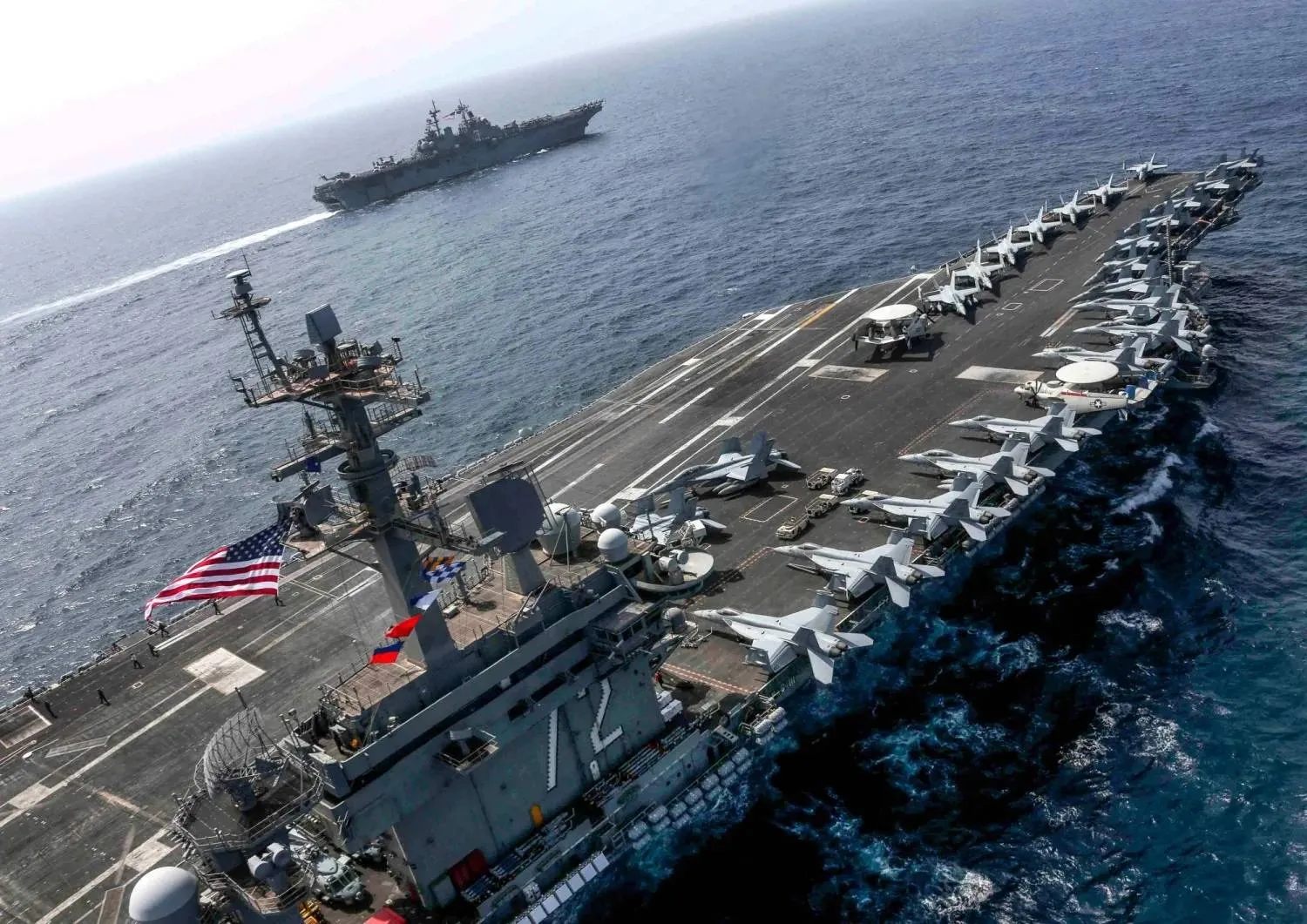
US aircraft carrier USS Abraham Lincoln (AFP)
TT

US Buildup Balances Iran Deterrence, Day-After Risks

US aircraft carrier USS Abraham Lincoln (AFP)

As the aircraft carrier USS Abraham Lincoln, several destroyers, and fighter aircraft, are expected to arrive in the Middle East in the coming days, a familiar but increasingly pressing question is back in play: Is Washington preparing the ground for another strike on Iran, or orchestrating a calibrated show of force designed to raise the psychological and political cost for Tehran without tipping into war?

The answer is not binary. The same military buildup can serve dual purposes: a defensive deterrent to shield US bases and allies, and a pressure tool that keeps the option of attack alive without formal warning.

According to US officials cited by media outlets, the movement of the force, alongside discussions about deploying additional air defense systems, comes at a sensitive moment following a broad crackdown on protests inside Iran.

President Donald Trump, for his part, has publicly insisted that he would prefer nothing happens militarily. Still, he has tied that preference to two conditions: that Tehran does not resume any nuclear path approaching the weapons threshold, and that it does not proceed with executions of protesters.

Three messages in one buildup

The first message is directed at Iran itself. Washington wants to signal that it can rapidly reposition forces and that it considers the “deterrence window” open. Months ago, the United States struck Iranian nuclear facilities in June 2025, and Trump is now reminding Iranians that it will happen again if the same activity resumes.

The second message is aimed at allies and regional adversaries alike. The buildup is not only a threat to Tehran but also an umbrella to protect US interests and bases from potential Iranian retaliation, especially as Iran’s military leadership has openly warned that any attack would make US bases and interests legitimate targets.

Such threats are not new, but they raise the sensitivity of any US decision.

Today’s reinforcements could amount to a preemptive defense aimed at limiting losses if events spiral out of control.

The third message is domestic and political. Trump is also brandishing non-military tools such as “secondary tariffs” on countries that trade with Iran, seeking to combine pressure instruments between sanctions and military deterrence.

In January, he announced a punitive tariff mechanism targeting states that trade with Tehran.

Nuclear ambiguity

The nuclear file adds another layer of uncertainty. The International Atomic Energy Agency has not verified Iran’s stockpile of highly enriched uranium for months. At the same time, estimates circulate of a large quantity enriched to 60 percent, a level technically close to the 90 percent required for a weapon.

This monitoring gap creates two contradictory dilemmas. Hardliners argue that ambiguity implies the possibility of covert rebuilding and therefore justifies tougher pressure.

Advocates of de-escalation counter that the same ambiguity makes any strike a blind gamble that could miss targets or widen the war, without guaranteeing that the program will be halted.

From this perspective, the military buildup could become a language of negotiation: raising the cost for Tehran to accept stricter verification arrangements, or to absorb an internal retreat without appearing defeated.

The Iranian street

If a strike were carried out, what would the Iranian street gain today, after the system has already suppressed protests? Here, limited expectations appear more realistic than grand promises.

Even in Washington, there is a clear debate: any military intervention, particularly a “limited strike” against instruments of repression such as the Revolutionary Guard, may not change the outcome of an internal confrontation if the opposition is fragmented, unarmed, and unorganized.

Analyses in the US press have warned that bombing alone does not “make a revolution.”

It may temporarily halt repression, but it does not dismantle the security apparatus without a lengthy and costly campaign.

Worse, a strike could produce the opposite effect: national mobilization in favor of the system through a narrative of “external aggression,” a hardening of repression under the banner of fighting agents and terrorism, expanded arrests or harsher sentences, and an uncontrolled slide toward internal conflict if some pillars of the state break while others remain intact.

With protest momentum receding after the crackdown, and with continued restrictions on the internet and communications, the “street effect” does not appear to be at its peak in a way that would allow Trump, if he wished, to tie any strike to a quick internal political outcome.

In recent days, there have been signs of debate inside Iran about easing the shutdown. Still, the information environment remains unstable to the point that state television was hacked, and inciting messages were broadcast.

The day after

The question prompting warnings in some Washington circles is this: what if a strike were decisive and weakened the head of the system or paralyzed its center, but the state did not collapse in an orderly way? This is where the specter of “the day after” looms large.

Michael Doran, a researcher at the Hudson Institute, warns that Iran, as a multi-ethnic state with sensitive border regions, could face fragmentation or internal conflict if the center of power collapses suddenly, as in historical cases where “state identity” eroded rapidly after a regime fell.

Doran notes that minorities, Azeris, Kurds, Arabs, Baluch, and Turkmen, are concentrated along the periphery and have cross-border extensions, making neighboring states directly invested in Iran’s internal fate.

The most dangerous scenario, in this logic, is not only fragmentation but also the persistence of the system in another form: the Revolutionary Guard and security services retaining control, shedding the religious ideological cover, and adopting a nationalist or military guise.

That would amount to a change of head rather than a change of regime.

He urges avoiding the idea of “appointing a successor” for Iran from outside or presuming the shape of the state in advance, as this could inflame ethnic sensitivities and plant the seeds of early conflicts.

What has changed from previous buildups is that Washington is no longer facing only the question of “do we strike?” but also “what comes after the strike?” inside Iran and across the region. This equation makes the decision harder. A strike may satisfy the logic of deterrence. Still, it could also open doors that cannot be closed if policy is not designed around uncertainty, rather than the illusion of quick stability.

ISIS Detainees at the Crossroads of Security Pressures and Politics in Iraq

Iraqi Prime Minister Mohammed Shia al-Sudani meets with US Special Envoy to Syria Tom Barrack in Baghdad, January 22, 2026 (Reuters)
TT

ISIS Detainees at the Crossroads of Security Pressures and Politics in Iraq

Iraqi Prime Minister Mohammed Shia al-Sudani meets with US Special Envoy to Syria Tom Barrack in Baghdad, January 22, 2026 (Reuters)

The issue of ISIS detainees transferred from prisons in northeastern Syria to Iraq has moved to the forefront of Baghdad’s security and political agenda, coinciding with intensified efforts to form a new government and determine the next prime minister.

Long confined to narrow security and technical discussions, the issue has entered broader political debate following Iraqi steps to receive a number of the detainees inside its territory, in coordination with concerned international parties. While the move carries direct security implications, it has also unfolded against a highly sensitive domestic political backdrop.

On Friday, Iraqi Prime Minister Mohammed Shia al-Sudani, in a phone call with French President Emmanuel Macron, urged “countries around the world, particularly European Union states,” to repatriate their nationals held as ISIS detainees, following their transfer from Syria to Iraq.


An Iraqi border guard at a checkpoint along the Syrian border in Sinjar, January 22, 2026 (AP)

From a Border Liability to a Domestic Challenge

For years, the presence of thousands of ISIS members in detention facilities beyond Iraq’s direct control has been a persistent security concern for Baghdad, given the proximity of those prisons to the Iraqi-Syrian border and the region’s fragile security conditions. The transfer of some detainees into Iraq has shifted the challenge from a cross-border threat to a domestic issue requiring complex security, judicial, and logistical arrangements.

Iraqi authorities say handling the detainees falls within the state’s responsibility toward its citizens and individuals accused of crimes committed on Iraqi soil, while also reducing the risk of a potential security breakdown at detention sites outside the country.

At the same time, political circles have raised questions about the security burden, societal repercussions, and Iraq’s capacity to manage the issue over the long term.

Where Security and Politics Converge

The renewed focus on the detainee issue has coincided with a sensitive phase of negotiations among political forces within the Coordination Framework coalition over government formation and the selection of a prime minister.

Although fundamentally a security matter, the timing has propelled the issue into political debate, particularly as international actors welcomed steps taken by the government of Mohammed Shia al-Sudani, while regional players monitored developments in Baghdad with caution.

On Friday, US envoy to Syria Tom Barrack praised what he described as Baghdad’s “exceptional leadership” and its firm commitment to helping protect the international community from the continuing threat posed by ISIS detainees, speaking on behalf of the US president and secretary of state.

Some political factions view the handling of ISIS detainees as a test of the Iraqi government’s ability to manage complex issues in coordination with the international community. Others see it as a highly sensitive issue that must be handled independently of political pressure or diplomatic signals between capitals with influence over Iraqi affairs.


Iraqi border guards are deployed along the Syrian border amid tight security measures (AP)

Complex Domestic Calculations

Within Iraq, debate over the detainees is inseparable from concerns about the possible resurgence of extremist cells, prison attacks, or escape attempts — scenarios Iraq has experienced in the past. As a result, security discussions have focused on intelligence readiness, securing detention facilities, and expediting judicial procedures for suspects.

Politically, most parties are careful to avoid appearing lenient on terrorism, yet they differ on the timing and approach to managing the issue, particularly amid a political transition whose outcome remains unsettled.

The detainee issue also highlights Baghdad’s effort to strike a balance between responding to international security concerns and asserting its sovereignty and national interest. Countries concerned with foreign fighters and ISIS dossier are pushing for lasting solutions, while Iraqi authorities are keen to prevent the country from once again becoming a theater for the fallout of regional and international conflicts.

In this context, the issue of ISIS detainees is no longer merely an isolated security concern; it has become a complex issue intertwining considerations of border control, sovereignty, security readiness, internal political tensions, and sustained international attention to the ISIS group.


Greenland Galvanizes Europe to Confront New US Reality

Apartment buildings and houses light up the city of Nuuk, Greenland on January 22, 2026. (AFP)
TT

Greenland Galvanizes Europe to Confront New US Reality

Apartment buildings and houses light up the city of Nuuk, Greenland on January 22, 2026. (AFP)

Europe may have rallied to see off President Donald Trump over Greenland, but its leaders recognize the confrontation is unlikely to be the last in dealings with his increasingly strident version of the United States.

The stakes could hardly be higher, given the $2 trillion trading relationship between the European Union and the US and the dominant role Washington continues to play in the NATO alliance and in support of Ukraine against Russia.

This week, ​in the space of a few hours at the World Economic Forum's annual meeting in Davos, Trump first ruled out taking Greenland by force and then removed the threat of new tariffs on eight European states standing in his way - hailing instead a vague deal for the Arctic island with NATO chief Mark Rutte.

European leaders believe Trump backed down in part because - in contrast to their more accommodating stance in last year's tariff negotiations - this time they made it clear he was crossing a red line by asserting that Greenland's status as an autonomous territory of Denmark was non-negotiable.

"All this shows that you cannot let the Americans trample all over the Europeans," said a European Union official, who requested anonymity to speak candidly about US ties.

"We did the right thing to push back, to be firm in what we said, but it is not over. My sense is that we will be tested constantly on issues like this," ‌the official told ‌Reuters.

While Europe may have learned the value of standing up to Trump, the challenge is ensuring it ‌is ⁠less ​exposed next time.

"It's ‌a hard route, and it's going to take time," said Rosa Balfour, director at Carnegie Europe, adding that Europe had "far more leverage than it has dared to use".

EUROPE NOT SEEKING A SPLIT

An emergency summit of Europe's leaders on Thursday called for last year's EU-US trade deal to be put back on track after lawmakers suspended its ratification in protest over Greenland.

"Despite all the frustration and anger of recent months, let us not be too quick to write off the transatlantic partnership," German Chancellor Friedrich Merz said in Davos beforehand.

While seeking to stabilize the partnership, Europe is also taking steps aimed at "de-risking" it given the open antipathy from Trump, whose new national security strategy accuses the continent of freeloading on defense and demands it open its markets to US companies.

Europe is only too aware of how long it can ⁠take to get agreement among 27 nations with different histories, politics and economies, which was highlighted in taunts this week by US Treasury Secretary Scott Bessent.

Two EU officials said the Greenland row has accelerated discussions on ‌how the approach taken on Ukraine - in which countries offer security guarantees on a voluntary basis ‍and no one has a right of veto - can be extended.

"We should ‍do more with coalitions of the willing and leave it open for others to follow if they want," said one, adding that joint efforts to ‍boost Europe's development of artificial intelligence technology could be one example.

Coalitions such as the "E3" group comprising France, Germany and Britain focusing on security matters also allow non-EU states to take part, which speaks to others on the rough end of Trump policies.

"The middle powers must act together, because if we're not at the table, we're on the menu," Canadian Prime Minister Mark Carney said in a Davos speech to warm applause.

Another route is using the leeway afforded by EU law.

In December, EU states used an emergency provision ​to indefinitely immobilize hundreds of billions of dollars of Russian assets. That removed the risk of a pro-Moscow country like Hungary blocking the roll-over of the measure at some point and forcing the EU to return the money.

NEW EUROPEAN DOCTRINE

Europe also plans to toughen ⁠up on economic policy.

Next month it will kickstart legislation that will include "Made in Europe" requirements on strategic sectors and strengthening conditionality clauses for any foreign direct investment in the EU.

"Some provisions were originally conceived to reduce reliance on China but in reality they will help us to de-risk from other markets," European Commissioner for Prosperity and Industrial Strategy Stephane Sejourne told Reuters.

"This will totally change the European doctrine on those sectors," Sejourne added.

Unlike Canada, there is no plan in Europe to pivot more towards China to compensate for transatlantic strains. But the bloc is actively pursuing others in a diversification drive.

While the impact of higher US tariffs on European goods is not clear - in fact Europe's trade surplus with the US initially rose over the course of 2025 as companies front-loaded exports ahead of the new levies - recent data shows that German companies nearly halved investments there last year.

After the signing of the EU-Mercosur pact this month - the largest in EU history - European Commission President Ursula von der Leyen said it is now "on the cusp" of a deal with India.

However, nobody is saying Europe can redress the imbalance with the US overnight, particularly on security.

Despite European commitments to a defense spending surge and even calls for an EU army, analysts say it will be years before its military might is up to ‌tasks which now include bolstering Arctic security.

The question is whether the past few weeks provide a catalyst for Europe to start reducing its US dependencies.

"All this is not surprising," Swedish deputy Prime Minister Ebba Busch said of Trump's showing in Davos.

"The EU needs to toughen up," she told Reuters.


Possible ‘Emergency Exit’ for Iraqi Factions, But Not for Everyone

An Iraqi man carrying the Iranian flag passes in front of security forces outside the Iranian embassy in Baghdad during a demonstration to show solidarity against US threats (DPA). 
TT

Possible ‘Emergency Exit’ for Iraqi Factions, But Not for Everyone

An Iraqi man carrying the Iranian flag passes in front of security forces outside the Iranian embassy in Baghdad during a demonstration to show solidarity against US threats (DPA). 

Since protests erupted in Iran, political elites in Iraq have quietly debated whether the “Islamic Revolution” in Tehran might be nearing a rapid collapse. Yet the more cautious question circulating in Baghdad is different: what if the Iranian system survives, but weakened and stripped of its tools, for years to come?

This question now resonates within the corridors of the Coordination Framework, the coalition most closely tied to regional power dynamics. It appears to be repositioning itself amid shifting centers of influence, but not before paying a price.

Figures from Shiite parties and armed factions, as well as researchers interviewed by Asharq Al-Awsat, say anxiety over Iran’s trajectory is palpable in Baghdad, though rarely expressed openly for ideological reasons and because of what they describe as a chronic inability to produce independent national policies.

Pressure on Shiite forces has been building for months. Washington is pushing to dismantle militias and sever their operational and economic ties with Iran. Tehran is weighed down by sanctions and protests whose sparks have reached even the bazaars. Meanwhile, the Coordination Framework is attempting to engineer a governing formula capable of surviving these pressures.

It is widely believed that the heavy presence of armed factions’ representatives in parliament - holding more than about 80 seats - is part of a broader strategy to adapt to US pressure, whether Iran’s system collapses or remains weak for years.

Accordingly, Shiite political actors appear compelled to move from the era of militias toward the state, though only after establishing a strong central power within state institutions, in order to avoid confrontation with Washington and prepare for the possibility of Iran’s declining influence.

Over time, it has become clear that avoiding confrontation with the United States requires not only reducing Iranian influence but also constructing local power under the umbrella of a national political settlement.

A situation resembling Saddam Hussein

Since 2003, Shiite parties have rarely debated Iran’s future publicly. There is a prevailing belief that discussing the fate of a system led by Supreme Leader Ali Khamenei is ideologically taboo for those who profess absolute loyalty to him, according to a senior leader in the Coordination Framework.

Many also dismiss the possibility of Iran’s collapse altogether. But Hisham Dawood, a researcher at the French National Center, argues that the impact of maximum sanctions on Iranian society cannot be ignored. He said sanctions do not overthrow regimes as much as they reshape societies, shifting them from a culture of living to one of survival.

In private gatherings, Iraqi politicians have begun drawing an analogy that alarms Shiite groups. They note that Tehran’s system is approaching a condition similar to that of Saddam Hussein’s regime after the invasion of Kuwait and the subsequent economic embargo, a crushed social base and a leadership gradually stripped of its traditional tools.

Aqeel Abbas, a researcher on US affairs, does not believe Iran’s system will collapse but is convinced that its behavior will change. On that basis, Shiite forces may seek to adapt in order to weather the storm.

This trajectory, however, does not appear sufficient in Washington’s eyes. The United States is not searching for treasure but for the key. US presidential envoy Mark Savaya wrote that militias are merely a symptom of a deeper disease in Iraq. For months, he has been shaping among Shiite circles in Baghdad a narrative of sustained pressure within a broader American strategy.

Groups such as Asaib Ahl al-Haq have shown striking flexibility compared with their past. The faction that once fought the Americans now stands as one of the main pillars of government and parliament and is reportedly planning to dominate both in the next legislative cycle, according to associates of its leader, Qais al-Khazali.

During his election campaign months ago, al-Khazali welcomed US investments. Yet Washington continues to press for the removal of his representative in parliament from the post of deputy speaker, according to information leaked from meetings held by Acting Chargé d’Affaires Joshua Harris with Coordination Framework officials.

A Western diplomat who served in a mission between Baghdad and Damascus during the fight against ISIS explains US behavior toward Shiite factions: after months of “power diplomacy” in exchange for avoiding military targeting, the Americans are not seeking a truce but a decisive blow followed by a deal on their terms. Savaya’s role, he says, is likely to clarify and enforce those conditions.

More than weapons

Spokespersons for armed factions declined to comment on questions about their plans for dealing with US pressure. But a senior figure in an armed faction, speaking anonymously, said they had reached a stage of “confrontation without masks — no intermediaries, no maneuvering.”

Aqeel Abbas believes Shiite forces may attempt to transform existing militias into local forces under new names, limited to protecting the system inside Iraq without regional roles or provoking the United States and Israel.

Theoretically, such a shift could satisfy Washington. But the faction leader warned that the confrontation goes beyond weapons: the Americans, he said, want the core of influence and resistance. “We tried to confine the crisis to weapons, but now they are pressing on our existence, our economy, and our ideological ties. What room for maneuver remains except defending our dignity?”

He added that such questions are being raised in Baghdad faster than they are answered in Tehran.

Iran “that cannot be defeated”

Hisham Dawood divides Shiite reactions in Baghdad into three groups.

The first consists of pro-Iran forces with direct ideological ties to Tehran, which do not view the Iraqi state as the ultimate framework of political belonging but rather as a field of action within a transnational project. These forces, Dawood argues, are prepared to bear high costs - even if they affect the Iraqi state - so long as they serve what they consider a religious obligation toward Tehran.

Indeed, many factions place near-absolute confidence in Iran. A faction leader who was active in Syria before the collapse of Bashar al-Assad’s regime said some battles are managed according to logic that transcends local calculations, and that the final decision is not always in the hands of those who pay the price on the ground. He argued that without Iran, the Islamic Revolution would have no meaning.

The second group comprises forces that have governed Iraq since 2003 and occupy a more complex position. They are not overtly pro-Iran ideologically or organizationally, but they remain deeply influenced by Tehran for historical and sectarian reasons, and out of fear that Iranian influence could reshape internal Shiite alignments.

These forces seek to present themselves as holders of national legitimacy, yet in decisive moments they still defer to Tehran. Many observers believe this dynamic was reflected in what was described as Mohammed Shia al-Sudani’s “concession” to Nouri al-Maliki over the premiership - an attempt, according to a senior Shiite leader, to restore Maliki’s centrality through a new-old alliance.

Pro-Iran groups mobilized demonstrations in central and southern cities, carrying images of Khamenei and Iranian flags. But the Coordination Framework issued only one statement urging diplomatic solutions and warning of economic challenges and falling oil prices. This has revealed a leadership caught between traditional power calculations and growing risks.

The third group consists of a popular majority with weak political representation, which views the continuation of the Iranian model in Iraq as a source of political stagnation, economic crisis, social paralysis, and international isolation.

The Sadrist movement may represent part of this majority. Dawood argues that it is politically reduced to an image of Iranian extension, a simplification that imposes a heavy symbolic and political cost.

Most Iraqi Shiite forces - except some ideological actors - appear ready to strike deals with Washington, provided their interests within the Iraqi state are guaranteed, in a manner resembling the model the United States is testing in Syria.

Meanwhile, attempts to create a strong institutional umbrella to fill the vacuum have emerged through the prominent role of the Supreme Judicial Council. On the eve of the legislative elections, Judge Faiq Zaidan urged adherence to constitutional timelines for forming Iraq’s leadership. Weeks later, he began publicly naming factions that must limit weapons. Iraqi elites now speak of an alternative governing umbrella that could fill the vacuum with the force of law.

An emergency exit

A Western diplomat believes this is the first time in years that Shiite groups may be forced to reconsider options that appear unrealistic, not only for Washington but even for Tehran. He pointed to the fate of the Syrian Democratic Forces as a warning for those who bet on open and absolute hostility.

While these developments paint a suffocating picture for Shiite factions, they also open an emergency exit from the old game toward new alliances.

A former government adviser described such an exit as a search for new alliances during a period in which Iran remains an ideological umbrella but without claws. He argued that pressures on armed factions leave no luxury of choice: Shiite forces must first build sustainable local partnerships and then balance relations with emerging centers of power in the region and the Arab world.

Yet this emergency exit may not accommodate all Shiite players within what Dawood describes as a fragmented state. The central question remains open: will the United States seek to preserve pluralism among Shiite political and factional actors, or will it prefer to support a centralized authority with an authoritarian grip, as some actors in Baghdad now advocate?