How Have US Presidents Tapped Strategic Petroleum Reserves During War?https://english.aawsat.com/features/5250392-how-have-us-presidents-tapped-strategic-petroleum-reserves-during-war
How Have US Presidents Tapped Strategic Petroleum Reserves During War?
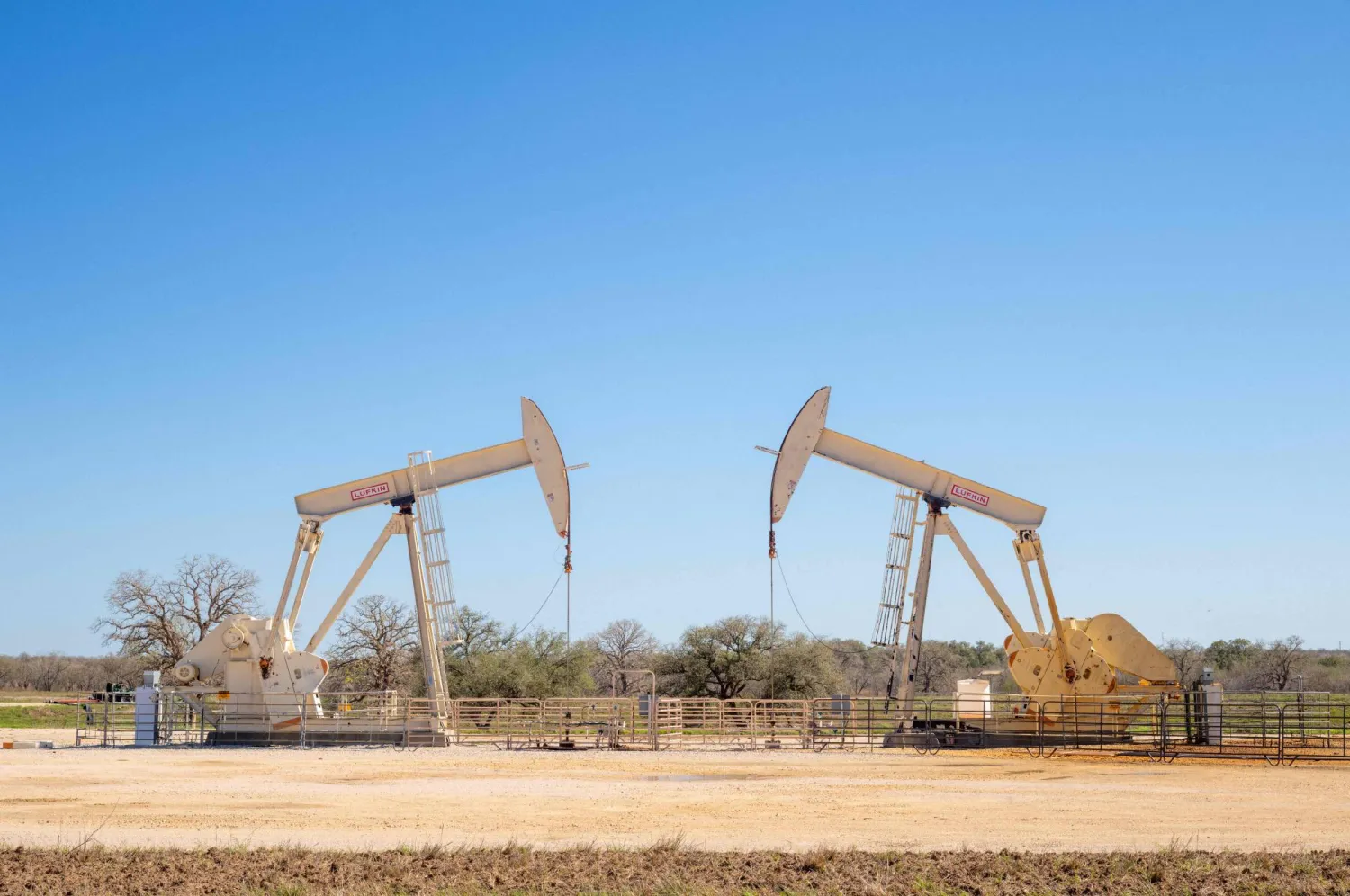
GILLETT, TEXAS - MARCH 11: Pump jacks operate in a field on March 11, 2026 in Gillett, Texas. Brandon Bell/Getty Images/AFP
The US plans to release 172 million barrels of oil from its Strategic Petroleum Reserve, more than 40% of a wider release coordinated with allies, to help dampen prices spiked by supply disruptions from the US-Israeli war on Iran.
The US sale, announced late on Wednesday, is part of a 400-million-barrel release by members of the International Energy Agency. The US Department of Energy said the US drawdown would begin next week and take about four months.
The SPR currently holds about 415 million barrels, most of which is high sulfur, or sour crude, that US refineries are geared to process. The crude is held underground in hollowed-out salt caverns on the coasts of Texas and Louisiana that can store 714 million barrels.
Here is how US presidents have tapped the SPR in times of war:
RUSSIA INVADES UKRAINE
In March 2022, the month after Russia invaded Ukraine, former President Joe Biden ordered the release of 180 million barrels over six months - the largest sale ever from the emergency stash. Biden, and later President Donald Trump, slowly bought some oil to replenish the reserves, but little has been added back as Congress needs to provide more money to do so.
LIBYA CIVIL WAR
In June 2011, former President Barack Obama ordered the release of 30 million barrels of oil from the reserve to offset disruptions to global markets from civil war in oil producer Libya. That sale was coordinated with the Paris-based IEA, resulting in an additional 30-million-barrel release from other member countries.
OPERATION DESERT STORM
In 1990-1991, after the Iraqi invasion of Kuwait, former President George H. W. Bush sold about 21 million barrels in two phases. In October 1990, the US ordered a 3.9-million-barrel test sale. In January 1991, after US and allied warplanes began attacks against Baghdad and other military targets in OPEC-member Iraq as part of Operation Desert Storm, Bush ordered the sale of 34 million barrels, of which half was sold.
Archaeologist Mohamed Mubarak walks past pyramids standing in the Meroe desert, at one of the archaeological sites of the so-called Island of Meroe on the eastern shore of the Nile River, about 220 km north of Khartoum, on April 22, 2026. (Photo by KHALED DESOUKI / AFP)
Mostafa Ahmed Mostafa is the heir to a long line of groundskeepers who have guarded Sudan's ancient pyramids of Meroe. Now, three years into the war between the army and paramilitary forces, he stands near-solitary sentinel over his heritage.
"These pyramids are ours, it's our history, it's who we are," the 65-year-old said, flanked by the dark sandstone structures of the Bajrawiya necropolis, which is part of the Island of Meroe, a UNESCO World Heritage site.
Clad all in white, Mostafa cut a striking figure crossing the 2,400-year-old burial site, which holds 140 pyramids built during the Kingdom of Kush's Meroitic period.
None are intact. Some were decapitated, others reduced to rubble, first in the 1800s by dynamite at the hands of treasure-hunting Europeans, and then by two centuries of sand and rain.
A three-hour drive from the capital Khartoum, it was once Sudan's most visited heritage site. Now three years into the war between Sudan's army and the Rapid Support Forces, only a lone camel's grunt cuts through the silence.
Archaeologist and site director Mahmoud Soliman gave AFP journalists a tour, explaining the Kush kingdom's matrilineal succession, trade routes and relationship with neighboring Egypt.
"It's maybe the fourth time I've shown people around since the war broke out," the scientist said.
Together, he, Mostafa and young archaeologist Mohamed Mubarak man the site, cobbling together resources to keep the erosive rain and sands at bay.
Apart from a short-lived influx of visitors early in the war -- mostly displaced people desperate for something to do -- the site has stood largely abandoned.
It is worlds away from its pre-war days, when there were "regular weekend visits from Khartoum, busloads of 200 people per day", Soliman remembered fondly.
Sudan's heritage sites had experienced a resurgence, he explained, after the uprising of 2018-2019, when young Sudanese protested against Omar al-Bashir.
One chant went: "My grandfather Taharqa, my grandmother Kandaka" -- the former a Kush Pharaoh, the latter the name for ancient queens, and also used to honor the women icons of the revolution.
"Young people were taking more of an interest, they were organizing trips to tourist sites and getting to know their own country," Soliman said.
Sudanese site director Mahmoud Soliman gestures inside a tomb beneath a pyramid at one of the archaeological sites of the so-called Island of Meroe, on the eastern shore of the Nile River, about 220 km north of Khartoum, on April 22, 2026. (Photo by KHALED DESOUKI / AFP)
Residents of the nearby Tarabil village -- named after the local word for "pyramids" -- sold souvenirs and rented camels and "were entirely dependent on the site".
On a breezy day in April, Khaled Abdelrazek, 45, rushed to the site as soon as he heard there were visitors. He squatted at the entrance, showed AFP journalists handmade miniature sandstone pyramids and reminisced about when there were "dozens of us selling".
In the months before the war, there were visits from documentary crews, a music festival and "big ideas for right after Eid al-Fitr", said Soliman -- all destroyed when the war broke out in the last days of Ramadan.
"I used to feel like I was teaching people about their culture," said Mubarak, who has worked at the site since 2018.
"Now, everyone's top priority is of course food and water and shelter. But this is also important. We need to protect this for future generations, we can't let it be destroyed or wither away."
Near the site's entrance, the proud pyramids, each fronted by a small mortuary temple, are framed by rolling black sandstone hills.
The vista is breathtaking, but Soliman said his eyes see only danger: Is that crack in that pyramid new? Has that sand mound moved? Does the pipe scaffolding at that burial chamber entrance need to be redone before the rainy season?
"I think if the pyramids had been left in their original state we wouldn't have all these problems," Mubarak said.
The structures are smaller and steeper than their Egyptian neighbors, built to "withstand the sands and sweep away the rainwater, but every fracture creates issues".
Local site guard Mostafa Ahmed speaks in front of pyramids standing in the Meroe desert, at one of the archaeological sites of the so-called Island of Meroe on the eastern shore of the Nile River, about 220 km north of Khartoum, on April 22, 2026. (Photo by KHALED DESOUKI / AFP)
The largest pyramid of the lot -- of Queen Amanishakheto, who reigned around the 1st century AD -- suffered more than just fractures and is now effectively a sandbox, fine sand swirling where her tomb once stood.
In 1834, Italian adventurer Giuseppe Ferlini, who destroyed dozens of pyramids, levelled Amanishakheto's and carted her jewelry off to Europe. It is now exhibited in the Egyptian museums in Berlin and Munich.
The outside of her temple wall still stands, where a larger-than-life carving of the queen shows her standing proud, holding a spear in one hand and smiting enemy captives.
Soliman showed AFP journalists more reliefs: the lion deity Apademak and motifs shared with Egypt, including the gods Amun and Anubis, lotus flowers and hieroglyphics.
He yearns for the day tourists and archeologists will return.
"This is just a distant dream, but I'd really like us to one day be able to do proper restoration on these pyramids," he said, as if he were not really allowing himself to hope.
Iran's Interior Minister Ahmad Vahidi briefs the media on elections in Tehran, Iran, March 4, 2024. (AP)
TT
TT
Iran’s Guards Seize Wartime Power, Blunting Supreme Leader’s Role
Iran's Interior Minister Ahmad Vahidi briefs the media on elections in Tehran, Iran, March 4, 2024. (AP)
Two months into a war with the US and Israel, Iran no longer has a single, undisputed clerical arbiter at the pinnacle of power — an abrupt break with the past that may be hardening Tehran’s stance as it weighs renewed talks with Washington.
Since its creation in 1979, the Islamic Republic has revolved around a supreme leader with final authority on all key matters of state. But the killing of Ali Khamenei on the first day of the war, and the elevation of his wounded son, Mojtaba, have ushered in a different order dominated by commanders of the Iranian Revolutionary Guard Corps (IRGC) and marked by the absence of a decisive, authoritative referee.
Mojtaba Khamenei remains at the apex of the system, but three people familiar with internal deliberations say his role is largely to legitimize decisions made by his generals rather than issue directives himself.
Wartime pressure has concentrated power into a narrower, harder-line inner circle rooted in the Supreme National Security Council (SNSC), the Supreme Leader’s office and the IRGC, which now dominates both military strategy and key political decisions, Iranian officials and analysts say.
"The Iranians are painfully slow in their response," said a senior Pakistani government official briefed on peace talks between Iran and the United States that Islamabad has been mediating. "There is apparently no one decision-making command structure. At times, it takes them 2 to 3 days to respond."
Analysts said the obstacle to a deal is not internal infighting in Tehran, but the gap between what Washington is prepared to offer and what Iran’s hardline Guards were willing to accept.
The diplomatic face of Iran at the talks with the US has been Foreign Minister Abbas Araghchi, more recently joined by parliament speaker Mohammed Baqer Qalibaf -- a former Guards commander, Tehran mayor and presidential candidate -- who has emerged during the war as a key conduit between Iran’s political, security and clerical elites.
On the ground, however, the central interlocutor has been IRGC commander Ahmad Vahidi, according to a Pakistani and two Iranian sources who identified him weeks ago as Iran's pivotal figure, including on the night a ceasefire was announced.
Mojtaba, who was severely injured in the opening Israeli and US strike that killed his father and other relatives and left him disfigured with serious leg wounds, has not appeared publicly and communicates through IRGC aides or limited audio links because of security constraints, two people close to his inner circle said.
There was no immediate reply from the Iranian foreign ministry to a request for comment on the issues raised in this article. Iranian officials have previously denied any divisions over negotiations with the United States.
People ride motorcycles near a billboard featuring an image of Iran's new Supreme Leader Mojtaba Khamenei, amid a ceasefire between US and Iran, in Tehran, Iran, April 20, 2026. Majid Asgaripour/WANA (West Asia News Agency) via Reuters
REAL POWER WIELDED BY WARTIME LEADERSHIP, INSIDERS SAY
Iran submitted a new proposal to Washington on Monday, which according to senior Iranian sources envisions staged talks, with the nuclear issue to be set aside at the start until the war ends and disputes over Gulf shipping are resolved. Washington insists the nuclear issue must be addressed from the outset.
"Neither side wants to negotiate," said Alan Eyre, an Iran expert and former US diplomat, adding that both believed time would weaken the other -- Iran through leverage over Hormuz and Washington through economic pressure and a blockade.
For now, neither side can afford to bend, Eyre said: Iran’s IRGC is wary of appearing weak to Washington, while President Donald Trump faces midterm election pressure and little room for flexibility without political cost.
"For either, flexibility would be seen as weakness," Eyre said.
That caution reflects not just the pressures of the moment, but the way power is now exercised inside Iran.
While Mojtaba is formally Iran's ultimate authority, he is a figure of assent rather than command, insiders say, endorsing outcomes forged through institutional consensus, rather than imposing authority. Real power, they say, has moved to a unified wartime leadership centered on the SNSC.
"Important deals probably pass through him," Iranian analyst Arash Azizi said, "but I can’t see him overruling the National Security Council. How could he go against those running the war effort?"
Hardline figures such as former nuclear negotiator Saeed Jalili and a cluster of radical MPs have raised their profile using forceful rhetoric during the war, but they lack the institutional clout to derail decisions or shape outcomes.
Mojtaba owes his elevation to the Guards, who sidelined pragmatists and backed him as a reliable guardian of their hardline agenda. Already strengthened by war, the Guards’ growing dominance signals a more aggressive foreign policy and tighter domestic repression, sources familiar with the country's inner policy-making circles told Reuters.
Driven by revolutionary sectarian ideology and a security-first worldview, the Guards see their mission as preserving the regime at home while projecting deterrence abroad.
That outlook, often shared with hardliners across the judiciary and the clerical establishment, prioritizes rigid centralized control and resistance to Western pressure, particularly on nuclear policy and Iran’s regional reach.
POWER SHIFTS FROM CLERICS TO SECURITY SECTOR, ANALYSTS SAY
In practice, the Guards' ideology shapes strategy and decision-making rests firmly in their hands. With the country at war and Ali Khamenei gone, no actor inside the system has the power or scope to resist them, even if they wished to, the people close to internal discussions said.
The choice facing Iran’s leadership is no longer between moderate and hardline policy, but between hardline and even harder line. A small faction may argue for pushing further still, two Iranian sources close to power circles said, but even that impulse has so far been kept in check by the Guards.
The shift marks a decisive reordering of power from clerical primacy to security dominance. "We’ve gone from divine power to hard power," said Aaron David Miller, a former US negotiator. "From the influence of the clerics to the influence of the Revolutionary Guard Corps. This is how Iran is being governed."
While differences of opinion exist, decision-making has consolidated around security institutions, with Mojtaba acting as a central convening figure rather than a lone decider, added Alex Vatanka, senior fellow at the Middle East Institute. Despite sustained military and economic pressure from the United States and Israel, Iran has shown no signs of fracture or capitulation nearly nine weeks into the war.
Nor, as Miller noted, is there evidence of fundamental rifts within the system or meaningful opposition on the streets.
That cohesion suggests that command now sits with the Guards and security services, which appear to be driving the war rather than merely executing it. A strategic consensus has emerged — avoid a return to full-scale war, preserve leverage, especially over the Strait of Hormuz, and emerge from the conflict politically, economically and militarily stronger, Miller said.
Netanyahu’s Rivals Are Joining Forces. Would They Shift Israel’s Security Policy?https://english.aawsat.com/features/5267272-netanyahu%E2%80%99s-rivals-are-joining-forces-would-they-shift-israel%E2%80%99s-security-policy
Former Israeli Prime minister Naftali Bennett and Israeli opposition leader Yair Lapid gesture as they announce their political union ahead of this year's general election, the new party will be called "Together", in Herzliya, Israel April 26, 2026. (Reuters)
TT
TT
Netanyahu’s Rivals Are Joining Forces. Would They Shift Israel’s Security Policy?
Former Israeli Prime minister Naftali Bennett and Israeli opposition leader Yair Lapid gesture as they announce their political union ahead of this year's general election, the new party will be called "Together", in Herzliya, Israel April 26, 2026. (Reuters)
Two of Israeli Prime Minister Benjamin Netanyahu's top rivals announced they would join forces in an upcoming election to oust his coalition government, with a focus mainly on domestic issues such as military conscription for the ultra-Orthodox.
But on issues like Iran, Gaza and Lebanon, the joint party led by right-wing Naftali Bennett and centrist Yair Lapid is expected to pursue a security posture similar to that of Netanyahu - who heads the most right-wing government in Israel's history - meaning Israel's foreign policy would remain largely unchanged.
The new party, called "BeYachad" meaning "together" in Hebrew, has not released a formal policy platform. But below is what is known about their positions on regional conflicts, based on recent public comments.
IRAN
Bennett, 54, and Lapid, 62, have staunchly backed Netanyahu's decision to jointly attack Iran with the US, reflecting broad public support in Israel for the war.
At the start of Israel's aerial bombardment in Iran, Lapid told Reuters in an interview that it was a "just war against evil."
Both Bennett and Lapid have since criticized Netanyahu, 76, for what they describe as a failure to achieve Israel's main objectives in the war, including toppling Iran's clerical government.
However, neither man has called for a resumption in fighting since Israeli and US attacks and Iranian missile fire was halted by an April 8 ceasefire.
A source close to their new party described Bennett and Lapid as "hawkish" and "tough on Iran."
They are also "pragmatic and understand the need for diplomatic agreements and the work that happens after the military use of force to achieve strategic goals," said the source, who spoke on condition of anonymity to describe their party's priorities.
LEBANON
Bennett and Lapid have also both staunchly supported Israeli military operations in Lebanon while questioning an April 17 ceasefire that has failed to halt fighting between the Israeli military and Iran-backed Hezbollah.
Shortly before Israel's military invaded southern Lebanon in March, Lapid said that Israel must take whatever steps were necessary to protect Israelis.
After the ceasefire with Hezbollah was announced in April, Lapid said the only solution was the permanent removal of the threat to northern Israel.
Bennett sharply criticized the ceasefire, saying in an April 17 Facebook post: "One can already count backwards towards the next round. Hezbollah began this morning to rebuild southern Lebanon and is becoming stronger with missiles ahead of the next round."
GAZA
On the war in Gaza, where Israel has continued to carry out deadly strikes despite a ceasefire last October, both Bennett and Lapid have criticized Netanyahu for not fully destroying the Hamas group after the October 7, 2023 attack on Israel that it led.
In January, Lapid said Netanyahu's government had achieved the "worst possible outcome" in Gaza, saying that Hamas still has tens of thousands of armed fighters. Hamas retained control of a sliver of territory on Gaza's coast under the ceasefire.
In a Facebook post this month, Bennett said Netanyahu's policies -- including allowing some aid into the enclave after restricting all humanitarian supplies for three months in 2025 -- had helped Hamas regain control.
"This is with the help of hundreds of aid trucks that Netanyahu's government brings them every day," Bennett wrote.
Netanyahu has cast Israel's devastating military assault that destroyed much of Gaza and killed more than 72,000 Palestinians as a success. He has held out the possibility of resuming a full-scale war if Hamas fails to disarm under a US-backed process, something the group has thus far rejected.
PALESTINIAN STATEHOOD
With public opinion polling showing that most Israelis oppose the formation of an independent Palestinian state in the occupied West Bank, Gaza and East Jerusalem, a Bennett-Lapid government would be unlikely to bring a major policy shift on the Palestinians.
Netanyahu opposes the establishment of a Palestinian state, and his government has accelerated settlement building plans in the West Bank, in what ministers in his government say is part of a bid to destroy any future for Palestinian independence.
In 2022, Lapid, who like many in Israel's political center and left are not outright opposed to Palestinian sovereignty, said that a two-state solution to the Israeli-Palestinian conflict was the right thing to do.
When asked by US broadcaster ABC during a 2024 interview why he opposes a two-state solution, Bennett said he believed it would lead to violence against Israelis.
"What we've learned over the past 30 years is that every time we gave the Palestinians a piece of land, instead of building it into a beautiful Singapore they turned it into a terror state and began killing Israelis," Bennett said.
On the West Bank, Netanyahu, Bennett and Lapid have all spoken forcefully against settler violence toward Palestinians. Such attacks have escalated under Netanyahu, who critics accuse of allowing settlers free rein to burn Palestinian villages and harm villagers. Netanyahu's office denies this.
لم تشترك بعد
انشئ حساباً خاصاً بك لتحصل على أخبار مخصصة لك ولتتمتع بخاصية حفظ المقالات وتتلقى نشراتنا البريدية المتنوعة