


A Grieving Father Buries His 6-Year-Old After a Land Mine Kills 3 Children in Syria’s Idlib

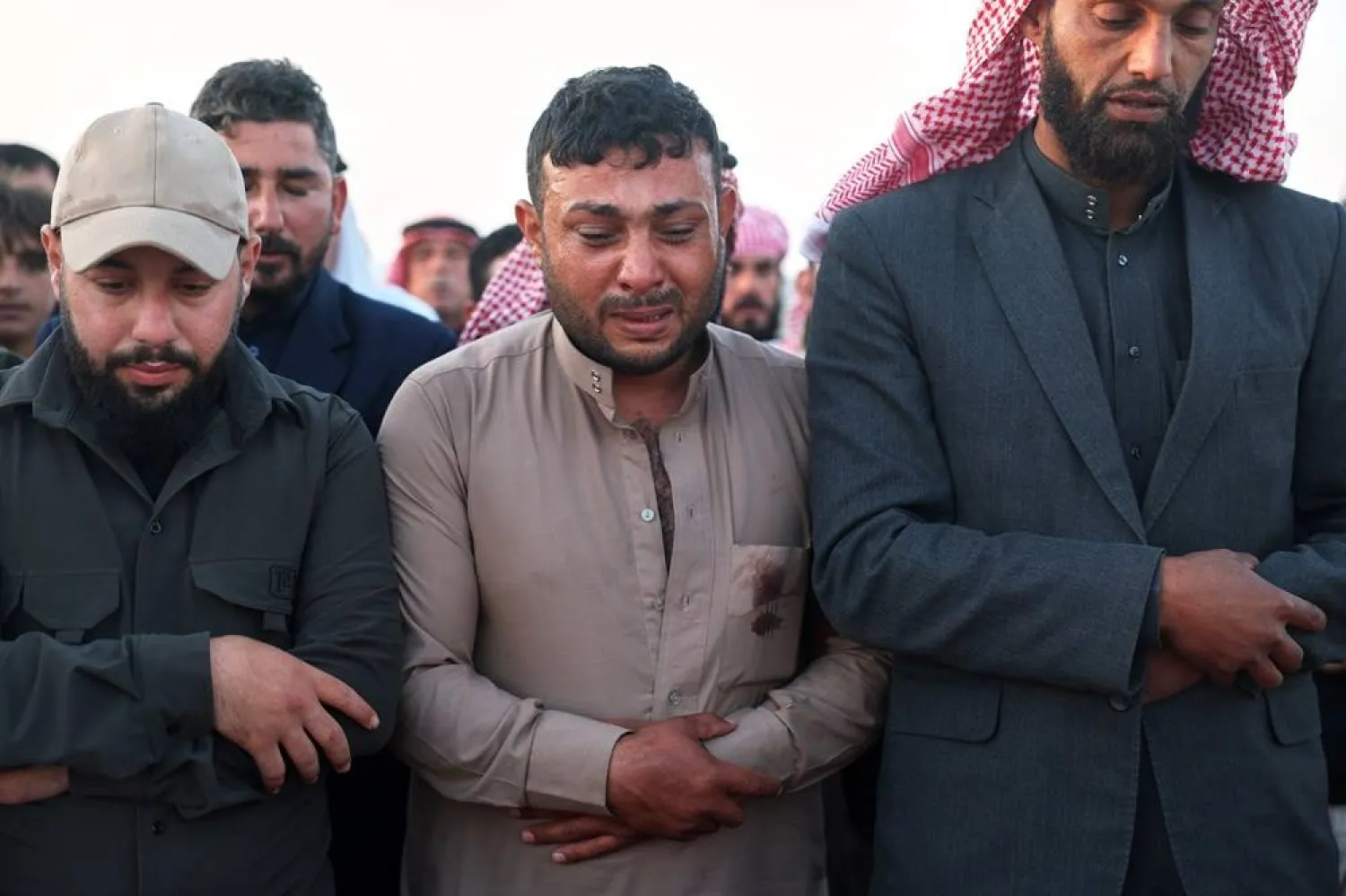
Idris Al-Ridah, center, weeps as he prays during the funeral of his son Mohammed, who was killed in an explosion caused by war remnants while playing with other children in the village of Abu Habbah in eastern Idlib countryside, in Abu Habbah, Syria, Thursday, May 21, 2026. (AP)
TT

A Grieving Father Buries His 6-Year-Old After a Land Mine Kills 3 Children in Syria’s Idlib

Idris Al-Ridah, center, weeps as he prays during the funeral of his son Mohammed, who was killed in an explosion caused by war remnants while playing with other children in the village of Abu Habbah in eastern Idlib countryside, in Abu Habbah, Syria, Thursday, May 21, 2026. (AP)

Idris al-Ridah wept as he carried the lifeless body of his 6-year-old son Amir, wrapped in a yellow and brown blanket, in northwest Syria.

The father collapsed to the ground as he laid his son to rest, his small body lowered into a grave next to two other young children who were siblings, Aya al-Fankih, 4, and Rayan al-Fankih, 6.

The three children were killed on Thursday in the village of Abu Habbah, in the countryside in the northwestern province of Idlib, when a land mine left behind from Syria's war exploded while they were playing near a well.

The deaths are the latest reminder of the dangers posed by unexploded war remnants scattered across the country years after the conflict began.

Mines and booby traps have killed and maimed hundreds of Syrians since Syria’s conflict began in March 2011, leaving about half a million people dead.

The Syrian Civil Defense said four other children who were near the well were also wounded in the blast.

"We heard a very loud explosion next to our house,” one resident, Mahmoud al-Aleiwi. He added that “when we got to the location there were a number of children’s bodies thrown around the well.”

He said one of the children was thrown 300 meters (984 feet) away by the explosion and was found on the roof of a house.

At a nearby hospital, wounded children cried as family members tended to them. One child had shrapnel wounds across his face and body, his legs wrapped in bandages. Another lay in bed with blood visible through bandages wrapped around his head.

Ten-year-old Ibrahim al-Suwadi was injured last month in a separate explosion caused by unexploded ordnance inside a damaged school in the town of al-Habit in Idlib’s southern countryside.

Sitting beside his father inside their home, al-Suwadi described how he was playing with his friends at the school when they went inside a room and found the mine.

“Two brothers picked it up and took it to the bathroom,” the boy said. “We thought it was an exploded mine so we started throwing rocks at it. All of a sudden, an older boy grabbed my hand and we ran, the mine exploded and I lost consciousness then I don’t remember anything.”

His father said the family had fled their village in 2013 during fighting and spent years living in displacement camps before returning after the fall of Bashar Assad’s government in December 2024.

Humanitarian organizations say unexploded ordnance remains one of the deadliest legacies of Syria’s war.

“Syria has ranked among the top contaminated countries around the world over the past years,” said Jakub Valenta, head of humanitarian disarmament and peace building for the Danish Refugee Council in Syria. He added that according to the data from the United Nations, around 14.3 million people are in danger of explosive ordnance in the country.

Valenta said the explosive hazards include anti-personnel mines, anti-tank mines and other unexploded devices left behind in residential and agricultural areas.

“We’re estimating that around 1,200 people and probably more have been affected by explosive ordnance accidents directly,” he said. “Out of those 1,200 people there were around 740 fatal casualties. The vast majority of these people are men and children.”

According to the Danish Refugee Council, around 60% of contaminated areas in Syria are agricultural lands, complicating efforts by displaced families to return home and rebuild livelihoods.

In Damascus’ southern suburb of Kisweh earlier this month, Syrian trainees working with Danish Refugee Council teams carefully removed and destroyed unexploded ordnance during training exercises aimed at expanding local demining capacity.

The organization says it has recruited and trained new Syrian explosive ordnance disposal teams to help clear contaminated areas and educate communities about the risks.

“The number of the casualties is among the highest worldwide in terms of explosive accidents and victims,” Valenta said.

“These people suffer lifelong injuries, physical like losing a limb or their vision and suffer mental health problems," he said. “These people also lose their jobs and livelihoods."



What Will the Next Leader of the UN Need to Get the Job Done in an Increasingly Complex World?

UN Secretary General Antonio Guterres receives a standing ovation after speaking during the 81st United Nations General Assembly at the United Nations Headquarters in New York, on September 22, 2026. (Photo by ANGELA WEISS / AFP)
TT

What Will the Next Leader of the UN Need to Get the Job Done in an Increasingly Complex World?

UN Secretary General Antonio Guterres receives a standing ovation after speaking during the 81st United Nations General Assembly at the United Nations Headquarters in New York, on September 22, 2026. (Photo by ANGELA WEISS / AFP)

On Jan. 1, the next United Nations secretary-general will take over an aging organization still controlled by World War II powers. What will the world need from that person?

Once a major player in solving conflicts and crises around the world, the 81-year-old institution has been sidelined from the top table in trying to end the wars in Iran, Ukraine and Gaza. And its precarious financial situation — caused mainly by the billions of dollars the United States owes — has forced major cuts to its humanitarian and development programs where it has remained a key player.

The annual global gathering of world leaders at the United Nations that ended last week shed some light on what the next UN chief needs to focus on and pursue.

In his farewell address to the General Assembly, outgoing Secretary-General Antonio Guterres told global leaders, “The world does not need a weaker United Nations.”

“It needs a UN strong enough to face the world as it is," he said, “and determined enough to build the world as it should.”

But is that even possible?

Much talk of a shared future with the UN at the center

After 10 years at the helm of the United Nations, Guterres said he is strongly convinced that its greatest power is to build a tomorrow that works for everyone. As he put it, “Our shared future will be forged by whether humanity can govern power wisely.”

Guterres then issued challenges to the United Nations that will be led by his successor, the 193 countries in the General Assembly “and humanity itself."

Will you “uphold the law before impunity becomes normalized?” Will you “end wars before they consume generations?” Will you tackle inequality “before societies fracture?” Will you accelerate climate action “before tipping points are crossed?” Will you govern artificial intelligence “before it governs us?" Guterres asked.

For the next secretary-general — the selection process is ongoing — the top priority will be reconfiguring the United Nations to reflect the 21st century rather than the post-World War II era when it was established.

The new UN chief “will have the most monumental task that the UN has faced in decades because you have a UN that’s going through this critical reform process that it has not gone through for a long time,” said Kizito Byenkya, the Open Society Institute’s advocacy director.

The UN's financial crisis has led to budget cuts and efforts to consolidate programs and agencies, and eliminate hundreds of mandates ordering the UN Secretariat to take a wide variety of actions and deliver reports, many that never get read. That's just to name a few.

At the same time, Byenkya told The Associated Press, “You have huge pressure on all sides for the new secretary-general to act like a general and really play a central role in mediation for world conflicts.” He cited the late secretary-general Kofi Annan, who became directly involved in some conflicts and was a skilled mediator and negotiator.

“If you look at the conflicts we've been facing in the last few years, let's say from Gaza to Sudan to Ukraine and more, you often have to ask yourself: Where has the role of the United Nations been with all of these?,” he said. “In the time of Kofi Annan, he was center to all.”

Reform sounds good but is a lot harder than one might think

During high-level week, leader after leader spoke of the need for reform. But when it comes to taking action, serious and sometimes impossible differences emerge, especially when it comes to reforming the Security Council, the UN’s most powerful body and still controlled by the World War II victors.

All UN member nations want to see the council reflect the 21st century world, but there are huge national differences on how it should be expanded. That has stymied progress for decades.

The five permanent members — the US, Russia, China, Britain and France — hold veto power, which gives them ultimate control. Africa, home to 1.5 billion people, has no permanent seat. Neither does Latin America. Neither do the collection of island nations whose existence is threatened by climate change.

“Security Council reform is not a favor to Africa,” Ghana’s President John Mahama told world leaders last week. “It is an imperative for the legitimacy, credibility, and survival of the United Nations.”

Mahama also raised perhaps the most difficult problem that will confront the next UN chief: the world’s “intense fragmentation, deepening inequality and eroded trust in our multilateral system.”

“We must address the alarming breakdown of global order today,” he said, pointing to “the dangerous drift toward unilateralism."

Mahama lauded the UN Charter, whose opening words say the organization was founded to prevent a repetition of the 20th century’s two world wars. That, he said, “must reign supreme over the cynical doctrine that `might makes right.’”


Thousands of Young Sailors Adjust to Iran War Aboard USS George Washington

Night Aircraft Handling Officer Breana Royston and AE1 Andrew Schmucker coordinate aircraft positioning aboard the USS George Washington in the Arabian Sea, September 13, 2026 (Reuters)
TT

Thousands of Young Sailors Adjust to Iran War Aboard USS George Washington

Night Aircraft Handling Officer Breana Royston and AE1 Andrew Schmucker coordinate aircraft positioning aboard the USS George Washington in the Arabian Sea, September 13, 2026 (Reuters)

An emergency alert blares from a loudspeaker, and Damon Dennard and other sailors on the deck of the aircraft carrier USS George Washington are scrambling. Dennard, 23, is readying bombs for loading onto aircraft as his crewmates race to their positions.

“It has been eventful,” said Dennard, an aviation ordnanceman airman apprentice. Once the alert ends, he takes a breath, sits on one of the bombs and jokes that he probably expected an easier deployment.

“It’s crazy, but at the end of the day, it’s work. That’s all.”

Dennard was one of dozens of sailors Reuters spoke with in September on a rare visit to a US warship that is central to the Iran war.

The visit began at a particularly tense moment, just three days after the US military blew up five Iranian oil tankers in retaliation for Iran targeting a US Navy warship.

The George Washington’s mission near the Strait of Hormuz which has no defined end-date came as a surprise to the crew, who were deployed from Japan at the end of August to relieve another carrier.

The aircraft carrier is effectively a floating city of around 5,000 personnel, each with their own mission, from Majesta Ochoa, who operates a cash register, to Lieutenant Commander Brody Samaha, a “shooter” who helps oversee the launch of aircraft from the carrier’s catapults.
But there is a sense of synchronization as the sailors go about their jobs, crew say.

The aircraft carrier is effectively a floating city of around 5,000 personnel, each with their own mission, from Majesta Ochoa, who operates a cash register, to Brody Samaha, a “shooter” who helps oversee the launch of aircraft from the carrier’s catapults.

“It’s a dance, with lots of people checking each other,” Samaha said, before adding that the flight deck is also a “very dangerous place to be. It’s very unforgiving.”

Ouija Board

Breana Royston, the night aircraft handling officer, or ‘NACHO,’ has a unique perspective over the dangerous maneuvering on the flight deck.

Her job is to supervise aircraft movement, including bringing fighter jets up to the flight deck and back down to the hangar bay via massive elevators.

To do that, she uses what’s known in Navy parlance as a “ouija board” — a real-time model of the deck, with miniature aircraft all lined up in their current positions. It looks a little like a strategy board game.

“We’ve been on our toes the last week, maneuvering and everything — with everything that's going on,” Royston said, adding it’s been “kind of crazy, really busy.”

“It’s nerve-wracking, but it’s fun,” she said.

The Iranian government has repeatedly condemned US military actions in the Strait of Hormuz. On September 25, the Iranian foreign minister said the insecurity prevailing in the strait was the “direct result of the aggressive actions of the United States and the Israeli regime.”

The war began in February with joint strikes on Iranian targets by the US and Israel. US President Donald Trump has said many times the conflict would soon be over, but it persisted for longer than initially expected.

In August, in response to reports of deteriorating conditions, low morale and suicide attempts on the Lincoln, US Secretary of Defense Pete Hegseth said the accounts “misrepresented” the reality, praising sailors who endure austere conditions.

Extended Deployments Pose Strain on Crew

Still, extended deployments can pose enormous strain on crews’ mental health, particularly in wartime, and are a challenge for any navy. Sailors must maintain a state of alert and readiness, heightened in the case of the George Washington due to the threat of drone and missile attack from Iran.

“Morale is really important to us,” said Rear Admiral Jeffrey Heames, the commander of Carrier Strike Group 5.

Heames talked about ensuring the ability of the crew to contact home and receive mail.

“Some of those things affect how sailors hold up out in this kind of environment,” Heames said. “They are huge focus areas for me.”

Reuters spoke with Seaman Deandre Cook as he checked in with his wife back home on a video call. She was holding one of their young daughters on her hip.

It was hard being away from his family, Cook said, but added: “The distance makes the relationship stronger.”

Growing Up

As jets thundered off the carrier’s deck above them, hundreds of members of the George Washington’s crew gathered for a ceremony to mark the 25th anniversary of the September 11, 2001 attacks — an event many of them were too young to remember.

Al Qaeda’s attacks on New York and Washington propelled the US into two decades of war that sent troops to Afghanistan, Iraq, Syria and elsewhere. Many supporters of Trump had hoped Middle East wars were a thing of the past.

After a sailor sang the national anthem, the chaplain on board, Ben Garrett, delivered a prayer as the assembled crew bowed their heads.

“Help us honor those who have gone before us,” Garrett said.

Garrett later told Reuters that many of the crew members are still learning the basics of growing up, including skills like patience, managing relationships and career expectations.

“A huge percentage of this ship are between the ages of 19 and 24 years old,” said Garrett, a Roman Catholic priest. “So they’re trying to figure out being an adult while they’re out here.”
Sometimes sailors enlist to get away from a small town or a situation back home, Garrett added.

Lieutenant Commander Brian Lasley said there were more people on the George Washington than back in his hometown of Fredericktown, Missouri, whose population was 4,429 in the 2020 census.

Camren Pollard, 24, an interior communications electrician third class, said he joined the Navy on a spur-of-the-moment decision after seeing older coworkers unhappy in his previous job. “I wanted to change things in my life,” he said.

“My mom freaked out more than anything. My little brother thought it was kind of cool.” For Pollard, however, “I don’t think about it a whole lot. It’s work for me.”


US-led Troops Exit Iraq: What's Next for Pro-Iran Groups?

A giant Iraqi flag hangs off the reconstructed 12th century "Hadba" leaning minaret at the historic Great Mosque of al-Nuri in the old city of Mosul on September 29, 2026 as Iraq marks the withdrawal of the US-led anti-ISIS coalition forces from the country.  (Photo by Zaid AL-OBEIDI / AFP)
A giant Iraqi flag hangs off the reconstructed 12th century "Hadba" leaning minaret at the historic Great Mosque of al-Nuri in the old city of Mosul on September 29, 2026 as Iraq marks the withdrawal of the US-led anti-ISIS coalition forces from the country. (Photo by Zaid AL-OBEIDI / AFP)
TT

US-led Troops Exit Iraq: What's Next for Pro-Iran Groups?

A giant Iraqi flag hangs off the reconstructed 12th century "Hadba" leaning minaret at the historic Great Mosque of al-Nuri in the old city of Mosul on September 29, 2026 as Iraq marks the withdrawal of the US-led anti-ISIS coalition forces from the country.  (Photo by Zaid AL-OBEIDI / AFP)
A giant Iraqi flag hangs off the reconstructed 12th century "Hadba" leaning minaret at the historic Great Mosque of al-Nuri in the old city of Mosul on September 29, 2026 as Iraq marks the withdrawal of the US-led anti-ISIS coalition forces from the country. (Photo by Zaid AL-OBEIDI / AFP)

With the US-led anti-extremist coalition leaving Iraq, Baghdad faces mounting pressure to rein in Tehran-backed armed groups, a difficult task in a country long caught between its allies, the US and Iran.

Prime Minister Ali al-Zaidi, who assumed power earlier this year with the United States' blessing, has pledged that after the coalition exits on Wednesday, pro-Iran groups would hand over their weapons to the state.

But the issue has proven far more complicated than simple announcements, said AFP.

Iraq has long been a proxy battleground for the US and Iran, with each interfering in major political decisions and government formation.

The ongoing Middle East war, during which Iran-backed groups in Iraq targeted US facilities there and around the region hundreds of times, has deepened Iraq's entanglement.

- 'Tricky' -

Several senior Iraqi officials told AFP that Iran will not accept that the factions hand over their weapons, especially amid the regional war, and its officials have clearly relayed the message.

"If there's a deal between the US and Iran, I think that this whole issue becomes very easy to deal with," Iraqi political analyst Sajad Jiyad said.

But Jiyad said "Iran has been very clear that while there is a conflict going on, they cannot give up their strategic capabilities", including the Iraqi groups and "their ability to attack US interests in Iraq and the region".

It is, however, a "tricky situation", because Iran doesn't want an "unstable Iraq", he added.

"Iran's agenda is to reach a deal with the US, so that these groups will naturally reduce their visibility and activity," without giving up capabilities.

The factions also want assurances that the US won't target them before they consider surrendering their weapons.

But if no progress is forthcoming in terms of disarming these groups, then "the US is not going to make a longer-term commitment of not targeting them", he said.

It will continue on its usual paths: diplomatic and economic pressure through sanctions, and occasional strikes.

- 'Liability' -

The US-led coalition deployed to Iraq and Syria in 2014 to fight the ISIS group, which seized large swathes of both countries and committed atrocities.

Both the coalition and Tehran-backed groups fought ISIS, their common enemy.

After ISIS's defeat in Iraq in 2017, those groups demanded the withdrawal of US troops and began targeting them with drones and missiles, triggering US retaliatory strikes that killed several of their commanders over the years.

US pressure on successive Iraqi governments to disarm the factions mounted, especially after they intervened in support of Palestinians during the Gaza war in 2023, and later backed Tehran in the Middle East war.

Political analyst Jiyad said little should be expected after the coalition's pullout.

"We are not going to get disarmament... but there has to be some sort of progress and some plan," he said.

"What is probably going to happen is the process begins" towards a solution, but it will require time and "trust-building measures".

The Tehran-backed groups feel the government is unable to protect them from the US, and the government sees them as a "liability," he added.

- No plan -

While some groups said they would disarm, other powerful factions refuse to do so.

But the government "does not even have a plan" for how it is going to disarm them, a diplomatic source in Baghdad said.

Two senior politicians told AFP that Zaidi, a newcomer to politics, had repeatedly said he was ready to "confront" the groups if they don't disarm.

For weeks, tensions grew until an unannounced truce was reached, with the intervention of senior politicians who are now hoping to work out a deal.

An Iraqi official said that "the issue needs time to reassure the factions, and prevent any confrontation between Iraqi forces and the armed groups".

Kazem al-Fartoussi, spokesperson for the Kataeb Sayyid al-Shuhada armed group, said the factions don't want a confrontation with the state because "there will be no winners".

But "our weapons are precious, so we have said these weapons are in exchange for sovereignty," including the withdrawal of foreign troops and an end to American political and economic interference.

Fartoussi said the factions are in talks with the government about "regulating" their weapons, as well as their relationship with the state, but he doesn't trust the US.

For the Americans and Israelis, their objective is "nothing other than eliminating the factions, not the weapons," Fartoussi said.

If the issue is the factions' "existence", then "we reject any discussion".