

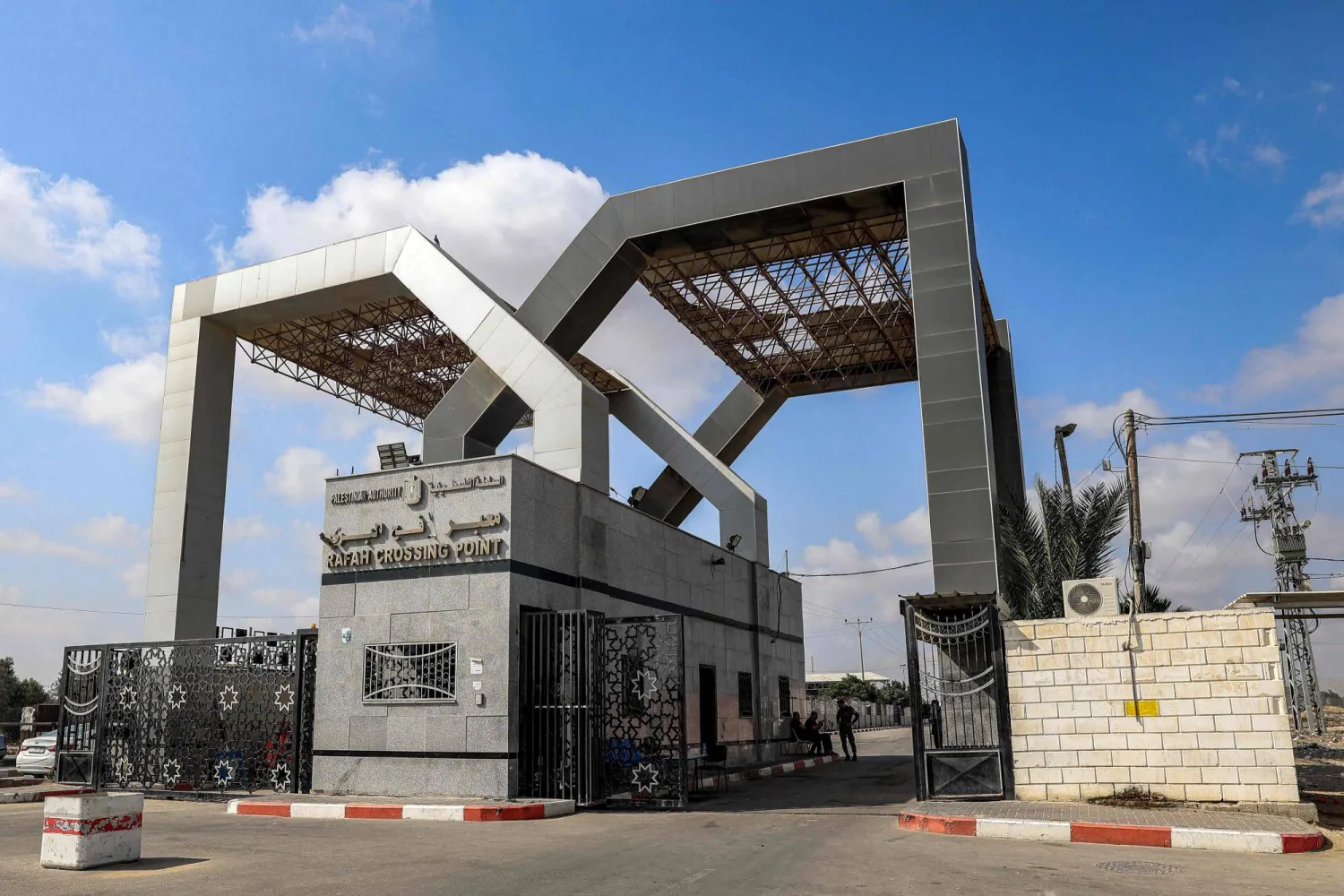

The Rafah Crossing Is Gaza’s Lifeline to the World and Could Open Soon

This picture taken on August 27, 2023 shows a view of the entrance of the Rafah border crossing with Egypt in the southern Gaza Strip. (AFP)
TT

The Rafah Crossing Is Gaza’s Lifeline to the World and Could Open Soon

This picture taken on August 27, 2023 shows a view of the entrance of the Rafah border crossing with Egypt in the southern Gaza Strip. (AFP)

Palestinians are eagerly awaiting the reopening of the Rafah border crossing, which is Gaza’s lifeline and only gateway to the outside world that wasn’t controlled by Israel before the war.

The opening is expected after Israel on Monday announced that the remains of the final hostage in Gaza, Ran Gvili, had been recovered. Hours earlier, Israel had said it would open the Rafah crossing with limitations once the search operation for Gvili was complete.

The opening of the crossing between Gaza and Egypt, which was controlled by Egypt before the war, is seen as ushering in the second phase of the US-brokered ceasefire, though its opening had been called for as part of the first phase.

Here’s why the crossing is so vital.

What comes next

It is not immediately clear when the crossing will open and whether it will allow the flow of goods and people both into and out of the war-shattered territory. Prime Minister Benjamin Netanyahu’s office late Sunday said Israel had agreed to a reopening “for pedestrian passage only, subject to a full Israeli inspection mechanism.”

Hamas in a statement Monday called on Israel to open the Rafah crossing in both directions “without restrictions.” Ali Shaath, head of the new Palestinian committee administering Gaza’s daily affairs, last week said the crossing would be opened this week to facilitate movement to and from the enclave.

A reopened Rafah crossing would make it easier for Gazans to seek medical treatment, travel internationally or visit family in Egypt, which is home to tens of thousands of Palestinians. It would also help Gaza’s devastated economy, as Palestinian-made olive oil and other products are widely sold in Egypt and throughout the Arab world.

“We hope this will close off Israel’s pretexts and open the crossing,” said Abdel-Rahman Radwan, a Gaza City resident whose mother is a cancer patient and requires treatment outside Gaza.

Israel also has said Palestinians wanting to leave Gaza will have to get Israeli and Egyptian security approval. Egypt says it wants the crossing immediately opened in both directions, so Palestinians in Egypt can enter Gaza. Egypt has been opposed to Palestinian refugees permanently resettling in that country.

A lifeline for Gaza

With much of Gaza turned to rubble, the United Nations has said the territory’s population of over 2 million people needs a massive influx of fuel, food, medicine and tents. While some aid has entered via the crossing, trucks have been lined up outside it for months while waiting for the chance to enter.

Before the war, the Rafah crossing bustled with goods and people. Although Gaza has four other border crossings, they are shared with Israel, and only Rafah links the territory with another neighboring country.

After Hamas-led fighters sparked the war by attacking southern Israel on Oct. 7, 2023, Egypt tightened its restrictions on traffic through the Rafah crossing. Israel took control of the Gaza side in May 2024 as part of its offensive and closed the crossing except to the occasional medical evacuation.

Questions about the future

The Gaza side of the Rafah crossing was heavily damaged during the war. Once it does reopen, Israel has agreed to adhere to the humanitarian terms put in place for the previous ceasefire that took effect in January 2025, including allowing a certain number of truckloads of aid per day into Gaza.

With the current ceasefire deal calling for Hamas to have no role in running Gaza, it’s unclear who will operate the territory’s side of the Rafah crossing once the war ends.

The crossing also will be central to Gaza's reconstruction. Last week, US President Donald Trump’s son-in-law and Middle East adviser Jared Kushner said postwar construction would first focus on building “workforce housing” in Rafah, the nearby southern city currently controlled by Israeli troops.

But Netanyahu on Monday told Israel's parliament, the Knesset: “We are at the start of the next (ceasefire) phase. What is the next phase? The next phase is disarming Hamas and demilitarizing the Gaza Strip. The next phase is not reconstruction.”

Meanwhile, humanitarian supplies inch forward. On Monday, the Egyptian Red Crescent facilitated the entry of a convoy carrying over 7,060 tons of food and medical aid through the Egyptian side of the Rafah crossing en route to Israeli inspection at Kerem Shalom before it potentially heads into Gaza, according to Egypt’s State Information Service.




'Metals of the Future': Copper and Silver Flow Beneath Poland's Surface

Smelter workers process copper at the Glogow plant in southwestern Poland, owned by KGHM. Wojtek RADWANSKI / AFP
TT

'Metals of the Future': Copper and Silver Flow Beneath Poland's Surface

Smelter workers process copper at the Glogow plant in southwestern Poland, owned by KGHM. Wojtek RADWANSKI / AFP

Thousands of meters beneath the ground, amid suffocating heat, lies one of the keys to Poland's rumbling mining sector -- and the world economy.

Whitish ore, rich in copper and silver, is extracted from the country's depths and exported around the world to fuel technological and energy transitions.

"These are the metals of the future," Ariel Wojciuszkiewicz, a geologist at the Polkowice-Sieroszowice mine in the west of the country, tells AFP, noting that copper and silver are "indispensable for electronic equipment, electric cars, and renewable energy installations".

Driven by the rise of artificial intelligence, renewable energies, and global defense needs, demand for these metals is expected to keep increasing in the future, with copper even being referred to as "red gold" and a "barometer" for world economic development.

Poland, responsible for as much as half of Europe's supply, is one of the industry's key players.

Equipped with a helmet and an emergency breathing device, Wojciuszkiewicz leads AFP journalists through the Polkowice-Sieroszowice mine -- one of three sites operated by KGHM, the Polish metals giant, which also owns local smelters and companies in the Americas.

The 24-hour operation runs at a constant roar as machines grind rock at deafening volumes, its tunnels stretching for hundreds of kilometers beneath Poland's surface.

The world's second-largest silver producer, the KGHM group also supplies between 40 percent and 50 percent of the copper produced in Europe.

Last year, it ranked eighth worldwide in terms of copper extraction volume, behind global giants such as BHP Group, Glencore Plc and Rio Tinto, according to industry statistics.

Global copper demand, already high, is expected to climb by over 40 percent by 2040, according to a 2025 UN Report.

To meet this demand, "it might take 80 new mines and 250 billion dollars in investments by 2030," the organization estimates.

The International Energy Agency (IEA), however, predicts that supply will lag 30 percent behind demand by as early as 2035.

- 1,200 degrees Celsius -

Dependence on copper is growing exponentially across the world economy's most innovative sectors.

"We don't realize how much we are surrounded by copper on all sides," Piotr Krzyzewski, KGHM vice president in charge of finance, explains to AFP.

"An electric car contains 80 kg of copper, compared with 20 kg in a conventional one," he notes, while "a wind turbine contains between four and ten tons of copper per megawatt."

Farther away, at the Glogow smelter, two workers in protective suits, armed with long lances, open huge furnaces where the ore is melted.

They work diligently as sparks fly from metal heated to 1,200C.

Several processing stages later, 99.99 percent pure copper plates, each weighing more than a hundred kilos, are shipped all over the world.

Last year, the KGHM group as a whole generated more than 36 billion zlotys ($9.7 billion) in revenue. Copper production reached 710,000 tons and silver production 1,347 tons, according to the group's annual report, published at the end of March.

No less than half of the silver is used in industry, mainly for electronics, solar panels, and medical applications. The rest goes to jewelery or serves as a safety net and financial asset.

But it is copper, now an irreplaceable metal for the economy, that has become the object of global strategic contention.

"Copper is on the strategic list of critical metals in Europe, the United States, and China," Krzyzewski tells AFP.

The metal's impact on geopolitics is already being noted in real time.

In July, US President Donald Trump announced a 50 percent tariff on copper, eventually limiting the measure to products made with the metal.

To justify his decision, he invoked the need to "defend national security".

"Copper is the second most used material by the Department of Defense!" he said.

- Record prices -

In 2025, copper prices jumped 41.7 percent, before hitting a record high of $14,527.50 a ton in January of this year.

Even in the face of the war in the Middle East and the slowdown of the global economy, the price remains high at about 12,000 dollars per ton.

In this uncertain context, Poland's subsoil appears to be a major asset for the energy sovereignty of the Old Continent.

"It's no longer about the security of our country alone, but the security of all of Europe," Krzyzewski says, adding that KGHM's resources "are still estimated to last for at least 40 years," not counting new exploration and concessions.

But mining consumes enormous amounts of water, making it subject to the effects of global warming and drought.


Trump’s Anger Over Iran Thrusts NATO into Fresh Crisis

A NATO flag flutters at the Tapa military base, Estonia April 30, 2023. (Reuters)
TT

Trump’s Anger Over Iran Thrusts NATO into Fresh Crisis

A NATO flag flutters at the Tapa military base, Estonia April 30, 2023. (Reuters)

The NATO alliance has in recent years survived existential challenges - ranging from the war in Ukraine to multiple bouts of pressure and insults from US President Donald Trump, who has questioned its core mission and threatened to seize Greenland.

But it is the US-Israeli war with Iran, thousands of miles from Europe, that has nearly broken the 76-year-old bloc and threatens to leave it in its weakest state since its creation, say analysts and diplomats.

Trump, enraged that European countries have declined to send their navies to open up the Strait of Hormuz to global shipping following the start of the air war on Feb 28, has declared he is considering withdrawing from the alliance.

"Wouldn't you if you were me?" Trump asked Reuters in a Wednesday interview.

In a speech on Wednesday night, Trump criticized US allies but stopped short of condemning NATO, as many experts thought he might.

But combined with other barbs aimed at Europeans in recent weeks, Trump's comments have provoked unprecedented concern that the US will not come to the aid of European allies should they be attacked, whether or not Washington formally walks away.

The result, say analysts and diplomats, is that the alliance created in the Cold War that has long served as the basic fabric of European security is fraying and the mutual defense agreement at its core is no longer taken as a given.

"This is the worst place (NATO) has been since it was founded," said Max Bergmann, a former State Department official who now leads the Europe, Russia, and Eurasia Program at the Center for Strategic and International Studies in Washington.

"It's really hard to ‌think of anything that ‌even comes close."

That reality is sinking in for Europeans, who have counted on NATO as a bulwark against an increasingly assertive Russia.

As recently ‌as February, ⁠NATO Secretary-General Mark ⁠Rutte had dismissed the idea of Europe defending itself without the US as a "silly thought." Now, many officials and diplomats consider it the default expectation.

"NATO remains necessary, but we must be capable of thinking of NATO without the Americans," said General Francois Lecointre, who served as France's armed forces chief from 2017 to 2021.

"Whether it should even continue to be called NATO - North Atlantic Treaty Organization - is a valid question."

White House spokeswoman Anna Kelly said: “President Trump has made his disappointment with NATO and other allies clear, and as the President emphasized, ‘the United States will remember.’”

A NATO representative did not immediately respond to a request for comment.

THIS TIME IT'S DIFFERENT

NATO has been challenged before, not least during Trump's first term from 2017 to 2021, when he also considered withdrawing from the alliance.

But while many European officials until recently believed that Trump could be kept on board with pomp and flattery, fewer now hold that belief, according to conversations with dozens of former and current US and European officials.

Trump and his officials have expressed frustration over what they see as NATO's unwillingness to help the United ⁠States in a time of need, including by not directly assisting with the Strait of Hormuz and by restricting US use of some airfields and ‌airspace. US officials have declared NATO cannot be a "one-way street".

European officials counter that they have not received US requests for specific ‌assets for a mission to open the strait and complain that Washington has been inconsistent about whether such a mission would operate during or after the war.

"It's a terrible situation for NATO to be in," said ‌Jamie Shea, a former senior NATO official who is now a senior fellow at the Friends of Europe think tank.

"It is a blow to the allies who, since Trump returned to ‌the White House, have worked hard to show that they are willing and able to take more responsibility (for their own defense)."

Trump's latest comments follow other signs of an increasingly unsteady alliance.

Those include his stepped-up threats in January to wrest Greenland away from Denmark and recent moves by the US that Europeans see as particularly accommodating toward Russia, which NATO defines as its principal security threat.

The administration has remained essentially mum amid reports that Moscow has provided targeting data for Iran to attack US assets in the Middle East and has lifted sanctions on Russian oil in a bid to ease global energy prices that have spiked during the war.

At a meeting of G7 foreign ministers ‌near Paris last week, US Secretary of State Marco Rubio and Kaja Kallas, the foreign policy chief of the European Union, had a tense exchange, according to five people familiar with the matter, underlining the increasingly fraught transatlantic relationship.

Kallas asked when US patience with Russian President Vladimir ⁠Putin would run out over Ukraine peace negotiations, prompting Rubio ⁠to respond with irritation that the US was trying to end the war while also providing support to Ukraine, but the EU was welcome to mediate if it wanted to.

NO GOING BACK

Legally, Trump may lack the authority to withdraw from NATO. Under a law passed in 2023, a US president cannot exit the alliance without the consent of two-thirds of the US Senate, a nearly impossible threshold.

But analysts say that, as commander-in-chief, Trump can decide whether the US military will defend NATO members. Declining to do so could imperil the alliance without a formal withdrawal.

To be sure, not everyone sees the current crisis as existential. One French diplomat described the president's rhetoric as a passing temper tantrum.

Trump has changed his position on NATO before.

In 2024, he said on the campaign trail that he would encourage Putin to attack NATO members that do not pay their fair share on defense. By the last annual NATO summit, in June 2025, the alliance was in his good graces, with Trump delivering a speech effusively praising European leaders as people who "love their countries."

Next week, Rutte, the NATO secretary-general, who has a strong relationship with Trump, is set to visit Washington in an effort to change Trump's view once again.

Analysts say European nations have good reason to keep the US engaged in NATO despite doubts over whether Trump would come to their defense. Among other reasons, the US military provides a range of capabilities NATO can't easily replace, such as satellite intelligence.

Even if Trump and the Europeans find a way to stay together in NATO, diplomats, analysts and officials say, the transatlantic alliance that has been central to the global order since World War Two may never be the same.

"I do think we're turning the page of 80 years of working together," said Julianne Smith, the US ambassador to NATO under Democratic President Joe Biden.

"I don't think it means the end of the transatlantic relationship, but we're on the cusp of something that's going to have a different look and feel to it."


A Look at the UK’s Royal Navy, Which Has Faced Jibe After Jibe from Trump and Hegseth

Indonesian soldiers stand guard as Royal Navy offshore patrol vessel HMS Spey is docked at Tanjung Priok Port during a port visit in Jakarta, Indonesia, Wednesday, Jan. 15, 2025. (AP Photo/Tatan Syuflana, File)
TT

A Look at the UK’s Royal Navy, Which Has Faced Jibe After Jibe from Trump and Hegseth

Indonesian soldiers stand guard as Royal Navy offshore patrol vessel HMS Spey is docked at Tanjung Priok Port during a port visit in Jakarta, Indonesia, Wednesday, Jan. 15, 2025. (AP Photo/Tatan Syuflana, File)

US President Donald Trump and his Defense Secretary Pete Hegseth have been damning of the UK's naval capabilities. Their jibes may have stung in a country with a long and proud maritime history, but they do carry some substance.

The UK has been at the forefront of Trump’s ire since the onset of the Iran war on Feb. 28, when British Prime Minister Keir Starmer refused to grant the US military access to British bases.

Though that decision has been partly reversed with the decision to permit the US to use the bases, including that of Diego Garcia in the Indian Ocean, for so-called defensive purposes, Trump is adamant he was let down. He has repeatedly lashed out at Starmer and branded the Royal Navy’s two aircraft carriers as “toys.”

“You don’t even have a navy,” he told Britain's Daily Telegraph in comments published Wednesday. "You’re too old and had aircraft carriers that didn’t work.”

Hegseth, meanwhile, said sarcastically that the “big, bad Royal Navy” should get involved in making the Strait of Hormuz safe for commercial shipping.

For numerous reasons, the Royal Navy is not as big and bad as it used to be when Britannia ruled the waves. But it's not as feeble as Trump and Hegseth imply and is largely similar with the French navy, which it is often compared with.

“On the negative side, there is a grain of truth, with the Royal Navy being smaller than it has been in hundreds of years,” said professor Kevin Rowlands, editor of the Royal United Services Institute Journal. “On the positive side, the Royal Navy would say that it’s entering its first period of growth since World War II, with more ships set to be built than in decades.”

Capabilities and preparedness

It’s not that long ago that Britain could muster a task force of 127 ships, including two aircraft carriers, to sail to the south Atlantic after Argentina’s invasion of the Falkland Islands. That 1982 campaign, which then-US President Ronald Reagan was lukewarm about, marked the final hurrah of Britain’s naval pedigree.

Nothing on that scale, or even remotely, could be accomplished now. Since World War II, Britain’s combat-ready fleet has declined substantially, much of it linked to changing military and technological advances and the end of empire. But not all.

The number of vessels in the Royal Navy fleet, including aircraft carriers, destroyers frigates and submarines has fallen from 166 in 1975 to 66 in 2025, according to The Associated Press' analysis of figures from the Ministry of Defense and the House of Commons Library.

Though the Royal Navy has two aircraft carriers at its command, there was a seven-year period in the 2010s when it had none. And the number of destroyers has halved to six while the frigate fleet has been slashed from 60 to just 11.

Diminished state

The Royal Navy faced criticism for the time it took to send the HMS Dragon destroyer to the Middle East after the war with Iran broke out. Though naval officials worked night and day to get it shipshape for a different mission than the one it was readying for, to many it symbolized the extent to which Britain’s military has been gutted since the fall of the Berlin Wall in 1989.

For much of the Cold War, Britain was spending between 4% and 8% of its annual national income on its military. After the Cold War, that proportion steadily dropped to a low of 1.9% of GDP in 2018, fuel to Trump's fire.

Like other countries, Britain, largely under the Labour governments of Tony Blair and Gordon Brown, sought to use the so-called “peace dividend” following the collapse of the Soviet Union to divert money earmarked for defense to other priorities, such as health and education.

And the austerity measures imposed by the Conservative-led government in the wake of the global financial crisis of 2008-9 prevented any pickup in defense spending despite the clear signs of a resurgent Russia, especially after its annexation of Crimea and parts of eastern Ukraine.

No quick fix

In the wake of Russia's full-blown invasion of Ukraine in 2022, and with another Middle East war underway, there's a growing understanding across the political divide that the cuts have gone too far.

Following the Ukraine invasion, the Conservatives started to turn the military spending tide around. Since the Labour Party returned to power in 2024, Starmer is seeking to ramp up British defense spending, partly at the cost of cutting the country's long-vaunted aid spending.

Starmer has promised to raise UK defense spending to 2.5% of gross domestic product by 2027, and the updated goal is now for it to rise to 3.5% of GDP by 2035, as part of a NATO agreement pushed by Trump. That, in plain terms, will mean tens of billions pounds more being spent — a lot more kit for the armed forces.

The pressure is on for the government to speed that schedule up. But with the public finances further imperiled by the economic consequences of the Iran war, it's not clear where any additional money will come.

The jibes will likely keep coming even though the critiques are unfair and far from the truth, said RUSI's Rowlands, who was a captain in the Royal Navy.

“We are dealing with an administration that doesn’t do nuance,” he said.