



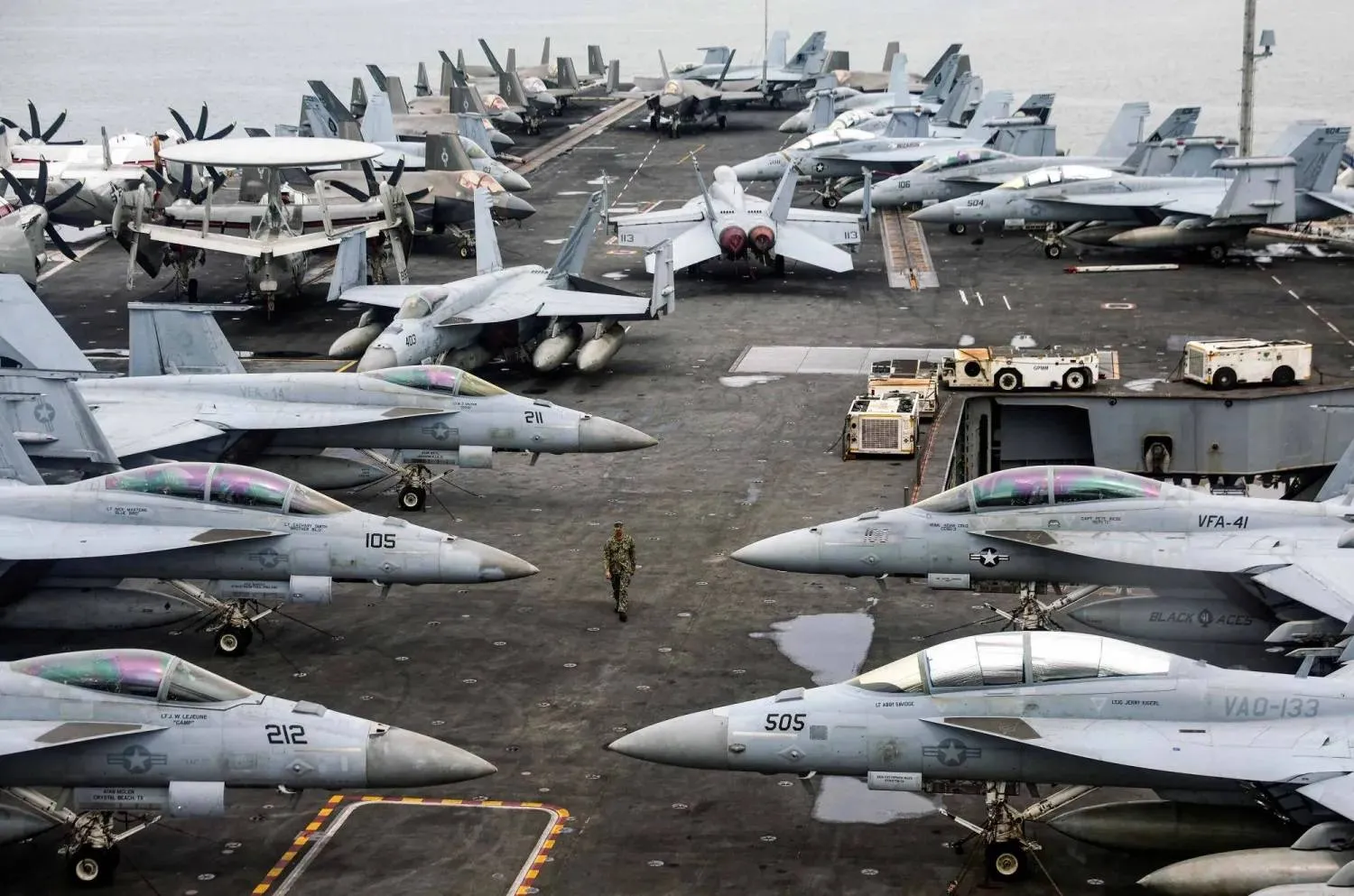

All indications suggest that US military action against Iran may be imminent. Yet the paradox is that edging toward the brink of confrontation may itself be part of negotiations being conducted under intense pressure.
Mutual threats, naval and air deployments, and deterrence messages are carefully calibrated to demonstrate seriousness without sliding into a war that President Donald Trump’s administration does not want.
Trump has repeatedly spoken of an “armada” in the region, while at the same time saying Tehran is sending signals of readiness to negotiate, a deliberate dual track aimed at keeping the adversary uncertain.
This tension between preparing for a strike and keeping the door to a deal ajar aligns with Farzin Nadimi's assessment. Nadimi is a senior Iran analyst at the Washington Institute for Near East Policy.
Speaking to Asharq Al-Awsat, Nadimi said he cannot predict what the US president will ultimately decide, adding that regardless of what Trump says to the media, the military buildup points to limited, focused strikes or a scaled-down military campaign.
According to Nadimi, such a campaign would intend to punish and deter the Iranian regime, weaken its ability to retaliate against the United States and its allies, and or disrupt oil flows from the Gulf.
The implication is that the buildup is not mere showmanship but the creation of an operational environment that enables a rapid strike if the political channel fails, without becoming mired in a prolonged war.
Calibrated options
The entry of the US aircraft carrier Abraham Lincoln and its strike group into the US Central Command area of operations in the western Indian Ocean shortens the timeline for possible action if a political decision is taken.
This has coincided with additional air reinforcements, including the deployment of F-15 fighter jets.
Together, these elements give Washington a ladder of options: a limited strike, a series of time-phased military strikes, or a defensive posture designed to raise the cost of any Iranian retaliation against US bases and allies.
But a “limited strike” is not just a technical choice; it is a political one, conditioned on answering a central question: what exactly does Washington want to achieve, and what is the “off-ramp” that would allow it to declare success and return to negotiations?
Here, Nadimi voices skepticism. He expressed doubts about the ability to achieve these objectives with such limited means.
A “mini” campaign may appear attractive because it avoids full-scale war, but it may not ensure deterrence or protect energy flows if Tehran opts for asymmetric retaliation, explained Nadimi.
Iran’s threats as a constraint
On the other side, Tehran and its regional allies have raised the tone of their threats. Iranian officials have warned of a “more painful” response if attacked, while statements from Hezbollah, Iraqi factions, and Yemen’s Houthis signal readiness to join any confrontation.
Such rhetoric serves the purpose of deterrence and boosting morale within the axis, but it carries a structural risk: the higher the ceiling of threats, the narrower the space for de-escalation.
The likelihood grows that an undisciplined actor, a faction or militia, could ignite an action that forces everyone into a “a cycle of retaliation,” widening the conflict beyond the calculus of a “limited” strike.
This is why Washington, according to reports, has focused on sending warning messages to Baghdad and to armed actors that any targeting of US forces would be met with direct retaliation against militias. The aim is to curb slippage that could turn a single strike into multiple fronts.
At the core of US concern is not only Iran’s ability to retaliate, but where it might do so. US bases across Iraq, Syria, and the Gulf are vulnerable targets in any escalation.
The buildup, therefore, has a clear defensive dimension, reinforcing interception systems and maritime and air defenses to contain missiles and drones.
While this is meant to protect forces, it also seeks to keep escalation in check: deterring or neutralizing retaliatory strikes so they do not force Washington into larger steps.
Alternatives to war
If force is used, the most likely scenario would involve limited, time-phased strikes targeting air defenses, missile sites, command-and-control nodes, and possibly sensitive facilities, before stopping at a point that allows a return to the political track.
The stated or implicit goal would be “punishment” and “deterrence” without ground entanglement.
Iran, however, always retains room to respond below the threshold but in painful ways, through proxies, disruption of shipping, or gradual attrition that embarrasses Washington and its allies and pushes them toward harder choices.
Here again, Nadimi questions whether limited tools would suffice, noting that success is not measured by the number of missiles launched on the first night, but by Washington’s ability to prevent Tehran from redefining the battlefield and its timing.
Targeting the leadership
In such crises, the question of “decapitation” often arises: could Washington move to target Iran’s leadership?
Nadimi addresses this cautiously, saying that targeting the supreme leader would be conceivable only “if there were a high probability of success and a low risk of casualties among US forces.”
He stresses the need to remember “the fundamental differences between Iran and Venezuela,” underscoring that what might be imagined in one political or security environment cannot be simply transplanted into Iran’s far more fortified and complex system.
Still, Nadimi adds that “the possibility of an internal operation should not be ruled out,” a phrase suggesting that the most dangerous scenarios may not begin with a missile, but with an internal rupture or movement intersecting with external pressure.
The heaviest factor in Washington’s calculations is not fear of immediate military defeat, but uncertainty about “the day after” if the system were shaken or lost control.
Iran is a large country with a complex institutional and security structure. Any major fracture could unleash a chain of scenarios, including factional conflict, security vacuums, economic turmoil, refugee flows, and immediate shocks to energy markets and the region.
Seen through this lens, the US buildup is also a negotiating tool: a threat sufficient to open doors without assuming responsibility for the consequences of collapse.
In sum, the Trump administration appears to be holding two threads at once: building up forces to make a strike an immediate option, and signaling enough pressure to force Tehran to consider negotiations, while trying to keep any confrontation below the threshold of a “mini campaign,” not a full-scale war.


