


The Last US-Russian Nuclear Pact Is About to Expire, Ending a Half-Century of Arms Control

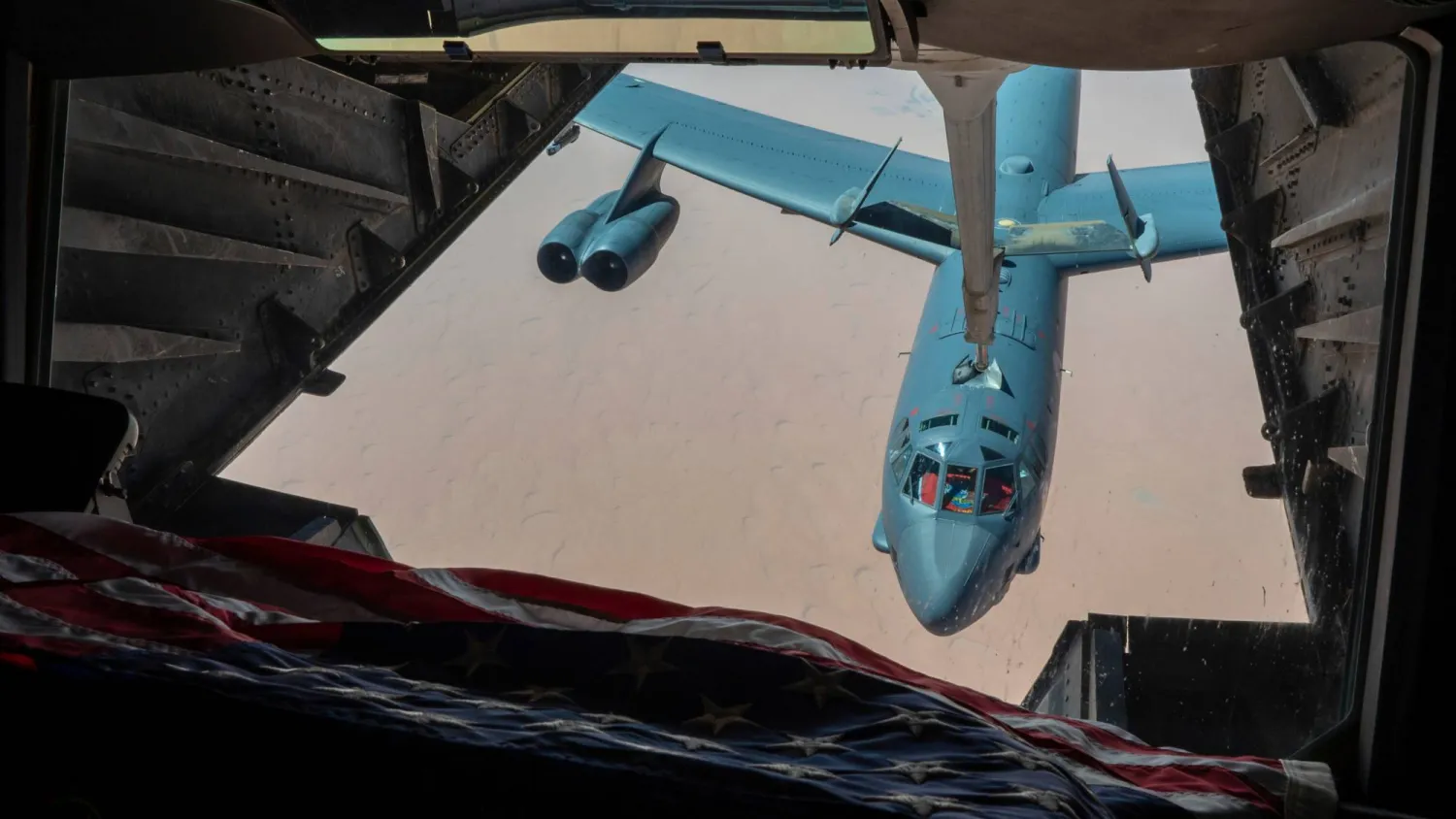
This photo released by the US Air Force shows a B-52H Stratofortress approaching a KC-10 Extender for refueling over the Middle East, Sept. 4, 2022. (US Air Force/Staff Sgt. Shannon Bowman, via AP, File)
TT

The Last US-Russian Nuclear Pact Is About to Expire, Ending a Half-Century of Arms Control

This photo released by the US Air Force shows a B-52H Stratofortress approaching a KC-10 Extender for refueling over the Middle East, Sept. 4, 2022. (US Air Force/Staff Sgt. Shannon Bowman, via AP, File)

The last remaining nuclear arms pact between Russia and the United States is set to expire Thursday, removing any caps on the two largest atomic arsenals for the first time in more than a half-century.

The termination of the New START Treaty would set the stage for what many fear could be an unconstrained nuclear arms race.

Russian President Vladimir Putin declared readiness to stick to the treaty’s limits for another year if Washington follows suit, but President Donald Trump has been noncommittal about extending it.

Trump has repeatedly indicated he would like to keep limits on nuclear weapons and involve China in arms control talks, a White House official who was not authorized to talk publicly and spoke on condition of anonymity said Monday. Trump will make a decision on nuclear arms control “on his own timeline,” the official said.

Beijing has balked at any restrictions on its smaller but growing nuclear arsenal.

Kremlin spokesman Dmitry Peskov said Tuesday it would be a “more dangerous” world without limits on US and Russian nuclear stockpiles.

Arms control advocates long have voiced concern about the expiration of New START, warning it could lead to a new Russia-US arms race, foment global instability and increase the risk of nuclear conflict.

Failure to agree on keeping the pact’s limits will likely encourage a bigger deployment, said Daryl Kimball, executive director of the Arms Control Association in Washington.

“We’re at the point now where the two sides could, with the expiration of this treaty, for the first time in about 35 years, increase the number of nuclear weapons that are deployed on each side,” Kimball told The Associated Press. “And this would open up the possibility of an unconstrained, dangerous three-way arms race, not just between the US and Russia, but also involving China, which is also increasing its smaller but still deadly nuclear arsenal.”

Kingston Reif of the RAND Corporation, a former US deputy assistant secretary of defense, also warned during an online discussion that “in the absence of the predictability of the treaty, each side could be incentivized to plan for the worst or to increase their deployed arsenals to show toughness and resolve, or to search for negotiating leverage.”

Putin repeatedly has brandished Russia’s nuclear might since sending troops into Ukraine in February 2022, warning Moscow was prepared to use “all means” to protect its security interests. In 2024, he signed a revised nuclear doctrine lowering the threshold for nuclear weapons use.

Signed in 2010 New START, signed in 2010 by US President Barack Obama and his Russian counterpart, Dmitry Medvedev, restricted each side to no more than 1,550 nuclear warheads on no more than 700 missiles and bombers — deployed and ready for use. It was originally supposed to expire in 2021 but was extended for five more years.

The pact envisioned sweeping on-site inspections to verify compliance, although they stopped in 2020 because of the COVID-19 pandemic and never resumed.

In February 2023, Putin suspended Moscow’s participation, saying Russia couldn’t allow US inspections of its nuclear sites at a time when Washington and its NATO allies have openly declared Moscow’s defeat in Ukraine as their goal. At the same time, the Kremlin emphasized it wasn’t withdrawing from the pact altogether, pledging to respect its caps on nuclear weapons.

In offering in September to abide by New START’s limits for a year to buy time for both sides to negotiate a successor agreement, Putin said the pact's expiration would be destabilizing and could fuel nuclear proliferation.

Rose Gottemoeller, the chief US negotiator for pact and a former NATO deputy secretary-general, said extending it would have served US interests. “A one-year extension of New START limits would not prejudice any of the vital steps that the United States is taking to respond to the Chinese nuclear buildup,” she told an online discussion last month.

Previous pacts

New START followed a long succession of US-Russian nuclear arms reduction pacts, starting with SALT I in 1972 signed by US President Richard Nixon and Soviet leader Leonid Brezhnev — the first attempt to limit their arsenals.

The 1972 Anti-Ballistic Missile Treaty restricted the countries’ missile defense systems until President George W. Bush took the US out of the pact in 2001 despite Moscow’s warnings.

The Kremlin has described Washington’s efforts to build a missile shield as a major threat, arguing it would erode Russia’s nuclear deterrent by giving the US the capability to shoot down its intercontinental ballistic missiles.

As a response to the US missile shield, Putin ordered the development of the Burevestnik nuclear-tipped and nuclear-powered cruise missile and the Poseidon nuclear-armed and nuclear-powered underwater drone. Russia said last year it successfully tested the Poseidon and the Burevestnik and was preparing their deployment.

Also terminated in 2019 was the Intermediate-range Nuclear Forces Treaty, which was signed in 1987 and banned land-based missiles with a range between 500-5,500 kilometers (310-3,400 miles). Those missiles were seen as particularly destabilizing because of their short flight time to their targets, leaving only minutes to decide on a retaliatory strike and increasing the threat of a nuclear war on a false warning.

In November 2024 and again last month, Russia attacked Ukraine with a conventional version of its new Oreshnik intermediate-range ballistic missile. Moscow says it has a range of up to 5,000 kilometers (3,100 miles), capable of reaching any European target, with either nuclear or conventional warheads.

Trump's ‘Golden Dome’

Without agreements limiting nuclear arsenals, Russia “will promptly and firmly fend off any new threats to our security,” said Medvedev, who had signed the New START treaty and is now deputy head of Putin's Security Council.

“If we are not heard, we act proportionately seeking to restore parity,” he said in recent remarks.

Medvedev specifically mentioned Trump's proposed Golden Dome missile defense system among potentially destabilizing moves, emphasizing a close link between offensive and defensive strategic weapons.

Trump’s plan has worried Russia and China, Kimball said.

“They’re likely going to respond to Golden Dome by building up the number of offensive weapons they have to overwhelm the system and make sure that they have the potential to retaliate with nuclear weapons,” he said, adding that offensive capabilities can be built faster and cheaper than defensive ones.

Trump’s October statement about US intentions to resume nuclear tests for the first time since 1992 also troubled the Kremlin, which last conducted a test in 1990 when the USSR still existed. Putin said Russia will respond in kind if the US resumes tests, which are banned by a global treaty that Moscow and Washington signed.

US Energy Secretary Chris Wright said in November that such tests would not include nuclear explosions.

Kimball said a US resumption of tests “would blow a massive hole in the global system to reduce nuclear risk,” prompting Russia to respond in kind and tempting others, including China and India, to follow suit.

The world was heading toward accelerated strategic competition, he said, with more spending and increasingly unstable relations involving the US, Russia, and China on nuclear matters.

“This marks a potential turning point into a much more dangerous period of global nuclear competition, the likes of which we’ve not seen in our lifetimes,” Kimball added.



'Unprecedented Mass Killing': NGOs Battle to Quantify Iran Crackdown Scale

Iranians walk in a street in Tehran, Iran, 02 February 2026. (EPA)
TT

'Unprecedented Mass Killing': NGOs Battle to Quantify Iran Crackdown Scale

Iranians walk in a street in Tehran, Iran, 02 February 2026. (EPA)

When the first pieces of information circumvented a near-total blackout during Iran's protests last month, rights defender Mahmood Amiry-Moghaddam was already ready to say the scale of the crackdown was "unbelievable".

"We have never experienced something like this," said the director of the Norway-based NGO Iran Human Rights (IHR), which has been tracking rights violations in the country for some two decades.

As a fragmented picture of the anti-government protests that peaked in early January emerged, IHR and other NGOs set out to verify the reports of thousands of deaths -- painstaking work they are still undertaking weeks later.

"Based on the witness testimonies, all the information we have managed to receive from different parts of the country, it's an unprecedented mass killing at a scale that we haven't seen before," he told AFP.

Along with the sheer numbers, NGOs say their task has been complicated by the internet shutdown, manipulated content and threats against sources inside Iran.

IHR relies on multiple layers of verification for its reports on rights abuses and capital punishment in Iran, including documentation and at least two independent, direct sources.

The organization has contacts in Iran but also receives information through a QR code that is divided among the team, who cross-reference with data from the same location or track down relatives of the deceased.

From the get-go they were conscious of content manipulation through artificial intelligence and other tools, and commonly found videos with sounds overlaid.

They geolocated videos and checked for authenticity, never reporting something based on only one source of evidence unless it was from a trusted contact with documentation.

"It is a very heavy work and not only physically, but also mentally heavy," Amiry-Moghaddam said.

"Finally you get in touch with the family and when they talk, say what they have seen, that's probably the heaviest part of the work."

- 'Obscured' scale of events -

IHR released death tolls from the beginning of the demonstrations, but stopped regular updates after confirming 3,428 deaths, as the scale of the violence outpaced the organization's capacity to verify according to its standards.

"This process is so slow," Amiry-Moghaddam said.

"We are still receiving cases every day and we are verifying cases every day, but the numbers that we publish doesn't reflect what has been going on," he added, emphasizing that figures reported in media -- some reaching more than 36,000 -- "are absolutely realistic".

The biggest challenge now that the internet restrictions have eased is that families of the dead and detained face threats of reprisals for speaking out, Amiry-Moghaddam said.

But, he added, "since they have been talking to us, it means that they have managed to fight the fear".

Some organizations, including Amnesty International, have said thousands were killed but have refrained from issuing a toll.

The clerical authorities have downplayed casualties and blamed the violence on a "terrorist operation" backed by foreign enemies.

They have acknowledged 3,117 people were killed, publishing on Sunday a list of 2,986 names, most of whom they say were members of the security forces and innocent bystanders.

The United Nations special rapporteur, Mai Sato, said in late January the communications filtering "has obscured the true scale of events" and was "enabling authorities to control information flow".

- 'Significantly overstretched' -

The US-based Human Rights Activists News Agency (HRANA), which has kept a running toll since the onset of the protests, says it has verified 6,872 deaths, mainly of protesters, and has another 11,280 cases under investigation. It has also counted more than 50,000 arrests.

The "team remains small and significantly overstretched due to limited resources", working extended hours to verify abuses against protesters since the demonstrations erupted, HRANA legal advisor Jennifer Connet told AFP over email.

"Each case undergoes an independent verification process based on primary sources through HRA's long-established documentation network inside Iran," she said.

"Because of Iran's restrictive information environment, particularly during periods of internet shutdown, accuracy and source protection are central to our work."

HRANA has made a public call for people to share documents, images and videos while also managing some contact with its network in Iran, using "safer, lower-tech channels" including landlines.

They have also encountered altered content, and cross-check videos against other information.

"If a video claims security forces were firing at civilians in a specific place and time, we check whether we have independent reports confirming gunfire in that location, what type of weapons were reportedly used, and whether anything else aligns," Connet said.

IHR and HRANA emphasize that their tolls are minimums.

Even now, Amiry-Moghaddam said many families are still searching for their loved ones and that verifying all the deaths could take years.

IHR has continued to tell the stories of people whose deaths they have confirmed -- a young woman who died in her father's arms, a teen whose life was cut short days after his 16th birthday.


Report: Iran Fears US Strike May Reignite Protests, Imperil Rule

A man walk past a mural depicting the Statue of Liberty with the torch-bearing arm broken, painted on the outer walls of the former US embassy in Tehran, colloquially-referred to as the "Spy Den,"on February 1, 2026. (AFP)
TT

Report: Iran Fears US Strike May Reignite Protests, Imperil Rule

A man walk past a mural depicting the Statue of Liberty with the torch-bearing arm broken, painted on the outer walls of the former US embassy in Tehran, colloquially-referred to as the "Spy Den,"on February 1, 2026. (AFP)

Iran’s leadership is increasingly worried a US strike could break its grip on power by driving an already enraged public back onto the streets, following a bloody crackdown on anti-government protests, according to six current and former officials.

In high-level meetings, officials told Supreme Leader Ali Khamenei that public anger over last month's crackdown -- the bloodiest since the 1979 revolution-- has reached a point where fear is no longer a deterrent, four current officials briefed on the discussions said.

The officials said Khamenei was told that many Iranians were prepared to confront security forces again and that external pressure such as a limited US strike could embolden them and inflict irreparable damage to the political establishment.

One of the officials told Reuters that Iran's enemies were seeking more protests so as to bring the republic to an end, and "unfortunately" there would be more violence if an uprising took place.

"An attack combined with demonstrations by angry people could lead to a collapse (of the ruling system). That is the main concern among the top officials and that is what our enemies want," said the official, who like the other officials contacted for this story declined to be named ‌due to the sensitivity of ‌the matter.

The reported remarks are significant because they suggest private misgivings inside the leadership at ‌odds ⁠with Tehran’s defiant public stance ‌towards the protesters and the US.

The sources declined to say how Khamenei responded. Iran's Foreign Ministry did not immediately respond to a Reuters request for comment on this account of the meetings.

Multiple sources told Reuters last week that US President Donald Trump is weighing options against Iran that include targeted strikes on security forces and leaders to inspire protesters, even as Israeli and Arab officials said air power alone would not topple the clerical rulers.

PEOPLE ARE EXTREMELY ANGRY, SAYS FORMER OFFICIAL

Any such uprising in the wake of a US strike would stand in contrast to Iranians' response to Israeli and US bombing attacks on Iran's nuclear program back in June, which was not followed by anti-government demonstrations.

But a former senior moderate official said the situation had changed since the crackdown in ⁠early January.

"People are extremely angry," he said, adding a US attack could lead Iranians to rise up again. "The wall of fear has collapsed. There is no fear left."

Tensions between Tehran and Washington are ‌running high. The arrival of a US aircraft carrier and supporting warships in the Middle ‍East has expanded Trump's ability to take military action if he so ‍wishes, after repeatedly threatening intervention over Iran's bloody crackdown.

'THE GAME IS OVER,' SAYS FORMER PRIME MINISTER

Several opposition figures, who were part of the establishment ‍before falling out with it, have warned the leadership that "boiling public anger" could result in a collapse of the ruling system.

"The river of warm blood that was spilled on the cold month of January will not stop boiling until it changes the course of history," former prime minister Mirhossein Mousavi, who has been under house arrest without trial since 2011, said in a statement published by the pro-reform Kalameh website.

"In what language should people say they do not want this system and do not believe your lies? Enough is enough. The game is over," Mousavi added in the statement.

During the early January protests, witnesses and rights groups said, security forces crushed demonstrations with lethal force, leaving thousands killed and many wounded. Tehran blamed the ⁠violence on "armed terrorists" linked to Israel and the US.

Trump stopped short of carrying out threats to intervene, but he has since demanded Iran make nuclear concessions. Both Tehran and Washington have signaled readiness to revive diplomacy over a long-running nuclear dispute.

SIMMERING ANGER, 'DANGER OF BLOODSHED'

Analysts and insiders say that while the streets are quiet for now, deep-seated grievances have not gone away.

Public frustration has been simmering over economic decline, political repression, a widening gulf between rich and poor, and entrenched corruption that leaves many Iranians feeling trapped in a system offering neither relief nor a path forward.

"This may not be the end, but it is no longer just the beginning," said Hossein Rassam, a London-based analyst.

If protests resume during mounting foreign pressure and security forces respond with force, the six current and former officials said they fear demonstrators would be bolder than in previous unrest, emboldened by experience and driven by a sense that they have little left to lose.

One of the officials told Reuters that while people were angrier than before, the establishment would use harsher methods against protesters if it was under US attack. He said the result would be a bloodbath.

Ordinary Iranians contacted by Reuters said they expected Iran's rulers to crack down hard on any ‌further protests.

A Tehran resident whose 15-year-old son was killed in the protests on January 9 said the demonstrators had merely sought a normal life and had been answered "with bullets.”

"If America attacks, I will go back to the streets to take revenge for my son and the children this regime killed."


What to Know about Gaza's Rafah Border Crossing

Ambulances wait on the Egyptian side of the Rafah border crossing with the Gaza Strip in northeastern Egypt on February 1, 2026. (Photo by AFP)
TT

What to Know about Gaza's Rafah Border Crossing

Ambulances wait on the Egyptian side of the Rafah border crossing with the Gaza Strip in northeastern Egypt on February 1, 2026. (Photo by AFP)

Pedestrians are set to begin passing through the Rafah border crossing between the Gaza Strip and Egypt on Monday, after it was largely shut for close to two years since Israeli forces seized the Palestinian side.

The reopening, demanded by the United Nations and aid groups, is a key part of the second phase of US President Donald Trump's truce plan for the Palestinian territory.

AFP looks at what to know about this crucial crossing:

- Vital access point -

COGAT, the Israeli defense ministry body coordinating Palestinian civilian affairs, has said it will only be open for the passage of "residents in both directions".

AFP images showed ambulances lined up on the Egyptian side of the border, preparing to receive medical evacuees, who are expected to be the first groups allowed out.

The Rafah crossing into Egypt -- often called Gaza's "lifeline" -- was the only border access for the territory that does not pass through Israel.

It now lies in an area held by Israeli forces following their withdrawal behind the so-called "Yellow Line" under the terms of the US-brokered ceasefire.

For a long time, the crossing was the main exit point for Palestinians from Gaza who were authorized to leave the narrow strip of land, under Israeli blockade since 2007.

From 2005 to 2007, it was the first Palestinian border terminal controlled by the Palestinian Authority, and later became a symbol of Hamas control over the Gaza Strip after the group seized power.

- Under Israeli control -

On May 7, 2024, the Israeli army took control of the Palestinian side, claiming that the crossing was being "used for terrorist purposes".

Many access points have since been mostly closed, including those used by the United Nations.

Rafah briefly reopened for medical evacuations during a short ceasefire between Israel and Hamas in January of last year.

Israel has said it will "conduct security clearance of individuals" permitted in and out of Gaza, which is meant to be administered by a 15-member Palestinian technocratic body.

The National Committee for the Administration of Gaza is also waiting to enter the territory, after Israel's approval.

No agreement has yet been reached on the number of Palestinians permitted through, sources said, noting that Egypt plans to admit "all Palestinians whom Israel authorizes to leave".

Palestinians intending to return to Gaza will be allowed limited luggage, no metal or electronic items and limited amounts of medication, according to the Palestinian embassy in Cairo.

- EU-Palestinian mission -

COGAT said "an initial pilot phase" began Sunday, "in coordination with the European Union Border Assistance Mission (EUBAM), Egypt, and all relevant stakeholders."

"The actual passage of residents in both directions will begin upon completion" of preliminary preparations, it added.

The Palestinian side of the crossing is expected to be administered by EUBAM and a delegation from the Palestinian Authority.

The EU had set up a civilian mission in 2005 to help monitor the Rafah crossing, but it was suspended two years later after the Hamas group took control of Gaza.

The European mission aims to provide a neutral, third-party presence at the key crossing and involves police from Italy, Spain and France. It was briefly redeployed in January of last year but suspended again in March.

Both the EUBAM and the Palestinian Authority delegation have arrived at the crossing, sources at the border told AFP.

- Aid entry -

Trump's plan, which underpins the ceasefire agreement between Israel and Hamas, stipulates the reopening of the Rafah crossing and the entry of 600 aid trucks per day.

But Israeli authorities have stalled on the matter and life-saving aid remains inadequate, according to aid groups.

International aid is generally routed from Egypt, through the Rafah checkpoint, before trucks are directed to the nearby Israeli crossing of Kerem Shalom -- which currently processes three-quarters of aid entering Gaza.

Drivers disembark their vehicles, which go through strict Israeli inspection before being unloaded and reloaded onto other vehicles authorized to enter Gaza.

Two aid sources on the Egyptian side told AFP on Thursday that Israel has continued to obstruct aid delivery, returning "dozens" of trucks without unloading them.

Other access points have operated in the past, but Israeli authorities have not communicated on whether they will reopen.