


A Look at the Violence Flaring in Gaza Months into an Israel-Hamas Ceasefire

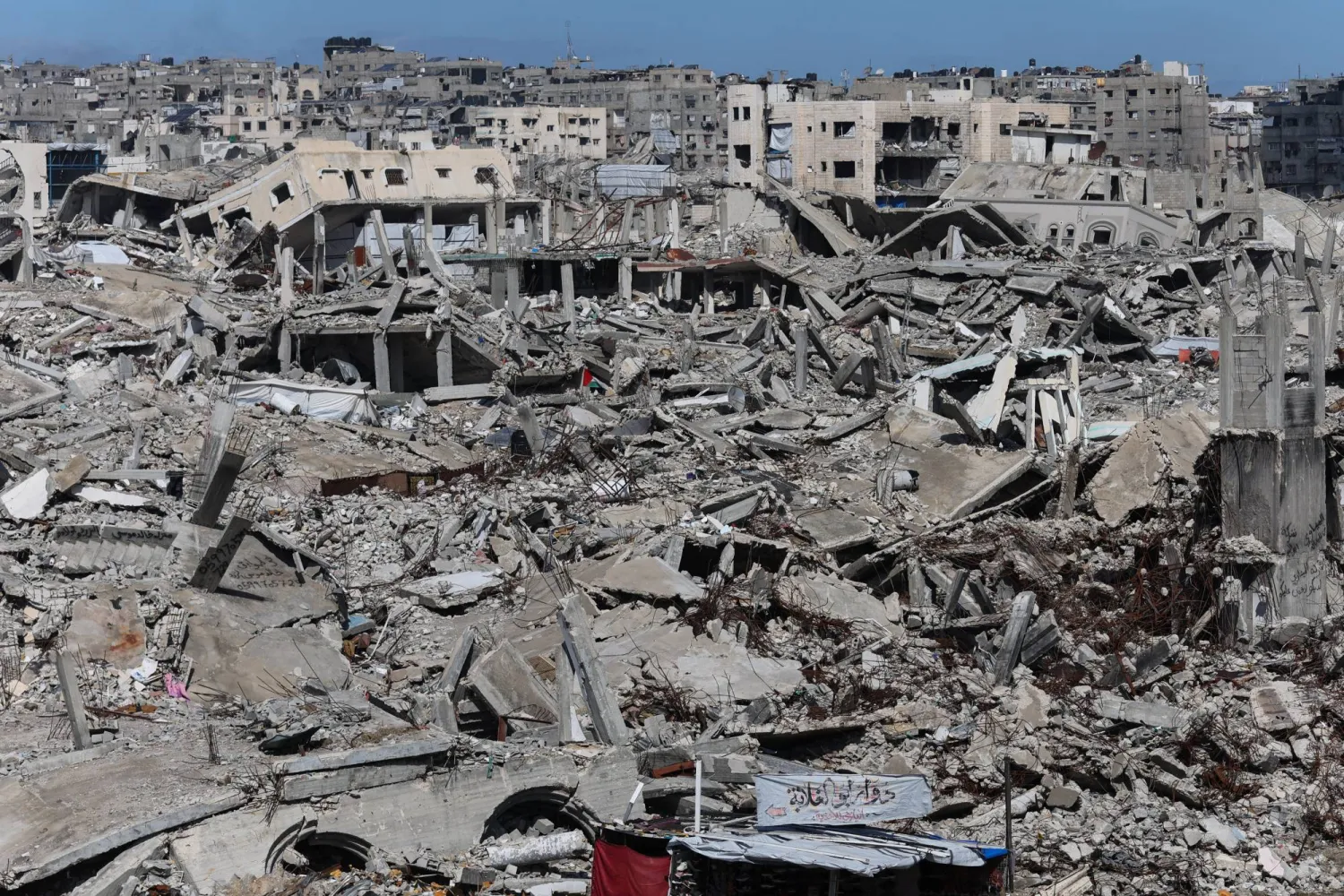
Ruins of buildings destroyed in Israeli shelling during two years of war... Gaza City on February 4, 2026 (Reuters)
TT

A Look at the Violence Flaring in Gaza Months into an Israel-Hamas Ceasefire

Ruins of buildings destroyed in Israeli shelling during two years of war... Gaza City on February 4, 2026 (Reuters)

As the bodies of two dozen Palestinians killed in Israeli strikes arrived at hospitals in Gaza on Wednesday, the director of one asked a question that has echoed across the war-ravaged territory for months.

“Where is the ceasefire? Where are the mediators?” Shifa Hospital's Mohamed Abu Selmiya wrote on Facebook.

At least 556 Palestinians have been killed in Israeli strikes since a US-brokered truce came into effect in October, including 24 on Wednesday and 30 on Saturday, according to Gaza's Health Ministry. Four Israeli soldiers have been killed in Gaza in the same period, with more injured, including a soldier whom the military said was severely wounded when gunmen opened fire near the ceasefire line in northern Gaza overnight.

Other aspects of the agreement have stalled, including the deployment of an international security force, Hamas' disarmament and the start of Gaza's reconstruction. The opening of the Rafah border crossing between Gaza and Egypt raised hope of further progress, but fewer than 50 people were allowed to cross on Monday.

Hostages freed as other issues languish

In October, after months of stalled negotiations, Israel and Hamas accepted a 20-point plan proposed by US President Donald Trump aimed at ending the war unleashed by Hamas' Oct. 7, 2023, attack into Israel.

At the time, Trump said it would lead to a “Strong, Durable, and Everlasting Peace."

Hamas freed all the living hostages it still held at the outset of the deal in exchange for thousands of Palestinian prisoners held by Israel and the remains of others.

But the larger issues the agreement sought to address, including the future governance of the strip, were met with reservations, and the US offered no firm timeline.

The return of the remains of hostages meanwhile stretched far beyond the 72-hour timeline outlined in the agreement. Israel recovered the body of the last hostage only last week, after accusing Hamas and other militant groups of violating the ceasefire by failing to return all of the bodies. The militants said they were unable to immediately locate all the remains because of the massive destruction caused by the war — a claim Israel rejected.

The ceasefire also called for an immediate influx of humanitarian aid, including equipment to clear rubble and rehabilitate infrastructure. The United Nations and humanitarian groups say aid deliveries to Gaza's 2 million Palestinians have fallen short due to customs clearance problems and other delays. COGAT, the Israeli military body overseeing aid to Gaza, has called the UN's claims “simply a lie.”

Ceasefire holds despite accusations

Violence has sharply declined since the ceasefire paused a war in which more than 71,800 Palestinians have been killed, according to the Gaza Health Ministry. The ministry is part of the Hamas-led government and maintains detailed records seen as generally reliable by UN agencies and independent experts.

Hamas-led militants killed some 1,200 people in the initial October 2023 attack and took around 250 hostage.

Both sides say the agreement is still in effect and use the word “ceasefire” in their communications. But Israel accuses Hamas fighters of operating beyond the truce line splitting Gaza in half, threatening its troops and occasionally opening fire, while Hamas accuses Israeli forces of gunfire and strikes on residential areas far from the line.

Palestinians have called on US and Arab mediators to get Israel to stop carrying out deadly strikes, which often kill civilians. Among those killed on Wednesday were five children, including two babies. Hamas, which accuses Israel of hundreds of violations, called it a “grave circumvention of the ceasefire agreement.”

In a joint statement on Sunday, eight Arab and Muslim countries condemned Israel’s actions since the agreement took effect and urged restraint from all sides “to preserve and sustain the ceasefire.”

Israel says it is responding to daily violations committed by Hamas and acting to protect its troops. “While Hamas’ actions undermine the ceasefire, Israel remains fully committed to upholding it,” the military said in a statement on Wednesday.

“One of the scenarios the (military) has to be ready for is Hamas is using a deception tactic like they did before October 7 and rearming and preparing for an attack when it’s comfortable for them,” said Lt. Col. Nadav Shoshani, a military spokesperson.

Some signs of progress

The return of the remains of the last hostage, the limited opening of the Rafah crossing, and the naming of a Palestinian committee to govern Gaza and oversee its reconstruction showed a willingness to advance the agreement despite the violence.

Last month, US envoy Steve Witkoff, who played a key role in brokering the truce, said it was time for “transitioning from ceasefire to demilitarization, technocratic governance, and reconstruction.”

That will require Israel and Hamas to grapple with major issues on which they have been sharply divided, including whether Israel will fully withdraw from Gaza and Hamas will lay down its arms.

Though political leaders are holding onto the term “ceasefire” and have yet to withdraw from the process, there is growing despair in Gaza.

On Saturday, Atallah Abu Hadaiyed heard explosions in Gaza City during his morning prayers and ran outside to find his cousins lying on the ground as flames curled around them.

“We don’t know if we’re at war or at peace,” he said from a displacement camp, as tarpaulin strips blew off the tent behind him.


Seif al-Islam al-Gadhafi: Why Shouldn’t I Trust Them?

Seif al-Islam al-Gadhafi speaks during a news conference in Tripoli on Aug. 4, 2010 (EPA)
TT

Seif al-Islam al-Gadhafi: Why Shouldn’t I Trust Them?

Seif al-Islam al-Gadhafi speaks during a news conference in Tripoli on Aug. 4, 2010 (EPA)

“Why shouldn’t I trust them?” That was Seif al-Islam al-Gadhafi’s blunt reply when asked why he had placed his confidence in Islamist prisoners held in his father’s jails in Libya, men he was negotiating to release.

He then set out, at length, the logic behind his gamble. He said the Islamists had admitted that taking up arms against the Libyan state had been a mistake, and that building “Tomorrow’s Libya” required the participation of all Libyans.

He added that those he had negotiated with and freed had proven worthy of trust and would not return to violence.

Seif spoke during a meeting with him during one of his visits to London in the late 1990s or early 2000s. At the time, he was focused on emptying his father’s prisons of members of Islamist groups, including leaders of the Libyan Islamic Fighting Group.

That group had waged a guerrilla war in the mid-1990s to overthrow the regime and had nearly succeeded in assassinating Moammar al-Gadhafi.

Libyan security forces eventually defeated it in the late 1990s. Some of the group’s leaders had been imprisoned in Libya for many years, while others were handed over to al-Gadhafi by the United States during the “war on terror” targeting groups based in Afghanistan after the Sept. 11, 2001 attacks.

My question to Seif al-Islam al-Gadhafi about “trust” was rooted in my awareness that there was a current within his father’s regime, which included at least one of his brothers, that was leading a campaign entirely opposed to what Seif was pursuing.

Those holding the opposing view argued that Seif was making a mistake by trusting that those he was releasing would not revolt again when the opportunity arose.

At the time, a senior security official responsible for detaining leaders of the Islamic Fighting Group said, “They will not leave except over my dead body,” in a direct challenge to Seif, believing that the elder al-Gadhafi shared his view rather than that of his son, regarding those the regime referred to as “heretics.”

In any case, Seif’s opponents failed to stop his efforts. Leaders of the Islamic Fighting Group agreed to issue what became known as the “revisions,” in which they declared armed action against ruling regimes in Islamic countries to be forbidden and condemned many practices attributed to al-Qaeda and other groups influenced by its ideology.

Ultimately, it was Moammar al-Gadhafi who settled the matter, siding with what Seif wanted. At the time, Seif was being promoted as a potential successor to his father.

When the February 2011 uprising erupted in Libya, Seif was among those most criticized by people around his father for his “trust in Islamists.” Some of those released were among the first to take up arms and join the rebels.

This, it was said at the time, prompted Seif to adopt a hardline stance against his father’s opponents in his well-known speech at Bab al-Aziziya in Tripoli in the early days of the uprising.

In reality, Seif’s relationship with his brothers had long been the subject of rumors and quiet speculation in the years before the fall of his father’s regime.

Talk circulated of deep disagreements between Seif and his brother Mutassim, who was killed alongside their father in Sirte in 2011. When asked about this, Seif's response suggested a degree of self-assurance.

He spoke with satisfaction about how hard the Americans were trying, but how little they understood about what was really going on between him and his brothers. He did not deny the existence of differences, but his answer suggested that the family ultimately remained united under their father.

Seif was a frequent visitor to London at the time.

He was reaping the results of efforts by Libyan negotiators working to resolve cases in which his father’s regime had been implicated.

These included the Lockerbie bombing of Pan Am Flight 103 in 1988, the bombing of a French UTA airliner in 1989, and the case of the Bulgarian nurses and the Palestinian doctor accused of infecting children at a Benghazi hospital with HIV.

Seif’s efforts succeeded in settling most of those cases, which involved compensation totaling millions of dollars. But his work was bound to collide eventually with the reality that he was trying to present a different image of Libya from the one shaped by his father’s rule.

That was the focus of a question he was asked during a public event before an audience of students at a London college. He replied, “I don’t like this question.”


Who Is Behind the Killing of Seif al-Islam Gadhafi, and Why Now?

11 February 2008, Berlin: Seif al-Islam Gadhafi, son of then Libya's leader Moammar Gadhafi, arrives at the charity gala "Cinema for Peace" at the Konzerthaus am Gendarmenmarkt. (dpa)
TT

Who Is Behind the Killing of Seif al-Islam Gadhafi, and Why Now?

11 February 2008, Berlin: Seif al-Islam Gadhafi, son of then Libya's leader Moammar Gadhafi, arrives at the charity gala "Cinema for Peace" at the Konzerthaus am Gendarmenmarkt. (dpa)

Seif al-Islam, the son of Libya's slain longtime ruler Moammar al-Gadhafi and once seen by some as his likely heir, has been killed.

Targeted by a warrant from the International Criminal Court for alleged crimes against humanity, and still a player in Libya's turbulent political scene, the 53-year-old was no stranger to violence.

But his sudden assassination has raised many questions:

- Who is behind it? -

Very little has emerged about the identity or motives of the assailants.

Seif al-Islam's lawyer, Marcel Ceccaldi, told AFP he was killed by an unidentified "four-man commando" who stormed his house on Tuesday afternoon in the city of Zintan, western Libya.

His adviser, Abdullah Othman Abdurrahim, told Libyan media the four unidentified men had stormed the home before "disabling surveillance cameras, then executed him".

Libyan prosecutors said Wednesday they were probing the killing after establishing that "the victim died from wounds by gunfire".

- Why now? -

Claudia Gazzini, a senior Libya analyst at International Crisis Group, described the timing of Seif al-Islam's death as "odd".

"He had been living a relatively quiet life away from the public eye for many years now," she told AFP.

Seif al-Islam had announced his bid to run for president in 2021. Those elections were indefinitely postponed, and he had barely made any major public appearances since.

His whereabouts had been largely unknown. Aside from a small inner circle -- and probably the Libyan authorities -- few people knew he lived in Zintan.

Ceccaldi said "he often moved around" but "had been in Zintan for quite some time".

Anas El Gomati, head of the Tripoli-based Sadeq Institute think tank, said the timing was "stark".

Libya is divided between the Tripoli-based Government of National Unity and its rival administration in the east.

- What Seif al-Islam represented -

Experts differ over the extent of Seif al-Islam's political influence. But there is broad agreement on his symbolic weight as the most prominent remaining figure associated with pre-2011 Libya.

" Seif al-Islam had become a cumbersome actor" in Libyan politics after announcing his bid for office in 2021, said Hasni Abidi, director of the Geneva-based Centre for Studies and Research on the Arab and Mediterranean World.

His killing "benefits all political actors" currently competing for power in the North African country, Abidi said.

For Gomati, his death "eliminates Libya's last viable spoiler to the current power structure".

"He wasn't a democrat or reformer, but he represented an alternative that threatened” current powers, Gomati added. "The pro-Gadhafi nostalgia bloc now has no credible leader."

Libya expert Jalel Harchaoui offered a more cautious assessment, saying Seif al-Islam's death was "no major upheaval".

"He was not at the head of a unified, cohesive bloc exerting real weight in the competition for power, rivalries, or the allocation of territory or wealth," Harchaoui explained.

Still, "he could have played a decisive role under specific circumstances," Harchaoui said, arguing that his mere name on a presidential ballot would have had a substantial impact.

- How has the public reacted? -

Among the public, speculation is rife.

Some have suggested the involvement of a local Zintan-based armed group that may no longer have wanted Seif al-Islam on its territory.

Others suspect foreign forces may have been involved.

"The operation's sophistication -- four operatives, inside access, cameras disabled -- suggests foreign intelligence involvement, not militia action," said Gomati.


The Last US-Russian Nuclear Pact Is About to Expire, Ending a Half-Century of Arms Control

This photo released by the US Air Force shows a B-52H Stratofortress approaching a KC-10 Extender for refueling over the Middle East, Sept. 4, 2022. (US Air Force/Staff Sgt. Shannon Bowman, via AP, File)
TT

The Last US-Russian Nuclear Pact Is About to Expire, Ending a Half-Century of Arms Control

This photo released by the US Air Force shows a B-52H Stratofortress approaching a KC-10 Extender for refueling over the Middle East, Sept. 4, 2022. (US Air Force/Staff Sgt. Shannon Bowman, via AP, File)

The last remaining nuclear arms pact between Russia and the United States is set to expire Thursday, removing any caps on the two largest atomic arsenals for the first time in more than a half-century.

The termination of the New START Treaty would set the stage for what many fear could be an unconstrained nuclear arms race.

Russian President Vladimir Putin declared readiness to stick to the treaty’s limits for another year if Washington follows suit, but President Donald Trump has been noncommittal about extending it.

Trump has repeatedly indicated he would like to keep limits on nuclear weapons and involve China in arms control talks, a White House official who was not authorized to talk publicly and spoke on condition of anonymity said Monday. Trump will make a decision on nuclear arms control “on his own timeline,” the official said.

Beijing has balked at any restrictions on its smaller but growing nuclear arsenal.

Kremlin spokesman Dmitry Peskov said Tuesday it would be a “more dangerous” world without limits on US and Russian nuclear stockpiles.

Arms control advocates long have voiced concern about the expiration of New START, warning it could lead to a new Russia-US arms race, foment global instability and increase the risk of nuclear conflict.

Failure to agree on keeping the pact’s limits will likely encourage a bigger deployment, said Daryl Kimball, executive director of the Arms Control Association in Washington.

“We’re at the point now where the two sides could, with the expiration of this treaty, for the first time in about 35 years, increase the number of nuclear weapons that are deployed on each side,” Kimball told The Associated Press. “And this would open up the possibility of an unconstrained, dangerous three-way arms race, not just between the US and Russia, but also involving China, which is also increasing its smaller but still deadly nuclear arsenal.”

Kingston Reif of the RAND Corporation, a former US deputy assistant secretary of defense, also warned during an online discussion that “in the absence of the predictability of the treaty, each side could be incentivized to plan for the worst or to increase their deployed arsenals to show toughness and resolve, or to search for negotiating leverage.”

Putin repeatedly has brandished Russia’s nuclear might since sending troops into Ukraine in February 2022, warning Moscow was prepared to use “all means” to protect its security interests. In 2024, he signed a revised nuclear doctrine lowering the threshold for nuclear weapons use.

Signed in 2010 New START, signed in 2010 by US President Barack Obama and his Russian counterpart, Dmitry Medvedev, restricted each side to no more than 1,550 nuclear warheads on no more than 700 missiles and bombers — deployed and ready for use. It was originally supposed to expire in 2021 but was extended for five more years.

The pact envisioned sweeping on-site inspections to verify compliance, although they stopped in 2020 because of the COVID-19 pandemic and never resumed.

In February 2023, Putin suspended Moscow’s participation, saying Russia couldn’t allow US inspections of its nuclear sites at a time when Washington and its NATO allies have openly declared Moscow’s defeat in Ukraine as their goal. At the same time, the Kremlin emphasized it wasn’t withdrawing from the pact altogether, pledging to respect its caps on nuclear weapons.

In offering in September to abide by New START’s limits for a year to buy time for both sides to negotiate a successor agreement, Putin said the pact's expiration would be destabilizing and could fuel nuclear proliferation.

Rose Gottemoeller, the chief US negotiator for pact and a former NATO deputy secretary-general, said extending it would have served US interests. “A one-year extension of New START limits would not prejudice any of the vital steps that the United States is taking to respond to the Chinese nuclear buildup,” she told an online discussion last month.

Previous pacts

New START followed a long succession of US-Russian nuclear arms reduction pacts, starting with SALT I in 1972 signed by US President Richard Nixon and Soviet leader Leonid Brezhnev — the first attempt to limit their arsenals.

The 1972 Anti-Ballistic Missile Treaty restricted the countries’ missile defense systems until President George W. Bush took the US out of the pact in 2001 despite Moscow’s warnings.

The Kremlin has described Washington’s efforts to build a missile shield as a major threat, arguing it would erode Russia’s nuclear deterrent by giving the US the capability to shoot down its intercontinental ballistic missiles.

As a response to the US missile shield, Putin ordered the development of the Burevestnik nuclear-tipped and nuclear-powered cruise missile and the Poseidon nuclear-armed and nuclear-powered underwater drone. Russia said last year it successfully tested the Poseidon and the Burevestnik and was preparing their deployment.

Also terminated in 2019 was the Intermediate-range Nuclear Forces Treaty, which was signed in 1987 and banned land-based missiles with a range between 500-5,500 kilometers (310-3,400 miles). Those missiles were seen as particularly destabilizing because of their short flight time to their targets, leaving only minutes to decide on a retaliatory strike and increasing the threat of a nuclear war on a false warning.

In November 2024 and again last month, Russia attacked Ukraine with a conventional version of its new Oreshnik intermediate-range ballistic missile. Moscow says it has a range of up to 5,000 kilometers (3,100 miles), capable of reaching any European target, with either nuclear or conventional warheads.

Trump's ‘Golden Dome’

Without agreements limiting nuclear arsenals, Russia “will promptly and firmly fend off any new threats to our security,” said Medvedev, who had signed the New START treaty and is now deputy head of Putin's Security Council.

“If we are not heard, we act proportionately seeking to restore parity,” he said in recent remarks.

Medvedev specifically mentioned Trump's proposed Golden Dome missile defense system among potentially destabilizing moves, emphasizing a close link between offensive and defensive strategic weapons.

Trump’s plan has worried Russia and China, Kimball said.

“They’re likely going to respond to Golden Dome by building up the number of offensive weapons they have to overwhelm the system and make sure that they have the potential to retaliate with nuclear weapons,” he said, adding that offensive capabilities can be built faster and cheaper than defensive ones.

Trump’s October statement about US intentions to resume nuclear tests for the first time since 1992 also troubled the Kremlin, which last conducted a test in 1990 when the USSR still existed. Putin said Russia will respond in kind if the US resumes tests, which are banned by a global treaty that Moscow and Washington signed.

US Energy Secretary Chris Wright said in November that such tests would not include nuclear explosions.

Kimball said a US resumption of tests “would blow a massive hole in the global system to reduce nuclear risk,” prompting Russia to respond in kind and tempting others, including China and India, to follow suit.

The world was heading toward accelerated strategic competition, he said, with more spending and increasingly unstable relations involving the US, Russia, and China on nuclear matters.

“This marks a potential turning point into a much more dangerous period of global nuclear competition, the likes of which we’ve not seen in our lifetimes,” Kimball added.
