


The Gaza Ceasefire Began Months Ago. Here’s Why the Fighting Persists

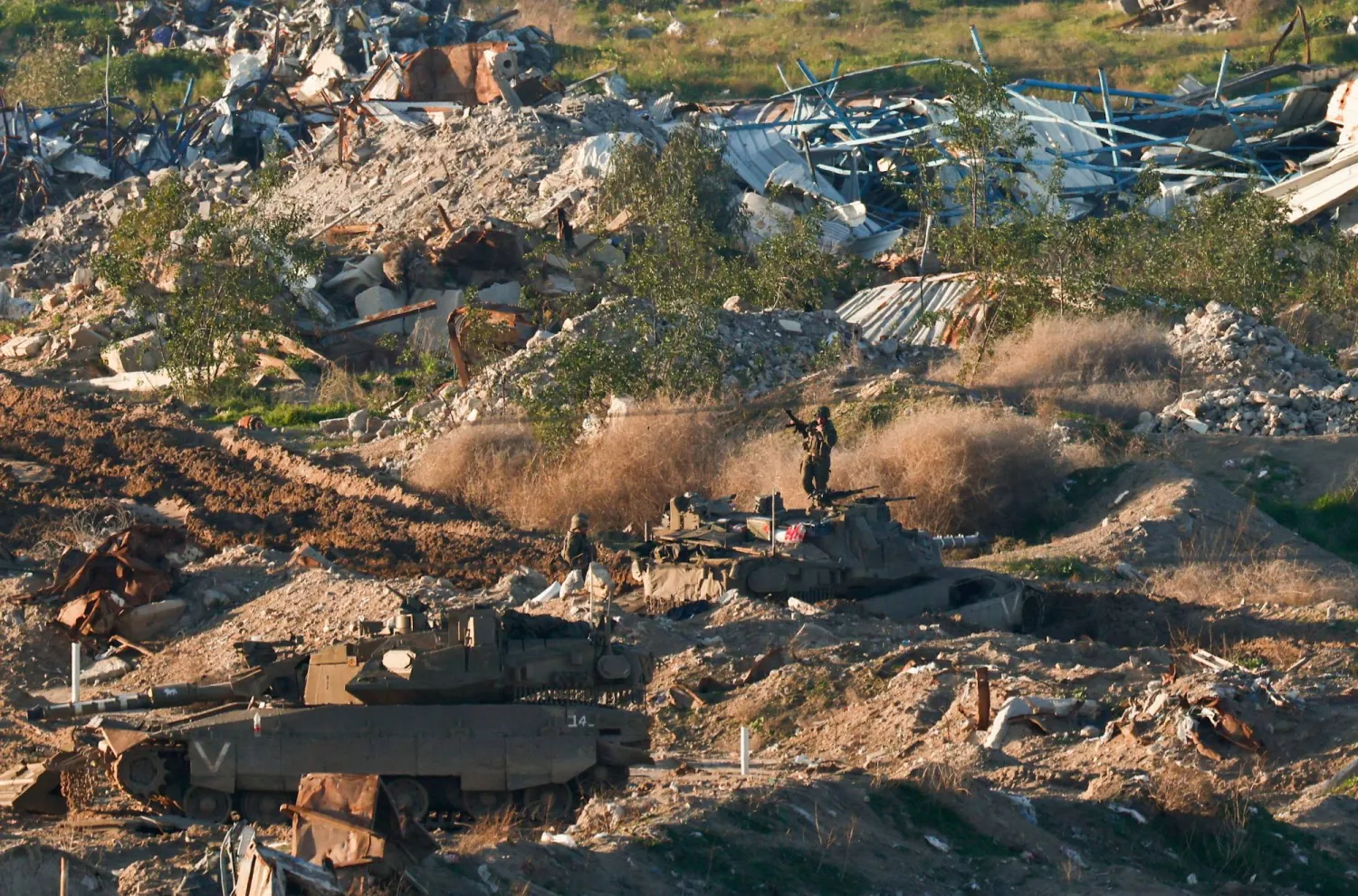
Israeli soldiers and tanks stand in Gaza, as seen from the Israeli side of the Israel-Gaza border, in Israel, February 4, 2026. REUTERS/Amir Cohen
TT

The Gaza Ceasefire Began Months Ago. Here’s Why the Fighting Persists

Israeli soldiers and tanks stand in Gaza, as seen from the Israeli side of the Israel-Gaza border, in Israel, February 4, 2026. REUTERS/Amir Cohen

As the bodies of two dozen Palestinians killed in Israeli strikes arrived at hospitals in Gaza on Wednesday, the director of one asked a question that has echoed across the war-ravaged territory for months.

“Where is the ceasefire? Where are the mediators?” Shifa Hospital's Mohamed Abu Selmiya wrote on Facebook.

At least 556 Palestinians have been killed in Israeli strikes since a US-brokered truce came into effect in October, including 24 on Wednesday and 30 on Saturday, according to Gaza's Health Ministry. Four Israeli soldiers have been killed in Gaza in the same period, with more injured, including a soldier whom the military said was severely wounded when militants opened fire near the ceasefire line in northern Gaza overnight.

Other aspects of the agreement have stalled, including the deployment of an international security force, Hamas' disarmament and the start of Gaza's reconstruction. The opening of the Rafah border crossing between Gaza and Egypt raised hope of further progress, but fewer than 50 people were allowed to cross on Monday, The Associated Press said.

Hostages freed as other issues languish In October, after months of stalled negotiations, Israel and Hamas accepted a 20-point plan proposed by US President Donald Trump aimed at ending the war unleashed by Hamas' Oct. 7, 2023, attack into Israel.

At the time, Trump said it would lead to a “Strong, Durable, and Everlasting Peace."

Hamas freed all the living hostages it still held at the outset of the deal in exchange for thousands of Palestinian prisoners held by Israel and the remains of others.

But the larger issues the agreement sought to address, including the future governance of the strip, were met with reservations, and the US offered no firm timeline.

The return of the remains of hostages meanwhile stretched far beyond the 72-hour timeline outlined in the agreement. Israel recovered the body of the last hostage only last week, after accusing Hamas and other militant groups of violating the ceasefire by failing to return all of the bodies. The militants said they were unable to immediately locate all the remains because of the massive destruction caused by the war — a claim Israel rejected.

The ceasefire also called for an immediate influx of humanitarian aid, including equipment to clear rubble and rehabilitate infrastructure. The United Nations and humanitarian groups say aid deliveries to Gaza's 2 million Palestinians have fallen short due to customs clearance problems and other delays. COGAT, the Israeli military body overseeing aid to Gaza, has called the UN's claims “simply a lie.”

Ceasefire holds despite accusations

Violence has sharply declined since the ceasefire paused a war in which more than 71,800 Palestinians have been killed, according to the Gaza Health Ministry. The ministry is part of the Hamas-led government and maintains detailed records seen as generally reliable by UN agencies and independent experts.

Hamas-led militants killed some 1,200 people in the initial October 2023 attack and took around 250 hostage.

Both sides say the agreement is still in effect and use the word “ceasefire” in their communications. But Israel accuses Hamas fighters of operating beyond the truce line splitting Gaza in half, threatening its troops and occasionally opening fire, while Hamas accuses Israeli forces of gunfire and strikes on residential areas far from the line.

Palestinians have called on US and Arab mediators to get Israel to stop carrying out deadly strikes, which often kill civilians. Among those killed on Wednesday were five children, including two babies. Hamas, which accuses Israel of hundreds of violations, called it a “grave circumvention of the ceasefire agreement.”

In a joint statement on Sunday, eight Arab and Muslim countries condemned Israel’s actions since the agreement took effect and urged restraint from all sides “to preserve and sustain the ceasefire.”

Israel says it is responding to daily violations committed by Hamas and acting to protect its troops. “While Hamas’ actions undermine the ceasefire, Israel remains fully committed to upholding it,” the military said in a statement on Wednesday.

“One of the scenarios the (military) has to be ready for is Hamas is using a deception tactic like they did before October 7 and rearming and preparing for an attack when it’s comfortable for them,” said Lt. Col. Nadav Shoshani, a military spokesperson.

Some signs of progress

The return of the remains of the last hostage, the limited opening of the Rafah crossing, and the naming of a Palestinian committee to govern Gaza and oversee its reconstruction showed a willingness to advance the agreement despite the violence.

Last month, US envoy Steve Witkoff, who played a key role in brokering the truce, said it was time for “transitioning from ceasefire to demilitarization, technocratic governance, and reconstruction.”

That will require Israel and Hamas to grapple with major issues on which they have been sharply divided, including whether Israel will fully withdraw from Gaza and Hamas will lay down its arms.

Though political leaders are holding onto the term “ceasefire” and have yet to withdraw from the process, there is growing despair in Gaza.

On Saturday, Atallah Abu Hadaiyed heard explosions in Gaza City during his morning prayers and ran outside to find his cousins lying on the ground as flames curled around them.

“We don’t know if we’re at war or at peace,” he said from a displacement camp, as tarpaulin strips blew off the tent behind him.



After Attacks on Iran’s Oil Facilities, Toxic Black Rain Endangers the Public

This video grab taken from UGC images posted on social media on March 7 and 8, 2026 shows fire erupting at an oil depot in Iran's capital Tehran. (UGC / AFP)
TT

After Attacks on Iran’s Oil Facilities, Toxic Black Rain Endangers the Public

This video grab taken from UGC images posted on social media on March 7 and 8, 2026 shows fire erupting at an oil depot in Iran's capital Tehran. (UGC / AFP)

Clouds of toxic smoke unleashed into the atmosphere by US-Israeli airstrikes on Iranian oil facilities made a dangerous return to Earth in the form of “black rain,” prompting international health officials to warn of serious risks to the public.

Residents in Tehran complained last week of burning eyes and difficulty breathing when the dark and oily precipitation fell near the Iranian capital after several fuel oil depots and a refinery were struck.

Plumes of dark smoke have also been seen across other parts of the region over two weeks of war, as Iran retaliates against US-Israeli airstrikes by firing drones and missiles at the oil and natural gas facilities of its Gulf neighbors.

Rain washes hazardous chemicals out of the atmosphere in a relatively short period of time, experts said, but people exposed to black rain should take precautions to avoid short- and long-term health risks.

Here's what to know:

What is black rain? It occurs when soot, ash and toxic chemicals combine with water droplets in the atmosphere, then fall back to Earth when it rains. It's common after oil refineries or oil fields catch fire, and also can be caused by wildfires, volcanic eruptions and industrial pollution.

In Iran, microscopic soot formed when hydrocarbons in the fuel oil burned incompletely, experts said. Burning oil also forms compounds called polycyclic aromatic hydrocarbons, or PAHs, as well as toxic gases such as sulfur dioxide and nitrogen oxides, which cause acid rain, said Peter Adams, a civil and environmental engineering professor at Carnegie Mellon University.

What are the health risks of exposure? Microscopic soot, whose particles are about 40 times smaller than the width of a human hair, can lodge deep in the lungs and enter the bloodstream, causing breathing and heart problems that can lead to premature death, experts said. Exposure to PAHs can increase cancer risk.

In Iran, the World Health Organization and the country's health and environmental officials advised people to stay indoors and wear masks. They warned that the rainfall was highly acidic and could burn the skin and cause lung damage.

“We can definitely expect acute health effects from an event like this,” said V. Faye McNeill, a chemical engineering professor at Columbia University who specializes in atmospheric chemistry.

Even regular air pollution events can trigger health problems and lead to more hospitalizations, especially among the elderly, children and people who already had health problems, she said. “But this is a higher level, so there likely are health problems going on right now because of it.”

Some Iranians fear the polluted rain, which also contains heavy metals, could contaminate drinking-water reservoirs and waterways.

How long do the chemicals last in the atmosphere? It usually takes only hours for fuel tanks to burn out. But — as happened in Kuwait during the Gulf War 25 years ago — oil fields can burn for months, said Adams.

For fires that burn out more quickly, most of the soot and chemicals will disperse on the wind and wash out of the atmosphere in about three to seven days, Adams said.

“So if we don’t create more problems, at least what’s in the atmosphere is going to go away,” even if long-term health risks haven't, Adams said.

“But we don’t know what’s going to happen with future strikes and whether other tanks will be struck or whether oil fields will be struck,” he added. “I'm less concerned about longer-term or regional stuff, but it's a real mess for the people in the immediate vicinity.”


Mohammed bin Salman in Nine Years: Domestic Growth and Global Engagement

Saudi Crown Prince Mohammed bin Salman receives the pledge of allegiance as crown prince at Al-Safa Palace in Makkah. (SPA)
TT

Mohammed bin Salman in Nine Years: Domestic Growth and Global Engagement

Saudi Crown Prince Mohammed bin Salman receives the pledge of allegiance as crown prince at Al-Safa Palace in Makkah. (SPA)

Nine years have passed since the royal decree issued by the Custodian of the Two Holy Mosques, King Salman bin Abdulaziz, appointing Prince Mohammed bin Salman as crown prince.

The prince’s presence in a leadership role that reflects the pulse and ambitions of Saudi youth, alongside the guidance of the king, helped launch a domestic vision that accelerated economic and social development while strengthening Saudi Arabia’s position as a leading actor in addressing the region’s shifting landscape, in addition to expanding its global reach and influence.

Fundamental transformations

Over the years, the Kingdom has witnessed turning points marked by positive developments and fundamental transformations. These were not merely superficial changes, but efforts to shape new directions that redefine the concept of success in the 21st century. The objective extended beyond change within Saudi Arabia itself to efforts aimed at shifting the broader region from conflict toward development.

Among the latest manifestations of that approach has been work to calm several regional conflicts and create opportunities for peace. In parallel, Saudi Arabia has become an influential international destination on the global map, according to numerous studies, commentaries, and research addressing major international issues and regional transformations.

As a result, the Kingdom has hosted dozens of summits and hundreds of high-level meetings on key global issues, particularly political ones. The king and crown prince have also met a large number of world leaders, with nearly 120 visits recorded in recent years.

From an early stage, the Saudi crown prince led a drive to expand the Kingdom’s engagement with the world on multiple fronts, including economic and cultural ties. Political openness has also emerged as a defining feature of recent years, reaching levels not previously seen in Saudi Arabia or the wider region.

Many observers say that Riyadh’s policies under the leadership of Crown Prince Mohammed bin Salman in recent years have strengthened the Kingdom’s role in complex international issues and helped bring various parties to the negotiating table, including through efforts to promote peace through dialogue.

Saudi Crown Prince Mohammed bin Salman and the Chinese president during one of his visits to Saudi Arabia (SPA).

International standing

Over the past decade, Saudi Arabia has been the only Middle Eastern country to host the leaders of the United States, China and Russia within a span of just a few months, despite intensifying geopolitical tensions worldwide.

This period has been marked by a series of global crises, from the war in Ukraine and trade and economic disputes to the war in Gaza and tensions across the Middle East. The developments have positioned Saudi Arabia as a key actor influencing international policies, reflected in the scale, number and level of diplomatic visits and consultations with the Kingdom, particularly since the outbreak of the war in Gaza, as well as the international summits and meetings held on Saudi soil aimed at achieving peace.

International mediation

Saudi diplomacy has also played an active role in recent years. Under the direction of Crown Prince Mohammed bin Salman, who also serves as prime minister, the Kingdom hosted US-Ukrainian talks as part of efforts to address the crisis, drawing on its balanced relations with various parties.

These efforts also included meetings in Diriyah and Jeddah last year involving the United States, Russia and Ukraine. The initiatives reflect an increasingly international orientation in Saudi foreign policy centered on peace efforts, ceasefires and ending wars, including continued mediation initiatives and promoting dialogue as a primary solution during the Russia-Ukraine crisis.

Saudi Arabia has also directed the provision of multiple forms of humanitarian assistance and relief support, as well as mediation efforts aimed at securing the release of prisoners.

Commenting on those efforts, Michael Mitchell, a regional spokesperson for the US State Department, previously told Asharq Al-Awsat that the world had become closer than ever to reaching a ceasefire between Russia and Ukraine following negotiations hosted by Saudi Arabia. He expressed Washington’s appreciation for the Kingdom’s role in advancing ongoing diplomatic efforts and hosting key talks, while reaffirming the US commitment to working with all relevant parties to achieve lasting peace in Ukraine.

The Palestinian issue

The Palestinian issue has witnessed diplomatic momentum described as unprecedented in decades. In recent months and years, Saudi Arabia has pushed many countries to recognize a Palestinian state, bringing the total number of recognizing states to 149, according to the Palestinian Foreign Ministry.

The Saudi crown prince has also reiterated the Kingdom’s position that normalization with Israel would not proceed without the establishment of a Palestinian state. Saudi Arabia has hosted Arab and Islamic countries in Riyadh on two consecutive occasions to unify positions and increase pressure on the international community.

The Kingdom also chaired the committee formed by the summit, led an international coalition supporting the two-state solution, and presided over an international conference on the issue in New York.

In remarks previously made to Asharq Al-Awsat, Palestinian Prime Minister Mohammad Mustafa praised what he described as “Saudi Arabia’s firm positions, which contributed to shaping international consensus toward recognizing a Palestinian state and providing all possible support, given that its realization within the framework of a two-state solution represents the foundation of peace, security and stability in the Middle East.”

Supporting Syria’s recovery

The Kingdom began expanding its support for Syria after it announced in late December 2025 that a Saudi delegation led by an adviser to the Royal Court had visited Damascus and met with Ahmad Al-Sharaa, then the “leader of the new administration” and now Syria's president.

Saudi air and land bridges continued to deliver aid to the Syrian people, alongside humanitarian, medical and development projects. By the end of last year, those projects had increased by more than 100 percent compared with 2024, reaching more than 103 initiatives with a total cost approaching $100 million.

Saudi Arabia also welcomed Syrian President Ahmad Al-Sharaa three times during the year. The Kingdom pushed for the lifting of US sanctions on Syria, which the US president announced from Riyadh in May at the request of Crown Prince Mohammed bin Salman.

Additional support included paying roughly $15 million in Syrian debt to the World Bank and covering part of Syrian government employees’ salaries through a joint initiative with Qatar and the United Nations.

Regional initiatives

Saudi diplomatic initiatives have also extended to multiple regional crises. These include efforts to end the Yemeni crisis and hosting Yemeni parties, including southern groups, while facilitating the first consultative meeting on the southern issue and providing a framework for dialogue on the matter this year.

Saudi Arabia also supported evacuation operations in Sudan, hosted the Jeddah platform on Sudan, and continued humanitarian assistance. More recently, high-level Saudi-US discussions led by the Saudi crown prince and the US president have focused on efforts to resolve the Sudanese crisis.

Saudi Crown Prince Mohammed bin Salman and Russian President Vladimir Putin in Riyadh in December 2023 (SPA).

Summits and consensus

Alongside its expanding regional and international role, Saudi Arabia has also played a significant role on the Arab and Islamic fronts during the nine years since Crown Prince Mohammed bin Salman assumed his position.

Under his direction, the Kingdom hosted seven Arab and Islamic summits between 2018 and 2024. These included the Dhahran Arab Summit in April 2018, the Makkah Summit in Support of Jordan in June 2018, the Emergency Arab Summit in Makkah in May 2019, the Arab-China Summit in December 2022, the Jeddah Arab Summit in May 2023, the Joint Arab-Islamic Extraordinary Summit in November 2023, and a follow-up summit in November 2024.

Last year, Saudi Arabia also strengthened its defense and strategic capabilities through a defense agreement with Pakistan stipulating that any attack on either country would be considered an attack on both. The Kingdom also signed a defense agreement with Washington during a historic visit to the United States in November 2025, in addition to expanding cooperation with major international powers including China, Russia and European countries.

Saudi Crown Prince Mohammed bin Salman and Donald Trump in Washington in November 2025 (SPA).

“A great dawn” in relations with the United States

US President Donald Trump praised the leadership of the Saudi crown prince, saying, “The Saudi crown prince best represents our strong allies,” and adding that “a great dawn” awaits the Middle East.

Trump also described Saudi Arabia as “the heart and center of the world,” and said Riyadh was on track to become a global business hub.

During the crown prince’s visit to Washington late last year, the two countries signed a wide-ranging package of agreements that included a strategic defense agreement, the Kingdom’s second defense agreement signed in 2025, along with a package of defense sales, cooperation in civilian nuclear energy, a strategic partnership in artificial intelligence, a framework for securing supply chains for uranium and minerals, and measures to accelerate investment.

The US president also announced the designation of Saudi Arabia as a major non-NATO ally and praised Saudi negotiating capabilities, describing the Saudis as “great negotiators.”


How Iranians Are Communicating Through Internet Blackout

 People walk past closed shops at the almost empty traditional main bazaar, in Tehran, Iran, Tuesday, March 10, 2026. (AP)
People walk past closed shops at the almost empty traditional main bazaar, in Tehran, Iran, Tuesday, March 10, 2026. (AP)
TT

How Iranians Are Communicating Through Internet Blackout

 People walk past closed shops at the almost empty traditional main bazaar, in Tehran, Iran, Tuesday, March 10, 2026. (AP)
People walk past closed shops at the almost empty traditional main bazaar, in Tehran, Iran, Tuesday, March 10, 2026. (AP)

Iran's latest internet blackout has lasted more than 14 days, connectivity monitor Netblocks said Friday.

The nature of the limits on internet activity shows "this is a government-imposed measure" and not the result of damage from US and Israeli airstrikes, Netblocks research chief Isik Mater told AFP.

"It is a deliberate shutdown imposed by the authorities to suppress the flow of information and prevent further dissent," said Raha Bahreini, Iran researcher at Amnesty International.

Here are some of the ways information is still flowing in and out of Iran.

- Shortwave radio -

Amsterdam-based nonprofit Radio Zamaneh began shortwave broadcasts during the January protests, sending a nightly Farsi news program from 11:00 pm Tehran time.

"It's really difficult for the regime to jam shortwave because it's a long-distance broadcast," executive director Rieneke van Santen told AFP.

"People can just listen on a super cheap, small, simple radio... It's one of those typical emergency fall-back solutions."

Declining to specify where the transmitter is located, she said it is "closer to the Netherlands than to Iran" -- although Tehran "can figure it out" if they choose.

- Phone calls -

Many with ties to Iran are still receiving landline phone calls from inside -- "quite surprising" given the internet blackout, said Mahsa Alimardani of global rights organization Witness.

Fearing the authorities listening in, people often avoid speaking directly about political topics, such as the killing of Ali Khamenei, she added.

"It's not possible to communicate about sensitive issues through these brief phone calls," Amnesty's Bahreini said.

The required prepaid international calling cards are expensive and often fail to provide their face value in minutes.

"You buy a phone card for 60 minutes, but in eight minutes, it's out," van Santen said.

"It's really just phone calls from family members saying, after the bombing, we're still alive."

- VPN or other internet services -

Virtual private networks (VPNs) -- widely-used services that encrypt internet traffic -- can't create an internet connection where none is available.

But even at around one percent of typical levels, Iran's connectivity is "still a large figure in absolute terms", Netblocks' Mater said.

Iranians suspected of using VPNs since the war began have received warning text messages claiming to be from the authorities.

Before the war, millions turned to Toronto-based company Psiphon, which creates specialist tools more capable than typical "off-the-shelf" VPNs.

Offering techniques including disguising users' data as different types of internet traffic, Psiphon "is able to evade detection more successfully", data and insights director Keith McManamen told AFP.

With up to six million unique daily users in Iran before the latest internet shutdown, connections have now tumbled to fewer than 100,000.

Few but the most tech-savvy users can reach Psiphon's network for now.

Nevertheless, "the situation is extremely dynamic. We're seeing changes not just day to day, but hour by hour," McManamen said.

A similar service, US-based Lantern, is also widely used in Iran.

- Satellite broadcasts -

Created by US-based nonprofit NetFreedom Pioneers, Toosheh is a "filecasting" technology using home satellite TV equipment to broadcast encrypted data to people in Iran.

Users record from the Toosheh satellite TV channel onto a USB stick plugged into their set-top box, which they can then decrypt using a special app installed on their phone or computer.

From that initial download, the data can be copied and shared across multiple households.

The group estimated around three million active users in Iran across 2025, with "thousands to hundreds of thousands... since the (internet) shutdown in January," the group's director of projects Emilia James told AFP.

From its usual educational repertoire ranging from English lessons to news, content these days includes more on "personal safety and digital security... helping people to stay safe," she added.

Since people are tuning in to a broadcast signal, there is no way for the government to track them, she added.

- Starlink -

Elon Musk-owned satellite internet service Starlink was used during this year's protests to get information out, while the government attempted to jam its signals.

At around $2,000 on Iran's black market, the terminals are expensive and very rare in poorer regions like Balochistan or Kurdistan that have suffered the most government repression, Alimardani said.

Meanwhile, Amnesty has received reports of "raids on houses... arrests of people who had Starlink devices," Bahreini said.

Charges for those caught communicating with the outside world range from prison sentences to the death penalty, she added.

Starlink did not respond to AFP's request for comment on usage in Iran.