
Trump’s Iran War Rattles US Swing Voters Ahead of Midterms

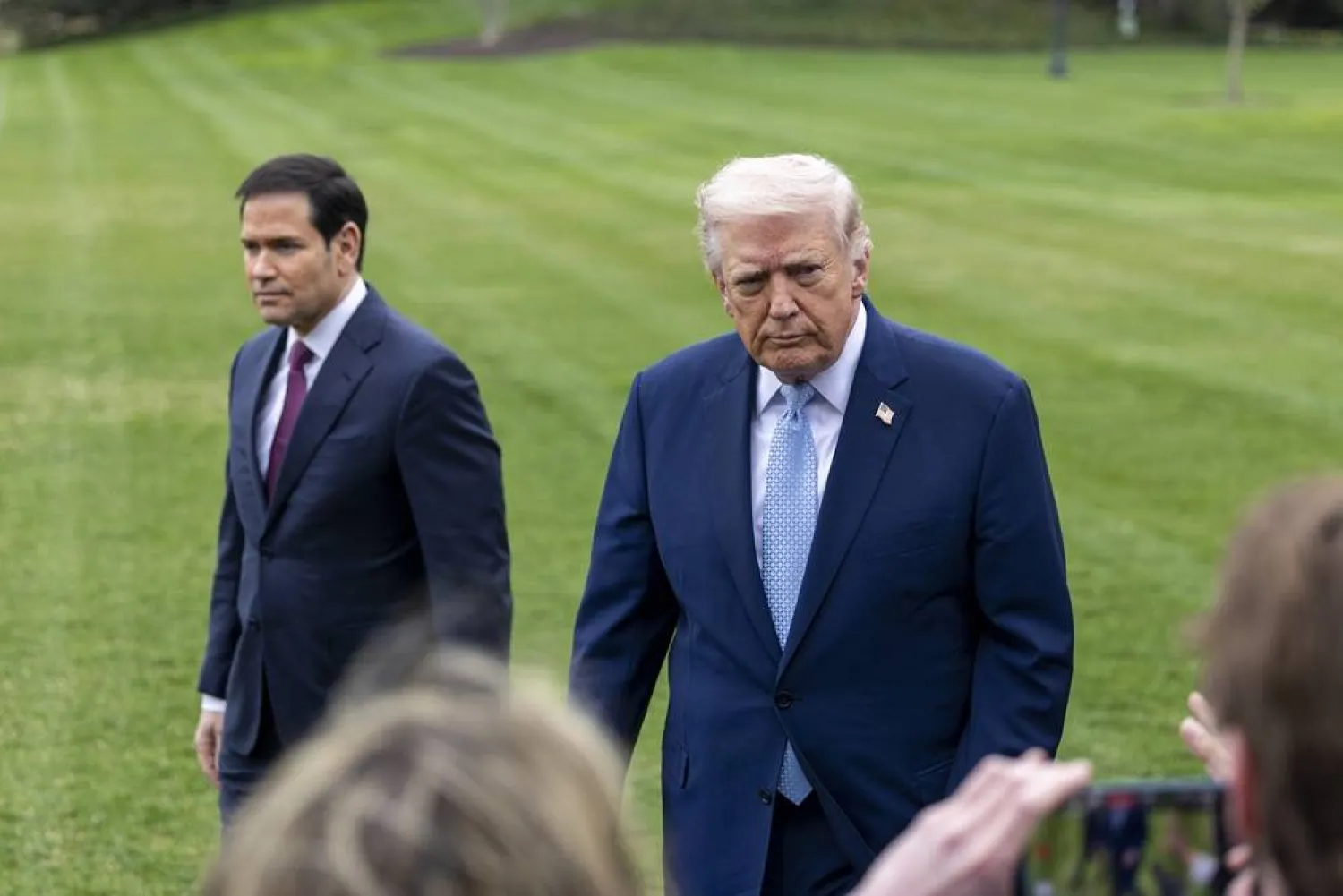
US President Donald Trump (R), with Secretary of State Marco Rubio (L), responds to a question from the news media as he walks to board Marine One on the South Lawn of the White House in Washington, DC, USA, 20 March 2026. (EPA)
TT

Trump’s Iran War Rattles US Swing Voters Ahead of Midterms

US President Donald Trump (R), with Secretary of State Marco Rubio (L), responds to a question from the news media as he walks to board Marine One on the South Lawn of the White House in Washington, DC, USA, 20 March 2026. (EPA)

Donald Trump's war with Iran is weighing on independent US voters, a crucial bloc likely to determine if the president's Republican Party maintains control of Congress in the November midterm elections.

At a breakfast diner in Pennsylvania, a swing state where voters often shift between parties, there was a mix of anger and confusion over the new conflict.

"Trump's just miring us in another Iraq, Vietnam situation," said retired postal worker Jolene Lloyd, 65, referencing the two prolonged wars often seen as failures for the United States.

Lloyd has never voted for Trump, but has previously split her ticket between parties.

Not this year -- in November, she will only support Democrats.

Republicans only narrowly control Congress -- where every seat is up in the House and about one-third of the Senate -- so even a small loss of voters could spell trouble.

The midterm contests will determine whether Trump governs with a cooperative Congress or faces a Democratic majority empowered to block legislation and launch investigations.

With the cost of living already front of mind for many voters, any price increases over the Iran war are sure to feature in Democratic campaign attacks.

"Gas prices are obviously skyrocketing... It's a total mess," said Lloyd, nursing a coffee as she watched the morning news.

Independent voters oppose US military action against Iran by 60 to 31 percent, according to a recent Quinnipiac University survey.

That division was clear when AFP visited Levittown, a blue-collar area on the outskirts of Philadelphia lined with car dealerships and auto repair shops.

- 'A little scary' -

Next to Lloyd sat welder Vince Lucisano, who voted for Trump in 2024 and said he sees Iran as a threat to the US.

"I'm fine with it as long as there's not boots on the ground. Then I'll be a little more like invested and worried about it," he said.

"We need to just handle it and basically put Iran in their place. Once it becomes a full-blown war, then it gets a little scary," added the 42-year-old.

Lucisano, who wore a hoodie reading "Don't let the hard days win," said he still planned to vote Republican in November despite misgivings about Trump's spending on foreign policy.

"The guy who ran on 'America First' is dumping billions overseas. We're not putting America first there, bud," Lucisano said.

The Quinnipiac University poll found that 71 percent of independents think the Trump administration has not provided a clear explanation of the reasons behind US intervention in Iran.

Analysts say that vague messaging could hurt Trump's Republicans in the midterms.

Christopher Borick, director of the Muhlenberg College Institute of Public Opinion in Pennsylvania, noted that the conflict comes on top of existing concerns about affordability and immigration.

"The administration's struggles in delivering a compelling and clear case for the military actions in Iran and the simultaneous exacerbating effects on the cost of living in the US have only added to the Republicans' tedious position among independents," he said.

- 'Cracking a few eggs'

Bobby Marozzi, an employee at the diner, said he admires Trump for acting to stop Iran from having nuclear weapons, even if he was unsure how military action will benefit Americans long-term.

"If Trump is coming out and saying we have to sacrifice in order to have a better future, I would buy into that 100 percent," the 37-year-old said.

"If it's high gas prices and high groceries that we have to sacrifice for the next four years, it's OK so long as the Trump administration is going to get something done."

Marozzi, who declined to share his voting record over privacy concerns, explained that he can empathize with a no pain, no gain mentality.

"We have a saying in the breakfast business that you can't make an omelet without cracking a few eggs, you know?" he said.

For Jolene Lloyd, the retiree and a regular at Marozzi's restaurant, her message on the Iran war was far less compromising.

"We need to stop," she said.


Palestinians Besieged in West Bank Village Fear Israeli Settlers will Seize Their Homes

CCTV footage shows, as witnesses say, Jewish settlers throwing rocks on the road in Qusra, in the Israeli-occupied West Bank, August 12, 2026 in this screengrab taken from a handout video- REUTERS
TT

Palestinians Besieged in West Bank Village Fear Israeli Settlers will Seize Their Homes

CCTV footage shows, as witnesses say, Jewish settlers throwing rocks on the road in Qusra, in the Israeli-occupied West Bank, August 12, 2026 in this screengrab taken from a handout video- REUTERS

From inside his home in the West Bank town of Qusra, Qusai Abu Rida watched on Friday as Israeli settlers moved from where they had erected a tent in front of his house to the valley below, rather than returning to the nearby outpost where they live.

Even as the army took positions around him and the homes of two other families that settlers had blockaded for most of this week, the settlers remained close enough that Abu Rida feared they would again return after the army left and try to take over the home owned by his Palestinian American brother in Ohio.

“I just don’t know when this will end,” he said.

The standoff in Qusra entered a new stage Friday as activists marched toward the besieged homes to try and replenish the families' food and water supply. But Abu Rida said he was growing tired of the pattern, with Israeli forces removing the settlers, only for them to return and reestablish their positions after the troops withdrew.

“It’s like a kids’ game, like cat and mouse,” Ziv Stahl, the executive director of the Israeli rights group Yesh Din, said. “It’s clearly not a matter of capability but a matter of will.”

The siege of the homes is the latest episode in a wave of settler violence convulsing the occupied West Bank, which Israel seized in the 1967 Mideast war and which would make up the main part of a future Palestinian state. Israel's military said the village — roughly 10 miles (16 kilometers) from the Palestinian city of Nablus — was a closed military zone.

They did not answer questions about the presence of the settlers. Both Israel’s military and Israel’s police both referred questions arrests in Qusra to the other.

The West Bank has become more dangerous for Palestinians as Israel, under Prime Minister Benjamin Netanyahu, has approved more than 100 new settlements. Extremist settlers routinely enter Palestinian towns, clashing with villagers, burning homes, mosques and cars.

Netanyahu is courting blocs of ultranationalist voters ahead of what’s expected to be a difficult reelection campaign in October. He and members of his cabinet have largely dismissed concerns about settler violence as overblown and attributed it to fringe groups of a few hundred youths. Yet rights groups and Palestinians say the government's policies have made it more difficult to restrain settlers, who are rarely punished for attacks.

The standoff in Qusra began on Sunday when dozens of settlers arrived and blocked the doors to the three houses, preventing occupants from leaving, according to the families inside.

Israeli troops intervened multiple times and arrived in large numbers Thursday.

Abu Rida and his teenage son were temporarily moved by the army on Thursday but allowed to return hours later. He told his brother in Ohio that he planned on staying to defend the home.

For many, the scene unfolding in Qusra — now in its sixth day — reflected broader failures by Israeli authorities to curb the violence in the West Bank.

Itamar Weil, an Israeli human rights activist from the group Bnei Avraham, said the army had threatened to use tear gas against the activists and forced them to leave, even as settlers remained in the valley below Qusra.

“The army used to prevent settlers from carrying out this kind of violence,” he said. “Now, with a government that fully supports them, they’re not doing their job. They should be protecting both sides from violence, but instead they’re removing activists while barely doing anything about the settlers.”

Palestinian officials have reported 1,476 attacks by Israeli settlers in 2026, including several earlier instances in which settlers staged takeovers of Palestinian homes on the outskirts of other West Bank towns.

A total of 87 Palestinians have been killed by Israeli settlers and soldiers in the West Bank this year, according to the Palestinian Authority’s Health Ministry. Israel says some were involved in terrorism, which it defines broadly to include militancy and rock-throwing. Three Israelis were killed by Palestinians, including two in a July clash during which four Palestinians were also killed.

Katz strips army of enforcement power against settlers Before calm was restored in Qusra, Israeli Defense Minister Israel Katz announced on Friday that he would transfer all enforcement powers against Israeli civilians in the West Bank from the army to Israel’s police.

“The (Israeli military’s) role is to fight Palestinian terrorism, focus on protecting the borders and settlements against threats, deal with the borders and the territory itself and security threats to the settlements and the State of Israel, and not chase after boys on the hills,” Katz said in a statement.

Historically, the army has been able to arrest Palestinians and bring those accused of crimes before military courts. But when it comes to Israeli civilians, in most circumstances it can only use temporary detention for those suspected of crimes, leaving arrests, investigations and prosecutions to police and civilian courts.

Katz’s move comes after he ended the use of administrative detention against Israeli civilians in November 2024. The military had used the policy as a tool to contain settler violence, allowing it to detain suspects without charge and remove them from the West Bank.

Much like with that move, rights groups said transferring all powers to the police was unlikely to restore order or ensure Palestinian safety.

Some 2.8 million Palestinians live under Israeli military rule in the West Bank alongside more than 560,000 Israeli civilians who live in settlements that the international community largely considers illegal and an obstacle to peace.

Though the Palestinian Authority exercises limited autonomy and policing power in the territory’s largest cities, agreements that date back to the 1990s give Israel security control over large swaths of the territory, including agricultural areas and communities such as Qusra.

Stahl, Yesh Din's executive director, said Katz's announcement wouldn't change or help stem the violence because police will still require army escorts to operate in Palestinian areas.

“Unless (Katz) means he’s going to apply Israeli law and have the police control the West Bank, the military is still the main body in charge,” she said.


Why is North Korea Ramping Up Criticism of Japan?

News coverage showing file footage of a North Korean missile launch is seen on a screen at Seoul Station in Seoul on August 12, 2026. (Photo by GREG BAKER / AFP)
TT

Why is North Korea Ramping Up Criticism of Japan?

News coverage showing file footage of a North Korean missile launch is seen on a screen at Seoul Station in Seoul on August 12, 2026. (Photo by GREG BAKER / AFP)

North Korea has stepped up a campaign of rhetoric against Japan's military ‌buildup and its security ties with the United States and South Korea, saying they threaten regional stability. The criticism in more than a dozen state media attacks since early July has coincided with an unusual silence over the North's own missile launches, raising questions about Pyongyang's broader strategic messaging, according to Reuters.

WHY IS NORTH KOREA TALKING MORE ABOUT JAPAN?

North Korean statements have targeted Japan's acquisition of counter-strike capabilities, testing of a US-made Tomahawk cruise missile, rising defense spending and Tokyo's annual defense white paper.

Last week, Kim Yo Jong, the influential sister of leader Kim Jong Un, warned of "additional military options" in response to what she described as Japan's transformation into a military power. On Tuesday, a KCNA commentary described Japan's 2026 defense white paper as a "re-invasion-minded" document aimed at justifying military expansion.

The latest broadside came on Friday, when North Korea criticized annual US-South Korean Ulchi Freedom Shield military drills and accused US-Japan-South Korea military cooperation of evolving into a "nuclear alliance". Washington and Seoul say the drills are defensive.

Another KCNA commentary accused Washington of pursuing a strategy that lowers the threshold for nuclear weapons use and cited US extended deterrence commitments to South Korea and Japan.

HOW HAS ‌JAPAN CHANGED ITS ‌DEFENCE STANCE?

Japan in 2022 announced plans to double defense spending to 2% of GDP to ‌counter ⁠growing security threats ⁠from China, Russia and North Korea.

A major part of that expansion includes spending on long-range missiles such as the US-made Tomahawk, which can strike targets more than 1,000 km (621 miles) away. Prime Minister Sanae Takaichi’s government is expected this year to revise Japan’s national security strategy, a move some analysts will likely lead to further increases in defense spending, including on drones and arms production.

IS THIS REALLY ABOUT JAPAN?

Analysts say Japan is only part of the story.

Park Won-gon, a professor at Seoul's Ewha Womans University, said the primary goal is to frame Northeast Asia as a contest between rival camps.

"The biggest objective is to create a US-South Korea-Japan versus North Korea-China-Russia framework," Park said.

He said Pyongyang wants stronger backing ⁠from Beijing and Moscow to cement its escape from diplomatic isolation and to bolster arguments that its ‌nuclear arsenal is necessary.

South Korea's Unification Ministry expressed a similar view on Thursday after ‌North Korean First Vice Foreign Minister Jang Kum-chol criticized Seoul's plans to acquire nuclear-powered submarines and accused South Korea, the United States and Japan of ‌preparing a "second AUKUS" in Northeast Asia. The ministry said North Korea appears to view South Korea's submarine plans, Japan's evolving security posture ‌and trilateral military cooperation as threats to the regional balance of power, as it increasingly aligns itself with China and Russia. Kyungnam University professor of North Korean studies Lim Eul-chul said North Korea's messaging increasingly mirrors China's concerns about Japan's military expansion.

WHY IS NORTH KOREA STAYING SILENT ABOUT ITS MISSILE TESTS?

The heightened rhetoric has coincided with unusual silence on North Korea's recent missile launches, which were condemned by South Korea, Japan and the United States.

Despite conducting ‌ballistic missile tests last week and again this week, state media has yet to report either, departing from its usual pattern of publicizing tests within a day.

Analysts say the launches may ⁠have involved upgrades to existing missile ⁠systems rather than new weapons, reducing their propaganda value. Shin Jong-woo of the Korea Defense and Security Forum said the tests may have involved improved short-range ballistic missiles developed with Russian technical assistance and potentially destined for Russia.

Kim Yong-hyun, a professor at Dongguk University, said North Korea may be avoiding publicity if launches are connected to prospective military exports.

WHAT DOES RUSSIA HAVE TO DO WITH IT?

North Korea's growing military cooperation with Russia has become a central factor in assessments of its weapons programs. Ukrainian President Volodymyr Zelenskiy has repeatedly said Russia continues to use North Korean missiles against Ukraine and has accused Pyongyang of providing Moscow with missiles, ammunition and a further promise of troops for the war effort.

Analysts say battlefield feedback and Russian assistance may have helped North Korea improve the accuracy and performance of some missile systems.

Shin said recent launches could have been tests of upgraded variants before deployment or export.

WHAT IS NORTH KOREA TRYING TO ACHIEVE?

Analysts say North Korea is seeking to cast the region in terms of competing blocs, with Pyongyang, Beijing and Moscow on one side and Washington, Seoul and Tokyo on the other.

Portraying US-South Korea-Japan cooperation as an increasingly threatening military and nuclear alliance helps Pyongyang justify its weapons programs, bolster Chinese and Russian backing and argue that its nuclear arsenal is a necessary response to a worsening security environment, they say.


Mazen Al-Sudairi Brings Financial Expertise as Saudi Market Expands Globally

Mazen bin Turki Al-Sudairi (Asharq Al-Awsat)
TT

Mazen Al-Sudairi Brings Financial Expertise as Saudi Market Expands Globally

Mazen bin Turki Al-Sudairi (Asharq Al-Awsat)

Mazen bin Turki Al-Sudairi will lead the board of Saudi Arabia’s Capital Market Authority after a royal order appointed him chairman with the rank of minister, as the kingdom’s capital market rapidly expands, deepens its offerings, strengthens ties with global markets and seeks to attract more foreign investment.

Al-Sudairi brings a career rooted in financial markets and investment before moving into government and policymaking, combining technical expertise in market analysis with institutional experience inside government.

His appointment comes as Saudi Arabia’s capital market enters a new phase of growth focused on greater depth and openness, a broader investor base and a stronger presence in global markets, alongside the economic and investment transformation under Saudi Vision 2030.

The royal order appointed Al-Sudairi chairman of the Capital Market Authority’s board with the rank of minister, succeeding Mohammed El-Kuwaiz. He takes charge of the market regulator as the financial sector assumes an increasingly important role in financing economic growth and attracting domestic and international capital.

Since 2024, Al-Sudairi has served as an adviser at the General Secretariat of the Council of Ministers at an excellent grade, adding a government dimension to his background in finance and investment. The role broadened his experience from analyzing markets and investments to working in an environment closely connected to policymaking and decision-making.

He holds a master’s degree in finance from HEC Paris in France and a bachelor’s degree in industrial engineering from King Saud University, an academic background combining financial knowledge with the analytical and quantitative training associated with engineering.

Al-Sudairi has extensive experience in financial services and capital markets. He served as head of research at Al Rajhi Capital, where he monitored company and sector performance and analyzed economic and financial developments and their impact on investor decisions.

He also headed sell-side research at Al-Istithmar Capital, adding experience in managing investment research and responding to market developments and investor needs during a period of rapid regulatory and investment change in the Saudi market.

Earlier, Al-Sudairi worked as an analyst covering the energy and petrochemicals sectors at Samba Capital, two of the most influential sectors in the Saudi economy and capital market. The role gave him direct experience analyzing companies and industries exposed to energy markets, global developments, commodity prices and economic cycles.

His career also took him outside Saudi Arabia, where he worked in equity research at Bank Degroof in Belgium. The experience added an international dimension to his background and gave him practical exposure to market and company analysis in a European financial environment.

Al-Sudairi is a recognized name in financial research and market analysis, having built experience across Saudi and international financial and investment institutions. His roles have been closely tied to assessing markets, analyzing companies and sectors, and evaluating investment opportunities.

His career spans financial and economic analysis, investment research and government work. After years of leading research functions at Saudi financial institutions and analyzing equities and sectors, his move into government added experience in institutional work and policymaking.

Al-Sudairi takes the helm of the Capital Market Authority’s board as the market becomes increasingly important as a channel for financing companies and projects, supporting private-sector growth, expanding savings and investment options, and connecting the Saudi economy more closely with global capital flows.