
Lebanese Displaced by War Fill Beirut’s Streets, Upending City Life

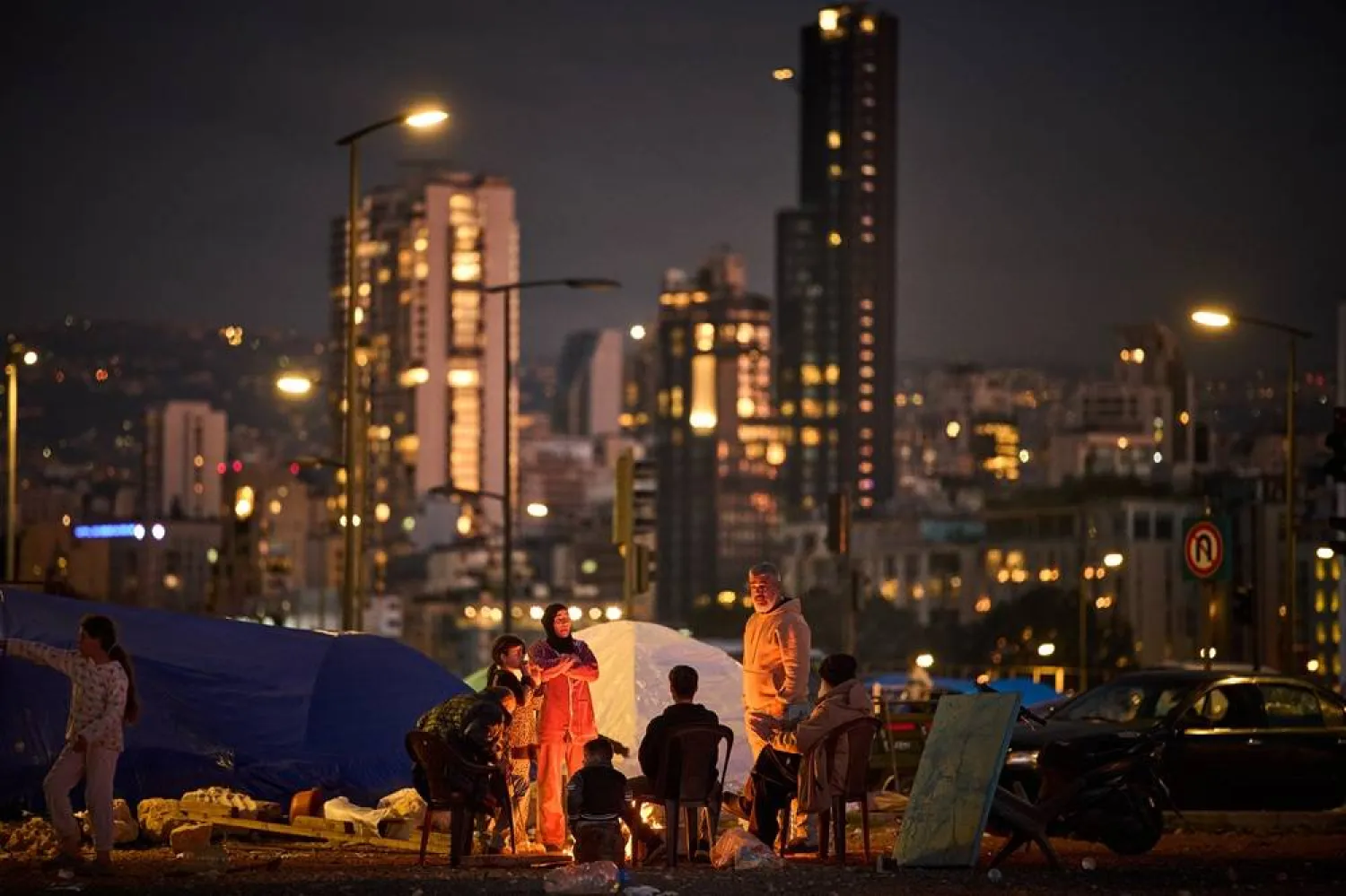
 Members of a family who fled Israeli shelling in southern Lebanon warm themselves by a bonfire next to tents used as shelters in Beirut, Lebanon, Tuesday, March 31, 2026. (AP)
Members of a family who fled Israeli shelling in southern Lebanon warm themselves by a bonfire next to tents used as shelters in Beirut, Lebanon, Tuesday, March 31, 2026. (AP)
TT

Lebanese Displaced by War Fill Beirut’s Streets, Upending City Life

 Members of a family who fled Israeli shelling in southern Lebanon warm themselves by a bonfire next to tents used as shelters in Beirut, Lebanon, Tuesday, March 31, 2026. (AP)
Members of a family who fled Israeli shelling in southern Lebanon warm themselves by a bonfire next to tents used as shelters in Beirut, Lebanon, Tuesday, March 31, 2026. (AP)

Beirut is bursting.

It's been a month since Hezbollah fired rockets into Israel after the US-Israeli attack on its patron, Iran, triggering Israeli bombardment of Lebanon and a ground invasion. Since then, more than 1 million people from southern and eastern Lebanon and Beirut's southern suburbs have fled. Many have crammed into the ever-tighter spaces of the country's capital where the bombs have not yet fallen.

Israel's attacks and evacuation orders — unprecedented in scope, covering what humanitarian agencies estimate to be 15% of this tiny country — have emptied villages in south Lebanon and pushed almost the entire population of the southern suburbs into Beirut, shifting the city's center of gravity, reshaping its geography and stirring fears about its future.

A huge tent encampment has sprouted up in the grassy field between a yacht club and nightlife venue, transforming the Beirut waterfront. Some families squat in storefronts, live in mosques and sleep in the cars they drove here, double- and triple-parking convoys on thoroughfares. Others huddle in tents pulled together from sheets of tarp along the curving coastal corniche or around Horsh Beirut, a park of pine trees on the outskirts of an area of the southern suburbs known as Dahieh.

"It's horrid because we feel this tension, that we're not wanted here," said Nour Hussein, who settled at the waterfront in early March after fleeing the first Israeli airstrikes on Dahieh. She watched a stream of well-to-do joggers navigate a maze of tents and soiled mattresses, her three youngest children clambering onto her lap.

"We don’t want to be here," she said. "We have nothing here and nowhere to go."

Experts say this displacement is unprecedented

Waves of displacement have upended this city before, most recently during the 2024 Israel-Hezbollah war. But experts struggle to recall such a dramatic exodus — about 20% of the country’s population, according to government statements — hitting Beirut so fast.

"The scale and intensity of this is just unprecedented," said Dalal Harb, the spokesperson for the United Nations refugee agency in Lebanon. She said the figure of 1 million displaced is almost certainly an undercount because it misses anyone who has not formally registered as displaced with the Ministry of Social Affairs.

The government has converted hundreds of public schools into shelters and pitched tents for displaced families beneath the bleachers of the city's main sports stadium. Charities have scrambled to help, with one refashioning an abandoned slaughterhouse destroyed in Beirut's 2020 port explosion into a dormitory for almost 1,000 displaced people.

But urban researchers note a staggering number of people on the streets compared with past conflicts, making it difficult for ordinary residents to block out the war and the misery it has wrought.

"This is relatively new, that you have so many people spending time in these open spaces, who are very vulnerable, living in very precarious conditions," said Mona Harb, a professor of urban studies at the American University of Beirut. "You have to confront this visually when you’re coming and going to work, to school ... and there are strong, mixed feelings associated with this presence that’s unregulated."

Families say they’ve struggled to find space at government-run shelters in Beirut and would rather brave the elements than travel north to cities where they might find better accommodations but where they have no relatives or connections.

"The further away we go, the more we'll lose hope about finding our way back," said Hawraa Balha, 42, when asked why her family of four was squeezing into the small car they drove from the devastated southern border village of Duhaira rather than sleeping in an available shelter further north. "We don't want to move again."

Residents of the suburbs of Dahieh have largely opted to remain in Beirut. That way, every so often, they can retrieve belongings and check whether their homes are still standing, albeit in furtive dashes under the threat of bombardment. Hussein said her kids grew so desperate for a shower after nearly a month without a bathroom that they rushed home to wash up last week despite the incessant buzz of Israeli drones.

Lebanon's sectarian balance is at risk

The prospect of hundreds of thousands of Shiites on the move has inflamed Lebanese sensitivities about the country’s fragile sectarian balance. Ever since its bloody 15-year civil war, Lebanon has relied on a power-sharing agreement to accommodate the interests of Christians, Shiite Muslims and Sunni Muslims, the country's largest religious groups, which make up roughly equal shares of the population.

"It's generating anxieties in Beirut, where the bulk of the displacement is, that this may cause a significant transformation in the demographic balance within the country, or within certain spaces and cities," said Maha Yahya, director of the Beirut-based Carnegie Middle East Center.

Each day that passes, more tents appear at the waterfront settlement. Children have started to complain of skin rashes. Heavy rainfall recently flooded the grassy lot and seeped into tents, leaving a trail of soggy clothes and sore throats. A fight broke out last week as volunteers arrived to distribute donations.

"We're not used to living like this — we had a house, we had normal lives," said Lina Shamis, 51, warming herself by a fire at the foot of a billboard advertising luxury watches. She, her three adult daughters and their small children set up camp here after heeding Israeli evacuation orders for Dahieh in a panic, carrying almost nothing with them.

"Now the kids are out of school and hungry, and our neighborhood is gone," she said. "All I feel is despair."

With Israel thrusting deeper into Lebanon and threatening to seize Lebanese territory as far as the Litani, a river 20 miles (30 kilometers) north of the Israeli border, the situation of displaced people in Beirut "will be even worse than what we’re seeing now," warned Harb, from the UN refugee agency.

"The needs will continue to increase," she said. "It's an imminent humanitarian catastrophe."


In War‑Scarred Gaza, Brides Turn to Refurbished Wedding Dresses

 Palestinians attend a mass wedding for 50 couples organized by the IHH Humanitarian Relief Foundation in Gaza City, May 11, 2026. (Reuters)
Palestinians attend a mass wedding for 50 couples organized by the IHH Humanitarian Relief Foundation in Gaza City, May 11, 2026. (Reuters)
TT

In War‑Scarred Gaza, Brides Turn to Refurbished Wedding Dresses

 Palestinians attend a mass wedding for 50 couples organized by the IHH Humanitarian Relief Foundation in Gaza City, May 11, 2026. (Reuters)
Palestinians attend a mass wedding for 50 couples organized by the IHH Humanitarian Relief Foundation in Gaza City, May 11, 2026. (Reuters)

In a small sewing workshop in southern Gaza, Nisreen Al-Rantisi pulls fabric from a pile and reshapes worn wedding dresses, trying to keep a fading tradition alive amid war and soaring costs.

Families said they have been struggling to find new wedding dresses and many search instead for places that refurbish gowns and other kinds of clothes for their children.

Importers cite delays, high shipping costs, and restrictions on materials, such as the crystals encrusted into the elaborate wedding dresses, as key factors behind the shortages ‌and price hikes.

Many workshops ‌have also been damaged during the conflict.

“We try ‌to ⁠reuse the old ⁠gowns that we have, produce them by fixing them a bit, work on them, wash them, arrange them, shape them,” said Rantisi, adding that work initially relied on a bicycle-powered sewing machine due to electricity shortages.

Rantisi said she used to buy the fabric for about 120 to 150 shekels ($41 to $51) before the war, but now pays around 500 shekels ($171).

“This has caused a big rise ⁠in the cost of bridal dresses and children’s gowns. We ‌are living in a vicious circle ‌from the war that affected us,” she added.

COGAT, the Israeli military agency that controls ‌access to Gaza, did not immediately respond to a request for comment.

Most ‌of Gaza's more than 2 million people have been displaced, many now living in bombed-out homes and makeshift tents pitched on open ground, roadsides, or atop the ruins of destroyed buildings after two years of war with Israel.

HIGH PRICES BEYOND REACH ‌FOR MOST IN GAZA

Despite the hardships, some couples still find ways to celebrate, with mass weddings held in ⁠Gaza offering a ⁠rare moment of joy amid the devastation.

Shop workers say the war has driven prices beyond reach.

“Before the war, prices were reasonable for everyone,” said Rawan Shalouf, an employee at a bridal shop.

“But now, given the circumstances we’re in, the price of a dress is ridiculous.”

Across Gaza, brides and families are struggling to afford even basic wedding needs. Shahed Fayez, 21, is due to marry in about four days but has been searching in vain for a dress.

“I don’t care about its style, what’s important is that it's new,” she added.

“The cheapest dress is $1,000 or more, that's the minimum, and all we have is less than $200. The entire dowry does not cover the price of a dress.”


In Tierra del Fuego, a Hunt for the Rodent Carrier of Hantavirus

This aerial view shows tourists taking photos at the Ushuaia sign in Ushuaia, Tierra del Fuego, Antartida e Islas del Atlantico Sur, Argentina, on May 17, 2026. (AFP)
TT

In Tierra del Fuego, a Hunt for the Rodent Carrier of Hantavirus

This aerial view shows tourists taking photos at the Ushuaia sign in Ushuaia, Tierra del Fuego, Antartida e Islas del Atlantico Sur, Argentina, on May 17, 2026. (AFP)

A scientific mission was set to kick off the search Monday for rodents that may be hantavirus carriers after an outbreak on a cruise ship departed this region at the southern tip of Argentina on April 1.

For several days, biologists from Buenos Aires will set traps at various locations on the southern island of Tierra del Fuego to analyze whether the captured rodents carry the Andes strain of the virus, the only one known to spread between people.

The mission is critical since the outbreak aboard the Hondius led to three deaths and triggered global alarm.

The first person to die from the disease, a Dutchman, had spent 48 hours in the picturesque city of Ushuaia with his wife -- who died two weeks later -- before embarking on the cruise, raising suspicions that they had contracted the virus in Argentina.

Provincial officials vehemently deny this hypothesis.

They insist that Tierra del Fuego province has not had a case of hantavirus since its reporting became mandatory 30 years ago, unlike in provinces to the north, such as Rio Negro and Chubut.

"There's no precedent," said Sebastian Poljak, an expert in local mammals.

- Night Traps -

Local scientists debate about whether the noteworthy rodent in Tierra del Fuego is the long-tailed rat (Oligoryzomys longicaudatus) or a subspecies, the Magellanic long-tailed rat (Oligoryzomys magellanicus).

"For some, it's the same species, for others, a subspecies, but the important thing is to analyze whether one of them is infected with hantavirus," said Juan Petrina, the province's director of epidemiology.

The woodland rodent that lives here is a small species measuring 6-8 centimeters (2.4-3.1 inches), but with a tail that can reach 15 cm.

The rodent is nocturnal and feeds on fruits and seeds. It lives in wooded and shrubby areas, nesting, for example, in tree cavities.

It is in these areas that scientists from Malbran, Argentina's leading institute for infectious diseases, will set trap cages in the evening and retrieve them in the morning, local health sources said.

A prime target is Tierra del Fuego National Park, 70,000 hectares (173,000 acres) of forests, lakes and mountains 15 kilometers (9 miles) from Ushuaia.

Another wooded area, not far from a landfill, will also be targeted, though the landfill itself will be excluded, they said.

Unconfirmed reports suggested that the Dutch person who died, a bird enthusiast, had visited the site to observe local scavengers, prompting speculation that his case involved contact with rodents there.

Capturing rats in the landfill itself would "make no sense, (because) the rodents found there are urban rodents, not susceptible to hantavirus," Petrina said.

Analysis results of the captured rats should be available within four weeks, he added.

- Isolated Rodents -

Local scientists welcome the mission, which will allow them to "assess with greater certainty the potential danger posed by the local rodents," said Guillermo Deferrari, a biologist at the Southern Center for Scientific Investigation (CADIC).

That should allow them to "definitively eradicate the idea that there is hantavirus here," said Poljak.

He points out that Tierra del Fuego is an archipelago separated from the mainland by the Strait of Magellan, a major geographical barrier for species.

The rodent population there is significantly isolated, he said.

Local scientists suspect that it is more likely that the infection happened in another region.

The Dutch couple had traveled extensively in Argentina for four months, with forays into Chile -- where hantavirus is also present -- and Uruguay.

Local authorities hope the Malbran mission will rule out the hypothesis of a local infection so as not to hurt the tourism business.

While Ushuaia is experiencing a slowdown at the start of winter, cruises that run from September to April attract up to 200,000 visitors annually.

"We don't want this situation to escalate any further," said Juan Manuel Pavlov, secretary of the Tierra del Fuego Tourism Institute.


Was Israel Secretly Running Two Military Bases in Iraqi Desert for Months?

 An Iraqi shepherd herds sheep and goats as the sun sets in the Iraqi town of Mishkhab south of Najaf, Iraq, Saturday, May 9, 2026. (APl)
An Iraqi shepherd herds sheep and goats as the sun sets in the Iraqi town of Mishkhab south of Najaf, Iraq, Saturday, May 9, 2026. (APl)
TT

Was Israel Secretly Running Two Military Bases in Iraqi Desert for Months?

 An Iraqi shepherd herds sheep and goats as the sun sets in the Iraqi town of Mishkhab south of Najaf, Iraq, Saturday, May 9, 2026. (APl)
An Iraqi shepherd herds sheep and goats as the sun sets in the Iraqi town of Mishkhab south of Najaf, Iraq, Saturday, May 9, 2026. (APl)

Israel built two covert bases in Iraq’s rugged western desert for well over a year to aid in its wars with Iran, The New York Times reported Sunday.

Iraqi officials described the development as a “blatant disregard for Iraqi sovereignty,” while a shepherd was killed after he stumbled on the base.

It all started on March 3, after Awad al-Shammari, 29, set off on a grocery trip, his cousin, Amir al-Shammari, told The New York Times.

Instead of making it home, the shepherd stumbled upon a closely guarded Israeli military secret, hidden in the Iraqi desert near the town of al-Nukhaib. His family believes it cost him his life.

Sometime between starting his ill-fated trip and its gruesome end, Awad had contacted Iraq’s regional military command to report what he had seen: soldiers, helicopters and tents clustered around a landing strip.

Israel was operating a base there to support its military operations against Baghdad’s regional partner, Iran, according to senior Iraqi and regional officials.

The presence of an Israeli outpost in Iraq was previously reported by The Wall Street Journal. Iraqi officials told The Times there was another undisclosed second base also in Iraq’s western desert.

The base Awad came across predated the current war between the United States, Israel and Iran, the regional security officials said, and was used during the 12-day war against Iran in June 2025.

The information the sources shared indicates that at least one of the bases — the one the shepherd stumbled upon — had been known to Washington since June 2025 or possibly earlier. That would most likely mean Baghdad’s other key ally, the United States, had withheld from Iraq the fact that hostile forces were on its soil.

“It shows a blatant disregard for Iraqi sovereignty, its government and its forces, as well as for the dignity of the Iraqi people,” said Waad al-Kadu, an Iraqi lawmaker who attended a confidential parliamentary briefing about that base.

Israel’s military declined repeated requests for comment on the camps or on Awad’s killing.

The US role in Iraqi security was part of Israel’s calculations in deciding it could safely operate clandestinely in Iraq, the regional officials said.

Major General Ali al-Hamdani, commander of the Iraqi military’s Western Euphrates Forces, said the army had suspected an Israeli presence in the desert for over a month before the shepherd’s discovery.

“Until now,” he said, “the government has been silent about it.”

Iraq’s government, for whom acknowledging Israeli outposts is fraught, has still not acknowledged the Israeli bases. Iraq has no diplomatic relations with Israel, and its population sees Israel as an enemy.

Lt. Gen. Saad Maan, a spokesman for Iraq’s security forces, told The Times that Iraq “has no information regarding the locations of any Israeli military bases.”

Growing outrage in Iraq over the revelations could threaten US efforts to curb Iranian influence in the country, even as the war’s outcome remains uncertain.

Iraqis also fear pro-Iran armed factions will use these developments to justify their refusal to disarm and to expand their military influence in Iraq.